Orbit Fab wins contract to refuel Astroscale’s satellite repair robots

Capitalism in space: Orbit Fab today announced that it has won a contract to provide up to 1,000 kilograms of xenon fuel for the satellite robots launched by the private company Astroscale and designed to repair other satellites.

Orbit Fab, a startup founded in 2018, developed a refueling port known as RAFTI, short for Rapidly Attachable Fluid Transfer Interface. The port is being offered to government and commercial operators to make their satellites compatible with Orbit Fab’s refueling tankers.

The company last year deployed its first propellant-storage tanker in low Earth orbit and plans to launch its first tanker to geostationary orbit on a SpaceX Falcon 9 lunar lander mission projected for late 2022 or early 2023. Orbit Fab’s first two fuel shuttles in LEO are expected to be operational in 2023.

Once Astroscale begins launching its repair robots in ’26, those robots will be able to extend their life by refilling their tanks from Orbit Fab’s tankers, and thus repair more satellites while in orbit, thus serving more customers.

0 comments

NASA’s safety panel claims management expertise in ’21 annual report, demanding that NASA run Artemis using a “top-down” approach

NASA’s safety panel today issued its 2021 annual report, and rather than review issues of safety in the operations of the agency’s various manned programs, the panel focused on proposing a redesign of the management structure of NASA manned programs, demanding that NASA run Artemis using a “top-down” approach, taking power and control away from private commercial space and putting it in the hands of NASA’s bureaucracy. From the press release:

Specifically, the report recommends that NASA should develop a strategic vision for the future of space exploration and operations; establish and provide leadership through a “board of directors” that includes agency center directors and other key officials, with the emphasis on providing benefit to the agency’s mission as a cohesive whole; and manage Artemis as an integrated program with top-down alignment. The panel also reiterated a recommendation from its 2020 report that Congress designate a lead federal agency for civil space traffic management.

This summary captures nicely the substance of the entire report [pdf]. Rather than review the specific safety issues in each of NASA’s manned programs — the panel’s actual job — the panel decided it would look at how Congress, the White House, and NASA’s leadership have organized the management of its manned program, and tell them all how to do things.

None of this is the safety panel’s business. Such recommendations should come from Congress or the White House, or from a specific panel created by those elected officials or NASA’s top management, tasked with the specific job.

The panel meanwhile ignored its real job, to review the engineering of NASA’s manned program and spot areas where such work might need to be revised or fixed. While the panel spent its time in 2020 putting together this inappropriate report, it apparently missed entirely the valve problem in Boeing’s Starliner capsule that has caused an additional year delay in its launch.

This panel continues to demonstrate its corrupt and power-hungry attitude about how the U.S. should explore space. For years it did whatever it could to stymie NASA’s efforts to transfer ownership to the private sector, putting up false barriers to the launch of SpaceX’s manned Dragon capsule that made no sense and were really designed to keep all control within the government bureaucracy.

Now this panel has decided its job is no longer to review the specific technical and engineering issues that could cause a manned spacecraft failure, such as with Boeing’s Starliner. Instead it now believes it should be the designer of NASA’s entire management.

It is long past time that this panel is shut down. It isn’t doing its actual job, and is instead interfering with everyone else’s.


1 comment

InSight recovering from safe mode caused by Martian dust storm

Engineers have been able to regain contact with the Mars lander InSight after a Martian dust storm that put it in safe mode and cut off all communications for three days.

The mission’s team reestablished contact with InSight Jan. 10, finding that its power was holding steady and, while low, was unlikely to be draining the lander’s batteries. Drained batteries are believed to have caused the end of NASA’s Opportunity rover during an epic series of dust storms that blanketed the Red Planet in 2018.

The lander remains however in safe mode. The engineers hope they can resume limited science operations in about a week. Even before this even the limitations on InSight’s power generation due to dust on its solar panels had forced the science team to only gather data from the seismometer, and even then had to suspend all data gathering periodically.

Though the lander has survived this dust storm, it is presently unclear how much dust remains on its panels and thus how much power it can generate. If it only can generate enough power to keep the lander from freezing, but not do any science, it might be time to shut it down entirely.

0 comments

Disney – Four artists paint one tree

An evening pause: This short was aired in 1958 on the Disney children’s television show, Disneyland. I emphasize children because this is the kind of material I was offered as a child.

Today it would be considered too sophisticated, and definitely unacceptable because it doesn’t indoctrinate the young on the importance of “racial justice.” My god, all the artists happen to be white!

Yet I know from experience that kids under six would love it just because it is fun to watch the artists work, while older children would find the narration by the artists themselves fascinating. I can say this with confidence because I am certain Disney showed this clip more than once, and I saw it multiple times as a child, watching it with pleasure at different times and ages.

And then there’s the main point. As Walt Disney himself says in the opening, “Don’t imitate anyone. … Go forward with what you have to say, expressing things as you see them. … Be yourself.”

10 comments

Today’s blacklisted American: Space historian and science journalist blackballed for opposing COVID shot mandates

Banned because the author expressed an opinion
Banned because the author expressed an opinion.

After a year of daily reporting the blacklisting of hundreds of innocent Americans for merely expressing dissenting opinions, I am sad to say that the new leftist McCarthyism has finally come after me.

In December I was blackballed by most of the Arizona caving community because I had disagreed with their decisions to discriminate against anyone who had not gotten a COVID shot. One of the local clubs was going to run an outdoor camping/caving event and had decided to require everyone who attended to either prove they had gotten the jabs or could show they were tested negative for the Wuhan flu in the past two days. I objected, first because this was discriminatory and was demanding private medical information from people that by law was forbidden, and second because the policy made no sense because the shots provided no certain protection against the virus.

Realizing that their policy was not going to do anything to protect anyone from COVID, the organizers cancelled the event out of fear, and then made both me and one other protesting caver scapegoats for their decision, demanding we be banned from all caving organizations. What made this particular action especially hurtful was that it was pushed and imposed by a number of people who I thought had been close friends. I instead discovered that they really didn’t give a damn about me, and if I didn’t bow to their political will they were most eager to make me a non-person.

So much for friendship, eh?

I hadn’t reported this at length in public because it was essentially a personal matter. Now however this new fad of blacklisting anyone who disagrees with the new fascists and their medical mandates has reached out to try to hurt me and others professionally.
» Read more

26 comments

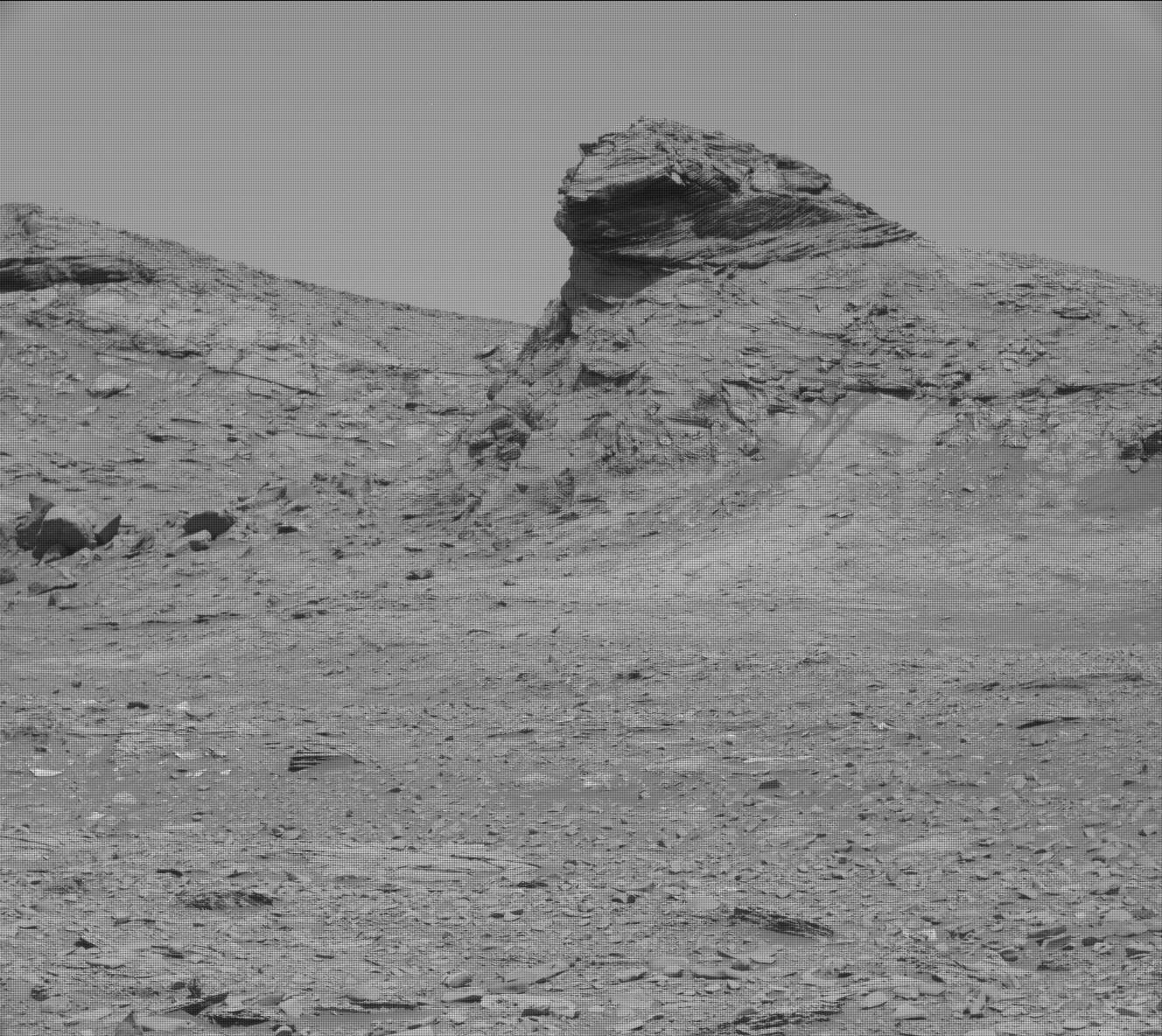
A butte on Mars

A butte on Mars
Click for full photograph.

Cool image time! Because the Martian geology inside the enclosed stone valley beyond Maria Gordon notch is so complex and exposed, the Curiosity science team is spending a lot of time there. As noted in their January 7th update:

[W]e are marvelling at the landscape in front of us, which is very diverse, both in the rover workspace and in the walls around us. It’s a feast for our stratigraphers (those who research the succession in which rocks were deposited and deduce the geologic history of the area from this). We are all looking forward to the story they will piece together when they’ve had a bit of time to think!

The image to the right, cropped and reduced to post here, was taken by the rover’s high resolution camera on December 18th, soon after it entered this stone valley and was part of scan covering both this butte as well as a nearby cliff. I had previously featured a close-up of the top of this butte and its incredible overhang on December 20, 2021. This image however shows the whole butte, which I estimate to be about 30 to 40 feet high is about 10 feet high.

Not only does the butte illustrate well the alien nature of this stark and barren Martian terrain, so does all the terrain surrounding it. The surface everywhere is nothing but pavement stones of all sizes. Once again, there is no life, something you practically never see on Earth.

6 comments

A tumbling 1,100-foot-wide asteroid

Nereus tumbling on December 10th close approach
Click for full image.

Using the Goldstone radio antenna in California, scientists have been able to take some of the highest resolution radar images of the 1,100-foot-wide asteroid Nereus during its close approach to Earth on December 10, 2021.

The montage to the right, cropped to post here, shows twelve images from the 39-image sequence, which can also be viewed as an animation here.

During the asteroid’s close approach, an image resolution of about 12.3 feet (3.75 meters) per pixel was possible, revealing surface features such as potential boulders and craters, plus ridges and other topography. Asteroid Nereus’ previous approach in 2002 was near enough to Earth to reveal the asteroid’s size and overall shape, but too distant to show surface features. The new observations will also help scientists better understand the asteroid’s shape and rotation while providing them new data to further refine its orbital path around the Sun.

The asteroid will not make a similar close-approach again until 2060.

5 comments

An oblong exoplanet?

The uncertainty of science: Astronomers, using a variety of space telescopes, have concluded that the shape of an exoplanet in the constellation Hercules is deformed by tidal forces imposed on it by its star.

On the planet WASP-103b, tides are much more extreme. The planet orbits its star in just one day and is deformed by the strong tidal forces so drastically that its appearance resembles a rugby ball. This is shown by a new study involving researchers from the Universities of Bern and Geneva as well as the National Centre of Competence in Research (NCCR) PlanetS, published today in the scientific journal Astronomy & Astrophysics.

The data also suggests that the nearby heat of its star has also caused the exoplanet to be inflated in size.

Need I add that this result is uncertain? It requires the scientists to make many assumptions based on only a tiny bit of data, something they admit to near the end of the press release, where the releases notes that this result needs to be confirmed by future observations.

1 comment

SpaceX pushing to launch 2nd generation Starlink satellites by March

Capitalism in space: In paperwork filed by SpaceX to the FCC, it has announced it is pushing to launch the first second generation Starlink satellites by March, 2022.

While some news reports have suggested that SpaceX intended to launch those upgraded satellites on Starship, this reporting is certainly wrong. As the article at the link correctly notes, SpaceX does not have to state what rocket it plans to use in its paperwork. It could very easily launch these first upgraded satellites on a Falcon 9.

The story however does provide this interesting tidbit about the FCC’s treatment of SpaceX in this licensing process:

SpaceX filed the first unmodified Gen2 Starlink application with the FCC in May 2020, requesting permission to launch an unprecedented 30,000 satellites. While the size of the proposed constellation is extraordinary, the FCC has also been exceptionally slow to process it. Only five months after SpaceX submitted its Starlink Gen2 modification request and nineteen months after its original Gen2 application did the FCC finally accept it for filing, which means that it has taken more than a year and a half to merely start the official review process. [emphasis in original]

In other words, the FCC stalled SpaceX for more than a year and a half. If the DC bureaucracy can play such games with Starlink, this suggests it might very well be doing the same with the approval of the environmental reassessment for SpaceX’s Boca Chica facility, which the FAA has now delayed repeatedly since last year. There are many people in Washington, both in the Biden administration and in the established and permanent bureaucracy, who do not like SpaceX’s success or its independence, and wish to use government power to squelch it. This story provides us some evidence that such misuse of government power in the FAA is very likely occurring.

3 comments

An independent Russian private space company?

Capitalism in space? The Russian company S7 Space announced today that plans to soon begin tests of the fuel tanks of its proposed reusable smallsat rocket, and is in the process of deciding what Russian facility to use.

“We plan to test the rocket’s elements, namely fuel tanks of a smaller size, with a diameter of 1.5 meters. The trials are aimed at proving that the structure is durable. A concrete laboratory is yet to be selected for the purpose. In other words, there has been no firm contract for trials so far,” [explained the head of the company’s technological research department, Arseny Kisarev.]

The official expressed hope that the trials would be carried out by TsNIIMash (Central Research Institute of Machine Building), a main research institution of Russia’s state-run space corporation Roscosmos.

“However, choosing another lab is also possible, if it corresponds to our requirements of the testing procedure,” he said.

This rocket was first announced in 2019. Development was suspended in 2020, however, when the Putin government imposed new much higher fees on the company for storing the ocean launch platform Sea Launch, fees so high that the company was soon negotiating to sell the platform to a Russian state-run corporation.

It is not clear whether that sale ever occurred, but the company itself appears only now to be resuming some operations. Though today’s story suggests it is operating independent of the control of Roscosmos and the Russian government, this is quite doubtful. Russia today functions much like the various Mafia mobs in the U.S. The various different government agencies divide up the work into “territories” that belong to each company. No other independent company can enter that territory and compete for business. Since S7 Space wants to build its own rocket, that makes it a direct competitor with Roscosmos and the government design bureaus within it that build the various Russian rockets.

More likely Roscosmos wants S7 Space to survive, but under its control and only for the purpose of building a smallsat rocket for Roscosmos. S7 Space appears to be struggling to stay independent, with this announcement likely part of that struggle.

2 comments

Strange land forms on the flanks of Mars’ Arsia Mons volcano

Strange landforms on the flanks of Arsia Mons
Click for original image. Click here for the context camera image.

Cool image time! The center of the photo to the right was taken by the high resolution camera on Mars Reconnaissance Orbiter (MRO) on September 5, 2021. For posting here I have rotated, cropped, and reduced it, as well as added to each side the lower resolution context camera image of this region.

The ground slopes downhill to the north. Make sure you click on the image to see the full resolution version. In only a few miles the terrain changes from a mound with small knobs to a smooth area with few knobs to a chaotic area where the larger ridges and knobs are the dominant feature, with hollows and canyons in between.

You should also take a look at the full context camera image. Just to the southeast of the above picture is a large depression that looks like it has been filled with lava, with its western rim covered by that flow. Scientists have taken a lot of high resolution pictures of this depression with MRO, trying to decipher its geology.
» Read more

4 comments
1 186 187 188 189 190 192