
Anne-Sophie Mutter – J.S. Bach’s Partita in D minor
An evening pause: Intense.
Hat tip Judd Clark.
An evening pause: Intense.
Hat tip Judd Clark.

Hakeem Oluseyi, Space Science Education Lead
for NASA’s Science Mission Directorate
They’re coming for you next: Today’s blacklist column describes an effort to not only cancel from history the man who led NASA for almost the entire 1960s space race, but to also blackball a scientist for doing good research that proved the campaign was not based on any facts.
Shortly before the launch of the James Webb Space Telescope last year, a petition was instigated to get it renamed because of accusations that Webb had persecuted homosexuals during his term as NASA administrator in the 1960s. As is now typical of our modern bankrupt intellectual class, as soon as this petition was issued more than 1,700 people signed it, all accepting at face value its accusations against Webb without any further research.
One scientist, who happened to be black, took a more detailed look at those accusations however and found them to be spurious. As Hakeem Oluseyi wrote:
» Read more

Click for full image.
Today’s cool image is a great example of the surprises one can find by exploring the archive of the high resolution pictures that Mars Reconnaissance Orbiter (MRO) has produced since it arrived in Mars orbit back in 2006. The picture to the right, rotated, cropped, and reduced to post here, was taken by MRO’s high resolution camera back on May 4, 2017. I only found it because I had picked out a October 24, 2022 high resolution image that covered a different area of this same flow feature just to the north east. In trying to understand that 2022 picture I dug to see other images had been taken around it, and found the earlier 2017 photo that was even more interesting.
Neither however really covered the entire feature, making it difficult to understand its full nature. I therefore searched the archive of MRO’s context camera, which has imaged the entire planet with less resolution but covering a much wider area per picture. The context camera picture below captures the full nature of this feature.
» Read more
Though the Iranian government opposes their use, according to a tweet by Elon Musk SpaceX now has almost 100 Starlink terminals working in Iran.
Elon Musk announced that SpaceX has almost 100 Starlink terminals active in Iran. SpaceX activated Starlink services in Iran in September, supporting the United States’ stance on providing internet freedom and free flow of information to Iranians.
Unlike Ukraine, SpaceX does not have the cooperation of the Iranian government to expand Starlink services in the country. In Ukraine, President Volodymyr Zlenskyy and the Minister of digital transformation Mykhailo Feorov have actively supports Starlink connection during the war with Russia.
In contrast, the Iranian government is actively trying to limit its citizens’ internet access. The United States government has taken a stance against the Iranian government’s decision regarding internet access for its people.
SpaceX has routinely cooperated with foreign governments before selling terminals, likely because to do otherwise would get it in trouble with the U.S. State Department. In this case however the State Department appears to have approved this action, and SpaceX then made it happen.
China today successfully launched a classified Earth observation satellite using its Long March 4B rocket.
As the launch was from an interior spaceport, the rocket’s lower stages landed somewhere in the interior of China.
The leaders in the 2022 launch race:
61 China
59 SpaceX
21 Russia
9 Rocket Lab
8 ULA
The U.S. still leads China 83 to 61 in the national rankings, but trails the entire world combined 93 to 83.
At the moment, the only known remaining launches in 2022 are two SpaceX Falcon 9 launches. However, China routinely launches a lot in the November/December timeframe, so we should not be surprised if they complete one or two launches as well in the next few days.
An evening pause: A truly talented singer who has sometimes been her own worst enemy.
Hat tip Wayne Devette.
Courtesy of BtB’s stringer Jay.
The rocket’s development has had problems, delaying it about two years.
Previously the Russians had said they’d make a decision by tomorrow, but now say they will hold off until after January 1, once they have finished analyzing the situation.
Kazakhstan has “renounced concessions for Russian logistics companies that transport goods for import to Russia,” even as a Russian official threatened Kazakhstan with invasion. For the Russian space program these tensions could be disastrous, as the Baikonur spaceport in Kazakhstan is presently the only place it can launch humans.
China officials had said it resume operations in December, but with the month about to end there has been no word on its status for quite awhile.
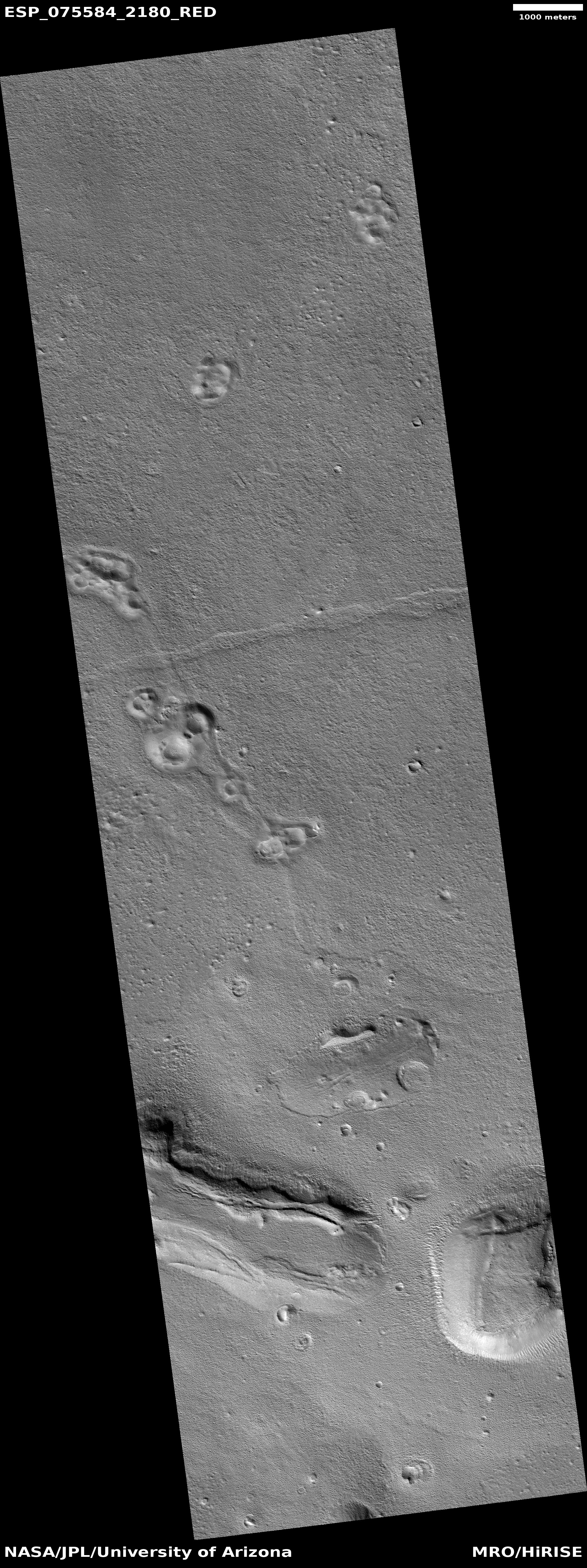
Click for full image.
Cool image time! The photo to the right, rotated, cropped, and reduced to post here, was taken on September 10, 2022 by the high resolution camera on Mars Reconnaissance Orbiter (MRO).
The location is at 38 degrees north latitude, in the Martian northern lowland plains. At this latitude in these plains the geological features seen in high resolution pictures almost always invoke near surface ice, including processes that disturb that underground ice layer.
This picture is no different. Not only does it appear that a glacier is flowing down from the top of east-west ridge, the middle mound includes a crater with its southeast rim gone and appears filled with material that suggests ice.
The greater geographic context of this location can be seen in the overview map below.
» Read more
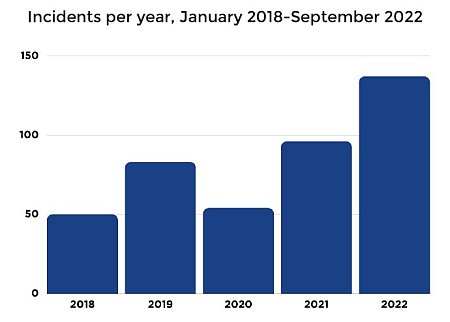
The modern dark age: According to a recently published 84-page report [pdf] by the Family Research Council, vandalism, violence, and arson against churches and religious institutions has nearly tripled since 2018.
From the report:
Family Research Council identified a total of 420 documented acts of hostility that targeted 397
individual churches. These incidents occurred between January 2018 and September 2022 across 45 U.S. states and Washington, D.C. To conduct this research, we analyzed open-source documents, reports, and media outlets to assess the number of acts of hostility against churches over a five-year span.
» Read more

Click for full image.
Cool image time! The photo to the right, cropped, enhanced, and reduced to post here, was taken by the Hubble Space Telescope as part of a survey of peculiar looking galaxies.
The peculiar spiral galaxy ESO 415-19, which lies around 450 million light-years away, stretches lazily across this image from the NASA/ESA Hubble Space Telescope. While the centre of this object resembles a regular spiral galaxy, long streams of stars stretch out from the galactic core like bizarrely elongated spiral arms. These are tidal streams caused by some chance interaction in the galaxy’s past, and give ESO 415-19 a distinctly peculiar appearance.
ESO 415-19’s peculiarity made it a great target for Hubble. This observation comes from an ongoing campaign to explore the Arp Atlas of Peculiar Galaxies, a menagerie of some of the weirdest and most wonderful galaxies that the Universe has to offer. These galaxies range from bizarre lonesome galaxies to spectacularly interacting galaxy pairs, triplets, and even quintets. These space oddities are spread throughout the night sky, which means that Hubble can spare a moment to observe them as it moves between other observational targets.
I have intentionally brightened the galaxy to make the two faint two tidal streams more obvious. That they are so faint compared to the galaxy itself is in itself a mystery.
An evening pause: In English this is better known as “Jesu joy of man’s desiring.” Nick Deutsch is on the oboe and Alexander Hamilton is on the organ.
Hat tip Judd Clark.
An evening pause: From their 1967 Christmas show. More information here.
Embedded below the fold in two parts.
To listen to all of John Batchelor’s podcasts, go here.
» Read more
An evening pause: The performers are obviously Russian, but they provide no English version of their name.

Dr. David Phillips
They’re coming for you next: Officials at the North Carolina Governor’s School (“a residential summer program for the state’s most talented rising high-school seniors.”) fired David Phillips, a professor there for eight summers, because they did not like the content of the optional three session seminar he held critiquing critical race theory.
In other words, they decided to blackball him simply because they did not agree with his opinions.
Phillips has now sued, with the Alliance Defending Freedom acting as his legal firm. The preamble of his lawsuit [pdf] describes what happened.
At the conclusion of each lecture, members of the audience — including staff members — reacted with open hostility to the ideas and viewpoints discussed. And they attacked whiteness, maleness, heterosexuality, and Christianity — none of which should have been relevant — in their comments and questions. Despite the hostility, Dr. Phillips stayed long after the published end time for each lecture to respond calmly to each question, and he even offered to meet with students and staff members later for further discussion.
» Read more

Dmitry Rogozin playing make-believe soldier
recently in the Ukraine
More details have now emerged about the explosion that injured former Roscosmos chief Dmitry Rogozin, including the fact that the attack, in Ukrainian occupied territory in Donetsk, also killed two.
The former head of Russia’s space agency was wounded when an artillery shell exploded as he celebrated his birthday in a hotel near the front line in Ukraine. Dmitry Rogozin, a flamboyant Russian politician who was once a deputy prime minister, was reportedly hit in the buttocks, head and back by shrapnel.
Two people were killed in the attack and several others were wounded, authorities in Donetsk said on Thursday, and Mr Rogozin said he was due to be operated on. Russian state news channel Rossiya 24 TV said the former space chief was celebrating his 59th birthday at the Shesh-Besh hotel and restaurant with several other separatist officials.
But Mr Rogozin insisted the incident took place during a “work meeting”.
Russian investigators think the shell came from a French-made Caesar self-propelled howitzer.
The criticism of Rogozin concerning this story has been quite ugly.
“A party 10 kilometres away from the front line with the Ceasar’s range of 40 kilometres? I would reprimand him for being childish,” [wrote Yuri Podolyaka, a prominent pro-Kremlin blogger.] “Two people have died in that restaurant, which, I think, is on his conscience.”
Rogozin’s path has been steadily downward since he was deputy prime minister of Russia’s defense department from 2011 to 2018. First he was demoted to head of Roscosmos, where he ended up losing Russia more than a half billion in income by his cancellation of the launch contract with OneWeb. Worse, that cancellation, and Rogozin’s confiscation of 36 OneWeb satellites, ended any chance of Russia getting any international business for years to come.
These actions caused him to be fired from Roscosmos in July, and shipped to the Ukraine (the modern equivalent of Siberia) to act as an envoy in the Russian-occupied territories. Once there, he did nothing to enhance his reputation. By holding this very public birthday party, at a public place so close to the front lines, was almost guaranteeing he and his party would be attacked.
I wish he quickly recovers from his injuries, but I also think Putin would be foolish to give this guy any further positions of authority.

Click for full image.
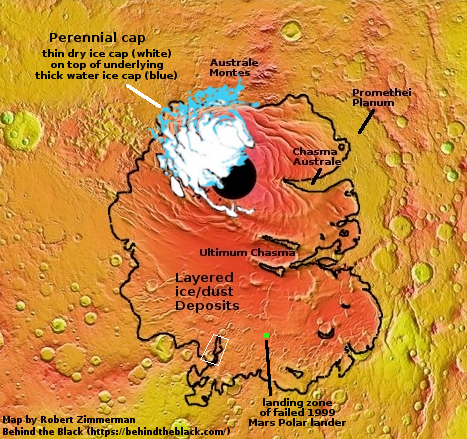
Cool image time! The oblique panorama above, reduced and sharpened to post here, was created from an image taken on May 19, 2022 by the European orbiter Mars Express. Its location on edge of the layered deposits of ice and dust that form most of the Martian southern ice cap is indicated by the white rectangle on the overview map to the right. From the press release:
While it may look like a winter wonderland, it was southern hemisphere spring at the time and ice was starting to retreat. Dark dunes are peeking through the frost and elevated terrain appears ice-free.
Two large impact craters draw the eye, their interiors striped with alternating layers of water-ice and fine sediments. These ‘polar layered deposits’ are also exposed in exquisite detail in the rusty red ridge that connects the two craters.
The scattered white patches are either water frost, or the winter mantle of dry ice, both now sublimating away with the coming of spring.
The black line on the overview map indicates the extent of the layered deposits, and suggest that the ridgeline is not considered part of that ice cap layer, in contradiction to the press release language above.
Which is it? I would guess the answer is simply the uncertainty of science. Some scientists took a look here and decided the ridge was actually a base layer sticking up through the layered deposits. The European scientists who took this picture have instead concluded, based on the image, that the ridge is part of the layer deposits.
Though the bill still needs to be passed by the House, a just passed Senate bill requires consultation between industry and government on space junk, short circuiting recent attempts at the FCC as well as in the House to impose arbitrary government regulations.
You can read the Senate bill here [pdf].
The final result will still be government regulation on the lifespan and final deposition of any object placed in orbit, from nanosats to large manned space stations, but unlike the earlier FCC proposal and House bill, NASA and other government agencies will have to obtain feedback from the commercial space industry before such regulations are imposed.
Sounds great, eh? In truth, this bill in the end still gives full power to the federal government to control the launching of future spacecraft of all sizes. It also leaves the details entirely up to the bureaucracy. If passed Congress would cede its regulatory power to unelected bureaucrats in the executive branch.
The requirement that industry consultation occur simply means that the initial regulations will likely make some sense. Beyond that however the power it bequeaths to the federal bureaucracy in NASA, FAA, FCC, and other agencies will in the long run be still abused.
The need for the establishment of an independent space-faring society, free from odious Earthbound regulation, continues to grow.
According to an analysis by both NASA and Russian engineers, the 0.8 mm hole in the coolant system on the Soyuz docked to ISS was not caused by an object from the Geminid meteor shower that had occurred about the time the leak appeared.
The Soyuz vehicle, known as MS-22, sprayed its coolant into space on Dec. 14, the same day that the annual Geminid meteor shower peaked. But there’s no causal connection, NASA and Russian space officials said. “We did look at the meteor showers that were occurring,” Joel Montalbano, NASA’s International Space Station program manager, said during a press briefing on Thursday (Dec. 22). “Both the trajectory team in Houston and the trajectory team in Moscow confirmed it was not from the meteor showers; it was in the wrong direction.”
The engineers claim the hole could still have been caused by an impact, just not from these meteors.
NASA has published a request for proposals from the private commercial space industry for a possible future mission to raise Hubble’s orbit.
NASA published a request for information (RFI) Dec. 22 asking industry how they would demonstrate commercial satellite servicing capabilities by raising the orbit of Hubble. The agency said it is looking for technical information about how a company would carry out the mission, the risks involved and the likelihood of success.
NASA emphasized in the RFI that it had no plans to procure a mission to reboost Hubble. “Partner(s) would be expected to participate and undertake this mission on a no-exchange-of-funds basis,” the document stated, with companies responsible for the cost for the mission.
Apparently, this RFI was issued as a direct result of the agreement between NASA and SpaceX to study a Dragon mission to do exactly this, which in turn was prompted by Jared Isaacman, as part of his private Polaris program of manned Dragon/Starship space flights. I suspect that NASA officials realized that not only were their engineering advantages to getting more proposals, there were probably legal and political reasons for opening the discussion up to the entire commercial space community.
Ideally, a Hubble reboost mission should occur by 2025, though the telescope’s orbit will remain stable into the mid-2030s.