
Counting Crows – Catapult
An evening pause: Performed live 1997.
Hat tip Dan Morris.
An evening pause: Performed live 1997.
Hat tip Dan Morris.

Click for full image.
Cool image time! The photo to the right, rotated, cropped, and reduced to post here, was taken on July 28, 2022 by the high resolution camera on Mars Reconnaissance Orbiter (MRO). It shows what the scientists label a “Circular and Banded Landform.”
I put this mesa into a geological category I dub “What the heck?!” We are clearly looking at a mesa, probably no more than 200 feet high, if that. What makes it baffling are the parallel bands that not only cut across the mesa but extend in the same direction for many miles in all directions. Though at first glance these bands appear to be dunes, their rocky eroded look along the mesa’s northwest rim suggests instead the bands are the top edge of many vertically oriented parallel layers, which at this mesa’s flanks are eroding alternatively at different rates.
The overview map below shows us where this mesa is located, relative to the south pole.
» Read more

They’re coming for you next: Her story is not unique in this age of blacklisting and oppression, but it does reveal how bad really things are because the source of the blacklisting happens to be a news outlet that many naively consider against such things. Breanna Morello had moved from Florida to take a new job with Fox News, with the expectation that it would not only get her on-air reporting time but might lead to becoming “a producer for Tucker Carlson.”
After packing up my beautiful Florida apartment in late December, I was relocating back to New York City for work. My remote role as a Fox Business booking producer was going to become an in-person position starting on January 3, 2022.
The day I moved into my new apartment, I was completely caught off guard by an email that was forwarded to me by my Executive Producer. » Read more
Capitalism in space: SpaceX yesterday successfully completed for the first time an eight-second-long static fire test of all six engines on Starship prototype #24.
I have embedded video of the test below. The amount of power exhibited is quite impressive. In fact, it was so powerful it likely melted the concrete below the rocket, sending hot debris flying that caused a major brushfire.
Most likely, eight long seconds of blast-furnace conditions melted the top layer of surrounding concrete and shot a hailstorm of tiny superheated globules in almost every direction. Indeed, in almost every direction there was something readily able to burn, a fire started. In several locations to the south and west, brush caught fire and began to burn unusually aggressively, quickly growing into walls of flames that sped across the terrain. To the east, debris even made it into a SpaceX dumpster, the contents of which easily caught fire and burned for hours.
Eventually, around 9pm CDT, firefighters were able to approach the safed launch pad and rocket, but the main fire had already spread south, out of reach. Instead, they started controlled burns near SpaceX’s roadblock, hoping to clear brush and prevent the fire (however unlikely) from proceeding towards SpaceX’s Starbase factory and Boca Chica Village homes and residents.
The rocket itself came though the test unscathed, a major milestone on the path to its first orbital flight.
During a launch, the rocket would have quickly lifted off, and thus caused far less stress to the concrete on the ground. Nonetheless, this test suggests SpaceX needs to do more pad preparation for any tests of Superheavy prototype #7, which has 33 engines at its base.
The FCC yesterday announced it is considering a new regulation that would require companies to de-orbit defunct satellites in low Earth orbit no more than five years after the satellite’s shut down.
The order, if adopted by commissioners, would require spacecraft that end their missions in or passing through LEO — defined as altitudes below 2,000 kilometers — dispose of their spacecraft through reentry into the Earth’s atmosphere as soon as practicable and no more than five years after the end of the mission. The rule would apply to satellites launched two years after the order is adopted, and include both U.S.-licensed satellites as well as those licensed by other jurisdictions but seeking U.S. market access.
According to the FCC press release [pdf], this new regulation will be discussed at the next public meeting of the commission on September 29, 2022.
Though in general this rule appears a good idea, there are several legitimate objections to it. NASA’s orbital debris office noted that this rule would only reduce space junk by 10%. Others questioned the FCC’s regulatory authority to do this at all, since its main statutory function is not the regulation satellite operations but the use of the frequencies those satellites use.
In outlining the status of the repair work on the hydrogen leak on SLS on the launchpad yesterday, NASA officials indicated that they are targeting a September 23rd launch date that will require the Space Force range safety office to okay the use of a flight abort system with batteries that are significantly past their use-by date.
NASA has submitted a request to the Eastern Range for an extension of the current testing requirement for the flight termination system. NASA is respecting the range’s processes for review of the request, and the agency continues to provide detailed information to support a range decision.
The range office had required that the batteries for that flight termination system be checked every 20 days, a process that requires the rocket to be rolled back to the assembly building. It had already given NASA a five day extension to 25 days, but even that was insufficient to get the rocket launched in its previous launch window, expiring on September 6th. Though NASA has not said how long an extension it is requesting, to do a September 23rd launch would require another extension of 17 days, making for a total 23-day waiver for those batteries. Thus, instead of limiting the life of those batteries to 20 days, NASA is requesting the range to allow the batteries to go unchecked for 43 days, at a minimum.
For the range to give that first waiver I think is somewhat unprecedented. To do it again, for that much time, seems foolish, especially as this will the rocket’s first launch, and a lot can go wrong.
NASA officials also hinted during yesterday’s press conference — in their bureaucrat way — that human error might have caused the hydrogen leak.
NASA has not confirmed if an “inadvertent” manual command that briefly overpressurized the hydrogen fuel line caused the leak, but the agency is investigating the incident. Bolger said new manual processes replaced automated ones during the second attempt and the launch team could have used more time to practice them. “So we didn’t, as a leadership team, put our our operators in the best place we could have,” Bolger said. During the Sept. 17 fueling test, NASA will try out a slower, “kinder and gentler” process that should avoid such events.
If the Space Force and the Biden administration demand the range officer allow this rocket, with this team, to be launched with a questionable flight termination system, we should expect public resignations from several range officers. Whether anyone in our present government however has the ethics to do such a thing appears very doubtful.
An evening pause: To commemorate the passing of Queen Elizabeth today.
Courtesy of string Jay:
The press kit [pdf] says nothing about any attempt to recover the first stage.
This pad is intended to serve China’s pseudo-commercial rocket companies, thus isolating them from the government’s other higher security military and manned missions.
The mission will carry two Russians and one American, the American’s flight part of the new barter deal with Russia whereby each nation flies an astronaut on the other’s spacecraft.
As reporter Anthony Zak correctly notes, the “budget and timeframe for the project look dimmer than ever.”

The modern dark age: Despite a history during the 1950s McCarthy era, when many of its most talented members were blacklisted because of their leftwing political beliefs, Hollywood today celebrates and encourages the blacklisting of conservative talent.
Consider the blacklisting described by comedian Adam Carolla and late night Fox show host Greg Gutfield during one recent podcast:
“Oh, we can’t get the guys who wrote on ‘Conan’ to come into the writers’ room because they’re scared of being blackballed. It drives me insane that they never stop complaining about McCarthyism and they’re more than happy to blackball anybody who crosses the line,” Carolla said.
“They’re the new McCarthy-ites, especially in this woke culture,” Gutfeld said. “I’m counting on this show succeeding without names and creating our own celebrities, which is actually what happens at Fox.”
Both men also described how, even if a writer or performer wanted to work for them, they often backed out because their agent or publicist told them not to, either because of the same fear or because of hostility to their politics.
In addition, Carolla in a different podcast described how this same blacklisting culture is now being used not just against conservatives, but against those who refuse to bow to the absurd COVID edicts.
The story of one actor, Clifton Duncan, is typical.
» Read more
Embedded below the fold in two parts.
To listen to all of John Batchelor’s podcasts, go here.
» Read more
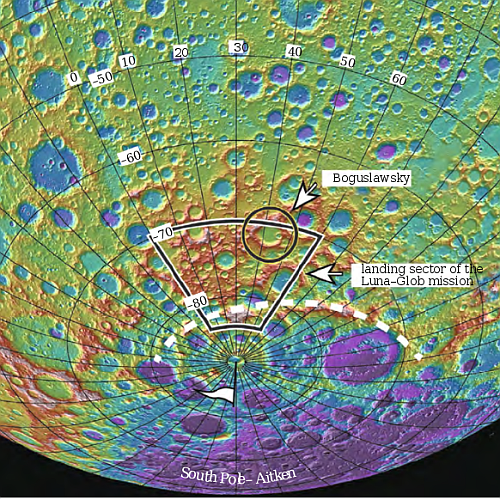
The landing zone for Luna-25 at Boguslawsky Crater
The head of Roscosmos, Yury Borisov, confirmed yesterday that the launch of Russia’s first lunar science probe since the 1970s has been delayed until 2023.
The Doppler speed and distance sensor made by the Vega Concern owned by the Rostech State Corporation, that could guarantee a soft landing, underperformed in terms of measurement precision, a source in the space industry told TASS in July. The launch will likely be postponed until 2023, the source added.
Russian sources had indicated in July that this delay was likely. Yesterday’s announcement merely made it certain.
This project has been under development for almost a quarter of century, which appears to be the average development time for government-run projects, whether in Russia or in the U.S. Just long enough to provide an almost entire career for bureaucrats.
An evening pause: I have posted scenes from this film twice (both sadly gone now from youtube), but I think the trailer sells it well. This movie remains one of the greatest made in the history of film. If you haven’t seen it, you must. Though its facts are of course not entirely accurate, its sense of the history, culture, time, and the political machinations going on in Arabia during World War I are spot on. The visuals, acting, and script (by Robert Bolt) are also magnificent.
It also speaks to the Middle East we see today, and helps explain why the Arabs have so far not really done well with the advantages of western technology.
Hat tip Tom Wilson, who says he makes it a point to watch this epic at least once a year.
Arianespace today used its Ariane-5 rocket, launching from French Guiana, to successfully place a Eutelsat communications satellite into orbit.
This was the fourth successful launch this year for Arianespace, so Europe still does not make the leader board. The company had predicted it would launch eleven times in 2022. At this moment it appears very questionable it will be able to match that prediction.
The leaders in the 2022 launch race:
40 SpaceX
36 China
11 Russia
6 Rocket Lab
5 ULA
American private enterprise still leads China 55 to 36 in the national rankings, but is now tied with the entire world combined 55 to 55.
Capitalism in space: NASA today awarded Axiom the contract to build the moonsuits the astronauts will use on the first lunar landing of its Artemis program, dubbed Artemis-3.
After reviewing proposals from its two eligible spacesuit vendors, NASA selected Axiom Space for the task order, which has a base value of $228.5 million. A future task order will be competed for recurring spacesuit services to support subsequent Artemis missions.
The contract award continues NASA shift from its failed spacesuit effort — taking fourteen years and a billion dollars to produce nothing — to hiring the private sector to do it.
Previously NASA had awarded contracts to both Axiom and Collins Aerospace to build spacesuits, either for spacewalks or on the Moon. Today’s award is specifically for moonsuits for that first lunar mission.

Click for interactive map
Though no details have yet been released, the engineering team for the Mars helicopter Ingenuity has posted the numbers for the helicopter’s 31st flight, which took place yesterday.
Ingenuity flew 318 feet to a height of 33 feet for 56 seconds. The maximum ground speed was 10.6 mph. The white dot on the map to the right indicates the approximate landing spot. The blue dot Perseverance’s location as of September 3rd.
The flight plan had been to fly 319 feet, so Ingenuity landed one foot short of that plan.
That difference does not indicate any problems. However, one of the present goals of the engineering team is to improve their landing accuracy in order to provide data for the future sample return helicopter that is now in development to come and get Perseverance’s sample cores. That future helicopter will need to be able to land very precisely, and they are using Ingenuity to refine the Martian flight software.

Click for full image.

Cool image time! The photo above, rotated, cropped, and reduced to post here, was taken on May 13, 2022 by the high resolution camera on Mars Reconnaissance Orbiter (MRO), and shows two dramatic ancient flows of flood lava. The arrows indicate what I think is the direction of flow for each, though the direction of the flow to the north appears more certain. In a wider context camera image the bulk of the evidence suggests the southern flow is heading west (as indicated by the arrow), but there are scalloped mesas within it that suggest the opposite.
The overview map above marks the location of this picture by the white cross inside the Athabasca Valles flood lava, thought by some scientists [pdf] to be Mars’ youngest major lava event that erupted about 600 million years ago and in just a matter of a few weeks poured out enough lava to cover an area about the size of Great Britain.
The general trend of the Athabasca flow was to the south, splitting into a big western and southeastern flows. This picture captures the southern edge of that southeastern flow, which might help explain why the flow directions in the picture seem so different from the main Athabasca flow. On a large scale, the flow was to the southeast. On a small scale at the edges the flow could go in many directions as the lava looks to find its level.
The Medusa Fossae Formation is the largest volcanic ash deposit on Mars, and is thought to be the source of most of the red planet’s dust. Though the origin of the ash is not yet known, it likely came from the eruptions that formed the planet’s giant volcanoes to the east and west.
The uncertainty of science? An online survey has found that large numbers of self-described Democrats now believe that it is possible for a man to give birth to babies.
The online survey, conducted by WPA Intelligence from August 22-25, found 22% of Democrats agreed with the statement, “Some men can get pregnant.” The percentage rose when only including women, and a whopping 36% of white, college-educated female Democrats concurred. [emphasis mine]
There is no uncertainty here. Men cannot get pregnant, and to believe it is possible tells us that you are either insane, or utterly disconnected from the real world.
The highlighted words underline the madness that is overtaking our intellectual upper classes. More than one-third of college educated Democrat women believe this. No wonder these same people wear masks, get triple and quadruple COVID jabs, and want any evidence that they are wrong censored with the speakers blackballed. They have become so divorced from reality that to even let a peep of it enter their brains will cause their heads to explode.

Twitter: Home for censorship.
Bring a gun to a knife fight: After getting suspended again by Twitter for merely proving that Boston Children’s Hospital was doing sex change operations on children, Libs of TikTok founder Chaya Raichik had her lawyers send the social media company a letter threatening a lawsuit if the suspension was not lifted immediately.
As she notes,
Last week, I was wrongfully suspended from Twitter for seven days after I exposed a hospital that admitted to performing gender-affirming hysterectomies on healthy minors. I say “wrongfully” because the reason given for my suspension was hateful conduct. I did not engage in hateful conduct. I accurately reported the truth
In their letter Raichik’s lawyers made it clear [pdf] that nothing she did was hateful. If anything, her actions caused others on Twitter to spew hate at her. As the lawyers noted also,
» Read more
Scientists have found that providing fruitflies 1g of artificial gravity on ISS using a centrifuge acted to reduce the medical changes that weightlessness produces.
In this study, scientists sent flies to the space station on a month-long mission in a newly developed piece of hardware called the Multi-use Variable-gravity Platform (MVP), capable of housing flies at different gravity levels. The flies in this hardware had access to fresh food as they lived and reproduced. By using distinct compartments, the MVP allowed for different generations of flies to be separated. On the space station, one group of fruit flies experienced microgravity similar to their human counterparts. Another group was exposed to artificial gravity by simulating Earth’s gravity on the space station using a centrifuge – an instrument that spins to simulate gravity. While on the space station, cameras in the hardware recorded behavior of these “flyonauts”. At different points in time, some of the flies were frozen and returned to Earth to study their gene expression.
…More in-depth analysis on the ground immediately post-flight revealed neurological changes in flies exposed to microgravity. As the flies acclimated to being back on Earth after their journey, the flies that experienced artificial gravity in space aged differently. They faced similar but less severe challenges to the flies that were in microgravity.
You can read the paper here.
To some extent, this study tells us nothing. We already know from a half century of research that zero gravity causes negative physical changes in both fruit flies and humans. What we really need to know is the lowest level of artificial gravity that would be beneficial. It is much easier to engine a spacecraft to produce 0.1g of artificial gravity than 1g. Even 0.5g would ease the engineering problem. The problem is that we do not yet know the right number.
It is a shame the scientists didn’t subject some flies to 0.5g, just to find out if that level of artificial gravity worked to provide benefits.
Capitalism in space: Rocket Lab yesterday revealed that the U.S. military has given it a contract to study whether its rockets could eventually be used for point-to-point cargo transport.
This study contract is similar to the one the military gave SpaceX for its Starship/Superheavy rocket. Both are intended not to actual fly missions, but to look at the engineering of the rockets to see if it will be practical to use them for point-to-point cargo transport on Earth.
The deal suggests the military has been impressed with Rocket Lab’s efforts to make its smallsat Electron rocket resusable, as well as its development program for its newer and larger Neutron resusable rocket.