
Keep It Real – Mercedes Benz G 63 AMG 6×6
An evening pause: I think this is the perfect gift for every man this Christmas season. Whaddya say, women?
Hat tip Mike Nelson.
An evening pause: I think this is the perfect gift for every man this Christmas season. Whaddya say, women?
Hat tip Mike Nelson.
With today’s monthly update from NOAA of its graph tracking the number of sunspots on the Sun’s Earth-facing hemisphere, we find that the Sun continues to confound the experts. As I do every month, I have posted this graph below, with additional details to provide the larger context.
In November the sunspot count rose slightly, but remained well below the highs that had occurred through most of the first half of 2023. Yet, despite that continuing reduction in the number of sunspots, the overall amount of activity remains above the prediction of some scientists, and below the prediction of other scientists.
» Read more
Courtesy of BtB’s stringer Jay.
The strap-on boosters are for future Vulcan launches, when the rocket needs extra power
My, the Russians really do seem to have jinx when it comes to the coolant systems on all their spacecraft.
Once again, like many similar Chinese concepts, development does not yet appear to have gotten past the powerpoint stage.

The smart phone: Proven very bad for kids
Making schools productive again: A Minnesota middle school has found that banning smart phones from all students during the school day has improved behavior both in and out of the classroom while improving the learning and social environment.
“I believe (the ban) is game-changing and will have lasting impacts on our students for years to come,” Maple Grove Middle School Principal Patrick Smith told WCCO. “There was no cross-the-table conversations, there was no interaction in the hallways,” he said. “And let’s be real, with these devices, our students – especially our teenagers – there’s a lot of drama that comes from social media, and a lot of conflict that comes from it.”
Last year, school officials banned student cell phone use for the entire school day, from 8:10 a.m. to 2:40 p.m., following a variety of issues at the school tied to the devices. “We have a culture and climate concern. We see issues that kids are getting on their phones through interactions of bullying, of setting up fights, just the gambit of a lot of the negative things kids are going back and forth on social media,” Smith said on the Chad Hartman Show, adding that the distraction from learning was also a major concern.
After a year school officials and parents are enthused by the results. Not only has the social atmosphere improved at the school, parents are reporting improvements in learning in their kids.
None of this is a surprise. » Read more
Angola today officially signed the Artemis Accords, becoming the 33rd nation to join this space alliance conceived during the Trump administration as a way to get around the limitations of the Outer Space Treaty.
The full list of signatories is as follows: Angola, Argentina, Australia, Bahrain, Brazil, Bulgaria, Canada, Columbia, Czech Republic, Ecuador, France, Germany, Iceland, India, Israel, Italy, Japan, Luxembourg, Mexico, the Netherlands, New Zealand, Nigeria, Poland, Romania, Rwanda, Saudi Arabia, Singapore, South Korea, Spain, the United Kingdom, the United Arab Emirates, the Ukraine, and the United States.
The competing alliance of communist nations, led by China, includes only Russia, Venezuala, Pakistan, Belarus, Azerbaijan, and South Africa. That former deep Soviet bloc nations like Bulgaria and Romania, as well as previously very Marxist Angola, went with the west rather than China illustrates the international distrust of China and its authoritarian methods.
As bilateral agreements between the U.S. and each nation. the accords were designed to create for the U.S. a strong political alliance focused on protecting private property and capitalism in space, something the Outer Space Treaty essentially forbids. As I think it was conceived, the plan had been to use this alliance to eventually either force changes to the Outer Space Treaty, or abandon it entirely. Whether that plan will continue under Biden is unclear, and in fact there have been indications it will not.
These trends could all change should a different president take over after 2024.
Hat tip to BtB’s stringer Jay for cluing me in to this story.
SpaceX today successfully used its Falcon 9 rocket to launch 25 payloads into orbit, including first five homebuilt surveillance satellites by South Korea, lifting off from Vandenberg in California.
The first stage successfully completed its seventeenth flight, landing back at Vandenberg. The fairings completed their fifth and sixth flights respectively. As of posting not all the payloads had been deployed.
The leaders in the 2023 launch race:
88 SpaceX
53 China
16 Russia
7 Rocket Lab
7 India
American private enterprise now leads China in successful launches, 100 to 53, and the entire world combined 100 to 85. SpaceX by itself now leads the entire world (excluding other American companies) 88 to 85.
SpaceX still has one more launch scheduled for today, from Cape Canaveral at 11 pm (Eastern). The link goes to the live stream.
This launch was significant for the United States. For the first time the U.S. has reached 100 launches in a single year, something that only the Soviet Union previously achieved, with 100 launches in 1982. With SpaceX’s launch tonight the U.S. will thus set a new record for the most launches in a single year by any nation.
A former Blue Origin engineer, Craig Stoker, has filed a lawsuit against the company, claiming it fired him because he had reported unsafe conditions caused largely because the company’s then CEO, Bob Smith, interfered with operations and insisted these unsafe conditions be hidden.
According to the complaint, Blue Origin’s contract with ULA requires the company to communicate issues that could impact rocket engine delivery one year in advance; Stoker wanted to tell ULA the engines would likely be delayed. [Ed. Delays that ended up actually happening.]
But Smith had allegedly instructed Stoker not to share these production and delivery issues with ULA.
Ultimately, after an internal investigation, Blue Origin HR concluded that Smith did not create a hostile work environment, nor violate any company policies. Stoker objected to this conclusion; the complaint says that Stoker later learned that no one from the engine program was interviewed as part of the investigation.
The complaint also notes that
Smith’s behavior caused employees “to frequently violate safety procedures and processes in order to meet unreasonable deadlines.” Smith would “explode” when issues would arise, generating a hostile work environment, the complaint says. Stoker sent a follow-up email to the two VPs — Linda Cova, VP of the engines business unit, and Mary Plunkett, senior VP of human resources — that included a formal complaint against Smith.
According to the complaint, Smith then “spearheaded” Stoker’s termination because of his refusal to sweep the safety issues under the rug.
If the accusations of this lawsuit prove true, it provides another piece of strong evidence explaining why Blue Origin went from a productive company to an utter failure after Bob Smith took over in 2017.
A new GAO report says that the first Artemis manned landing on the Moon is almost certainly not happen in 2025 as NASA presently wants, but will probably be delayed to 2027.
You can read the report here [pdf]. It clearly references the delays experienced by SpaceX due to regulatory roadblocks, but couches its language carefully so as to lay no blame on the government for those delays, placing the problem entirely on SpaceX instead.
In April 2023, after a 7-month delay, SpaceX achieved liftoff of the combined commercial Starship variant and Super Heavy booster during the Orbital Flight Test. But, according to SpaceX representatives, the flight test was not fully completed due to a fire inside the booster, which ultimately led to a loss of control of the vehicle. Following the launch, the Federal Aviation Administration—which issues commercial launch and reentry licenses—classified the commercial Starship launch as a mishap and required SpaceX to conduct a mishap investigation. The Federal Aviation Administration reviewed the August 2023 mishap report submitted by SpaceX and, as a result, cited 63 corrective actions for SpaceX to implement before a second test.
SpaceX had planned this demonstration as the first test flight of the booster stage, as well as the first test with the Starship riding on the booster and the whole system experiencing stage separation. However, SpaceX representatives said their Autonomous Flight Safety System initiated the vehicle self-destruct sequence and the vehicle began to break up about 4 minutes into the flight after the vehicle deviated from the expected trajectory, lost altitude, and began to tumble. HLS [Human Landing System] officials said that while the flight test was terminated early, it still provided data for several Starship technologies, including propellant loading, launch operations, avionics, and propulsion behavior.
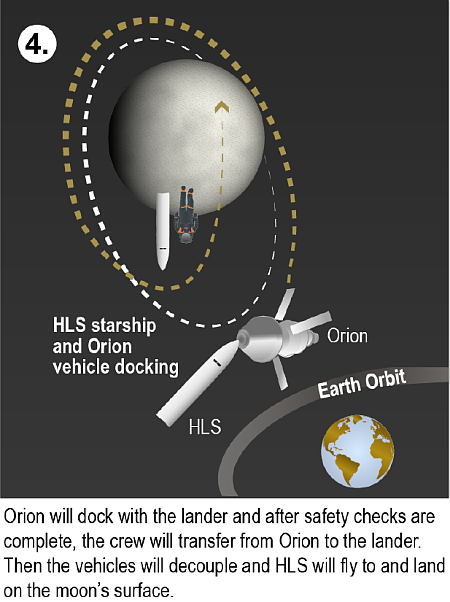
Note how this language makes it seem like the launch was a failure, when in fact SpaceX never expected it to reach orbit and instead intended to use the problems that occurred during this engineering test launch to find out what engineering designs needed to be reworked.
This language illustrates the fundamental dishonesties that routinely permeate government actions. The funniest and most absurd example of this intellectual dishonesty however has to be the graphic posted to the right, taken from the GAO report. The graphic gives the false impression that Orion and Lunar Gateway are far larger than Starship, when in fact, several of both could easily fit inside Starship’s planned cargo bay. In fact, when Starship finally docks with Lunar Gateway the size difference is going to make NASA’s effort here seem very picayune. Apparently, the GAO (or possibly NASA) decided it needed to hide this reality.
The real problem NASA’s Artemis program faces is red tape coming from the FAA and Fish & Wildlife. The GAO fails to note this fact, which makes its report far less helpful than it could have been.
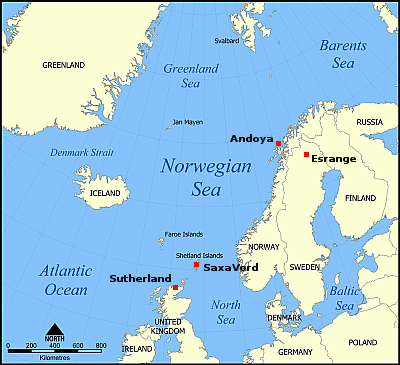
Proposed spaceports surrounding Norwegian Sea.
The Sutherland spaceport being built in the north of Scotland has announced plans to shrink its size in order to satisfy environmental concerns, likely raised by the many bureaucrats in the United Kingdom that have to approve its spaceport license.
Orbex is now consulting with the local community on proposed changes, including a smaller launch pad, to better protect the surrounding environment. There will also be smaller access roads, and the size of the integration facility, where rockets are assembled before launch, is to be reduced.
The company said: “These changes will make the building footprint smaller, leading to a reduction in peat disturbance and a lower impact on the groundwater ecosystem. The visual impact of the site will also be reduced, and there will be less disturbance to local watercourse crossings, with mammal migration paths widened to better preserve the natural environment.
Orbex has signed a 50-year lease to use this spaceport, and has been building its Prime rocket in a facility nearby. It had hoped to complete a first launch in 2023, but that is clearly not going to happen. It had applied for a launch license in February 2022, but apparently the Civil Aviation Authority (CAA) in the United Kingdom has still not issued it, almost two years later.
Much of the environmental opposition to the Sutherland spaceport was initially instigated by a billionaire who had invested in the competing Saxavord spaceport on the Shetland Islands. Though his lawsuit was dismissed in August 2021, this does not mean that the opposition by him and others has ceased.
Overall, it appears that like at Saxavord in Shetland, work at Sutherland has significantly slowed in recent months. It appears both are being blocked for regulatory reasons, delays that once again provide an opportunity for the spaceports being developed in Norway and Sweden.
The satellite communications company Intelsat has begun partnering with both Starlink and OneWeb to provide service to its customers using satellites from its own constellation as well as the constellations of these competiting companies.
Intelsat is producing a new flat panel antenna that enables moving vehicles to use broadband services from the company’s geostationary satellites and from SpaceX’s Starlink network in low Earth orbit. The phased array electronically steered antenna was installed on the roof of a sports utility vehicle for demonstrations at an Intelsat investor day event Nov. 30.
This antenna is designed to be rugged enough for military use, thus targeting the prime customer Intelsat is aiming at. It also hopes to make a deal to use Amazon’s Kuiper constellation in the same way, once that constellation is launched.
The company also has a deal with OneWeb to use a combination of their satellites to provide broadband services during commercial airline flights.
The rocket engine startup Ursa Major has successfully raised an additional $138 million in private investment capital in an extended round of fund-raising.
Rocket propulsion startup Ursa Major announced Nov. 30 it has raised $138 million in Series D and D-1 funding rounds. Investors include Explorer 1 Fund and Eclipse, RTX Ventures, funds and accounts managed by BlackRock, Exor Ventures, Mack & Co., XN and other institutional shareholders.
Based in Berthoud, Colorado, Ursa Major manufactures liquid engines for small space launchers and hypersonic vehicles, and recently announced plans to expand into solid rocket motors. An initial Series D round was completed earlier this year. But Ursa Major said it extended fundraising to include a Series D-1 round “due to strong interest in accelerating development on several future programs.”
The company’s decision to enter the solid rocket motor market was apparently greeted with enthusiasm by investors. The biggest user of these motors is the U.S. military, and it desperately needs more provides to refresh its stockpile, since so much of that stockpile has been shipped to the Ukraine.
Link here. Much of the activity the article describes has to do with preparing for a first launch of Blue Origin’s New Glenn rocket, suggesting that it might finally take place in 2024 as presently planned.
In fact, the activity also suggests that the company intends to attempt to recover its first stage from a landing ship in the ocean on that first flight.
In early October, a large Liebherr mobile crane was delivered to Port Canaveral to support Blue Origin’s continuously growing presence on the Space Coast. Once New Glenn begins flying, this crane will assist recovery operations by lifting the 57.5-meter-tall first stage from the landing vessel and onto shore.
More recently on Nov. 27, a large jig on a barge was towed into Port Canaveral and proceeded to be offloaded by Blue Origin’s new crane. This custom-made structure appears to be a stand to support New Glenn first stages after being offloaded from its landing vessel. Various work platforms will allow crews to inspect the boosters in different locations before the booster itself is transported back to the factory, or the future refurbishment facility which is still yet to be built.
It also appears the company has built a full scale test version of New Glenn to allow testing of all operations prior to launch.
Keep your fingers crossed. With former CEO Bob Smith gone, Blue Origin might finally be coming back alive at last.
Russia early this morning successfully launched a Progress freighter to ISS, its Soyuz-2 rocket lifting off from Baikonur in Kazakhstan.
The rocket’s core stage, strap-on boosters, and second stage crashed in the standard drop zones the Russians have used since the launch of Sputnik in 1957. It is unclear how close to inhabited areas any of these are.
The leaders in the 2023 launch race:
87 SpaceX
53 China
16 Russia
7 Rocket Lab
7 India
American private enterprise still leads China in successful launches, 99 to 53, and the entire world combined 99 to 85. SpaceX by itself still leads the entire world (excluding other American companies) 87 to 85.
SpaceX however has two launches scheduled for today, one at Vandenberg at 10:04 am (Pacific) and the second at Cape Canaveral at 11 pm (Eastern). The links go to the live streams.
Courtesy of BtB’s stringer Jay.
The launch is presently scheduled for December 10, 2023 on a Falcon Heavy.
The old Progess was sent to burn up over the Pacific today.
From the videographer: ” I could literally taste the hypergolic fuel.”
And I believe him.
The tests are designed to make sure it can survive launch and space. It will launch as part of the first launch Sierra’s Tenacity Dream Chaser mini-shuttle, set to launch next year.
The mission delivered new upgraded solar panels to the station.
She flew two missions, in 1985 and 1989.

Click for original image.
Cool image time! The picture to the right, rotated, cropped, reduced, and sharpened to post here, was taken on July 10, 2023 by the high resolution camera on Mars Reconnaissance Orbiter (MRO). It shows the northeast corner of an unnamed 7-mile-wide crater, located near the equator in the dry Martian tropics.
The MRO science team labels this “crater and lava fill”, suggesting that the crater interior is filled with lava material. The nature of that crater floor reinforces this conclusion, as it is relatively smooth and does not have rough aspects of glacial material found in craters in the mid-latitudes. Instead, it looks like a frozen lake of lava that has the peaks of mostly buried features poking up at various spots.
What makes this crater interesting however are the gullies on the northern interior rim. Gullies on Mars are normally thought to be associated with some water-frost-ice process, probably seasonal, where the thaw-freeze cycle causes small collapses and avalanches. Yet, this crater is almost at the equator, in a very dry region where no evidence of near-surface ice is found. Gullies here suggest the hypothesis for explaining the gullies on Mars have not quite solved the mystery.
» Read more
The European Space Agency today announced that the first launch of its new Ariane-6 rocket will not take place in the first quarter of 2024 and is now targeting a summer launch instead.
At a Nov. 30 briefing, ESA Director General Josef Aschbacher announced a launch period for the inaugural Ariane 6 flight of June 15 through July 31. A more precise launch date will be provided after qualification reviews in the spring of 2024. The announcement comes after a Nov. 23 long-duration test firing of a model of the core stage of the Ariane 6. That test, conducted on the launch pad at Kourou, French Guiana, was intended to simulate a full burn by the core stage.
The delay is not significant by itself, but in the large scheme of things it continues for another few months Europe’s lack of any large rockets to launch any payloads. The original plan when the Ariane-6 project was announced in the mid-2010s was for it to begin flights in 2020 with a several year overlap as the Ariane-5 was retired around 2023. As planned, the last launch of Ariane-5 occurred this summer, but Ariane-6 is now four years behind schedule.
At the moment the rocket has one more major test required, an upper stage static fire test scheduled for December. That test must go well for this new schedule to go forward, which will include a second Ariane-6 launch in 2024 followed by “as many flights as possible” in 2025. ESA hopes to do 9 to 10 Ariane-6 launches per year, most to fulfill the contract of 18 launches with Amazon to put some of its Kuiper satellite constellation into orbit.

Increasingly viewed at useless educational institutes
According to a new survey of 800 American companies, about half say they have now dropped their requirement that new employees have a college degree, with some businesses replacing this requirement with actual apprenticeship programs.
For example, Accenture launched an apprenticeship program in 2016 through which it has since hired 1,200 people, CNBC reported. Some 80 percent of those people joined the company without a four-year-degree.
Earlier this year, the company expanded the program with the goal of filling 20 percent of its US entry-level roles. ‘A person’s educational credentials are not the only indicators of success, so we advanced our approach to hiring to focus on skills, experiences and potential,’ CEO of Accenture North America, Jimmy Etheredge, told the outlet.
According to the report, 45% of all businesses surveyed intend to eliminate college degree requirements next year, while 55% say they have already done so. Major companies like Walmart, IBM, Facebook, Intel, and Microsoft have been public about their shift away from college degree requirments, while others like Google and Apple have done so more quietly.
According to this survey [pdf] from the Burning Glass Institute, which analyzed trends across 51 million job postings, this trend appeared to begin before the Wuhan panic, was accelerated significantly by it, but has continued subsequent. This short quote from that report however says it all:
» Read more

Click for original image.
Astronomers today announced the discovery of a solar system with six Earth-sized exoplanets that orbit their Sun-like star in a synchronized manner, their orbits in a gravitational lock-step called resonance.
The graphic to the right illustrates that pattern. From the press release:
While multi-planet systems are common in our galaxy, those in a tight gravitational formation known as “resonance” are observed by astronomers far less often. In this case, the planet closest to the star makes three orbits for every two of the next planet out – called a 3/2 resonance – a pattern that is repeated among the four closest planets.
Among the outermost planets, a pattern of four orbits for every three of the next planet out (a 4/3 resonance) is repeated twice. And these resonant orbits are rock-solid: The planets likely have been performing this same rhythmic dance since the system formed billions of years ago. Such reliable stability means this system has not suffered the shocks and shakeups scientists might typically expect in the early days of planet formation – smash-ups and collisions, mergers and breakups as planets jockey for position. And that, in turn, could say something important about how this system formed. Its rigid stability was locked in early; the planets’ 3/2 and 4/3 resonances are almost exactly as they were at the time of formation. More precise measurements of these planets’ masses and orbits will be needed to further sharpen the picture of how the system formed.
All the planets have orbits less than 55 days long, and though all have masses less than six Earth-masses, data suggests they more resemble Neptune because of their expanded gaseous make-up caused by the close orbits to the star.
Future observations are planned, most especially with Webb because its infrared capability will detect much of the chemistry of this system.
By a party-line vote of 21-17, the Republicans on the House Science, Space and Technology Committee yesterday passed the proposed new commercial space act that had been earlier formulated with industry input and approval, rejecting the alternative proposal that the White House had suddenly dropped on them two weeks ago.
The head of the committee, Frank Lucas (R-Oklahoma), outlined the problems with the White House proposal.
For Lucas, the Space Council’s proposal is a “needless expansion of government authority.” Instead of consolidating new regulatory authority at the Department of Commerce as proposed in H.R. 6131, the White House would assign some activities there and others to the FAA. “Whereas our bill creates a one-stop shop to the extent possible, under this proposal, organizations would be forced to get multiple licenses from multiple cabinet-level departments.” Along with other objectionable provisions, he concluded that “instead of streamlining already convoluted processes, the Space Council is adding to bureaucracy and stifling innovation.”
That White House proposal was also opposed by the industry, which saw it as a power grab that would stifle the industry.
Whether this bill will become law remains to be seen. The full House still has to vote on it, and then the Senate, and then Joe Biden has to be wheeled into his office, a pen handed to him, and someone must guide that hand to sign the bill. Considering that the White House staff opposes the bill, it might refuse to do this latter guiding. Similarly, the Democratic Party’s eagerness to expand regulation and the power of the federal government means that in the Senate it will likely oppose this bill as well.