The next chapter in my own personal blacklisting story

The ARA: An organization run by bullies

This past Saturday, January 28, 2023, another chapter in my own personal blacklisting saga took place. On that day the Arizona Regional Association (ARA), a division of the National Speleological Society, the country’s national organization for cavers, held its annual winter technical meeting at Kartchner Caverns in Arizona.

It is this same organization had blacklisted me and two other individuals in November 2021 because they did not like our opinions about COVID. Its leadership therefore assumed that it also the right to eject us from the public event on Saturday. It was our intention to show them they were wrong.

The goal of the winter technical, which has been occurring annually for about a half century, is to allow southwest cavers to present papers highlighting their research and projects during the past year. While intended mostly for Arizona cavers, it has not been unusual for others from other parts of the country to present, especially if their work has some connection with Arizona. Consider it a very informal kind of scientific conference.

Thus, this event has always been open to the public, and in fact has always been designed as a form of outreach.

The Wuhan panic had unfortunately caused the winter technical to be canceled in 2021 and 2022. Thus, the January 2023 event was to be the first in-person winter technical since 2020.

It was also going to be the first in-person winter technical since this organization had blacklisted myself and two others. » Read more

50 comments

Today’s blacklisted American found innocent of federal trumped up charges

The Houck Family: Targets of FBI harassment and arrest
The Houck Family: Targets of FBI harassment and arrest.

Back in September 2022 I wrote an essay entitled “The rising federal Gestapo” in which I described the numerous recent stories of the Biden administration using the FBI and the Department of Justice as weapons to harass its political opponents, either by conducting armed raids on their homes and persons, or by trumping up false charges against them.

Mark Houck, the father in the picture the right, was one of those under attack. Not only was his home raided by an FBI SWAT team, terrifying his children, but Houck was arrested on a trumped up charge of physically attacking a worker at an abortion clinic, a charge that had other courts had already dismissed as spurious.

The good news yesterday is that Houck has been found innocent of that trumped up charge.

At first it appeared the jury was deadlocked, but that changed instantly when one juror was replaced with an alternate. Within an hour the not-guilty verdict was in, strongly suggesting that juror had had a political ax to grind and was refusing to follow the facts of the case or the judge’s instructions.

As I wrote in that September essay,

In the past two years the effort by Democrats to portray Republicans criminals and traitors, merely because they disagree with Democratic Party policy, has become normalized. To Democrats today, if you are a Republican you are a fascist, an insurrectionist, a traitor, a criminal, and evil. Your rights are voided and they have the right to arrest you, at any time.

The Biden administration tried to void Mark Houck’s rights. It failed in court. Was this vicious effort however a failure? I say no, because 1) the Biden administration remains free to continue this abuse of power and 2) conservatives have now been put on notice that, at any moment, their lives could be torn apart by these thugs.

In fact, this short post is only posted to give an update on a previous column. It is not today’s daily blacklist column, which will follow shortly and will give perfect example of how the abusive power-hungry in our culture now routinely abuse their power against any who oppose them.

7 comments

SpaceX successfully launches 49 Starlink satellites and a D-Orbit space tug

SpaceX today successfully used its Falcon 9 rocket to launch 49 Starlink satellites as well as a D-Orbit space tug carrying one of its own customer’s satellites from Vandenberg Space Force Base in California.

The first stage successfully completed its seventh flight, landing on a drone ship in the Pacific. The D-Orbit tug with its four payloads has also successfully deployed.

The 2023 launch race:

7 SpaceX
5 China
1 Rocket Lab
1 Japan

American private enterprise leads China 8 to 5 in the national rankings, and the entire world combined 8 to 6.

5 comments

Perseverance completes placement of first ten samples for later pick up

Overview map
Click for interactive map.

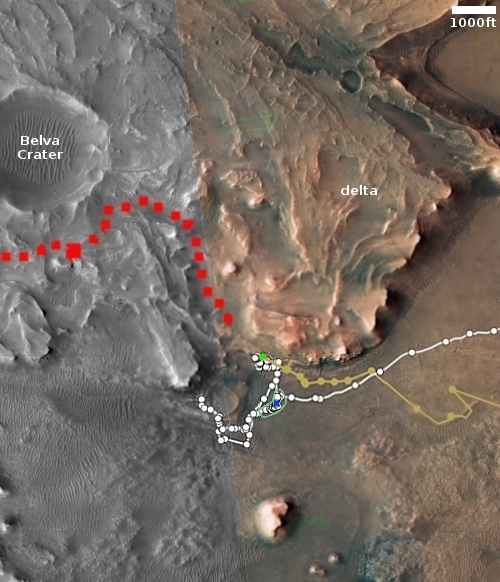
On January 29, 2023 the Perseverance science team completed the placement of the first ten core samples on the floor of Jezero Crater.

On the overview map to the right, the green outline indicates the location of this sample depot. The blue dot marks Perseverance’s present location, while the green dot marks Ingenuity. The red dotted line shows the planned route up onto the delta, which is Perseverance’s next goal.

The titanium tubes were deposited on the surface in an intricate zigzag pattern, with each sample about 15 to 50 feet (5 to 15 meters) apart from one another to ensure they could be safely recovered. Adding time to the depot-creation process, the team needed to precisely map the location of each 7-inch-long (18.6-centimeter-long) tube and glove (adapter) combination so that the samples could be found even if covered with dust. The depot is on flat ground near the base of the raised, fan-shaped ancient river delta that formed long ago when a river flowed into a lake there.

This mapping will be used by a future Mars helicopter to precisely land by each sample, grab it, and then take it to the ascent vehicle for return to Earth.

1 comment

Viewing the Green Comet

Link here. Though there has been much hype about this comet, which has a 50,000 year orbit as well as an unusual color, it really doesn’t deserve that hype because it will barely become bright enough to be visible to the naked eye.

Nonetheless, in the northern hemisphere it will be in the sky all night during the month of February, so if you are in a good dark sky location, you should try to spot it. On February 1st it will be closest to Earth.

According to In-the-Sky, from New York City C/2022 E3 (ZTF) is circumpolar, meaning it is permanently above the horizon, and should therefore be visible for most of the night. It will be visible in the Camelopardalis constellation while at perigee, a large but faint area of sky devoid of bright stars and located close to the north celestial pole.

The comet will become visible at around 6:49 p.m. EST (2349 GMT) on Wednesday (Feb. 1) when it will be 49 degrees over the northern horizon. C/2022 E3 (ZTF) will climb to its highest point in the sky, 58 degrees over the northern horizon, at around 9:46 p.m. EST (0246 GMT). Following this it will disappear in the dawn light at around 5:57 a.m. EST (1057 GMT) on Feb. 2 while at around 30 degrees over the horizon to the north.

The link provides more information for finding it, which will likely be seen best with binoculars.

2 comments

Juno’s camera experiences temperature problem

Because of an unexpected rise in its temperature, Juno’s camera was unable to take its full schedule of planned images during its January 22, 2023 close approach of Jupiter.

The JunoCam imager aboard NASA’s Juno spacecraft did not acquire all planned images during the orbiter’s most recent flyby of Jupiter on Jan. 22. Data received from the spacecraft indicates that the camera experienced an issue similar to one that occurred on its previous close pass of the gas giant last month, when the team saw an anomalous temperature rise after the camera was powered on in preparation for the flyby.

However, on this new occasion the issue persisted for a longer period of time (23 hours compared to 36 minutes during the December close pass), leaving the first 214 JunoCam images planned for the flyby unusable. As with the previous occurrence, once the anomaly that caused the temperature rise cleared, the camera returned to normal operation and the remaining 44 images were of good quality and usable.

Engineers are analyzing the issue to try to determine its cause, as well as a fix. The camera at this moment appears to be operating properly, with the next close fly-by occurring on March 1, 2023.

1 comment

January 30, 2023 Quick space links

Courtesy of BtB’s stringer Jay.


3 comments

Today’s blacklisted American: Professor quits because of the leftist takeover of his college

Matthew Wielicki
Matthew Wielicki

Matthew Wielicki, a professor at the University of Alabama, has quit his job because of what he calls the “rise of illiberalism” as well as the takeover of the college by the leftist diversity, equity and inclusion (DEI) crowd.

While Matthew Wielicki said his main reason for leaving Tuscaloosa was to be closer to family in Colorado, the “rise of illiberalism” made his decision easier. “The rise of illiberalism in the name of DEI is the antithesis of the principles that universities were founded on,” Wielicki tweeted Monday. “These are no longer places that embrace the freedom of exchanging ideas and will punish those that go against the narrative.”

You can read his full statement in this thread on Twitter.
» Read more

11 comments

Curiosity looking back

Panorama by Curiosity, looking back
Click for full image.

Overview map
Click for interactive map.

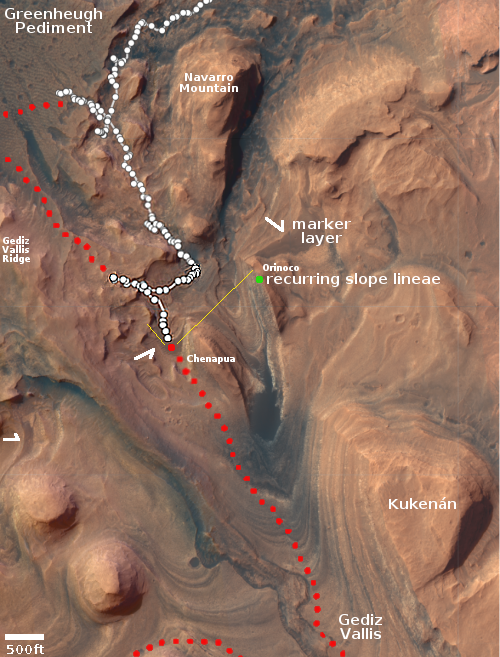
Curiosity is now about halfway across the flat marker band terrain it faced last week, and as part of its routine, used its right navigation camera on January 28, 2023 to create a 360 degree panorama mosaic of the Mount Sharp foothills that now surround it. The panorama above, cropped, reduced, and sharpened to post here, focuses on the part of that mosaic looking behind Curiosity.

You can see the rover’s recent tracks as it crossed this part of the marker band. In the far distance can be seen in the haze the rim of Gale Crater, approximately 20 to 40 miles away. The yellow lines in the overview map to the right show the approximate area covered by this section of the panorama. It is possible the peak of Navarro Mountain is peeking up in the center of this panorama, but more likely it is no longer visible, blocked by the smaller but closer hills.

As Curiosity is now inside the foothills of Mount Sharp, the floor of Gale Crater is no longer easily seen. The rover needs to be at a high lookout point, something that will likely not occur in its travels for many months if not years to come.

The Curiosity pictures I am featuring this morning are cool, and they are also the only real news in the space field at this moment. As is usual on Monday, it takes few hours for the news at the beginning of the week to make itself known.

1 comment

A cloud on Mars

A cloud on Mars
Click for original image.

Cool image time! The photo to the right, reduced and sharpened to post here, was taken on January 27, 2023 by Curiosity’s high resolution camera (dubbed Mastcam) as part of its periodic survey of the sky, looking for clouds. Most of the time the sky is either hazy or clear. This time the camera picked up this cloud, which resembles a cirrus cloud on Earth.

In March 2021 I posted another example of clouds found above Gale Crater by Curiosity. Two months later the science team released a press release about those clouds, which might help explain the cloud above.

The fine, rippling structures of these clouds are easier to see with images from Curiosity’s black-and-white navigation cameras. But it’s the color images from the rover’s Mast Camera, or Mastcam, that really shine – literally. Viewed just after sunset, their ice crystals catch the fading light, causing them to appear to glow against the darkening sky. These twilight clouds, also known as “noctilucent” (Latin for “night shining”) clouds, grow brighter as they fill with crystals, then darken after the Sun’s position in the sky drops below their altitude. This is just one useful clue scientists use to determine how high they are.

Even more stunning are iridescent, or “mother of pearl” clouds. “If you see a cloud with a shimmery pastel set of colors in it, that’s because the cloud particles are all nearly identical in size,” said Mark Lemmon, an atmospheric scientist with the Space Science Institute in Boulder, Colorado. “That’s usually happening just after the clouds have formed and have all grown at the same rate.”

Though usually formed from water-ice, there is a chance this cloud is formed from crystals of dry ice. More analysis will of course be necessary to make that determination.

0 comments
1 180 181 182 183 184 196