Stephanie Trick & Paolo Alderighi – Home in Pasadena
An evening pause: Song by Harry Warren and first published in 1923.
Hat tip Tom Biggar.
An evening pause: Song by Harry Warren and first published in 1923.
Hat tip Tom Biggar.

Lies from CNN

Lies from MSNBC
Before Israel began its full scale ground assault on Gaza and the Hamas tunnels two weeks ago, the general consensus from practically every expert interviewed or writing about the attack assumed it would be long, hard, and difficult, taking many months before Israeli troops were able to take control of the Gaza strip and render Hamas impotent.
A good example of that analysis can be seen in this October 13, 2023 article. To quote:
When the huge force Israel has amassed is finally given the orders to enter Gaza and destroy Hamas, they will face a deeply dug-in, well-armed enemy with thousands of anti-tank weapons, drones, and small arms on the most complex battlefield there is. Hamas will be fighting from tunnels, sewers, and strong points set up in high-rise buildings and rubble. They will rake incoming troops with machine guns from alleyways and windows, as well as employ heavier weapons from rooftops and prepared cover, and then melt into the urban maze that makes up much of the Gaza Strip. There will be no element of surprise for this sojourn into deeply hostile territory.
Israeli troops “will face the greatest challenge of their lifetime,” John Spencer, chairman of urban warfare studies at the Modern War Institute (MWI) at West Point told The War Zone. “Attacking a defended city like this will be combat in hell. I do believe they can do it, but the cost will be high in urban warfare like this, since they will be attacking multiple cities.”
All the experts generally predicted the offensive would take months, and would involve huge casualties on the Israeli side.
I however predicted that the offensive, though not easy, would unfold far faster than these predictions.
This invasion will not be easy, but I also suspect it will not be as hard as many have suggested. Hamas’s power is mostly that of a bully, all threats and violence against the weak and helpless, with little real military capabilities. Israel now enraged is neither weak nor helpless. It will steadily but implacably work its way through Hamas’s tunnel system, but I think it will do so within a month.
Based on this report today, the experts now admit their pessimistic assessments were all wrong, and my analysis was right.
» Read more
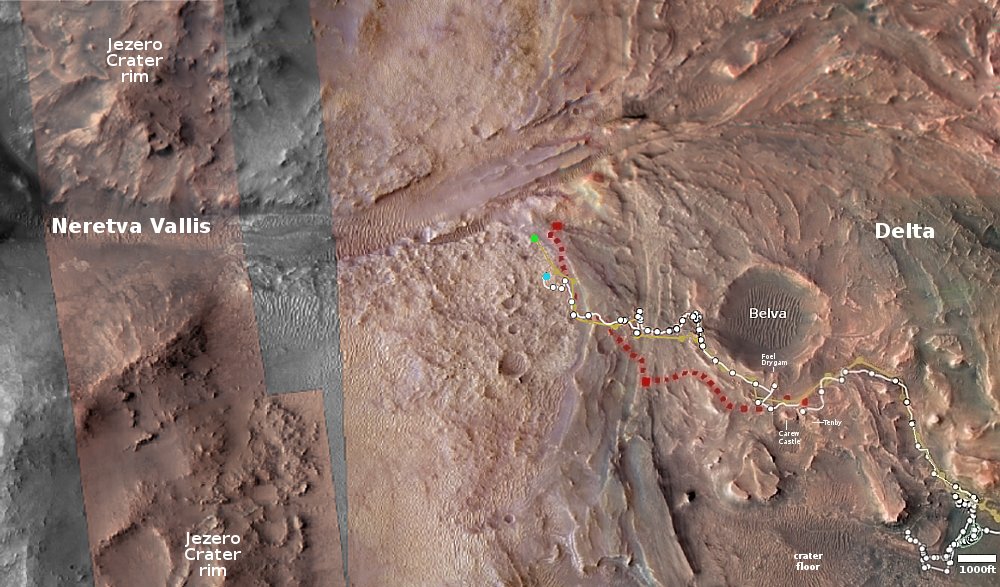
Cool image time! The picture to the right, rotated, cropped, reduced, and enhanced to post here, was taken on August 22, 2023 by the high resolution camera on Mars Reconnaissance Orbiter (MRO). I have also inserted data from a July 28, 2008 context camera image into the blank strip that now exists in the center of high resolution camera images due to the failure of one sensor.
This photo is what the camera team calls a terrain sample, and was probably taken not as part of any specific request but to fill a gap in the camera’s schedule in order to maintain its proper temperature. When the camera team does this they try to find locations that either have not been observed in much detail previously or have interesting features. In this case the team accomplished both. The interesting features are the two pedestal craters, both surrounded by splash aprons. Neither has been observed in high resolution previously, and the context camera has only taken two pictures of this location in total.
» Read more
China last night successfully put a geosynchronous communications satellite into orbit, its Long March 3B rocket lifting off from its Xichang spaceport in southern China.
No word on where the rocket’s core stage, second stage, and four side boosters crashed inside China. All use extremely toxic hypergolic fuels, so anyone approaching any wreckage risks serious health issues.
The leaders in the 2023 launch race:
80 SpaceX
51 China
14 Russia
7 Rocket Lab
7 India
American private enterprise still leads China 92 to 51 in successful launches, and the entire world combined 92 to 80. SpaceX by itself is once again tied with the rest of the world (excluding American companies) 80 to 80, but this will probably change later today, when the company launches a cargo Dragon to ISS. NASA’s live stream is here.
NASA has awarded the solar panel company Solestial its second development contract, with both contracts worth more than one million dollars, to develop new advanced solar panels for use on future commercial space stations.
The 18-month SBIR Phase II contract will provide funds to support development of next generation, 50-kilowatt (kW) class solar array wings. Solestial’s silicon solar blanket technology will allow for arrays larger than any ever built, while also maintaining lower mass and competitive efficiency. The array will be developed in collaboration with Opterus Research & Development, who will develop a low-cost, novel deployment system for Solestial’s ultrathin, flexible, silicon solar blankets.
These blankets will be an upgrade from the new panels presently being deployed on ISS, that unroll like a blanket rather than unfold like hard panels. The design is lighter weight, easier to deploy, and cheaper. It will thus become a valuable product that every private space station will want to buy.
A federal judge in Texas yesterday dismissed the Biden Justice Department lawsuit against SpaceX that accused the company of discrimination for not hiring illegal immigrants.
A federal judge in Texas on Wednesday halted the Justice Department’s case, after the company called it “factually and legally insupportable.” Musk has argued that SpaceX was barred from hiring foreign nationals because of restrictions placed on sharing of information related to rocket technology.
The Justice Department had been investigating SpaceX’s hiring practices since 2020 after receiving a complaint from a person who claimed he was turned down for a job after revealing during an interview that he wasn’t a US citizen or a lawful permanent resident.
At the present Biden’s Justice department has not responded to this decision. The lawsuit might have been idiotic on its face, but its deeper intention was simply to harass SpaceX and Elon Musk — now considered an enemy to Democratic Party rule — and in that it has so far succeeded. Appealing this decision will continue that harassment, even if it is patently obvious that the suit has no merits at all.
Firefly yesterday announced that the Australian commercial company, Fleet Space Technologies, will fly its seismometer on Firefly’s second Blue Ghost lunar lander mission, planned to land on the far side of the Moon in 2026.
Fleet Space’s SPIDER payload is part of the Australian Space Agency’s Moon to Mars initiative that’s aligned with NASA’s Artemis program to support future habitation on the Moon. Upon deployment of the payload, Firefly’s Blue Ghost lunar lander will provide ongoing power and communications, enabling SPIDER to capture seismic data from the lunar surface for up to 14 days. This data will offer insights into the geological properties of the lunar subsurface and its mineral profile, such as water ice, that can support lunar infrastructure and further regolith exploration.
The mission also has payloads from NASA and the European Space Agency. Note that all three governments are buying the lunar landing services from this private company, rather than build the lander themselves.
The next X-37B launch has now been scheduled for a December 7, 2023 launch, and will be sent into orbit for the first time on SpaceX’s Falcon Heavy rocket.
The mission, designated USSF-52, will conduct a wide range of tests, including operating the reusable spaceplane in new orbital regimes, experimenting with space domain awareness technologies, and investigating the radiation effects on materials provided by NASA, the Space Force said in a statement Nov. 8. “We are excited to expand the envelope of the reusable X-37B’s capabilities,” said Lt. Col. Joseph Fritschen, the X-37B program director. The NASA experiment onboard, known as Seeds-2, will expose plant seeds to the harsh radiation environment of long-duration spaceflight.
SpaceX was awarded a $130 million contract in June 2018 to launch USSF-52. The mission was originally scheduled to launch in 2021 and has been delayed by payload and range availability.
The use of the Falcon Heavy suggests the payloads on this next flight are heavier and require that rocket’s extra boost. This will be the seventh X-37B flight of the Space Force’s fleet of two reusable mini-shuttles, beginning in 2010. The previous mission lasted 908 days in orbit, and landed one year ago in November.
Japanese billionaire Yusaku Maezawa finally admitted publicly today that his manned Moon mission using SpaceX’s Starship/Superheavy rocket won’t happen in 2023 as first announced in 2018.
The most significant part of the announcement? “”We’re not sure when the flight will be,” Maezawa noted on X. Though SpaceX and several news sources claim that federal approval for the next test launch could occur as soon mid-November, Maezawa — as one of SpaceX’s most important customers — might have more detailed non-public information about that approval process.
Even if that second flight get approved and flies in November, it does not mean Maezawa’s manned mission will soon follow. SpaceX will certainly not be ready for manned Starship launches following this test. It will likely require at least a few more unmanned test launches, with each likely delayed months by the same federal bureaucracy that delayed the second test launch by months.
Unless something significant changes in how the federal government is regulating SpaceX at Boca Chica, the first manned flight of Starship is likely years away, no sooner than 2025, but more likely 2026 or 2027.
Rocket Lab has completed its investigation into a September 2023 launch failure and has now scheduled its next Electron launch for the end of November.
More significant, it says it has 22 booked launches scheduled for 2024, a pace that would more than double its previous annual record of 9 launches in 2022.
In its third quarterly report it also revealed that it lost just over $40 million in that quarter, more than last year’s third quarter by 17%. The September launch failure impacted those numbers, though the company’s revenue in the third quarter still grew by 7% from the previous year.
To achieve 22 launches next year will require the company to launch twice a month. With three launchpads (two in New Zealand and one in the U.S.) this is possible, but challenging. Of those launches, nine will attempt to recover and reuse the first stage, and two will not be orbital but suborbital hypersonic tests for the military.
Embedded below the fold in two parts.
To listen to all of John Batchelor’s podcasts, go here.
» Read more
An evening pause: Performed live 2023. The sound and camerawork could be better, but her performance more than compensates.
Hat tip Alton Blevins.