Russia’s Soyuz-2 rocket launches military satellite

Russia today used its Soyuz-2 rocket to launch a classified military surveillance satellite, lifting off from its Plesetsk spacesport in northern Russia.

A graphic at the link shows the rocket’s flight path crossed over almost all of Russia as it flew east, with its lower stages and fairings crashing on land. Though the drop zones were inside Russia, there are very isolated regions in the high Arctic latitudes, with few inhabited areas.

The leaders in the 2023 launch race:

76 SpaceX
48 China
14 Russia
7 Rocket Lab
7 India

American private enterprise still leads China 88 to 48 in successful launches, and the entire world combined 88 to 77. SpaceX by itself now trails with the rest of the world (excluding American companies) 76 to 77.

0 comments

Belén Bandera & Carla Motis – El Testament d’Amèlia

An evening pause: From Wikipedia: “El testament d’Amèlia is a popular Catalan folk song. It tells the story of a young lady in her deathbed who knowingly drank the poisoned drink given to her by her stepmother, whom she knows has been sleeping with her husband.”

Hat tip Judd Clark.

1 comment

October 26, 2023 Quick space links

Courtesy of BtB’s stringer Jay.


0 comments

Pushback: Fired director of college’s Diversity, Equity, and Inclusion department accuses movement of promoting bigotry

Tabia Lee
Tabia Lee, fighter for freedom and a
color-blind society

They’re coming for you next: Tabia Lee, a black woman who was fired as faculty director for the Office of Equity, Social Justice, and Education [OESE] at De Anza College in California has, as promised, refused to go quietly.

As I reported in March, Lee was fired because she took the word “inclusion” literally, trying to establish a color-blind policy that would provide some aid and comfort to the Jewish students on campus who were experiencing almost daily incidents of harassment and bigotry, simply because they were Jewish.

Her reward? She was herself harassed, with some calling her a “dirty Zionist,” then denied tenure, then fired.

Since then she has not gone quietly into that good night. In July Lee suited De Anza College, as well as ten specific school officials, charging the school violated her First Amendment rights, California’s Constitution, and its Common Law in censoring and firing her.

Her name came up again this week because she wrote a blistering op-ed for the New York Post, blasting not only De Anza for its racist DEI policies, but blasting the entire “Diversity, Equity, and Inclusion” movement as nothing more that a Nazi-like movement promoting bigotry and hate.
» Read more

1 comment

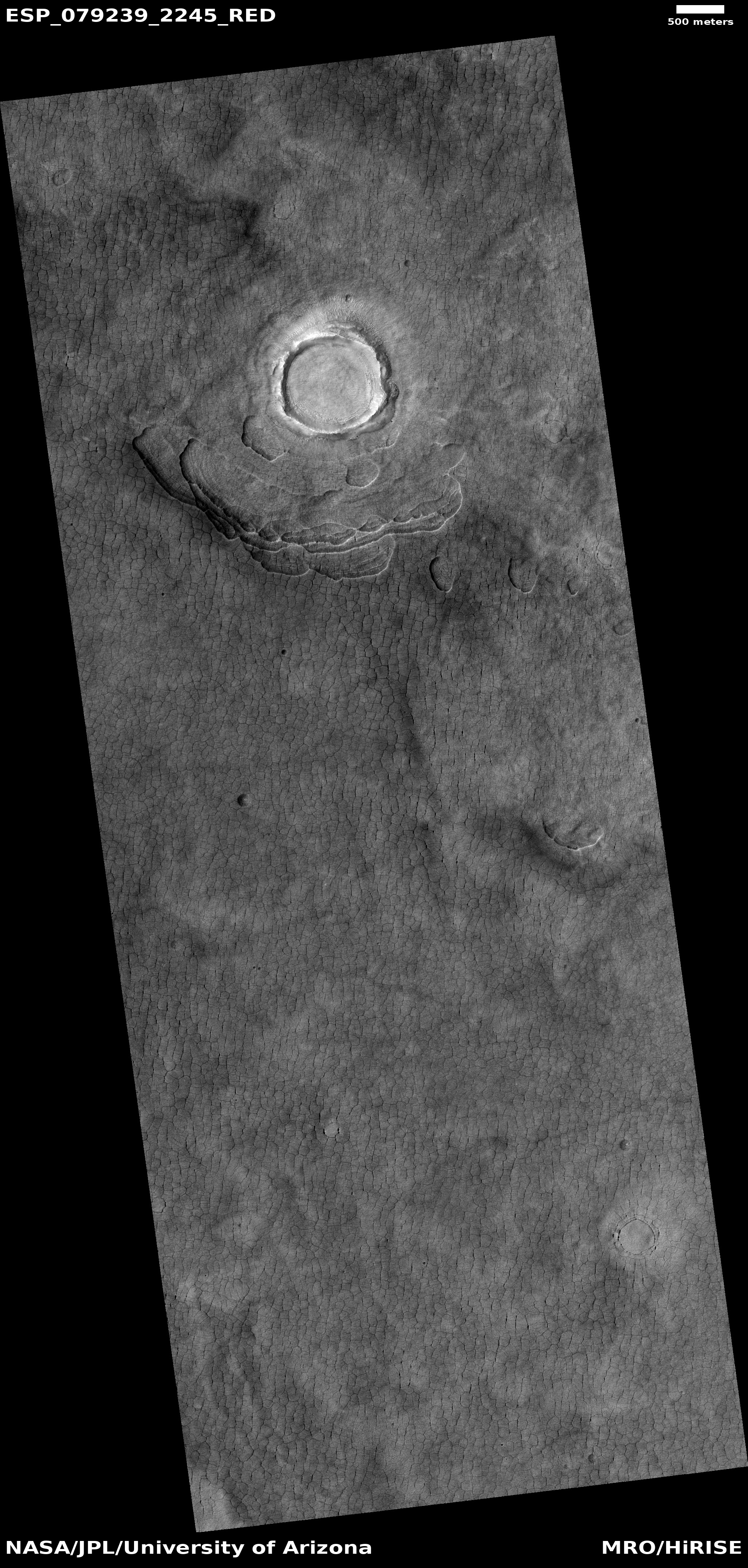
The icy terrain near one of Starship’s prime candidate landing spots on Mars

The icy terrain near Starship's prime landing spot on Mars
Click for original image.

Cool image time! The picture to the right, cropped to post here, was taken on August 22, 2023 by the high resolution camera on Mars Reconnaissance Orbiter (MRO). The camera team labeled the picture a “terrain sample,” which generally means it was not taken as part of any scientist’s specific research request, but to fill a gap in the schedule so as to maintain the camera’s proper temperature. When the team needs to do this, they try to pick a location in the gap that might have some interesting features. Sometimes such pictures show relatively boring features. Sometimes the results are fascinating.

In this case the location chosen was in the northern lowland plains of Mars, in a region called Amazonis Planitia. At 38 degrees north latitude it is not surprising that the photo shows ice features. All the depressions here appear to have an eroding glacier, while the surrounding plateau resembles an untouched snow field in the very early spring, the snow beginning to sublimate away to leave the top rough and stuccoed. Note too that these depressions are likely not impact craters (they have no upraised rims and many are distorted in shape), but were likely formed by that same sublimation process.
» Read more

0 comments

New data better maps the supernova remnant SN1006

SN1006, as seen in X-rays
Click for original image.

Using data from both the Chandra X-ray Observatory and the Imaging X-ray Polarimetry Explorer (IXPE), scientists have now better mapped the magnetic field and the remnant from the supernova that occurred in 1006 AD.

The false color image to the right shows this data. From the caption:

The red, green, and blue elements reflect low, medium, and high energy X-rays, respectively, as detected by Chandra. The IXPE data, which measure the polarization of the X-ray light, is show in purple in the upper left corner, with the addition of lines representing the outward movement of the remnant’s magnetic field.

From the press release:

Researchers say the results demonstrate a connection between the magnetic fields and the remnant’s high-energy particle outflow. The magnetic fields in SN 1006’s shell are somewhat disorganized, per IXPE’s findings, yet still have a preferred orientation. As the shock wave from the original explosion passes through the surrounding gas, the magnetic fields become aligned with the shock wave’s motion. Charged particles are trapped by the magnetic fields around the original point of the blast, where they quickly receive bursts of acceleration. Those speeding high-energy particles, in turn, transfer energy to keep the magnetic fields strong and turbulent.

At present scientists really do not understand the behavior of stellar-sized magnetic fields. It is very complex, involving three dimensional movements that are hard to measure, as well as electromagnetic processes that are not well understood. While this new data doesn’t provide an explanation, it does tell us better what is actually happening. The theories will follow.

1 comment

Australia and the U.S. agree to facilitate rocket launches in Australia

A technology agreement announced on October 25, 2023 between Australia and the U.S. included language that will allow for American rocket companies to launch from Australia, as well as Australian rocket companies to launch American satellites.

According to the White House statement, the agreement…

…provides the legal and technical framework for U.S. commercial space launch vehicles to launch from Australia in a manner that: protects sensitive U.S. launch technology and data in Australia consistent with our shared nonproliferation goals; and creates the potential for new space-related commercial opportunities.

A private Australian spaceport, Equatorial Launch Australia (ELA), has been working to bring U.S. launches there. In addition, an Australian rocket startup, Gilmour Space, wants to launch American payloads. This new government agreement is supposed to facilitate both.

2 comments

Rocket Lab expects to resume Electron launches before end of year

Following September 2023 launch failure of its Electron rocket, Rocket Lab now says it has obtained a launch approval from the FAA, and expects to resume Electron launches before end of year.

In the company’s October 25, 2023 press release, it stated the following:

The FAA, the federal licensing body for U.S. launch vehicles, has now confirmed that Rocket Lab’s launch license remains active, which is the first step to enable launches to resume. Rocket Lab is now finalizing a meticulous review into the anomaly’s root cause, a process that involves working through an extensive fault tree to exhaust all potential causes for the anomaly, as well as completing a comprehensive test campaign to recreate the issue on the ground. The FAA is providing oversight of Rocket Lab’s mishap investigation to ensure Rocket Lab complies with its FAA-approved mishap investigation plan and other regulatory requirements. In addition, the National Transportation Safety Board (NTSB) was granted official observer status to the investigation. The full review is expected to be completed in the coming weeks, with Rocket Lab currently anticipating a return to flight later this quarter with corrective measures in place.

Though the FAA is apparently not trying to slow things down, this release gives us a hint at how the new so-called streamlined regulations established this year are actually making things harder. These regulations force the FAA to get more involved in making sure the company has done all due diligence, something the FAA really isn’t qualified to do. To meet these demands, companies now apparently have to jump through many new hoops to satisfy the new regulations.

2 comments

ABL preparing for second launch attempt of its RS1 rocket

ABL's redesigned rocket launch mount
ABL’s redesigned rocket launch mount

Since its first test launch of its RS1 rocket failed in January 2023, ABL has spent the last ten months doing major revisions of the rocket’s launch mount as well as preparing an upgraded new rocket for a second test launch attempt, expected in the coming months.

This information comes from a long update posted by the company’s CEO, Harry O’Hanley on October 25, 2023.

It appears failure occurred because of a fire at the base of the rocket after liftoff, which in turn was caused by the small size of the rocket’s launch mount.

By analyzing video and data, we formulated a leading theory behind the source of the fire. Our hypothesis centered around the Launch Mount, which is the GS0 assembly that raises and lowers the vehicle. It was designed to fit fully assembled inside a shipping container. While this made transport simple, it resulted in the rocket being held close to the ground.

We believe the compact Launch Mount and proximity of RS1 to the ground restricted the flow of engine exhaust gas. This caused plume recirculation and drove pressures and temperatures beneath the rocket to exceed the RS1 base heat shield design capability. The hot combustion gases breached the aft heat shield and initiated the engine compartment fire. We corroborated this theory with a variety of tests and analyses, including multi-species CFD performed both in-house and by an independent partner.

The graphic to the right, rearranged and annotated to post here, shows the new larger mount. Because of the time it has taken to make that launch mount upgrade, the company also decided to fly its next version of RS1 on this second test launch, rather than the backup rocket from the first launch. This upgraded RS1 has 20% more thrust with a detachable engine section that makes access to it much easier.

O’Hanley made no mention of a specific target launch date from the Kodiak spaceport in Alaska, but his post implies the launch is coming very soon.

0 comments

Further data adds weight to the dust outburst theory for explaining Betelgeuse’s dimming in 2019

Betelqeuse
An optical image of Betelgeuse taken in 2017 by a ground-based
telescope, showing its not unusual aspherical shape.
Click for original image.

Further analysis of the data gathered from Beteleguese during its unusual dimming in 2019 to 2020, has now strengthened the hypothesis that the dimming was caused by an outburst of dust from the star, creating a cloud that temporarily blocked its light.

Although the star as a whole appeared to darken, Betelgeuse’s photosphere seemed to actually brighten during the event. The Université Côte d’Azur astronomers say this observation is consistent with a likely theory, supported by observations, that Betelgeuse dimmed from our view due to a burst of dust, in the form of silicon monoxide, coming from the star. In turn, that burst might be related to a sudden cooling of the star’s surface.

“The changes in the structure of the photosphere and the silicon monoxide are consistent with both the formation of a cold spot on the star’s surface and the ejection of a cloud of dust,” the statement reads.

This new data also suggests that this dimming did not presage the star going supernova, but was simply part of the star’s normal fluctuations. Betelgeuse is essentially a giant gasbag that actually pulses not only in light but in shape. In a sense it behaves exactly like a blob of water floating in weightlessness.

1 comment

Russian astronauts locate coolant leak on spacewalk

Coolant leak on Nauka radiator

In an almost eight hour spacewalk yesterday, two Russian astronauts were able to locate the source of the coolant leak on a radiator unit connected to the new Nauka module on the Russian half of ISS.

The image to the right, a screen capture from the live stream, shows the leak location, where a small white droplet sits on one of the coolant lines that connect two radiator panels. You can also see darkening on the tubes to either side, likely also caused by the leaking ammonia. To locate it ground controllers opened valves to let coolant into the line while the astronauts watched for changes, and were able to see the coolant come out of this spot.

One astronaut also noted the following during the inspection:

[B]efore noticing the growing deposit of liquid coolant, Kononenko reported seeing a myriad of small holes on the surface of the radiator’s panels. “The holes have very even edges, like they’ve been drilled through,” Kononenko radioed to the flight controllers working in Moscow Mission Control. “There are lots of them. They are spread in a chaotic manner.”

In the past year similar coolant leaks have occurred on both a Progress freighter and a Soyuz manned capsule, with the leak location in almost the exact same spot, suggesting an intentional cause, not a random micrometeorite hit. This coolant leak in Nauka is on equipment that was launched to ISS in 2010. If it was also drilled, whoever did it did so a long time ago, which implies Russia has a long standing saboteur within its operations.

This conclusion however remains wild speculation. In the dozen-plus years since launch, this radiator has been stored on the outside of ISS, where it could easily have been hit by micrometeorites that would cause those holes and this leak.

The plan is to consider some repair operation on future spacewalks. In the 1980s the Russians did something similar, with astronauts doing six spacewalks to replace a section of fuel line that was leaking on its Salyut-7 station. They cut open its hull and installed a second section of line so that the valves could remove leaking section from operations.

2 comments
1 33 34 35 36 37 196