September 13, 2023 Zimmerman/Batchelor podcast
Embedded below the fold in two parts.
To listen to all of John Batchelor’s podcasts, go here.
» Read more
Embedded below the fold in two parts.
To listen to all of John Batchelor’s podcasts, go here.
» Read more
An evening pause: Performed live in Japan, around 1986.
Hat tip Judd Clark, who describes this accurately as “appealingly bizarre.” To me it simply shows how Cyndi Lauper had a humble sense of humor.
Courtesy of BtB’s stringer Jay.
I will put up a full post when this tweet is confirmed.
ULA switched the launch to an Atlas-5 because of the delays with Vulcan.
The tweet suggests that this sale, plus the small profits in the last quarter, are the reasons why the stock has dropped in the past week. Longer term however the stock remains higher than the numbers prior to July.
The chart also suggests that Arianespace plans two launches of the older Vega rocket first.
The footage was taken next to a pier, so this was likely not part of a recovery right after launch.

Click for original image.
A new long range model of the Moon’s orbit and rotational tilt now suggests that the permanently shadowed regions (PSRs) in its south polar regions are much younger than previous predicted, which reduces the likely amount of ice that has been preserved there.
The map of the south pole region to the right, reduced, sharpened, and annotated to post here, shows the locations of those shadowed regions, with their predicted ages indicated by the colors (Gyr = billion years). Note that the Nova-C lander, planned for launch in mid-November, will land somewhat near some relatively young PSRs, as indicated by the red cross. From the press release:
“We calculated the lunar spin axis orientation and the extent of PSRs based on recent advances for the time evolution of the Earth-Moon distance,” he said. Early in its history, the Moon (which is 4.5 billion years old) was bombarded by comets and volcanism released water vapor from its interior, but continuously shadowed areas started to appear only 3.4 billion years ago. By that time these processes had started to die down, so most of the water that was delivered to the Moon or outgassed from its interior could not have been trapped in the polar regions. Any ice in the polar regions today must have a more recent origin.
“We have been able to quantify how young the lunar PSRs really are,” Schorghofer said. “The average age of PSRs is 1.8 billion years, at most. There are no ancient reservoirs of water ice on the Moon.”
Since other data suggests the presence of ice, it is possible that these reserves are regularly renewed by the arrival of impacts. It also suggests however that there might be less ice available than hoped. Above all, the red colored regions appear to be the most valuable real estate to explore first.
Note: The landing sites for both India’s Vikram lander and Russia’s Luna-25 lander were well beyond the map’s upper right edge, far outside the region where any permanently shadowed craters are located. The news outlets that talked about finding water or ice on either mission were simply illustrating their ignorance and sloppy reporting.

Emily Drabinski, president of the ALA and proudly
Marxist and queer
Bring a gun to a knife fight: Back in July I reported how the library commission of Montana had decided to withdraw its support from and membership in the American Library Association (ALA), not only because of the Marxist agenda being pushed by its new president, Emily Drabinski, but because of the ALA’s aggressive effort to insert pornography in school libraries.
At the time I wrote this:
[I]f more local library organizations followed through as Montana has, the ALA might finally feel the pinch and rethink its policies. Or if it didn’t, it would justify these libraries leaving its fold, as it does not represent them.
Since then there has been a rising flood of other states moving to break free from the ALA. In July, almost immediately after the decision in Montana, the secretary of state of Missouri, who oversees the Missouri State library, withdrew from the ALA, citing the organization’s public effort — pushed under Drabinski’s leadership — to block a “faith-based publisher from holding story hours in libraries.”
» Read more

Click for original image.
Cool image time! The picture to the right, cropped, reduced, and sharpened to post here, was taken on June 26, 2023 by the high resolution camera on Mars Reconnaissance Orbiter (MRO). The science team calls the features surrounding these small 20 to 60 foot high hills “polygon features,” an apt description and a geological feature that is seen in many places on Mars.
When these features are found in the icy higher latitudes, it is believed they are formed in connection to the freeze-thaw cycle that causes cracks in the near surface ice. When found in the dry equatorial regions, where these polygons are located, they are usually thought to be ancient evidence of past standing water that left behind these cracks, much like the cracks seen in mud after the water has evaporated away on Earth.
The formation of these tiny hills is a bit more complex.
» Read more
Click for original image.
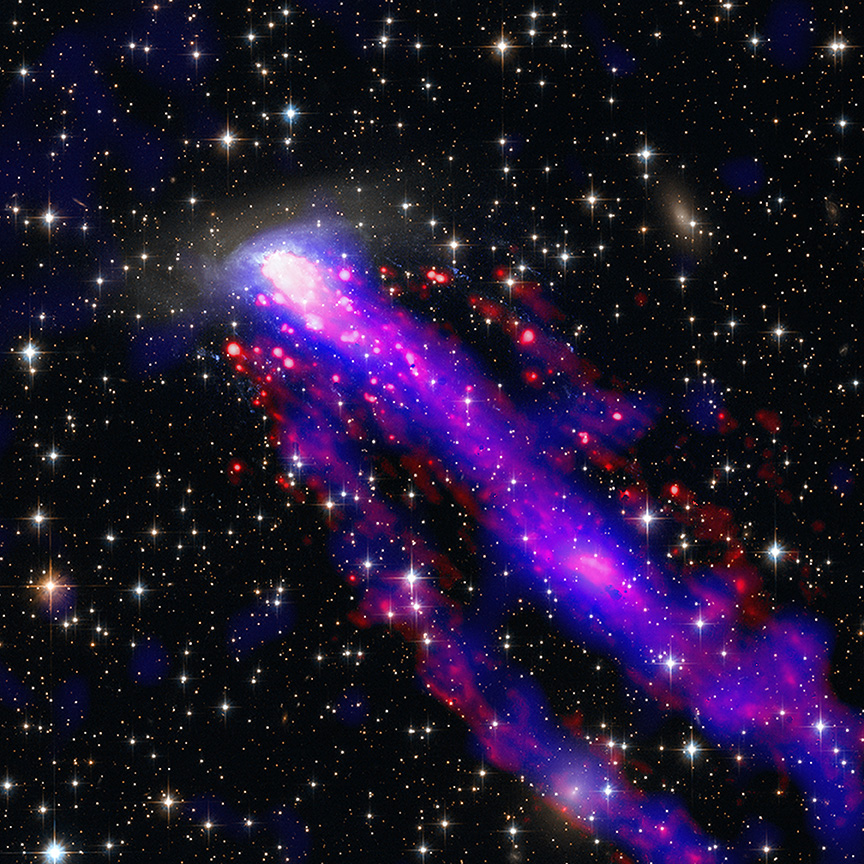
The science team for the Chandra X-Ray observatory today released five new composite images of two galaxies, two supernovae remnants, and the center of the Milky Way, combining data from multiple telescopes looking in radio, infrared, optical, and X-ray wavelengths.
The image to the right, reduced and sharpened to post here, is one of those pictures. From the press release:
As the galaxy moves through space at 1.5 million miles per hour, it leaves not one — but two — tails behind it. These tails trailing after ESO 137-001 are made of superheated gas that Chandra detects in X-rays (blue). ESO’s Very Large Telescope shows light from hydrogen atoms (red), which have been added to the image along with optical and infrared data from Hubble (orange and cyan).
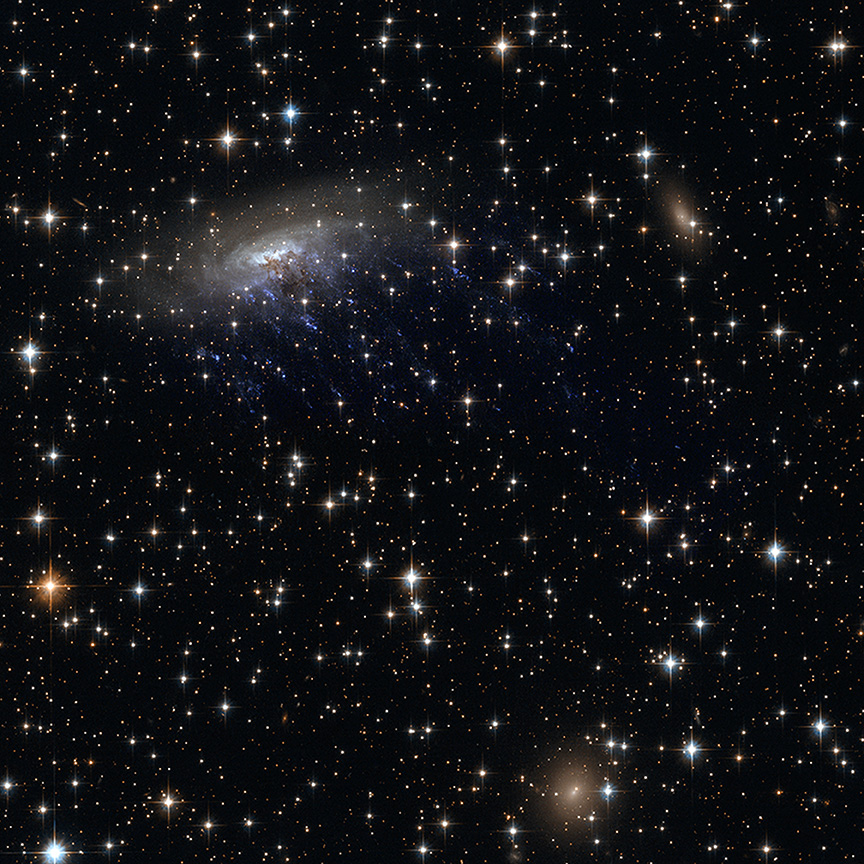
The inset shows just the Hubble optical image, reduced by about 50%, to get a clearer sense of the galaxy itself. It appears to be a jelly-fish galaxy, flying through space at right angles to its plane and with tendrils of stars trailing off below.
The other four images are as interesting. The full set, including separate images in the individual wavelengths prior to combination, can be found here.
Link here. This excellent article is focused on whether these three new rockets, none of which has yet completed its first test flight, will be able to meet their launch contract obligations with Amazon, which needs to launch at least 1,600 satellites of its Kuiper broadband constellation by July 2026 to meet its FCC license requirements. Those requirements also obligate Amazon to have the full constellation of about 3,200 satellites in orbit by July 2029.
The launch contracts to these three untried rockets was the largest such contract ever issued, involving 83 launches and billions of dollars.
To sum up where things stand in terms of the first test launch of each rocket:
» Read more
More than five months after completing its mishap investigation of the New Shepard launch failure one year ago, Blue Origin’s suborbital spacecraft remains grounded, with no clear indication when it will fly again.
In March, Blue Origin announced the results of its anomaly investigation: The nozzle on the first stage’s single BE-3PM engine suffered a “thermo-structural failure,” which caused a thrust misalignment and brought the mission to a premature end.
In its March 24 announcement, Blue Origin said that it had begun implementing some corrective actions, “including design changes to the combustion chamber and operating parameters, which have reduced engine nozzle bulk and hot-streak temperatures.” The company also stressed that it expected to return to flight “soon,” with a re-launch of those same 36 research payloads.
Almost six months later, that “soon” has translated into “someday.” It seems the slow pace of everything Blue Origin does has now taken over its one successful operational product. It has released no information about a new flight schedule, or even the present status of the spacecraft.
The result? Even though Blue Origin was flying commercial suborbital flights regularly about two years earlier that Virgin Galactic, the latter company has now completed more flights. This slow pace is not how a commercial company driven to earn profits and compete successfully operates. In the end it drives away customers, while ceding market share to competitors.
Click for original image.
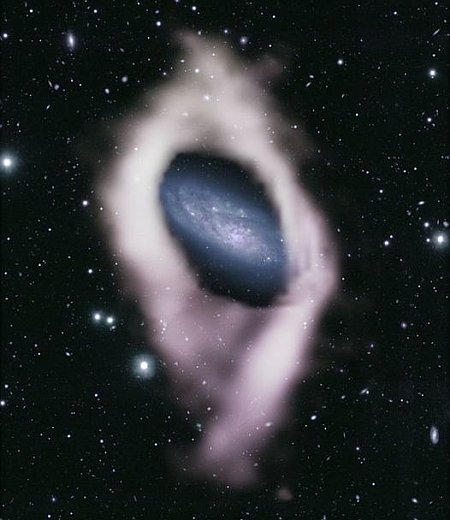
Using a combination of optical and radio telescopes as well as computer modeling, astronomers think they have identifed polar rings of gas orbiting two different galaxies, adding these to the relatively small population of known polar-ring galaxies.
Polar ring galaxies are unique in that they have an outer ring of gas and stars circling the galaxy at right angles to its plane. A composite image of one of these new galaxies is to the right, cropped, reduced and sharpened to post here. From the press release:
Jayanne English, a member of the WALLABY research team and also an expert in astronomy image-making at the University of Manitoba, developed the first images of these gaseous polar ring galaxies using a combination of optical and radio data from the different telescopes. First, optical and infrared data from the Subaru telescope in Hawaii provided the image for the spiral disk of the galaxy. Then, the gaseous ring was added based on data obtained from the WALLABY survey, an international project using CSIRO’s ASKAP radio telescope to detect atomic hydrogen emission from about half a million galaxies.
The creation of this and other astronomical images are all composite because they include information that our eyes can’t capture. In this particular case, the cold hydrogen gas component, invisible to the human eye, is seen in radio “light” using CSIRO’s ASKAP. The subtle colour gradient of this ring represents the orbital motions of the gas, with purple-ish tints at the bottom tracing gas that moves towards the viewer while the top portion moves away. The emission from the ring was separated from the radio emission emanating from the disk of the galaxy using virtual reality tools, in collaboration with Professor Tom Jarrett (University of Cape Town, South Africa).
As the abstract of the research paper notes, the computer models used “show that the data are consistent with PRGs [polar-ring galaxies] but do not definitively prove that the galaxies are PRGs.” There is much uncertainty, as it is difficult to determine the orientation of some rings relative to their galaxy’s plane.
Nonetheless, these result suggest polar ring galaxies might be more common, and thus might help refine the theories of galaxy formation and merger.
SpaceX’s Starlink constellation and SES’s satellites in higher orbits are forming a partnership to provide cruise ships better global coverage for broadband.
The SES Cruise mPowered + Starlink service would mostly use SpaceX’s low Earth orbit network (LEO) and satellites in medium Earth orbit (MEO) from SES. In northern and southern regions, apart from the poles where there is no service, SES vice president of product management for maritime products Gregory Martin said their joint offering would leverage its geostationary satellites.
SES would sell and manage the multi-orbit service when it becomes operational later this year and SpaceX would get a cut of the sales, Martin told SpaceNews in an interview.
It appears by partnering their services, the two companies make the deal better for cruise companies.
The uncertainty of science: Using a computer program developed in 2018 that can predict with accuracy the orbits of more than three interacting objects, scientists have found that the orbits of the 27 nearest stars orbiting the Milky Way’s central black hole, Sagittarius A* (pronounced A-star) are impossible to predict after only a very short time.
“Already after 462 years, we cannot predict the orbits with confidence. That is astonishingly short,” says astronomer Simon Portegies Zwart (Leiden University, the Netherlands). He compares it to our solar system, which is no longer predictable with confidence after 12 million years. “So, the vicinity of the black hole is 30,000 times more chaotic than ours, and we didn’t expect that at all. Of course, the solar system is about 20,000 times smaller, contains millions of times less mass, and has only eight relatively light objects instead of 27 massive ones, but, if you had asked me beforehand, that shouldn’t have mattered so much.”
According to the researchers, the chaos emerges each time in roughly the same way. There are always two or three stars that approach each other closely. This causes a mutual pushing and pulling among the stars. This in turn leads to slightly different stellar orbits. The black hole around which those stars orbit is then slightly pushed away, which in turn is felt by all the stars. In this way, a small interaction between two stars affects all 27 stars in the central cluster. [emphasis mine]
To my mind, the quote by the scientist above should be considered the most absurd statement by a scientist ever spoken, except that nowadays scientists make such idiotic statements all the time. To think that such different conditions wouldn’t produce different results suggests a hubris that is astonishing for a person supposedly trained in the scientific method.
Regardless, these results suggest that acquiring an understanding of the dynamics that created these stars is going to be very difficult, if not impossible. The conditions change so rapidly, and in an unpredictable manner, that any theory proposed will be simply guessing.
An evening pause: For those familiar with the 1960s British television show, Danger Man (which in the U.S. was titled Secret Agent) starring Patrick McGoohan (more famous for the later spy series The Prisoner), this music will be very familiar. It was written by Edwin Astley, was the theme music for the second iteration of the British release. In the American release it was used as background music throughout the show. You can watch the entire series here. It has what I call muscle, and is well worth your time.
Hat tip Wayne DeVette.
Courtesy of BtB’s stringer Jay.
This is Firefly’s third contract in connection with NASA’s lunar projects, totaling almost $230 million.
You need to turn on closed captions with translation set to English. Not much information, being a standard shallow TV interview, though she does make clear the irony that a European space company has to go to an American space company to get business.
The mission will go to ISS, ferried there by SpaceX.
This kind of blather really means little, as they can say anything when asked. It is what the Air Force actually does down the road that matters. However, the article at the link seems written so as to gin up friction between SpaceX and the Air Force.
The company’s goal is to build a completely reusable upper stage using its radical rocket design of small nozzles set in a ring around the outside of the spacecraft.

Isaac Yoder at the Capitol, dressed as George Washington
They’re coming for you next: When Isaac Yoder put on his home-made costume of George Washington and went to the demonstrations on January 6, 2021, he was doing what he had been doing for years, making his statement about the roots of American liberty and free speech at many different protests. His goal wasn’t solely to protest the election of Joe Biden. He was there as much to remind everyone where our freedoms came from, “to honor the memory and legacy” of our Founding Fathers.
The Biden Department of Justice however didn’t like this innocent expression of free speech. It arrested Yoder, and has gotten him sentenced to a one year prison term for “Parading, Demonstrating, or Picketing in a Capitol Building,” actions that the First Amendment to the Constitution expressly permits, and in fact outlaws our federal government from prohibiting.
A Missouri man walked into the U.S. Capitol on January 6, 2021, dressed as George Washington. He caused no damage, engaged in no violence, and was even recorded peacefully speaking with police before leaving. For daring to dress as America’s pre-eminent Founding Father and symbolically rebuking our corrupt ruling class, Isaac Yoder was surveilled for seven months, eventually arrested, fined, and sentenced to a year in prison.
When Yoder arrived, the worst protests had ended, and the Capitol police had already opened the doors and were letting people quietly walk through the building. But he was part of a protest against Joe Biden, the Washington ruling class, and its control of the Federal government, and that could not be allowed, even though he was dressed as George Washington.
» Read more

For original images, go here and here.
Time for two cool images, this time from both of the American rovers on Mars.
The left picture above was taken on September 9, 2023 by the high resolution mast camera on Curiosity. It shows what appears to be a many-layered but rounded rock which appears typical of the many boulders that cover the terrain through which Curiosity is presently traveling. In the past the layered rocks that Curiosity has observed lower on the flanks of Mount Sharp have not been rounded. Instead, the delicate layers have often extended outward at the rock’s edges, almost like paper or threads. For some reason, the layers in the rocks here have been eroded smooth, suggesting they were once covered by flowing water or ice, able to round the rough edges in a way that Mars’ thin atmosphere can’t.
What is puzzling is the location, higher on Mount Sharp. One would expect the reverse, with such erosion more typical lower on the mountain and uneroded delicate layers more common higher on the mountain.
The right picture above was taken on September 8, 2023 by one of the high resolution mast cameras on the rover Perseverance in Jezero Crater, about 5,000 miles to west of Curiosity. It shows a rock whose shape is so strange it is hard to fathom a geological process that would result in this form. Possibly the rock was a surface layer on a larger round boulder, and the normal freeze-thaw cycle of Mars caused it crack off as one piece. The lump in the middle however makes this explanation questionable.
Also puzzling is the curved shape. On Mars almost no geological layers have been found that are curved. They are generally flat and horizontal, reflecting the lack of tectonic processes that on Earth often twist and squash layers.

Click for interactive map.
Ingenuity yesterday successfully completed its 58th flight on Mars, flying 571 feet to the northwest for 107 seconds at a height of 33 feet.
The overview map above shows with the green line the approximate route of the helicopter. Though the Ingenuity engineering team has updated the flight log (at the link above), the route has not yet been added to the Perseverance interactive map. I am guessing at that route based upon the flight plan posted on September 7, 2023, which stated the rover would head northwest as well as image science targets. That suggests it was flown above Perseverance’s planned route, as indicated by the red dotted line.
This particular flight was different than recent flights, which have generally lasted slightly longer and covered a slightly longer distance, probably so the helicopter could find a safe landing spot. This time Ingenuity landed about 23 seconds early, though the distance traveled was still slightly longer. The difference once again was almost certainly caused by the helicopter’s software picking a good landing spot. It just got above its planned landing spot sooner than expected, found a good pad, and then landed.
The blue dot marks Perseverance’s present location. It is presently moving west to reach what the scientists consider an important geological contact between two layers.
Scientists reviewing the archive seismic data produced by the seismometers placed on the Moon by the Apollo missions have discovered that repeating small moonquakes in that data were actually caused by base of Apollo 17’s Lunar Module (LM) that provided a launchpad for the part of the LM that lifted the astronauts off the Moon.
Triangulating the origin of the mystery quakes, researchers surprisingly realized they came from the Apollo 17 lunar lander base, which expands and vibrates each morning as it becomes heated by the sun.
“Every lunar morning when the sun hits the lander, it starts popping off,” Allen Husker, a Caltech research professor of geophysics who worked on the project, said in a statement. “Every five to six minutes another one, over a period of five to seven Earth hours. They were incredibly regular and repeating.”
That the extreme range of temperatures experienced by the LM could cause detectable quakes as the LM base expanded suggests strongly how difficult it is for a spacecraft to survive the lunar night lasting 14 Earth days. For all we know, that base has now literally fallen apart due to these stresses. This in turn suggests it is highly unlikely that India’s Pragyan rover will come back to life when the sun rises on September 22, 2023.

The asteroid probe Lucy has obtained its first images of Dinkinesh, the first of the ten asteroids the spacecraft is hoping to visit during its twelve year voyage to the Trojan asteroids.
The image to the left shows the motion of that asteroid over a two day period when Lucy was getting the pictures.
Lucy took these images while it was 14 million miles (23 million km) away from the asteroid, which is only about a half-mile wide (1 km). Over the next two months, Lucy will continue toward Dinkinesh until its closest approach of 265 miles (425 km) on Nov. 1, 2023. The Lucy team will use this encounter as an opportunity to test out spacecraft systems and procedures, focusing on the spacecraft’s terminal tracking system, designed to keep the asteroid within the instruments’ fields of view as the spacecraft flies by at 10,000 mph (4.5 km/s). Lucy will continue to image the asteroid over the next months as part of its optical navigation program, which uses the asteroid’s apparent position against the star background to determine the relative position of Lucy and Dinkinesh to ensure an accurate flyby. Dinkinesh will remain an unresolved point of light during the long approach and won’t start to show surface detail until the day of the encounter.
Lucy’s primary targets are asteroids in the two Trojan groups that orbit the Sun in the two Lagrange points in same orbit as Jupiter, fore and aft of the gas giant by 60 degrees. For a map of Lucy’s full mission profile, go here.
Though Frank Rubio was only supposed to do a six month mission, a leak on the Soyuz capsule that brought him and his two crewmates into space has resulted in all three doing a mission exceeding one year, and setting a new record for an American in space.
Today Rubio broke the old American record of 355 days, set by Mark Vande Hei in 2022. When they return on September 27, 2023, all three will have spent 371 days in space, the third longest manned mission in history, exceeded only by Sergei Avdeyev’s 381 in 1999 and Valeri Polyakov’s 437 in 1994-1995, both on Russia’s Mir space station.
Based on my interviews with Polyakov and Musa Manarov (who was on the first mission with Vladimir Titov to spend one year in space — 366 days total — in 1988) for my book Leaving Earth, it will take Rubio about one year to fully recover from this mission, though he will likely be able to function almost normally within a month or so.
It remains interesting that these American records set by Rubio and Vande Hei occurred because of decisions by the Russians, not the American space agency NASA. NASA has consistently resisted doing long missions on ISS, even though this is exactly the kind of medical research required if we are to send humans on multi-year missions to Mars and beyond. Even more embarrassing, the longest NASA planned mission, flying Scott Kelly for 340 days, was touted by NASA as a year-long mission, even though it was never going to and did not achieve that distinction.
In doing this research the Russians have always led, and appear to continue to do so on ISS.