Another look at the vastness of Valles Marineris on Mars

The vast Valles Marineris
Click for interactive map.

This week I have returned several times to the giant Valles Marineris canyon on Mars in an attempt to capture its incomprehensible and glorious scale. Without question this canyon is going to become one of the prime tourist spots when humans begin living and working throughout the solar system. Fortunately, its vast size will mean that it will take many many centuries before it even becomes close to crowded there.

Today I try a different approach, using the global mosaic created by scientists at Caltech from the context camera images taken by Mar Reconnaissance Orbiter (MRO). That mosaic processes the images to allow one to see the surface from an oblique angle. The picture to the right covers one small part of the eastern end of Valles Marineris (the white rectangle in the inset), but though small the scale once again is gigantic.

The three white dots are our reference points, one on the north rim, one on the south, and one in the middle on the peak of that central mountain chain. Beginning from the south, the distance from the rim to the middle mountain peak is 43 miles, with the elevation dropping almost 13,000 feet to the floor of the south canyon, than rising almost 10,000 feet to the middle peak. The northern canyon is smaller. From the peak to the north rim is 27 miles, dropping about 9,300 feet and then rising about 8,500 feet to the north rim.

From rim to rim the distance is about 70 miles. Since the middle mountain chain about 18 miles wide, it fills only about 25% of the entire canyon.

In every case, the Grand Canyon would be merely be a small side canyon here. The depths are twice as deep, and the distances are many times larger. In width alone at this point Valles Marineris is seven times wider than the widest part of the Grand Canyon, and this is by far not Valles Marineris’s widest point.
» Read more

0 comments

NASA survives first budget review in Congress

The first 2024 budgets approved by Senate and House appropriation committees for NASA maintain about the same current numbers from NASA’s 2023 budget.

The House committee is recommending $25.367 billion, just shy of the $25.384 billion NASA has now. The Senate committee is proposing $25.000 billion, a greater reduction from current spending. Biden requested a 7.1 percent increase for FY2024, $27.2 billion.

In the House the Republican leadership is requiring this House committee to impose a 28.8% cut in the total money allocated to all the agencies under its control (Justice, Commerce, and Science). It appears the committee members have decided to find the cuts in the other departments, such as the Justice Department. In fact, this first budget review strongly suggests Justice is about to see huge cuts, something that corrupt and partisan agency richly deserves.

As for NASA, the Senate report [pdf] had harsh words for the growing expense of the Mars Sample Return mission, and proposed major cuts, including the possibility of eliminating the project entirely. Instead, the Senate committee preferred wasting that money on Artemis and SLS.

1 comment

UK government reluctantly admits its space regulatory framework is a problem

According to a report issued by a committee formed by a number of members of the United Kingdom’s parliament, the regulatory licensing framework for its space launch industry is a problem that needs fixing, and in a hurry.

The report also expressed concern about the licensing delays that led to the Virgin Orbit launch being postponed. Virgin Orbit and some of its satellite customers were critical of the UK regulatory process, which was led by the Civil Aviation Authority.

But the committee concluded there was no evidence that the regulatory system contributed to the failure of the Virgin Orbit. The report did state, however, that there is “insufficient co-ordination between the large number of regulatory bodies involved in licensing launches, and this continues to place unnecessary burdens of complexity and administration on companies”.

The MPs [members of parliament] are calling on the Government to take steps to improve the licensing system of UK satellite launch.

It is amusing how these politicians speak from both sides of their mouths. First they say the regulatory system did not contribute to Virgin Orbit’s failure, but then admit the regulatory system is so complex and messy that anyone can see that it certainly did contribute to that failure. It took that system fifteen months to approve the launch, even though Virgin Orbit expected that approval to come in half that time.

Whether this MP report will force action remains unclear. As I noted earlier this week, Orbex applied for a launch license seventeen months ago for a launch it hopes to complete at the Sutherland Spaceport before the end of this year, and it is as yet unclear if any license has been issued. The UK’s two spaceports cannot compete if it is going to take one to two years for each launch license to be approved

3 comments

Rocket Lab gets two-launch deal with Japanese satellite company

Rocket Lab today announced that it has signed a two-launch deal with the Japanese satellite company Synspective, bringing to six total the number of Synspective satellites its Electron rocket will place in orbit.

Rocket Lab has been launching for Synspective since 2020 when the Company deployed the first satellite in Synspective’s synthetic aperture radar (SAR) constellation, which is designed to deliver imagery that can detect millimetre-level changes to the Earth’s surface from space. Since that first mission, Rocket Lab has been the sole launch provider for Synspective’s StriX constellation to date, successfully deploying three StriX satellites across three dedicated Electron launches. Including the two new missions, Rocket Lab is now scheduled to launch three missions for Synspective beginning in late 2023 from Launch Complex 1 in New Zealand.

This deal illustrates Rocket Lab’s continuing strong position in the launch market, while simultaneously illustrating the lack of any Japanese presence. Japanese Synspective might prefer to work with a Japanese rocket, but none exists that can compete with Rocket Lab.

0 comments

ULA officially admits first Vulcan launch is delayed to end of year

Though the announcement was not news or unexpected, ULA’s CEO Tory Bruno yesterday officially confirmed that the first Vulcan launch will not occur before the fourth quarter of this year, not this summer as hoped.

In a call with reporters July 13, Tory Bruno, president and chief executive of ULA, said the changes to the Centaur upper stage stemmed from an investigation into a test mishap in March, where hydrogen leaked from a Centaur test article and ignited, damaging both the stage and the test rig. The company announced June 24 that it would delay the launch to make “minor reinforcements” to the Centaur.

Bruno also poo-pooed the significance of a failure of a Blue Origin BE-4 engine during a static fire test in mid-June, a failure that had been kept secret until this week.

“This doesn’t indict the qualification at all,” he said, noting that BE-4 engines have more than 26,000 seconds of cumulative runtime. “We’re very confident in the design and the workmanship of the assets that have passed acceptance. This is not unexpected.”

Forgive me if I don’t take him entirely at his word. I guarantee his engineers are looking at that failure very closely to make absolutely sure it doesn’t indicate issues with the two engines on that first Vulcan rocket. It is very likely this is part of the reason that first launch is now delayed until the end of the year.

3 comments

Solid-fueled second-stage motor for Japan’s new Epsilon-S rocket explodes during static fire test

A solid-fueled second stage of Japan’s upgraded Epsilon-S four-stage rocket exploded 57 seconds into a two minute static fire test today, likely preventing that rocket’s planned first launch this year.

Police received an emergency call shortly after 9 a.m. from a nearby resident reporting that she heard “a loud noise and saw smoke” rising from the Noshiro Rocket Testing Center.

JAXA said that an explosion occurred during a combustion test of the second-stage engine of the Epsilon S rocket, which is an improved model of the small solid-fuel Epsilon rocket, at the facility in the prefecture in the northeastern Tohoku region.

While explosions during static fire tests of liquid-fueled rockets occur periodically, for a solid-fueled motor to explode seems much rarer, and suggests the mix and placement of the solid-fuel within the stage did not occur properly.

This failure continues a string of failures within Japan’s government-run space program, including a failure during the first launch of its new large H3 liquid-fueled rocket earlier this year. At present Japan’s space agency JAXA has set August 26th for one of the last launches of the rocket the H3 is replacing, the H2A, carrying an X-ray space telescope and a small lunar lander. Though today’s failure involves very different technologies and should therefore not impact that launch, it is possible JAXA will stand down entirely to see if there was some systematic issue throughout its management. It sure appears there is.

0 comments

India successfully launches Chandrayaan-3


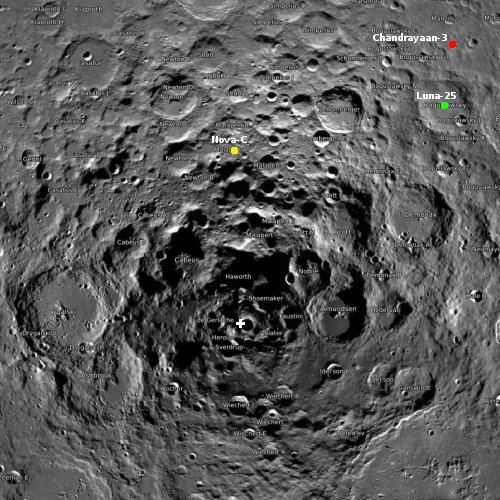
Click for interactive map.

India today successfully launched its Chandrayaan-3 lunar lander/rover probe toward the Moon, carried aloft by its LV-M3 rocket (a variation of its GSLV) from its coastal spaceport in Sriharikota.

Chandrayaan-3 carries the Vikram lander, which will bring the Pragyan rover to the surface. Pragyan will spend about two weeks operating on the lunar surface. The location is indicated by the red dot on the map to the right, in the high southern latitudes. The white cross marks the lunar south pole. Russia’s Luna-25 is scheduled to launch sometime in mid-August.

It will take time to get Chandrayaan-3 into the right lunar orbit for landing, which is presently scheduled for August 13, 2023.

For India this was its fifth successful launch for the year, the most since 2019, before it panicked over COVID. The leaders in the 2023 launch race:

46 SpaceX
26 China
9 Russia
5 Rocket Lab
5 India

American private enterprise still leads China in successful launches 52 to 26, and the entire world combined 52 to 45, while SpaceX by itself still leads the rest of the world (excluding other American companies) 46 to 45.

1 comment

Repost: Freedom is under siege, and the besiegers have now told us they have no mercy

Earlier today I posted a news item about the failure theater of Texas Republican Senator Ted Cruz making a motion to “favorably” report the Biden administration’s FCC nominations for a full vote in the Senate, even as Cruz at the same time stated he was against their nomination. This absurd lack of real fight now prompts me to add this quick comment, and a repost of a January 2022 essay.

In that essay I quoted the words that open each volume of Winston Churchill’s memoirs of World War II:

In War: Resolution
In Defeat: Defiance
In Victory: Magnanimity
In Peace: Good Will

Cruz’s actions are typical of our conservative leadership for decades. They are good at magnanimity and good will, but know nothing of resolution or defiance. To them, there is no war, and defeat is really just another word for victory.

We are in a war however, and we have been losing that war now for more than a century. We have reached a point where a sizeable part of the American population thinks it is okay to imprison its opponents, even as it firmly supports censorship and blacklisting.

Fortunately, more and more Americans recognize this, and are no longer easily fooled by Republican failure theater. As a reminder to help strengthen that resolve and to remind the fence-sitters of the real war we are in, a war that now requires resolution and defiance by all who value freedom, the Constitution, the Bill of Rights, and the rule of law, I give you my January 2022 essay, which outlined starkly what the other side wants:

————————-
Freedom is under siege, and the besiegers have now told us they have no mercy

Liberty under siege
Liberty under siege.

For many years I deeply and sincerely believed that many rank-and-file Democrat voters honestly did not know how corrupt and power-hungry the political leaders of their party had become. I thought that if I could simply get them to see the clear evidence of misbehavior and abuse of power that has been going on in the Democratic Party without check since Bill Clinton was president, they would reconsider their voting habits and abandon their support of that party.

I thought that the vast majority of Democrats were decent people who opposed oppression and intolerance and simply were unaware that they were voting for it when they supported the Democratic Party.

I now know unequivocally that I was wrong. Two stories in the past week illustrate bluntly that a large number of ordinary Democrats, maybe even a majority, are eager supporters of oppression and intolerance and dictatorship. They like the corruption and abuse-of-power coming from Democratic Party politicians. They even want more of it.
» Read more

13 comments

July 13, 2023 Quick space links

Courtesy of BtB’s stringer Jay.

  • ULA’s CEO says Blue Origin is manufacturing two BE-4 engines per quarter
  • 8 engines a year, eh? New Glenn requires seven to launch. ULA will need two for each Vulcan launch. I don’t see this working as planned. If true ULA has a serious problem, and New Glenn will not fly for years.

    Jay adds this link for comparison: SpaceX produces one Raptor-2 engine every two days, and was previously manufacturing 400 Merlin engines per year (before the reuse of the Falcon 9 first stage reduced the need for so many engines).


13 comments

Enthusiastic censorship and blacklisting at St. Philip’s College in Texas

St. Philip's College, home to blacklisting and censorship
St. Philip’s College, the poster child of academic
blacklisting and censorship

They’re coming for you next: The university was conceived as a place of where young minds would be exposed to new ideas in order to challenge their youthful assumptions and unbridled certainty, with the determined goal to teach critical thinking. (For those who no longer know what critical thinking is, it is the concept that you question everything rigorously, including most importantly your own assumptions.)

It seems most American colleges no longer practice this. In fact, many now teach the exact opposite. Faced with ideas you don’t like, students are encouraged to complain, and hide in “safe spaces” so they don’t have to question anything.

It also appears that St. Philip’s College in Texas is the poster child of this new “teaching” concept. This semester it fired two different teachers when several anonymous students complained because those professors expressed some basic facts in their classrooms that conflict with the modern queer agenda and the leftist hostility to open debate.

First, Dr. Johnson Varkey was fired in January 2023 because he had the audacity during a November 2022 human anatomy and physiology class to state that human sex is determined by the X and Y chromosomes, a basic fact of biology.

Four students walked out of that class in protest, and then complained to the administration. Within weeks it terminated Varkey, with no due process. In its termination letter [pdf] (part of the response by Varkey’s attorney’s at the non-profit legal firm First Liberty), it claimed
» Read more

3 comments

A Martian gully formed by disappearing glacial ice?

Puzzling Martian gully
Click for original image.

Cool image time! The picture to the right, cropped and reduced to post here, was taken on April 30, 2023 by the high resolution camera on Mars Reconnaissance Orbiter (MRO). It shows the rim of a seventeen-mile wide crater, and was the scientists label a “gully without apron,” meaning that though something has caused material to disappear within that gully, beginning high on the rim wall, there does not appear to be any piled up apron or debris at the gully’s base.

The blue colors imply the possibility of frost within the gully, while the orange suggests dust or coarse surface material.

The cracks emanating away at right angles from the gully’s base suggest glacial ice, which makes sense based on the location.
» Read more

0 comments
1 92 93 94 95 96 196