November 20, 2025 Quick space links

Courtesy of BtB’s stringer Jay. This post is also an open thread. I welcome my readers to post any comments or additional links relating to any space issues, even if unrelated to the links below.

5 comments

Cracks on Mars

A cracking Martian surface

Cool image time! The picture to the right, cropped, reduced, and sharpened to post here, was taken on September 20, 2025 by the high resolution camera on Mars Reconnaissance Orbiter (MRO).

The camera team describes these features as “ridges,” which in one sense is entirely true. The features are ridges that rise above the surrounding plain. The problem is that they are also cracks, with most showing a distinct central fissure in their middle.

Such double ridged cracks are reminiscent of the surface of dried mud or paint, when it begins to crack and shrink. The surface on each side of a crack pulls away, rising upward slightly as it does so. Is that what we are seeing here, the drying of this surface?

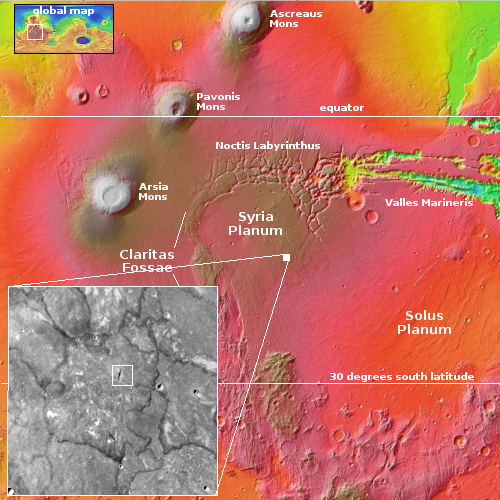
As always, location is critical to understanding the Martian geology.
» Read more

0 comments

The DC swamp proposes beating China in space by creating another bureaucracy here on Earth

Gotta feed those DC pigs!

My heart be still: A bi-partisan group of senators, led by Senator John Cornyn (R-Texas), yesterday introduced legislation they claim will help the U.S. beat China in space by creating a new government agency called the “National Institute for Space Research,” designed to encourage research in space tied to the proposed commercial space stations.

Reports indicate that China is launching new modules to its Tiangong space station to meet growing demands for science and to boost international cooperation and is developing a new-generation crew spacecraft with two variants: one for low Earth orbit (LEO) and one for crewed lunar missions. China has been actively promoting international cooperation through Tiangong, offering countries like Oman, Egypt, Pakistan, and others opportunities to participate in space research largely for free or at an extremely low cost. China has also offered to train foreign astronauts, garnering interest from countries like Saudi Arabia, Pakistan, and the UAE to train engineers, scientists, and mission operators for satellite development, and to launch services in which Egypt, Algeria, and Argentina are actively involved. This is a part of China’s broader Belt and Road Initiative, where space cooperation is bundled with tech transfer, loans, development projects, and the like.

This underscores strategic and accelerating investment by foreign adversaries in space-based infrastructure, research, and exploration. China’s ability to offer space-based partnerships to other nations allows it to build soft power and potentially shift international norms in space governance and tech standards.

In response, the Space RACE Act would create a National Institute for Space Research, a federally controlled but independently operated entity designed to coordinate and advance U.S. microgravity research in LEO using next-generation space platforms after the retirement of the ISS.

The last thing this bill will achieve is a stronger American space industry. Rather than funding real research or development in space, this legislation simply creates another Washington government agency supposedly functioning independent of presidential or even congressional oversight (a legal structure the courts have increasingly declared unconstitutional).

This is just more pork. It is also symbolic of the stupidity of our elected officials, who still do not really understand the real reasons beyond the on-going renaissance in America’s space effort. It hasn’t been the government that made it happen. It has been the private dreams of competing companies and individuals, figuring out ways they could make money launching rockets, often with the government acting as a major obstacle. Rather than streamline our bloated government to get it out of the way of this new private sector, these senators want to create more government to dictate how that sector functions.

Ugh. There are times I wish I didn’t have to read the news from DC. It almost always depresses me.

25 comments

Blue Origin announces plans to upgrade New Glenn to match SLS

New Glenn compared to the Saturn-5
Graphic issued by Blue Origin’s CEO comparing
New Glenn to the Saturn-5. Click for source.

In an update posted today, Blue Origin announced that it is planning to begin upgrades to its New Glenn orbital rocket as soon as its very next launch early in 2026, with those upgrades eventually raising the rocket’s capabilities to that of NASA’s overpriced, cumbersome, and poorly designed SLS rocket.

One of the primary enhancements includes higher-performing engines on both stages. Total thrust for the seven BE-4 booster engines is increasing from 3.9 million lbf (17,219 kN) to 4.5 million lbf (19,928 kN). BE-4 has already demonstrated 625,000 lbf on the test stand at current propellant conditions and will achieve 640,000 lbf later this year, with propellant subcooling increasing the current thrust capability from the existing 550,000 lbf.

The total thrust of the two BE-3Us powering New Glenn’s upper stage is increasing from the original design of 320,000 lbf (1,423 kN) to 400,000 lbf (1,779 kN) thrust over the next few missions. BE-3U has already demonstrated 211,658 lbf on the test stand.

These numbers are a little more than half that put out by the Saturn-5 in the 1960s. New Glenn however has a reusable first stage, so it will cost far less to launch, and will be able to do so frequently. These changes will also make it comparable to SpaceX’s Falcon Heavy.

These engine upgrades however are only a start. Blue Origin also plans to offer a second more powerful version of New Glenn by adding two BE-4 engines to the first stage and two BE-3U engines to the upper stage.
» Read more

45 comments

Rocket Lab sets new annual launch record for the company

Rocket Lab today set new annual launch record for the company, quickly scheduling and launching a payload for a “confidential commercial customer”, its Electron rocket lifting off from one of the company’s two launchpads in New Zealand.

This was the 15th orbital launch by Rocket Lab in 2025, beating the record of 14 the company set in 2025. Rocket Lab has also launched its HASTE suborbital version of Electron three times, so the company has actually completed the equivalent of 18 Electron launches this year, though three were not intended to reach orbit.

What made this launch unusual is that it was not announced in advance, and took place suddenly without revealing the customer. It is likely the customer was flying a classified military payload. UPDATE on November 26, 2025: That customer was actually the commercial imagery company BlackSky, launching another one of its satellites for its constellation used by both the military and the public. The company did not explain why it wished its identity hidden during the launch.)

The leaders in the 2025 launch race:

151 SpaceX
71 China
15 Rocket Lab (a new record)
13 Russia

SpaceX still leads the rest of the world in successful launches, 151 to 119.

15 comments

ArianeGroup confirms it is targeting about six Ariane-6 launches in 2026

According to an official with ArianeGroup, the company that builds and owns the Ariane-6 rocket, it hopes in 2026 to double the launch rate from 2025, from four this year to as many as eight launches next.

The Group is ramping up production at its sites in France and Germany for this purpose. The main stage will be manufactured in Les Mureaux, France, and the upper stage in Bremen, Germany. The latter is considered the heart and brain of the rocket, as it is responsible for controlling the final flight section and reaching the target.

In Bremen, the Group developed a serial production process – similar to assembly line production in car manufacturing. Six upper stages are to be produced in parallel at the plant in future. Ten to twelve upper stages are to be completed and delivered each year. “The target of around ten missions per year should be achieved by 2027,” said Franzeck.

Franzeck’s prediction matches that made two weeks ago by the head of Arianespace, which manages Ariane-6 for ArianeGroup.

It is likely that these companies will get at least six launches off in 2026. Whether they can achieve eight is less likely, based on their past recent record. Reaching 10 launches in 2027 is probably more certain however. They have a big 18-launch contract with Amazon to launch its Amazon LEO satellites (formerly Kuiper), and there is great pressure to achieve those launches quickly because of Amazon’s FCC license requirements.

After this however the future of Ariane-6 remains uncertain. It is too expense (being expendable) to compete in the present launch market. Few European companies want to buy it, and there are numerous new reusable rockets about to begin operations.

2 comments

Webb captures spiraling shells around massive binary star system

Webb's false color image of shells
Click for original.

Using the Webb Space Telescope, astronomers have been able to produce a reasonably detailed map of the four shells that surround a triple-star system of two massive Wolf-Rayet (W-R) stars and an as-yet unseen supergiant, produced by the interaction of the winds that come off the two W-R stars combined with the interaction of the third.

The image to the right is that Webb false-color infrared image, combined with the data from the ground-based Very Large Telescope in Chile. It has been reduced to post here. The researchers have also produced a 3D simulation mapping out those shells, which you can view here.

The scientists have dubbed this system Apep after the Egyptian god of chaos. From the conclusion of the research paper [pdf]:

We imaged the colliding-wind W-R binary Apep with [Webb] and [the Very Large Telescope]. The JWST images detected four concentric dust shells with highly regular and detailed structures surrounding Apep. The mean expansion speed of the dust shells is 90 ± 4 mas yr−1 and the mean spacing between neighboring shells is 17.30″ ± 0.17″ [in degree seconds]. The shell spacing and expansion speed together suggest an orbital period of 193 ± 11 years, which is independent of uncertainties on the distance, and that the dust structure observed was produced over the past 700 years.

It is believed that Wolf-Rayet stars are primary candidates to eventually go supernova. The data for this system also suggests this system could produce a gamma ray burst as well. At present the astronomers estimate the distance to this system to be about 15,000 light years, which means such an explosion would likely poses no risk to us. It would however give scientists a great view of the event, better by many magnitudes compared to previous such explosions.

0 comments

India tests new and better restart method for upper stage of its biggest rocket

India’s space agency ISRO has successfully tested new restart method for the engine it uses on the upper stage of its LVM rocket, its biggest rocket that it also intends to use for its manned and interplanetary missions.

For future missions, multiple in-flight restarts of the CE20 engine will be required for mission flexibility towards multi-orbit missions. However, with the present configuration, each restart demands an additional start-up gas bottle and associated systems, leading to a reduction in vehicle payload capability. Hence, achieving boot-strap mode start – where the engine builds up to steady operation without external start-up assistance – is essential.

In this regard, a boot-strap mode start test on the CE20 Cryogenic engine was successfully conducted under vacuum conditions in the High-Altitude Test (HAT) facility at ISRO Propulsion Complex, Mahendragiri on 7th November 2025, for a duration of 10 seconds. A multi-element igniter was employed in both the thrust chamber and gas generator to facilitate boot-strap starting. In this test, following the ignition of the thrust chamber, the gas generator was ignited under tank head conditions, and the turbopumps were started without the use of the start-up system. Subsequently, boot-strap mode build-up and steady-state operation of the engine were successfully demonstrated.

In other words, the engine now be restarted numerous times, giving any payload attached much greater flexibility in positioning and orbital maneuvers. For manned missions this means it can be used to reposition the modules for India’s planned space station, maneuver its manned capsule Gaganyaan, and send interplanetary missions to the Moon and beyond.

0 comments

NASA releases numerous images of interstellar Comet 3I/Atlas

Comet 3I/Atlas as seen by Mars Reconnaissance Orbiter

NASA yesterday released a slew of images of interstellar Comet 3I/Atlas, taken by numerous in-space probes at Mars and elsewhere.

The picture to the right, cropped to post here, is probably the one with the most detail, taken by Mars Reconnaissance Orbiter (MRO) from Mars orbit on October 2, 2025. In addition, images were captured by:

None of these pictures show the comet in any great detail. All however confirm once again that it is a comet, not an interstellar alien spacecraft as some idiots in academia have been proposing wildly. The Maven observations in ultra-violet wavelengths for example identified hydrogen and other isotopes coming off the comet as it is heated by the Sun. MRO’s image to the right once again showed the comet’s coma and tail.

Above all, these observations were great engineering experiments for all the science teams, demonstrating that they could point their instruments in an unplanned direction and capture a very faint object quite far away.

8 comments

Katalyst picks Northrop Grumman’s Pegasus rocket to launch its Swift rescue mission

Katalyst's proposed Swift rescue mission
Katalyst’s proposed Swift rescue mission.
Click for original image.

The orbital repair startup Katalyst yesterday announced it has chosen Northrop Grumman’s air-launched Pegasus rocket to launch its mission to rescue NASA Gehrels-Swift space telescope.

Unlike typical launch campaigns that take up to 24 months, Katalyst has under eight months to get its LINK spacecraft on orbit to rescue Swift. Swift’s orbital decay demands an urgent mission, launching before atmospheric drag makes recovery impossible. Pegasus is the only system that can meet the orbit, timeline, and budget simultaneously.

Swift’s orbit at 20.6° inclination is difficult to reach from U.S. launch sites, where most small rockets are limited by launch site to inclinations above ~27°. Pegasus, carried aloft by Northrop Grumman’s L-1011 Stargazer aircraft and released midair at 39,000 feet, offers the flexibility to launch from virtually anywhere on Earth, making it one of the few viable systems capable of achieving Swift’s orbit on a highly compressed timeline.

This plan has numerous unusual aspects. First, the decision by NASA in September 2025 to pick Katalyst was a surprise. The company is new, and has never actually flown a repair mission yet. It got the contract basically because it could quickly reshape its first planned demo mission into a Swift repair mission.

Second, Pegasus was originally created in the 1980s as a low-cost rocket by the company Orbital Sciences (now part of Northrop Grumman). Though it initially undercut the prices of the existing rocket companies, in the long run it failed to offer a viable option. It hasn’t launched in almost five years, and has only been used five times in the past sixteen years. Northrop Grumman stopped making it years ago, and presently only has this one last rocket in its warehouse.

Finally, saving Gehrels-Swift is critical. It has been one of NASA’s most successful relatively low-cost space telescopes, designed to quickly target high energetic events like gamma ray bursts in order to capture the optical component of the blast. Its orbit is fast decaying and if not raised it will burn up in the atmosphere by 2029. To save it however requires a unique and improvised solution as it has no grapple attachment. Katalyst’s rescue spacecraft ““will rely on a custom-built robotic capture mechanism that will attach to a feature on the satellite’s main structure–without damaging sensitive instruments.”

To put it mildly, in many ways this might be one of the most daring NASA missions ever flown.

2 comments
1 21 22 23 24 25 182