
The 5.6.7.8s – I Walk Like Jayne Mansfield
An evenin pause: Performed live 2022.
Hat tip Cotour.
Sorry this is late tonight. Was too busy doing other things over the weekend to schedule pauses.
An evenin pause: Performed live 2022.
Hat tip Cotour.
Sorry this is late tonight. Was too busy doing other things over the weekend to schedule pauses.
Courtesy of BtB’s stringer Jay. This post is also an open thread. I welcome my readers to post any comments or additional links relating to any space issues, even if unrelated to the links below.

Click here and here for sources.
This past weekend hundreds of thousands of leftist protesters gathered in numerous cities nationwide to protest Donald Trump under the strange banner of “No Kings” that somehow portrayed Trump as a new king attempting to subvert democracy. Numerous commenters on the webpage have documented the protest’s emptiness, noting that it offered no real policy options except a desire to have Donald Trump removed from office (violently in many cases), even though he was properly elected by law.
Many others, including an NBC anchor, also could not help noticing the aged nature of the protesters.
So from what we can see from our viewpoint here in the studio and talking to our crew on the ground and some people I know who are there, this is an older crowd. There’s not a lot of folks, and granted, it’s a big crowd here, I’m not good at estimating, but it’s definitely over 2000, maybe close to 3000. We can’t see everyone, but it’s an older crowd, a lot of white hair you see out there, Q-tips, as we used to call them in the business. They are out protesting, and not a lot of young people.
None of this is a surprise. The strongest base of the Democratic Party is the 1960s baby boom crowd that protested the Vietnam War in the 1960s, celebrated sex, drugs, and rock & roll, and has never found a Democrat they did not love blindly. For the past decade this aging Baby Boom generation has been repeatedly told to hate Trump, and this past weekend’s demonstration allowed these old hippies the chance to show off how well they have been indoctrinated by the left.
What was far more striking about this event to me however was the contrast between the old, white-haired “No Kings” protesters and the very youthful attendees at every single conservative demonstration or event. » Read more
While flying at 36,000 feet last week, the right half of the windshield on a United 737-Max airplane was suddenly hit by something hard and dense, shattering it.
The outer glass fractured. One of the pilots was injured. In photos shared online, the captain appeared to have injuries consistent with shattered glass: his forearm bloodied, shards of broken glass strewn across the flight deck. Scorch marks appeared across the impacted section. Whatever hit the aircraft left no debris, no residue, and no clear explanation.
The crew was able to safely bring the plane back so that everyone could be off loaded.
Though we don’t know what the object was, there is now reasonable speculation that it might have been a piece of space junk falling to Earth. The plane was flying high enough to almost completely eliminate a bird as the cause, and the damage showed no sign of feathers, blood, or tissue. Moreover, the captain reported seeing something metallic just before impact.
The National Transportation Safety Board (NTSB) has started an investigation. Though space junk could have caused the incident, NASA estimates the odds of such a thing occurring at a trillion to one. It is far more likely there was some internal flaw in the window itself that caused it to catastrophically fail, though even this theory doesn’t fit all the known facts.
Though it has not yet been confirmed, a burned tank has been found in western Australia that is thought to come from the fourth stage of China’s solid-fueled Smart Dragon-3 rocket that lifted off from an ocean platform on September 24, 2025.
Suspected space junk that crashed near an iron ore mine in remote WA has been linked to a Chinese rocket launch, as authorities continue to probe the object’s origin. The smoking [sic] piece of debris was found on Saturday about 30 kilometres east of Newman, on a BHP mine access track.
The Australian Transport Safety Bureau and WA Police are investigating, but Flinders University space archaeologist Alice Gorman said she believed the debris was from the fourth stage of a Chinese rocket called Jielong [Smart Dragon].
If that debris is from the September launch, there is no where it was “smoking” when found two days ago. The images of the object simply show it to be well-blackened from its trip. It is also not clear when the object fell to Earth, making pinpointing its source more difficult.
If it is from China’s Smart Dragon-3 rocket, it suggests China has more work to do to keep its rockets’ stages from falling on land. Smart Dragon-3’s launch from an ocean platform just off China’s northeast coast, so one would think the lower stages would all fall in the ocean. In this case it appears the problem is similar to what has happened to some parts of the service module from de-orbiting SpaceX Dragon cargo capsules. The company found that if it allowed the service module to fall on its own, some parts would hit the ground. It has since changed its de-orbit procedures to guarantee this won’t happen any longer.
China needs to do the same. Based on its past record, it is not clear it will make any effort to do so.
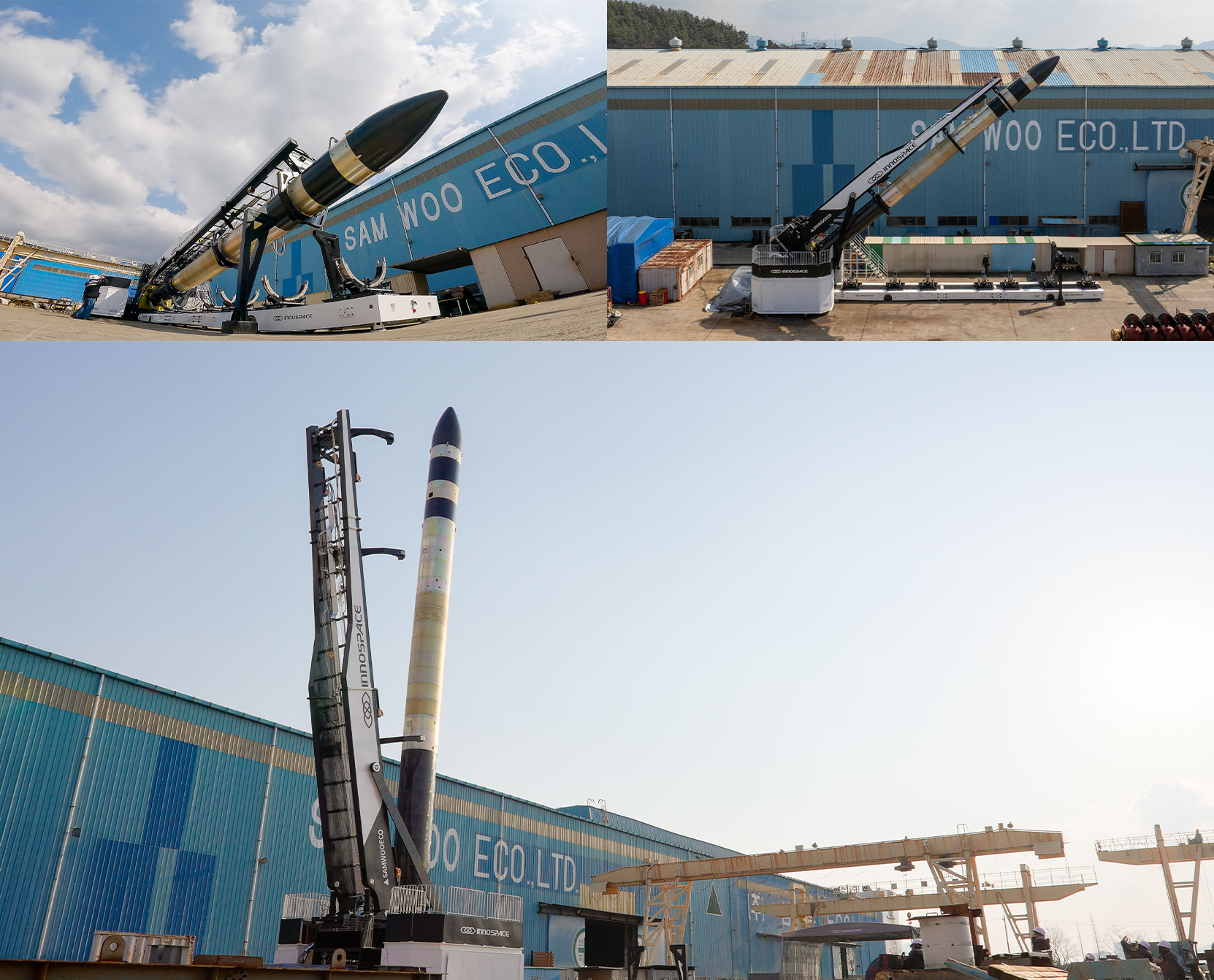
Engineering prototype of Hanbit-Nano testing portable
launchpad. Click for original image.
The South Korea Aerospace Administration (KASA) today issued its first launch license for a private South Korean rocket company, clearing the way for the first launch Innospace’s Hanbit-Nano rocket in the next few weeks from Brazil’s Alcantera spaceport.
For the launch, Innospace has set a launch window from Oct. 28 to Nov. 28. The launch window refers to the period during which the actual launch can take place. Initially, it was set for Oct. 28 to Nov. 7, but was extended to Nov. 28 after coordinating launch inspection procedures, mission stability and joint operation schedules with the Brazilian Air Force.
Innospace said the upcoming launch will also mark the first commercial vehicle launch from a Brazilian space center, adding that Brazilian authorities have provided active support to ensure optimal conditions and a stable launch. While the launch site is operated by the Brazilian Air Force, Innospace will use its own independently built launch platform for the mission.
The rocket will carry five smallsats and three other payloads, one of which is from a South Korean beer company.
If successful, Innospace will become the first commercial rocket startup outside the U.S. to get to orbit, excluding the pseudo-companies in China. The launch will also re-open Brazil’s long abandoned Alcantera spaceport, off of its northeast coast. Used only a few times in the 1990s and then shut down when the Brazilian government abandoned its rocket program, Brazil has been trying to get commercial rocket companies to come there now for about five years, with little success.
The beat goes on: There were three launches globally today, repeating a pattern we’ve seen several times in the past few weeks, with China completing one launch and SpaceX completing two.
First, China’s solid-fueled Kinetica-1 (Lijian-1) rocket placed three Pakistani satellites into orbit, one of which is what Pakistan’s state-run press claimed was its first multi-spectral environmental satellite. China’s press also provided no information about where Kinetica-1’s lower stages crashed inside China, having launched from its Jiuquan spaceport in the country’s northwest. The rocket itself is supposedly commercial, but it is built by a government agency, the Chinese Academy of Sciences, and the government state-run press illustrated this by making no mention of this agency in reporting the launch.
Next, SpaceX set a new record for the reuse of a Falcon 9 first stage in placing 28 Starlink satellites into orbit, the rocket lifting off from Cape Canaveral in Florida. The first stage, B1067, completed its 31st flight, a new record for a Falcon 9 first stage, landing on a drone ship in the Atlantic. The updated rankings for the most reflights of a rocket:
39 Discovery space shuttle
33 Atlantis space shuttle
31 Falcon 9 booster B1067
29 Falcon 9 booster B1071
28 Columbia space shuttle
28 Falcon 9 booster B1063
27 Falcon 9 booster B1069
Finally, less than two hours later, SpaceX launched another 28 Starlink satellites, its Falcon 9 rocket lifting off from Vandenberg Space Force Base in California. The first stage completed its 11th flight, landing on a drone ship in the Pacific.
With these two launches, SpaceX has now placed more than 10,000 Starlink satellites into orbit, though a large percentage have been de-orbited over the years as the company has upgraded the satellites. Nonetheless, the number of Starlink satellites presently in orbit far exceeds all the satellites now in orbit for every other planned constellation, combined.
The leaders in the 2025 launch race:
135 SpaceX
63 China
13 Russia
13 Rocket Lab
SpaceX now leads the rest of the world in successful launches, 135 to 104.
In the coming days the global rocket industry will also achieve a number of additional milestones. SpaceX is just two launches short of its record of 137 launches achieved last year, while the U.S. is just three launches short of its own record of 157 launches, also set last year. Similarly, China is just three launches short of its own record of 66 set in 2023.
Globally, the world has presently completed 239 successful launches in 2025, a number only exceeded by the 2024 record of 256. Expect this record also to fall before the end of the year.

The Middle East, showing the location of
Oman’s proposed spaceport at Duqm.
In its effort to establish its new Etlaq spaceport in the coastal town of Duqm, the government of Oman announced on October 16, 2025 that it has streamlined its launch licensing process so that approvals will be given within 45 days.
The recently issued Civil Aviation Directive (CAD 5-01) sets out the process for coordinating spaceflight activities within Oman’s airspace. Under the directive, companies seeking launch approval must submit an evidence-based safety case to the CAA in order to reserve launch windows in the Muscat Flight Information Region (FIR). Applications aim to be processed in as little as 45 days, giving operators one of the fastest approval cycles globally, while maintaining rigorous aviation, maritime, and ground safety requirements.
Though this appears good on the surface, at the moment it could be nothing more than a lot of sizzle rather than a real steak. The spaceport in April had outlined five planned suborbital launches through the end of 2025, but none of those launches have taken place. Both the April and July tests were scrubbed supposedly due to weather, but no new launch dates have been announced. The April launch was to test a prototype vertical take-off and landing rocket by the Middle Eastern rocket startup Advanced Rocket Technologies. The company’s website now says it is targeting a third quarter launch date, though that quarter has already ended.
Oman has made a strong effort to encourage companies to launch there, with the Spanish rocket startup PLD signing a deal to use Etlaq in future launches. American companies are not going to sign similar deals however because of strict State Department rules designed to prevent U.S. technology from being stolen by hostile foreign powers, and at the moment Oman is certainly not considered a reliable ally.
An evening pause: Performed live 1993.
Hat tip Diane Zimmerman.
Courtesy of BtB’s stringer Jay. This post is also an open thread. I welcome my readers to post any comments or additional links relating to any space issues, even if unrelated to the links below.

Click for original image.
Cool image time! The picture to the right, cropped, reduced, and sharpened to post here, was taken on August 30, 2025 by the high resolution camera on Mars Reconnaissance Orbiter (MRO).
Dubbed a “channel” by the MRO science team, it shows us a meandering canyon with a floor that seems filled with corroded linear features seen frequently on Earth glaciers. Here, the linear ridges appear broken, in many places missing, and in other places so broken their linear nature disappears.
If this was on Earth and I was a global warming activitist, I would immediately claim that the glacier has been evaporating away due to a warming climate caused by SUVs and Republican intransigence. This however is on Mars, where there are no SUVs or Republicans. So what is going on?
» Read more
The uncertainty of science: New research that attempted to simulate conditions in the ice on Mars has determined that ancient microbes are more likely survive there for very long periods, as much as fifty million years, rather than the red planet’s dry sediments.
The research team, led by corresponding author Alexander Pavlov, a space scientist at NASA Goddard — who completed a doctorate in geosciences at Penn State in 2001 — suspended and sealed E. coli bacteria in test tubes containing solutions of pure water ice. Other E. coli samples were mixed with water and ingredients found in Mars sediment, like silicate-based rocks and clay.
The researchers froze the samples and transferred them to a gamma radiation chamber at Penn State’s Radiation Science and Engineering Center, which was cooled to minus 60 degrees Fahrenheit, the temperature of icy regions on Mars. Then, the samples were blasted with radiation equivalent to 20 million years of cosmic ray exposure on Mars’ surface, vacuum sealed and transported back to NASA Goddard under cold conditions for amino acid analysis. Researchers modelled an additional 30 years of radiation for a total 50-million-year timespan.
In pure water ice, more than 10% of the amino acids — the molecular building blocks of proteins — from the E. coli sample survived the simulated 50-million-year time span, while the samples containing Mars-like sediment degraded 10 times faster and did not survive. A 2022 study by the same group of researchers at NASA found that amino acids preserved in a 10% water ice and 90% Martian soil mixture were destroyed more rapidly than samples containing only sediment.
In other words, if there was ever microbiology on Mars, it is very unlikely Perseverance or Curiosity will ever find any, roving as they are in the dry Martian tropics.
Though this work has many uncertainties, especially in its assumption that it successfully simulated a 50-million-year time span, the result is hardly an earth-shaking discovery. If anything, it confirms the obvious, which is why NASA’s ludicrous claim that Perseverance’s prime mission is to look for life has always been a lie. It is traveling in the wrong place, a fact that was self-evident from the start.
Whether any microbiology might exist in Mars’ ice however is unknown. The odds are very very low, but not zero. If it does, it is even less likely it is living, based on orbital data.
China today successfully placed 18 more Spacesail or Qianfan satellites in orbit, its Long March 6A rocket lifting off from Taiyuan spaceport in northeast China. No word on where the rocket’s lower stages crashed inside China.
This was the sixth launch for this internet satellite constellation, intended to provide Chinese citizens service similar to Starlink, but controlled by the Chinese government. At present it has 119 satellites in orbit, out of a planned 648 in the constellation’s first phase. That phase was supposed to be completed by the end of this year, something that now seems very unlikely. The constellation’s final configuration could have as many as 10,000 satellites.
The leaders in the 2025 launch race:
133 SpaceX
62 China
13 Russia
13 Rocket Lab
SpaceX still leads the rest of the world in successful launches, 133 to 103.
An evening pause: Another new sport that harnesses technology for fun. The music Bonsaye by Mirages.
Hat tip Cotour.
Courtesy of BtB’s stringer Jay. This post is also an open thread. I welcome my readers to post any comments or additional links relating to any space issues, even if unrelated to the links below.

Click for original image.
Cool image time! The picture to the right, cropped, reduced, and sharpened to post here, was taken on August 31, 2025 by the high resolution camera on Mars Reconnaissance Orbiter (MRO).
The science team labels this as “layering”, which surely is an apt description. As the latitude is 9 degrees south, this location is within the dry tropics of Mars, where no near surface ice has yet been found. Thus, the terraced layers of this low 20-foot-high mesa are not indicative of the many glacial climate cycles found in the mid-latitudes.
Instead, we are looking at sedimentary layers of rock or dust, laid down over time and later exposed by erosion.
So what caused the layers? And what is causing them to be exposed, one by one? As always the overview map helps provide a possible explanation.
» Read more

Click for original.
The European Space Agency (ESA) has awarded the Italian company Ingegneria Dei Sistemi (IDS) a contract to build an ocean vessel for recovering the planned reusable test upper stage being built by the Italian rocket company Avio, as shown in the graphic to the right.
In late September, ESA awarded a €40 million contract to Avio for the design of a reusable rocket upper stage. The project scope encompasses preliminary design work, including system requirements and technological solutions, for both the launch system and the ground segment. According to the agency, the project has a number of potential applications, including as an evolution of Avio’s Vega family of rockets.
On 15 October, IDS announced that it had been awarded the contract to design the project’s recovery vessel, which falls under the systems ground segment. The company has subcontracted Italian naval systems consultancy Cetena and Norwegian shipbuilder Vard to assist with the project.
ESA very clearly is trying to encourage the development of reusable rockets by Europe’s private sector, but the nature of this particular program seems badly thought out. Rather than have Avio design the system in its entirety, in order to make it as efficient and profitable as possible, it appears ESA is micromanaging the design process, and thus bringing other subcontractors in who are outside Avio’s control. As a result, the final demo might work, but it is not likely it will be competitive with the private reusable rockets being built in the U.S. and elsewhere. Too many cooks in the kitchen.
According to an article in South Africa yesterday, regulatory red tape and political demands in South Africa will likely block approval of Starlink in that country for years to come, if not forever.
Minister of Communications and Digital Technologies Solly Malatsi gazetted a draft policy direction on the role of EEIPs [Equity Equivalent Investment Programme] in the Information and Communication Technologies (ICT) sector on 23 May 2025. He explained that rules requiring electronic communications service providers to have 30% historically disadvantaged ownership prevented some companies from contributing to the country’s transformation in ways other than traditional ownership.
The Broad-Based Black Economic Empowerment (B-BBEE) Act and the ICT Sector Code supported the use of EEIPs to allow qualifying multinationals to meet empowerment obligations through alternatives. These can include investing in local suppliers, enterprise and skills development, job creation, infrastructure support, research and innovation, digital inclusion initiatives, and funding for small businesses.
However, the Independent Communications Authority of South Africa’s (Icasa) ownership regulations do not provide for EEIPs.
In other words, the laws contradict each other, and to make it possible to issue any licenses for a foreign company like SpaceX, the government needs to resolve this conflict. That is expected to take years of political maneuvering.
Even if this issue is resolved, SpaceX has already said it would not agree to the racial quota system proposed. It has offered to instead provide Starlink for free to 5,000 schools. It is not clear if politicians in South Africa will consider that sufficient.

Artist rendering of Dragonfly soaring
over Titan’s surface
Scientists have discovered that, under the very cold conditions on Titan, three normally incompatible substances — methane, ethane and hydrogen cyanide — can mix together in a way that previously was considered impossible.
The background to the Chalmers study is an unanswered question about Titan: What happens to hydrogen cyanide after it is created in Titan’s atmosphere? Are there metres of it deposited on the surface or has it interacted or reacted with its surroundings in some way? To seek the answer, a group at NASA’s Jet Propulsion Laboratory (JPL) in California began conducting experiments in which they mixed hydrogen cyanide with methane and ethane at temperatures as low as 90 Kelvin (about -180 degrees Celsius). At these temperatures, hydrogen cyanide is a crystal, and methane and ethane are liquids.
When they studied such mixtures using laser spectroscopy, a method for examining materials and molecules at the atomic level, they found that the molecules were intact, but that something had still happened. … In their analysis, they found that hydrocarbons had penetrated the crystal lattice of hydrogen cyanide and formed stable new structures known as co-crystals.
Not surprisingly, this result suggests that the alien environment on Titan includes a lot of very unexpected chemistry, some of which we right now cannot predict, or even imagine. While exciting, it also suggests that NASA’s Dragonfly mission to Titan will face challenges that make that mission far more risky. It could quickly fail once it arrives, because of this alien environment.
Such a failure will of course help engineers design later missions, but Dragonfly is a very expensive mission, already overbudget at $3 billion. It might have made more sense to fly a fleet of small and cheaper missions to Titan to begin with, to lower the risks.
Sadly, that is not NASA’s plan.

Click for source.
Thailand’s government has begun a study to find out whether it makes financial and technical sense to establish its own commercial spaceport in that country.
The Geo-Informatics and Space Technology Development Agency (Public Organisation), or GISTDA, organised a seminar titled “Thailand’s Future Opportunities for Spaceport Development” on October 15 at iConsiam. The seminar aimed to establish a platform for exchanging views and gathering suggestions from all sectors regarding the future of a “Spaceport” in Thailand, underscoring a critical juncture for the country to elevate its presence on the global space stage fully.
Pakorn Apaphant, GISTDA Director, revealed that GISTDA is currently conducting a feasibility study for establishing a Spaceport in Thailand, in collaboration with the business consulting firm KPMG Phoomchai Business Advisory Ltd. The comprehensive study covers economic aspects, business strategy, environmental and social impacts, as well as a nationwide survey of potential sites to evaluate the most suitable location for future development.
As the map to the right shows, Thailand’s geography is not perfect. It has plenty of coast, in the country’s south, but at any location the trajectory of most launches would almost have to cross land of Thailand or other countries. Nonetheless, with the advent of reusable lower stages, such considerations will eventually become less of a concern.