November 21, 2025 Quick space links

Courtesy of BtB’s stringer Jay. This post is also an open thread. I welcome my readers to post any comments or additional links relating to any space issues, even if unrelated to the links below.

  • On this day in 1998, the first module of ISS was launched from Baikonur
    Dubbed Zarya, it was built by Russia but paid for by the U.S., which still owns it. Though it is the oldest module on ISS, it is the Russian Zvezda module, launched two years later, that presently has the stress fractures in its hull from which the station’s atmosphere is leaking, and which threaten the station’s survival in the next four years.
9 comments

Bigoted academia upset that Trump won’t allow them to push the racist DEI agenda

Lysenko with Stalin
Trofim Lysenko (on the left), preaching to Stalin as he destroyed
Soviet plant research by persecuting anyone who disagreed with him,
thus causing famines that killed millions. He is now the role model for
today’s entire science community.

Cue the world’s smallest violin! An article today in the journal Science proves once again that science has nothing to do with what that journal now publishes. The headline:

‘This is censorship.’ Conference requires abstracts to comply with Trump anti-DEI order

It seems scientists submitting abstracts to the annual Lunar and Planetary Science Conference (LPSC) in Texas are upset because the Trump administration will not allow any papers to include any mention of diversity, equity, or inclusion (DEI) as a topic.

The Lunar and Planetary Science Conference (LPSC), hosted annually by the Lunar and Planetary Institute (LPI) in Texas, last week announced a new requirement for the upcoming 2026 conference: All submitted abstracts must comply with executive orders from the administration of U.S. President Donald Trump. His 20 January executive order called DEI “illegal and immoral discrimination programs” and terminated both federal DEI programs as well as grant funding for DEI initiatives. The conference policy follows moves earlier this year by LPI’s parent organization, the Universities Space Research Association (USRA), to scrub DEI-related content—including archived LPSC abstracts—from its websites.

Researchers are fuming, saying LPSC is doubling down on its previous decisions, and prioritizing avoiding trouble with the government over intellectual freedom. “This is censorship,” says planetary scientist Paul Byrne of Washington University in St. Louis. “Even if the percentage of people who would normally write a DEI abstract is small, a much larger percent are pissed off.”

In other words, the science community wants to support DEI racial discrimination, because it is designed to favor the racial and sexual groups they favor. To them it is more important to infuse these bigoted ideas into all science, rather than actually report real research about the solar system and planets.
» Read more

7 comments

What might be the weirdest crater on Mars

What might be Mars' weirdest crater
Click for original.

Cool image time! The picture to the right is taken from a global mosaic created from images taken by the wide-view context camera on Mars Reconnaissance Orbiter (MRO). The original source image was probably a photograph taken on February 15, 2020.

I normally begin with an image from MRO’s high resolution camera, but the only images that camera took of this crater did not show it entirely. This context camera shows it in all its glory, what to my eye appears to be one of the weirdest craters I’ve seen on Mars.

First, note its oblong shape — 5.5 miles long and 3.7 miles wide — which appears to narrow to the southeast. It certainly appears that if this crater was caused by an impact, the bolide came in at a very low angle from the northwest, plowing this 700-foot-deep divot as it drove itself into the ground. Research has shown that an impact has to come in almost sideways to do this. Even at slightly higher angles the resulting craters will still appear round.

But wait, there’s more!
» Read more

4 comments

Superheavy intended for next test flight damaged during static fire test

Damaged Superheavy
Click for source.

According to video taken by the Labpadre live stream of SpaceX’s operations at Boca Chica, the Superheavy booster that the company was preparing for the next orbital test flight was damaged while it was being fueled for a static fire test.

The video, which I have embedded below, suggests a tank rupture occurred in the booster’s lower section, where its main oxygen tanks are located. Another post-incident image from different source on social media and to the right, shows the hull of that section badly deformed, with the far side not visible apparently blown out. It also appears the test stand experienced no or little damage.

This incident will likely delay the next orbital Starship/Superheavy test flight, but not significantly. SpaceX has more prototype Superheavys in the queue. While it might need to do some quick additional work preparing one, that should’t slow things down by much.

Figuring out what happened to cause this burst tank is more likely to cause a delay. The company needs to identify and fix the issue before it can proceed.
» Read more

18 comments

China launches a “communications technology test satellite”

China today successfully launched what its state-run press called a “communications technology test satellite,” its Long March 3B rocket lifting off from its Xichang spaceport in southwest China.

No other details about the satellite were released. Nor did that state-run press provide any information about where the rocket’s lower stages, using very toxic hypergolic fuels, crashed inside China.

The leaders in the 2025 launch race:

152 SpaceX
72 China (a new record)
15 Rocket Lab
13 Russia

SpaceX still leads the rest of the world in successful launches, 152 to 120.

0 comments

Moss placed on the outside of ISS for nine months was still capable of reproducing

Graphic from research paper
Graphic from paper.

Scientists have now demonstrated that moss, a bryophyte, can still reproduce despite spending nine months exposed to the harsh vacuum and radiation environment of space on the outside of ISS.

In fact, the researchers found that more than 80% of the spores survived and were able to germinate. You can read their peer-reviewed paper here [pdf].

That the moss could survive is in itself not as surprising as you might think. When the Apollo 12 astronauts brought back pieces from the unmanned Surveyor-3 lander scientists found a single bacterium that survived in space for more than two years. What makes this new result more significant is that moss isn’t simply bacteria, but plant life far more complex. More important, the results found that the moss was far more tolerant of that harsh environment than other lifeforms. From the paper:

In contrast, desiccation-tolerant animals such as tardigrades (Hypsibius dujardini and Ramazzottius varieornatus) and UV-resistant insects’ hydrated larvae undergoing anhydrobiosis (Polypedilum vanderplanki) failed to match the UVC tolerance observed in P. patens spores. Similarly, spores of bacteria and fungi, such as Bacillus subtilis and Aspergillus niger, showed only limited UVC resistance. Thus, these patterns highlight that certain plant structures, namely spores and seeds, tend to exhibit superior UV resistance, likely due to the presence of specialized UV-screening pigments such as flavonoids and carotenoids, which help protect DNA and cellular structures from UV-induced damage.

As the paper notes in its conclusion:

As pioneer plants, bryophytes have the potential to transform regolith into fertile soil, facilitating ecosystem development on other planets, similar to peat moss improving soil fertility on Earth.

That moss isn’t bother significantly by radiation means any greenhouse on Mars need not be shielded as aggressively as previously thought, at least in the initial stages.

5 comments

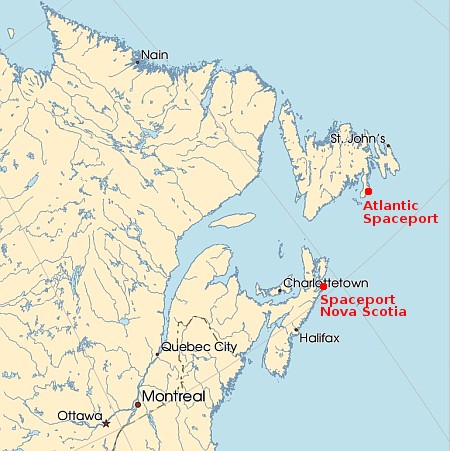
Maritime Launch Services touts a second non-orbital launch from Spaceport Nova Scotia

Proposed Canadian spaceports

The competition between Canada’s two proposed spaceports heated up yesterday when the owner of Spaceport Nova Scotia, Maritime Launch Services, announced that the second launch had taken place there, this time by a rocket startup named T-Minus Engineering.

The launch took place at 11:54 AM, and the mission marked an important milestone in advancing the operational readiness of Spaceport Nova Scotia, critical infrastructure that will provide Canada with sovereign launch capability. The launch was conducted from Spaceport Nova Scotia under approved regulatory and safety frameworks. The demonstration strengthened coordination among launch site teams and stakeholder partners, while refining launch operational procedures and the safety and security systems that govern all activities at the spaceport.

The press release provided no details about the launch itself, though this report noted that the rocket failed to reach its goal of 100 kilometers, the altitude considered by most as the edge of space. The rocket, dubbed Barracuda, is solid-fueled and was apparently designed by T-Minus to demonstrate its capability for hypersonic testing.

This was the second suborbital launch from this spaceport. The first, in 2023, was a student test flight. In both cases, the launches were mostly a PR effort to sell the spaceport, which was first proposed in 2016 but has been unable so far to draw any launch customers. Maritime now also faces competition from the Atlantic Spaceport being proposed by a different company, Nordspace.

0 comments

Firefly to provide the launch rocket for Kratos’ hypersonic test vehicles

The rocket/lunar lander startup Firefly yesterday announced that it has signed a partnership deal with the hypersonic test startup Kratos.

In August Kratos partnered with the Australian company Hypersonix to build 20 scramjet test vehicles for the Pentagon for hypersonic test flights. Firefly with this new deal will provide the launch vehicle for getting those scramjets into the air at the speeds required. In fact, it appears Firefly is now going to do with its Alpha rocket the same thing that Rocket Lab did with its Electron rocket, revising it for suborbital testing.

Rocket Lab has already completed six successful HASTE launches. It will be interesting how quickly Firefly can get Alpha reconfigured and launched in this manner. Some of that schedule will also hinge on Kratos’ ability to provide the scramjets. The press release makes no mention of schedule.

Firefly’s action here continues the recent shift by many American space startups from rocketry and space exploration to defense work that is only tangentially related to space. It appears they are all diversifying to grab the expected rich contracts the Pentagon is expected to hand out to develop Trump’s proposed Golden Dome defense system. It also appears that many are diversifying because they have doubts the civilian space industry can sustain them, by itself.

1 comment

Spanish rocket startup PLD unveils the first qualification unit of its Miura-5 rocket

1st Miura-5 qualification unit
The 1st Miura-5 qualification unit. Click for original.

The Spanish rocket startup PLD yesterday unveiled the first of two full-scale qualification units it is building to test the design of its Miura-5 orbital rocket, scheduled for a first launch sometime in 2026.

The QM1 unit will serve to qualify two key elements of the launcher. Firstly, the MIURA 5 second stage will undergo a destruction test in the United States to validate the functioning of the Flight Termination System. This test will verify the operation of the explosive charges onboard the vehicle, designed to destroy the launcher in the event of an in-flight anomaly.

Secondly, a Wet Dress Rehearsal will be carried out on the rocket’s first stage – a full propellant loading test that replicates all structural load scenarios during the fuelling and pressurisation phase. This test is essential to validate the behaviour of structures under real operational conditions.

By December (next month) the company hopes to complete a second qualification unit for further testing, followed by the flight rocket, which will be shipped to French Guiana for a launch sometime next year.

Right now PLD and Germany’s Isar Aerospace are in the lead in the race to become the first European rocket startup to reach orbit. Isar — which in March attempted one launch that failed — has already shipped the stages to Norway for its second attempt before the end of this year. PLD thus appears to be just behind, though all this could easily change. This is rocket science y’know.

0 comments

SpaceX launches 29 more Starlink satellites

The beat never stops! SpaceX tonight successfully placed another 29 Starlink satellites into orbit, its Falcon 9 rocket lifting off from the Kennedy Space Center in Florida.

The first stage completed its 23rd flight, landing on a drone ship in the Atlantic.

The leaders in the 2025 launch race:

152 SpaceX (a new record)
71 China
15 Rocket Lab
13 Russia

SpaceX now leads the rest of the world in successful launches, 152 to 119.

0 comments
1 20 21 22 23 24 182