
Edgar Winter Group – Frankenstein
An evening pause: Performed live 1973.
Hat tip wamphyr.
An evening pause: Performed live 1973.
Hat tip wamphyr.
The new government of Starbase has reached an agreement with its local county to take control of the nearby beaches that will allow Starbase to not only maintain them but close them when it chooses.
Cameron County commissioners approved the agreement to hand over a portion of Boca Chica Beach on Tuesday. The deal outlines cleaning and maintenance obligations among other terms. Under the agreement, Starbase will be allowed to set requirements for beachfront construction and special events on the beach.
…The compact includes a plan to address beach erosion, which occurred at a rate of 10 to 20 feet per year from 1950 to 2012, Starbase Commissioner Jordan Buss told the county commissioners, citing a study conducted by the University of Texas at Arlington.
This agreement mirrors one Starbase had previously made with South Padre Island for other beach portions.
The article once again gives lots of column space to the fringe groups that oppose SpaceX and its operations at Boca Chica, even though the evidence suggests they have almost no support from the general public.
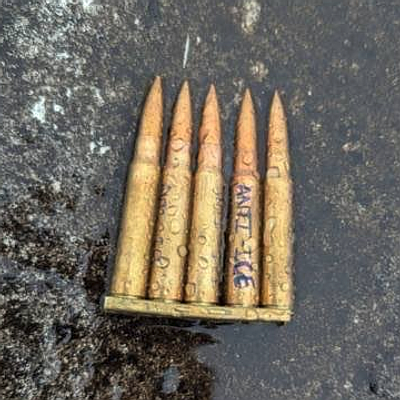
Click for source from FBI.
The madness from the left continues: A rooftop sniper who had engraved “anti-ICE” messages on his ammunition today killed on one and injured two in Dallas before killing himself.
The now-deceased shooter who targeted a Dallas, Texas ICE facility wrote “anti-ICE” messages on his rounds, according to the FBI.
Three people at an ICE facility were shot by a gunman on the roof of an adjacent building on Wednesday morning. The victims were reportedly detainees, though law enforcement did not confirm this on Wednesday. Authorities did confirm, however, that no officers were injured in the shooting. One of the victims died at the scene, and the shooter died of a self-inflicted gunshot wound.
At this same Dallas ICE facility last month a man was arrested when he claimed he had a bomb in his backpack. Nor are these recent attacks limited to this one facility.
This incident comes just two weeks after a threatening letter with a white powdery substance was sent to an ICE office in New York City. Less than a week ago, a violent rioter was charged with assault in San Francisco after he threatened to stab an ICE officer and harm his family,” a DHS senior official said in a statement about the incident at the time.
In another case six anti-ICE vandals have been charged in a shooting at a different ICE facility in Texas in July.
According to federal court documents, police initially responded to reports of vandalism at the facility, with several cars spray-painted with anti-immigration statements. However, when authorities arrived on the scene, one was shot in the neck. Authorities said the officer who was shot survived.
Meanwhile, California governor Gavin Newsom last night continued the Democratic Party’s vicious rhetoric that has encouraged this behavior by saying on Stephen Colbert’s leftwing propaganda show that ICE is President Trump’s “private domestic army.” Nor did Newsom stop there.
» Read more

Click for original. More images here.
In what appears to be a tit-for-tat competition, a Chinese reconnaissance satellite, dubbed Jilin-1, has now taken photographs of a commercial Earth imaging satellite owned by Maxar, that the company had previously used to photograph other Chinese satellites.
Chinese commercial remote sensing constellation operator Changguang Satellite Technology (CGST), a spinoff from an arm of the state-owned Chinese Academy of Sciences, published images Sept. 13 of a Maxar Worldview Legion 2 satellite.
The images were taken by CGST’s Jilin-1 remote sensing constellation satellites across a few hours on Sept. 8, from ranges between 40-55 kilometers, showing details of the spacecraft. While part of an expanding Earth observation constellation, Jilin-1 satellites have apparently had their operations adjusted to include Non-Earth Imaging (NEI).
Maxar had earlier published high resolution images of China’s Shijan-26 satellite, being used to test remote sensing and surveillance technologies.
None of this is particular new, though for China the technology is the most advanced it has ever had. Nations have been launching high resolution surveillance satellites since the 1960s. Nor is there anything anyone can do about it. Nations will always do this. If anything, having this ability to observe each other closely will likely reduce tensions and misunderstandings.

Apparently Wall Street has lost faith in the rocket startup Firefly since that company went public last month. The stock zoomed initially, but has now sagged due to a poor 1st quarter report that showed revenues far below expectations.
The stock’s initial price had been predicted to range from $35 to $39, but quickly rose to $70.
Since then the price has steadily dropped, so that today it sits about about $41.
The news reports seem to think this indicates bad things for the company. I see this as simply a long term correction from the initial over-enthusiasm by buyers. The company had first offered a stock price close to this number. The price is now exactly where Firefly predicted.
If I was interested in buying stock, this might actually be a good time to buy. As a rocket startup, Firefly appears quite solid, being the only startup to successfully soft land on the Moon. Its Alpha rocket has also been cleared for further launches, and though it has had a mixed launch record, with several launches failing due to upper stage issues, it has likely solved these problems.
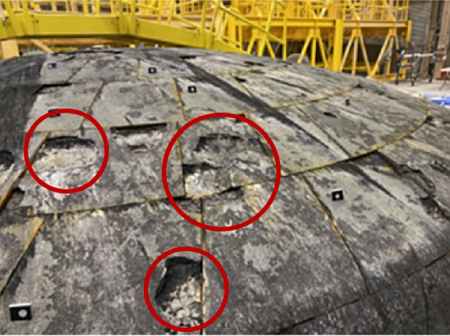
Damage to Orion’s heat shield caused during re-entry in 2022,
including “cavities resulting from the loss of large chunks”.
Nor has this issue been fixed.
According to a NASA official at an event yesterday, the agency is now targeting launch window starting on February 5, 2026 and extending into April for the first manned Artemis mission, dubbed Artemis-2, that will slingshot four astronauts around Moon and back to Earth on a 10-day-flight.
If Artemis 2 does lift off on Feb. 5, it will be at night, NASA officials said. The space agency has about five days apiece in February, March and April to launch the flight. The latest possible date is April 26, according to NASA. NASA will aim to hit the earlier part of that launch window, Hawkins said, but she stressed that crew safety will drive the timeline.
That mission will fly with an Orion capsule that has safety concerns, including a questionable heat shield (see picture above) and an untested environmental system.
Meanwhile, as part of NASA’s never-ending PR effort to sell the mission, it announced today that the mission’s four astronauts have now given their Orion capsule a name, Integrity.
The name Integrity embodies the foundation of trust, respect, candor, and humility across the crew and the many engineers, technicians, scientists, planners, and dreamers required for mission success.
Considering NASA’s level of dishonesty during the entire development of SLS and Orion, the ironies of this name and these claims is quite breath-taking.
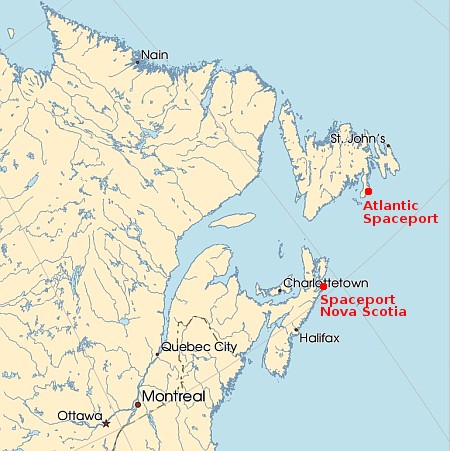
Proposed Canadian spaceports
UPDATE: The launch attempt today has also been scrubbed due to another small pad fire due to leaking fuel. The company is now aiming for another launch attempt tomorrow.
Original post:
———————
The Canadian rocket startup Nordspace was forced yesterday to cancel its first launch attempt of its Taiga suborbital rocket when flames and smoke appeared on the launchpad.
An update posted to the company’s website said it had to delay the launch “due to an anomaly on the launch pad. … Rocket, pad, and personnel are safe. We are working to resolve the issue and return to launch,” the update said. Later, in a comment on its livestream, the company said it would reschedule the launch to Wednesday morning.
I have embedded a live stream of today’s launch attempt below, set for lift off a little past noon today (Pacific).
With this launch, the company will not only complete the first Canadian launch of any kind from Canada by a private company, it will initiate operations at its own spaceport in Newfoundland, dubbed the Atlantic Spaceport. This achievement would also leapfrog Canada’s other proposed spaceport in Nova Scotia, which has been promising launches since 2016 without success.
» Read more
Both China and SpaceX completed launches today. First, China launched another 11 satellites for its Geely internet-of-things constellation, its Smart Dragon-3 rocket lifting off from a ocean platform off the nation’s eastern coast.
This was the sixth launch for this constellation, bringing the number of satellites in orbit to 64, out of a planned 240. The constellation is designed to provide positioning and communications for trucking and other ground-based businesses.
Next, SpaceX successfully placed three government science satellites into orbit (two for NASA and one for NOAA), its Falcon 9 rocket lifting off from the Kennedy Space Center in Florida. The first stage completed its second flight, landing on a drone ship in the Atlantic. The two fairings both completed their first flight.
The two NASA satellites were the Interstellar Mapping and Acceleration Probe (IMAP) to study the Sun’s heliosphere at the edge of the solar system and the Carruthers Geocorona Observatory to study the exosphere, the outermost layer of the atmosphere. The NOAA probe, Space Weather Follow On – Lagrange 1 (SWFO-L1), will observe the Sun from one million miles from Earth, providing advance knowledge of strong solar flares and eruptions so that utility companies can shield the electric grid appropriately.
The leaders in the 2025 launch race:
123 SpaceX
55 China
13 Russia
12 Rocket Lab
SpaceX now leads the rest of the world in successful launches, 123 to 94.
An evening pause: The camera soon focuses on this couple, whose performance eventually won the competition, which apparently was their tenth victory. As noted in the comments, “You don’t understand exactly how great they are until you see them in a roomful of other people dancing the same dance.”
Hat tip Judd Clark.
Courtesy of BtB’s stringer Jay. This post is also an open thread. I welcome my readers to post any comments or additional links relating to any space issues, even if unrelated to the links below.

Jimmy Kimmel on September 15, 2025, spreading lies and
slandering half the nation. Click for original video.
Not surprisingly, the leftist Disney corporation that owns ABC backed down yesterday from its suspension of Jimmy Kimmel, posting a pandering explanation for why it no longer considers it a problem that Kimmel spouted a blatant lie about the leftist killer of Charlie Kirk.
“Last Wednesday, we made the decision to suspend production on the show to avoid further inflaming a tense situation at an emotional moment for our country. It is a decision we made because we felt some of the comments were ill-timed and thus insensitive,” Disney said in a statement Monday. “We have spent the last days having thoughtful conversations with Jimmy, and after those conversations, we reached the decision to return the show on Tuesday.” [emphasis mine]
Kimmel’s comments weren’t “ill-timed” or “insensitive.” What Kimmel said was an outright slander of every person who voted for Donald Trump by claiming it was one of them that killed Kirk.
The pushback against Disney and ABC over Kimmel however has not diminished. The independent companies Nexstar and Sinclair, which own 30 and 40 affiliate television stations that are presently part of ABC’s network, have not backed down. Both have announced they will continue to refuse to air Kimmel’s show, Jimmy Kimmel Live! Sinclair has further said that it won’t change its position until Kimmel apologizes to Kirk’s family and makes a “meaningful personal donation” to them and Turning Point USA.
Sinclair has additional personal reasons for standing up to Disney, ABC, and the terrorist left. It had planned to air a tribute to Charlie Kirk, but decided to cancel it because of multiple violent threats from the left to is local stations.
» Read more


Click for original image.
Cool image time! The picture to the right, rotated, cropped, reduced, and sharpened to post here, was taken on August 4, 2025 by the high resolution camera on Mars Reconnaissance Orbiter (MRO).
The science team labels this a “concentric fill crater,” a term used by planetary scientists for Martian craters that appear to be filled with glacial material. That certainly appears to be the case, but this 3.5-mile-wide unnamed crater also appears to have been warped by the ice that impregnates the ground all around it.
The overview map above explains why. The white dot marks the location, on the eastern end of the 2,000-mile-long northern mid-latitude strip that I label glacier country, because almost every image in this region shows similar glacial features. Though it is hard to tell from the inset, all the craters here have similar glacial material within them, and the ground surrounding them also appears glacial in nature.
This particular location is at 40 degrees north latitude. While it might be difficult to establish a colony here, on ground that appears so unstable, going 700 to 800 miles to the southeast would put you in what is considered one of Mars’ prime mining regions. Thus, with the right equipment mining operations would have accessible water not that far away.

Click for original.
In a major announcement, the House Judiciary committee today revealed that Google has admitted that it had bowed to direct pressure by the Biden administration to censor conservatives, and it now vows to never bow to such pressure again.
The company has also agreed to allow everyone it banned due to that pressure to return to Youtube.
The graphic to the right comes from the committee’s announcement. All five points listed are critical to the future. First, Google now confirms the truth of another “rightwing conspiracy theory”. The Democratic Party under Biden was aggressively abusing its power to censor its opposition. Second, Google now admits it participated in this wrong-doing, and pledges to never do it again.
Finally, and most important, it notes the threat to freedom and free speech now posed by Europe and its new censorship laws. That threat is real, and unless American companies have the courage to tell Europe to pound sand, we could see them agreeing to squelch our speech in order to keep their businesses open in Europe. Google is essentially asking Congress and the federal government to do something to protect it from those laws.

NASA is being conquered by Americans
That two different former SpaceX employees, one of whom had already flown on a private mission in space, applied and were accepted by NASA yesterday — as part of the 24th class of astronauts since its creation three-quarters of a century ago — reveals the major shift that is occurring across the entire space industry, and most especially within NASA.
This new class of ten included four men and six women, the first time women were the majority chosen. More significantly however were the two former SpaceX employees.
Yuri Kubo, 40, is a native of Columbus, Indiana. He earned a bachelor’s degree in electrical engineering and a master’s in electrical and computer engineering from Purdue University. He spent 12 years working across various teams at SpaceX, including as launch director for Falcon 9 rocket launches, director of avionics for the Starshield program, and director of Ground Segment.
Anna Menon, 39, is from Houston and earned her bachelor’s degree from Texas Christian University with a double major in mathematics and Spanish. She also holds a master’s in biomedical engineering from Duke University. Menon previously worked in the Mission Control Center at NASA Johnson, supporting medical hardware and software aboard the International Space Station. In 2024, Menon flew to space as a mission specialist and medical officer aboard SpaceX’s Polaris Dawn. The mission saw a new female altitude record, the first commercial spacewalk, and the completion of approximately 40 research experiments. At the time of her selection, Menon was a senior engineer at SpaceX.
Menon is also married to another NASA astronaut, Anil Menon, making them the fourth married couple picked by NASA.
At first I wondered why either would want to leave the private sector to work at NASA, especially considering that the opportunity to fly in space through NASA is going to decline significantly in future years. Its Artemis program will at best launch once a year, carrying four, and when ISS retires NASA’s flights to the commercial stations will be fewer and farther apart.
Then I realized the financial and personal benefits of getting picked and trained by NASA as an astronaut. It is a wonderful item to put on one’s resume. These astronauts don’t have to stay at NASA forever. As the private commercial stations and other private manned capsules begin flying, those companies are going to need trained individuals to fly their ships and run their stations. Most will look for candidates from NASA’s astronaut corps.
The presence of those two SpaceX employees in this class also shows us the shift from the government to private enterprise. In the past almost all of NASA’s astronaut picks would have come from the military and academia (In fact, the other eight astronauts picked this time all have such backgrounds). Rarely would NASA have chosen anyone from the private sector.
The choice of two such private sector individuals by NASA yesterday is simply another indication of the agency’s shift from the top-down government model to the capitalism model. It is finally recognizing the private sector is (and has always been) the heart of America’s space effort, and it is beginning to reward it appropriately.
Even as that private sector begins to take over NASA itself.
In March 2024 the orbital tug startup Exlabs announced that it will use its orbital tug to deliver three cubesats to the asteroid Apophis when that object makes its next close fly-by of the Earth on April 13, 2029.
The California-based Exlabs has now signed its first customer for that mission. An Australian satellite startup, Fleet Space Technologies, has agreed to fly an instrument on this private commercial mission.
Under the ApophisExL mission, Fleet will provide geophysical sensing technologies for ExLabs’ mothership to collect targeted data and characterize the asteroid. The datasets should enable new avenues for data sharing and commercial use, set criteria for prioritizing asteroids for prospecting and feed critical intelligence into planetary‑defence planning.
Fleet already has a contract to fly another instrument, a seismometer, on Firefly’s second Blue Ghost lander mission to the Moon. It has also developed and flown satellite instruments used to detect minerals on Earth.
Both companies are clearly aiming to enhance their brand name with this mission, set to launch in 2028.
The University of Surrey in the United Kingdom, a decades-long pioneer in cubesat technology, has now signed a partnership deal with the National Central University in Taiwan to work together.
Both universities began their work with cubesats to simply as a low-cost way to teach students about satellite design, but quickly found there was money to be made selling this technology commercially. This deal attempts to make two plus two equal six.
The collaborative plans follow multiple successful engagements between the Universities, from NCU professor Loren Chang joining a Taiwanese delegation to Guildford in March to partnership working between students from each university earlier this summer when Surrey and NCU worked with launch provider Stellar Kinetics at Etlaq Spaceport in Oman. The students worked together to integrate the Jovian-O and SIGHT space payloads that they had developed onto the KEA-1 rocket.
The universities also share research interests. The Surrey Space Centre has built space-based radiation detectors and, as part of the UK’s SWIMMR programme to improve resilience to space weather, developed miniature detectors to measure radiation at different altitudes and created a model for the UK Met Office to predict radiation levels experienced by aircraft.
NCU has developed multiple scientific payloads and small satellite science missions, including the Deep Space Radiation Probe (DSRP), which flew aboard the commercial lunar payload service provider, ispace, Inc.’s Resilience lunar lander, launched in January 2025. DSRP was operational for more than 97% of the five-month mission, providing measurements of the radiation belts, several solar radiation storms and radiation in lunar orbit. It was the first Taiwanese payload to fly and operate beyond Low Earth Orbit.
This deal now enhances both universities and the products both sell (educating students and developing new satellite technologies).
An evening pause: Performed live c2006.
Hat tip Alec Gimarc.
Courtesy of BtB’s stringer Jay. This post is also an open thread. I welcome my readers to post any comments or additional links relating to any space issues, even if unrelated to the links below.

Erika Kirk, at the moment she publicly forgave
her husband’s murderer. Click for video.
As numerous pundits on the web have already noted, the assassination of Charlie Kirk last week has clarified most starkly the political divide in both the United States as well as across the world.
On the right, we have Kirk’s widow yesterday speaking at a memorial service for her husband, and with tears standing before the world to forgive his killer.
I forgive him. I forgive him because it was what Christ did, and it is what Charlie would do. The answer to hate is not hate. The answer, we know from the Gospel, is love. And always love. Love for our enemies, and love for those who persecute us.
Her speech matched the general tone of most of the speakers at that memorial service. The service itself, as well as the numerous peaceful candlelight vigils nationwide in memory of Kirk, illustrate clearly the response of the right to this heinous act. No riots, no violence, no calls for bloodshed. Only prayer and a cold fury to make sure such violence never happens again.
That tone was set by Kirk himself, before he died. All he ever did was want to debate his very mainstream conservative ideas with leftists, with good will and rationality. He proved it in a text he sent to leftist pundit Van Jones just before his murder:
I’d love to have you on my show to have a respectful conversation about crime and race. I would be a gentleman as I know you would be as well. We can disagree about the issues agreeably.
The left’s response to Kirk however has been not love or good will but hate. Hundreds and hundreds of partisan leftists went on social media to gleefully celebrate his assassination. Leftist politicians and entertainers defamed both him and what he stood for, with lies and slanders. And when the television show of one entertainer, Jimmy Kimmel, got canceled by ABC because Kimmel had falsely claimed on the air that a Trump supporter had killed Kirk, one leftist and former teacher’s union employee decided it was okay to protest Kimmel’s cancellation by firing multiple bullets into the offices of an ABC affiliate in Sacramento. The man, Al Hernandez Santana, also has an extensive X feed where he had expressed hate for Donald Trump, often wishing him dead.
He is clearly not sane, but he is also not an outlier on the left. The response of the left to Kirk’s murder has revealed that for too many Democratic Party supporters, Santana is mainstream.
» Read more
SpaceX this morning successfully launched a classified payload for the National Reconnaissance Office, its Falcon 9 rocket lifting off from Vandenberg in California.
The first stage completed its 18th flight, landing back at Vandenberg. The two fairing halves completed their 27th and 28th flights respectively. As of posting the payload had not yet been deployed.
The leaders in the 2025 launch race:
122 SpaceX
54 China
13 Russia
12 Rocket Lab
SpaceX now leads the rest of the world in successful launches, 122 to 93.