China launches three satellites from ocean platform

The Chinese pseudo-company Orienspace yesterday successfully placed three satellites into orbit, its solid-fueled Gravity-1 rocket lifting off from an ocean platform off the country’s northeast coast.

This was Orienspace’s second launch, both using its Gravity-1 rocket from the ocean. Of the three satellites, one was an Earth observation satellite, and the other two were part of the pseudo-company Geespace’s Geely constellation of satellites, though it is not clear if these are for its Internet-of-Things (IoT) constellation or for general communications. The IoT constellation already has 64 satellites in orbit out of a planned 240.

Another launch of China’s Long March 8A rocket was supposed to happen yesterday, but there is no indication in China’s state-run that it took place, nor any information about a rescheduled launch date. That state-run press also illustrated the pseudo nature of these Chinese companies by only mentioning Orienspace as an afterthought at the end of the article.

The leaders in the 2025 launch race:

129 SpaceX
59 China
13 Russia
12 Rocket Lab

SpaceX still leads the rest of the world in successful launches, 129 to 99. The company will try again this evening to launch its third mission for Amazon, placing a set of Kuiper satellites into orbit. Weather has scrubbed the past two attempts in the previous few days.

0 comments

October 10, 2025 Quick space links

Courtesy of BtB’s stringer Jay. This post is also an open thread. I welcome my readers to post any comments or additional links relating to any space issues, even if unrelated to the links below.

2 comments

New research confirms the steady decline of Martian ice with each glacial cycle

The obliquity cycles of Mars

Using orbital data from Mars Reconnaissance Orbiter (MRO) of glaciers inside mid-latitude craters, scientists have concluded that there was a steady decline in the growth of those glaciers with each new glacial cycle.

They focused on craters with indicative signs of glaciation, such as ridges, moraines (piles of debris left behind by glaciers), and brain terrain (a pitted, maze-like surface formed by ice-rich landforms). By comparing the shapes and orientations of these features with climate models, they found that ice consistently clustered in the colder, shadowed southwestern walls of craters. This trend was consistent across various glacial periods, ranging from approximately 640 million to 98 million years ago.

The results show that Mars didn’t just freeze once—it went through a series of ice ages driven by shifts in its axial tilt, also known as obliquity. Unlike Earth, Mars’ tilt can swing dramatically over millions of years, redistributing sunlight and triggering cycles of ice build-up and melting. These changes shaped where water ice could survive on the planet’s surface. Over time, however, each cycle stored less ice, pointing to a gradual planetary drying. [emphasis mine]

You can read the paper here [pdf]. This result is not new. Based on the orbital data scientists have theorized now for almost a decade that as Mars’ rotational tilt (its obliquity) swings from 11 to 60 degrees, it produces extreme climate cycles on the planet. Those swings are shown on the graph to the right, taken from this 1993 paper [pdf]. When the obliquity is low, the mid-latitudes are warm and the glaciers there shrink, with the snow falling at the poles. When obliquity is high, the poles are warmer and its ice sublimates away to fall as snow in the mid-latitudes, thus causing those glaciers to grow instead.

The orbital data has consistently shown that with each new cycle, the glaciers grew less, suggesting that less global water was available on the planet. This new study further confirms these conclusions.

One last point: Though the amount of water ice on Mars has declined, we mustn’t think the red planet now has none. The orbital data shows that there is a lot of near surface ice on Mars, covering the planet from 30 degrees latitude poleward. As I’ve noted numerous times, Mars is a desert like Antarctica.

9 comments

Orbital tug company Momentus gets two NASA contracts

The orbital tug startup Momentus yesterday announced that NASA has awarded it two contracts worth $7.6 million total to fly two experimental NASA payloads on its Vigoride tug.

One payload will test “test the ability to make semiconductor crystals in microgravity”, while the second will “test a rotating detonation rocket engine, a propulsion system designed to provide higher efficiency than traditional engines.” In this case the propellants used will be nitrous oxide and ethane.

Both will fly on the same Vigoride tug on a mission to be launched no earlier than October 2026. Momentus also says there is room for additional payloads on that mission.

It appears the increase in the number and launches of rockets has actually hurt the orbital tug business:

Momentus is among several companies that developed orbital transfer vehicles, or OTVs, like Vigoride to ferry spacecraft between orbits. They are designed to provide last-mile delivery to specific orbits for spacecraft launched on rideshare missions such as [SpaceX’s] Transporter [launches]. However, demand for such services has been slower to materialize than expected. “Candidly, that part of the market has not developed as much as people thought, say, five years ago,” [said John Rood, Momentus’ chief executive] during a panel at World Space Business Week in September. “The reason is many small manufacturers are multi-manifesting satellites to deploy a single plane with a single launcher.”

As a result, Momentus has focused on getting technology demonstration contracts such as the two above, with the tug acting more like a service module.

0 comments

Astronomers take first radio image of the supermassive binary system OJ287

First image of OJ287

Using archive data from the now retired Russian orbiting radio telescope RadioAstron, scientists have now obtained the first image of the binary supermassive black hole system OJ287 that was previously detected flaring as predicted when the smaller black hole (150 million solar masses) circled near the larger (18 billion solar masses).

That image is to the right, cropped and annotated to post here. The cartoon in the lower right shows the theorized orientation of the system, taken from figure 2 of the published paper [pdf]. According to the paper the elongation of the three objects is an artifact of the data and is “not real.” From the press release:

In this latest study, the astronomers compared the earlier theoretical calculations with a radio image. The two black holes were there in the image, just where they were expected to be. This gave the researchers an answer to a question that has been open for 40 years: whether black-hole pairs exist in the first place. “For the first time, we managed to get an image of two black holes circling each other. In the image, the black holes are identified by the intense particle jets they emit. The black holes themselves are perfectly black, but they can be detected by these particle jets or by the glowing gas surrounding the hole,” Valtonen says.

The researchers also identified a completely new kind of a jet emanating from a black hole. The jet coming out of the smaller black hole is twisted like a jet of a rotating garden hose. This is because the smaller black hole moves fast around the primary black hole of OJ287, and its jet is diverted depending on its current motion. The researches liken it to “a wagging tail” which should be seen twisting in different directions in the coming years when the smaller black hole changes its speed and direction of motion.

This image is cropped from the full dataset. The jet continues upward and then curves to the right as it “wags” away.

This incredible black hole binary system, estimated to be about 3.5 billion light years away, has been posited since 1982, when one astronomer noticed that it repeatedly flared every twelve years. Since then scientists have successfully predicted several flares, based on the system’s theorized orbit. These images further confirm the system’s shape.

0 comments

Canadian rocket startup Nordspace signs deal for its mission control center

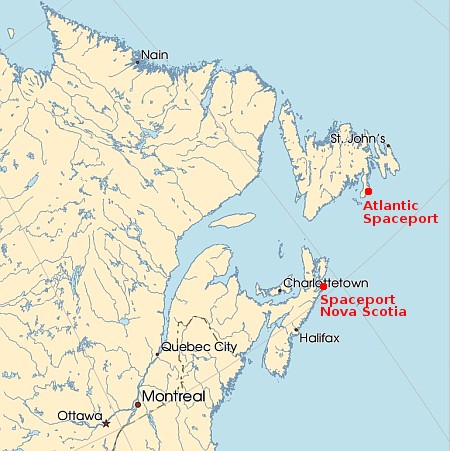
Proposed Canadian spaceports

The Canadian rocket startup Nordspace, which earlier this week signed a deal for another company to establish ground stations for its proposed Atlantic Spaceport, today signed an agreement with the company Kongsberg Geospatial to provide software for running its mission control center.

According to the news release TerraLens “will ingest data from multiple sensors to deliver real-time three-dimensional (3D) visualization of launch operations, range safety, decision support, and vehicle tracking. This will help streamline launch operations and enable deployment of critical space missions to orbit in under 48 hours.” Kongsberg said TerraLens builds on their “experience supporting range safety and mission-critical visualization for the Andøya Space and Defence project in Norway.”

Andøya is Norway’s new commercial spaceport that has been launching suborbital government rockets for decades.

Nordspace continues to move forward quickly, having been established only three years ago. It is putting the pieces together for its spaceport, and is testing both a small suborbital rocket and the engines for its proposed orbital Tundra rocket. Though the race is certainly not over, it does appear Nordspace will get to orbit ahead of the Nova Scotia spaceport that was first proposed in 2016.

0 comments

Is Trump considering re-nominating Jared Isaacman for NASA administrator?

Jared Isaacman
Billionaire Jared Isaacman

According to a report late today (based on anonymous sources), President Trump has held several face-to-face meetings in the past few weeks with billionaire Jared Isaacman, and those meetings have raised the possibility of Trump re-nominating him for NASA administrator.

According to Bloomberg News, President Trump has reportedly met with Isaacman several times in recent weeks to discuss NASA’s operational plans and future plans. Isaacman is the founder of fintech company Shift4 Payments and a private astronaut at SpaceX who has had a longstanding relationship with Elon Musk.

Isaacman, who has flown two private missions in space (and done one spacewalk), had been nominated by Trump for NASA administrator in December 2024, and was only days away from a Senate confirmation vote when Trump suddenly withdrew the nomination on May 31, 2025. Though it has never been clear why Trump withdrew the nomination, Isaacman’s past support of Democrats and his close links to Musk have been raised as issues, especially because of the Trump-Musk kerfuffle in the spring. Isaacman has also expressed some opinions since then about NASA and what it should do that might not have fit with Trump’s plans.

At the same time, NASA is presently without its own administrator, with Transportation Secretary Sean Duffy holding down the job as an interim head. It appears Trump might be reconsidering his earlier decision in order to get someone in charge of NASA who isn’t distracted by other responsibilities.

Note however that this report is solely from anonymous sources, and we all know how unreliable those are. The whole story could be fantasy cooked up by someone in DC for any number of devious political purposes.

12 comments

October 9, 2025 Quick space links

Courtesy of BtB’s stringer Jay. This post is also an open thread. I welcome my readers to post any comments or additional links relating to any space issues, even if unrelated to the links below.

5 comments
1 41 42 43 44 45 182