
Kalandra – Borders
An evening pause: Performed live 2024.
Hat tip Judd Clark.
An evening pause: Performed live 2024.
Hat tip Judd Clark.
Courtesy of BtB’s stringer Jay. This post is also an open thread. I welcome my readers to post any comments or additional links relating to any space issues, even if unrelated to the links below.
A meteorite that crashed through the roof of a home in Georgia in June 2025 has now been dated to have formed 4.56 billion years ago, to a time when the solar system was just beginning to form.
[The University of Georgia] received 23 grams of the 50 recovered from the piece that penetrated the house. Using optical and electron microscopy to analyze the fragments, Harris says he believes the meteorite to be a Low Metal (L) ordinary Chondrite. That classification means he expects the meteorite to have formed 4.56 billion years ago in the presence of oxygen — older than the Earth itself.
“It belongs to a group of asteroids in the main asteroid belt between Mars and Jupiter that we now think we can tie to a breakup of a much larger asteroid about 470 million years ago,” Harris said. “But in that breakup, some pieces get into Earth-crossing orbits, and if given long enough, their orbit around the sun and Earth’s orbit around the sun end up being at the same place, at the same moment in time.”
There has been a lot of unjustified hype in the mainstream press about this story, mostly about the age of the meteorite. The fact is that this age for a meteorite is simply not a surprise, that almost all chondrite meteorites found are of comparable age, coming from the beginnings of the solar system.
The most unusual part of the story is that the impact occurred through a person’s house. Such events are exceedingly rare. That it happened however was actually fortuitous, in that, first, no one was hurt, and second, it allowed the meteorite to be quickly recovered and analyzed.

Today’s modern Democratic Party
They’re coming for you next: According to this Fox New report, major bank executives have admitted that White House officials during the Obama and Biden administrations aggressively pressured them to cancel the bank accounts and blacklist many customers, simply because those customers had political opinions that Obama, Biden, and the Democratic Party did not like.
Fox News Digital spoke with two executives at leading U.S. banks, who asked to remain anonymous, fearing reprisals. The executives said that ambiguity in federal laws was exploited by regulators under the Obama and Biden administrations in order to pursue political objectives. According to one executive, banks were pressured to deny services to certain industries as part of Operation Choke Point and Operation Choke Point 2.0. “When there’s ambiguity in the law, beauty is in the eye of the beholder, and for a long time the beholder was the Obama and Biden administration,” the official said.
A House Oversight Committee report found that “Operation Choke Point,” a DOJ task force whose aim was to “choke out” legal companies disfavored by the Obama administration, worked with bank regulators to label certain industries, including firearms sales, as “high risk.”
During the height of the blacklisting craze in both the Obama and Biden administrations, numerous conservative candidates and organizations and individuals suddenly found their bank accounts canceled and their businesses blocked from ordinary financial transactions. These new allegations confirm what was strongly suspected at the time, that the Democrats were using the regulations to blackmail banks into doing this blacklisting.
This story proves without doubt the despicable and thuggish nature of Barack Obama, Joe Biden, and the Democratic Party minions who worked under them. Moreover, these allegations add great weight to the other accusations against Obama and many intelligence officials for making up the Trump-Russian collusion hoax. If Obama was willing to threaten banks if they didn’t blacklist conservatives, he and those intelligent officials would surely have had no problem working up a fake story to slander and destroy Trump.
All the more reason for voters to utterly reject this Democratic Party. It has not reformed itself, and it is clearly now a threat to not only our Constitution and the rule of law, it is a direct threat to the livelihood and freedom of every single American. It has no morals at all. All these Democrats care about is power. If the voters give that power back to them in any future election, they will use it to destroy all who disagree with them.
And there no longer any doubt about this at all.
Russia today successfully launched the first Bion-M returnable capsule in more than a dozen years, its Soyuz-2 rocket lifting off from the Baikonur spaceport in Kazakhstan.
The capsule will remain in orbit for about a month doing weightlessness and radiation experiments with a variety of biological samples, 1,500 fruit flies, and 75 mice. Though similar to the commercial capsules recently launched by Varda, Bion-M is different in that it appears the research has no marketability. As a government-run project by Russian Academy of Science, no effort was made to use weightlessness to produce a product for sale on Earth.
The leaders in the 2025 launch race:
101 SpaceX
47 China
11 Rocket Lab
10 Russia
SpaceX still leads the rest of the world in successful launches, 101 to 81.
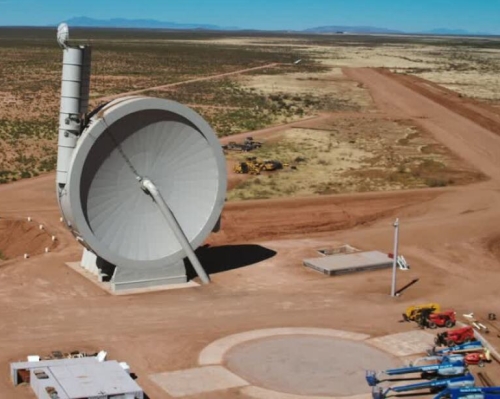
The Spinlaunch prototype launcher
Spinlaunch, the startup that began by proposing launching payloads into space using a giant vertically oriented spinning centrifuge (as shown to the right), has now raised $30 million in private investment capital for its proposed Meridian broadband satellite constellation, designed to compete directly with Starlink and Kuiper.
The funding includes new investment from existing investors, including lead investor ATW Partners, as well as the previously announced strategic investment from Kongsberg Defence & Aerospace.
Kongsberg had previously invested $12 million, and is building 280 micro-satellites for this constellation.
It is very unclear from the press release when Spinlaunch will launch its first satellite, though it claims its “first customer link” will take place in second half of 2026. Considering the level of blarney the company exhibited in its initial spin-launch concept, we should remain very skeptical about its satellite constellation claims. Though the company has signed a deal to build a full scale spin launcher in Alaska, it increasingly appears it is shifting its effort from that to satellites.

Now standing on feet of clay.
The Fifth Circuit of the US. Court of Appeals ruled yesterday that the National Labor Relations Board’s (NLRB) unfair labor practice cases against SpaceX and two other companies should remain suspended until the legal challenges by those companies to the NLRB’s legal authority is settled.
The US Court of Appeals for the Fifth Circuit said Tuesday that being subjected to an unconstitutional administrative proceeding was an irreparable harm that justified preliminary injunctions halting NLRB cases. “The Employers have made their case and should not have to choose between compliance and constitutionality,” Judge Don Willett, a Trump appointee, wrote for the court. “When an agency’s structure violates the separation of powers, the harm is immediate—and the remedy must be, too.”
You can read the court decision here [pdf].
» Read more

Soon to be gone, and likely forgotten
The Starmer Labor government in the United Kingdom today announced that it is stripping the UK Space Agency of its independent status and absorbing it into a larger agency, the Department for Science, Innovation and Technology,
Taking place by April 2026, the new unit will keep the UK Space Agency (UKSA) name and brand and will be staffed by experts from both organisations. This will drive up efficiency in line with the government’s Plan for Change, cutting red tape and making Whitehall more agile.
Today also sees the publication of over 60 recommendations from industry leaders on how to improve regulation for space missions, including Rendezvous and Proximity Operations (RPO) – where spacecraft work together in orbit.
The press release is filled with similar language extolling this bureaucratic change as guaranteeing a reduction of the red tape that has squelched the space industry in the United Kingdom, but a close review should make us all highly skeptical. The link for those “60 recommendations” lists nothing of a kind. Instead, it provides a second link to a report describing a government simulation of a licensing process for a commercial rendezvous and proximity satellite mission (RPO) (working with three different commercial companies) which is filled with bureaucratic language that is practically incomprehensible. For example, from the executive summary:
» Read more
Embedded below the fold in two parts.
To listen to all of John Batchelor’s podcasts, go here.
» Read more
An evening pause: Performed live c2019. I have started the embed after introductions. If you want to see it all, click to begin at the beginning.
Hat tip Doug Johnson.
Courtesy of BtB’s stringer Jay. This post is also an open thread. I welcome my readers to post any comments or additional links relating to any space issues, even if unrelated to the links below.
The uncertainty of science: Using the Webb Space Telescope, astronomers now claim they have detected a super-massive black hole at a new record-setting distance that puts it far closer to the Big Bang that cosmologists have predicted.
A global team of astronomers, led by The University of Texas at Austin’s Cosmic Frontier Center, has confirmed the discovery of the most distant black hole ever observed. This black hole resides within a galaxy known as CAPERS-LRD-z9, which existed only 500 million years after the Big Bang.
In other words, the light we see from it has traveled 13.3 billion years, revealing the universe at just 3% of its current age.
The black hole, estimated to have the mass of 300 million suns, sits in the center of one of the mysterious “little red dots” that Webb has discovered in the early universe that remain a mystery. This black hole suggests each is an early galaxy with its own super-massive black holes.
I must note that there is great uncertainty in the claim of a black hole discovery. It is based on the spectroscopic emissions detected by Webb, which had features generally seen only in super-massive black holes in the recent universe. Thus, the scientists are making some large assumptions in concluding those emissions also indicate a super-massive black hole in this little red dot.
We must also note that if this black hole really exists, it confounds the theories of cosmologists as to the formation of the universe. It is too soon after the Big Bang for such a black hole to have formed, according to those theories.
The first rocket launch from Quebec and the first attempt by a student-built rocket to reach suborbital space unfortunately failed soon after lift-off on August 15, 2025 when the second stage separated prematurely.
The launch was part of a program by the rocketry division of a Canadian educational organization, Space Concordia.
While the launch appeared to start smoothly, it was approximately 23 seconds into the launch that the team reported that “vehicle split apart into 2 pieces.” Space Concordia said “the nosecone (came) tumbling to the ground” and that the airframe coasted “briefly before following suit.”
After the launch, and during the webcast, a representative said the “second stage separated early” and mentioned MaxQ, which is when the rocket will be under maximum aerodynamic pressure. Space Concordia said in a press release, “The team is continuing to review data to find the root cause of the anomaly.”
This student rocketry division has had some success over the years with smaller rockets, winning first prize in 2018 in the Intercollegiate Rocket Engineering Competition. This failure simply means it must try again. Either way, it appears it is training a new cadre of Canadian rocket engineers.
Note too that a similar student educational organization in Great Britain, Surrey Space, eventually upgraded its student-built cubesats into a profitable and very successful commercial cubesat manufacturing operation. It is very possible Space Concordia could do the same in Canada with rockets.

Click for original image.
In a successful test of its cameras and pointing capabilities, the science team operating the probe Psyche — on its way to the asteroid Psyche — were able to snap a picture of Earth-Moon system from about 180 million miles away.
On July 20 and July 23, the spacecraft’s twin cameras captured multiple long-exposure (up to 10-second) pictures of the two bodies, which appear as dots sparkling with reflected sunlight amid a starfield in the constellation Aries.
One of those pictures is shown to the right. The scientists had previously taken similar calibration images of Jupiter and Mars.
To determine whether the imager’s performance is changing, scientists also compare data from the different tests. That way, when the spacecraft slips into orbit around Psyche, scientists can be sure that the instrument behaves as expected. “After this, we may look at Saturn or Vesta to help us continue to test the imagers,” said Jim Bell, the Psyche imager instrument lead at Arizona State University in Tempe. “We’re sort of collecting solar system ‘trading cards’ from these different bodies and running them through our calibration pipeline to make sure we’re getting the right answers.”
The spacecraft is scheduled to arrive at the metal asteroid Psyche in 2029, and will then spend at least two years flying in formation with it.
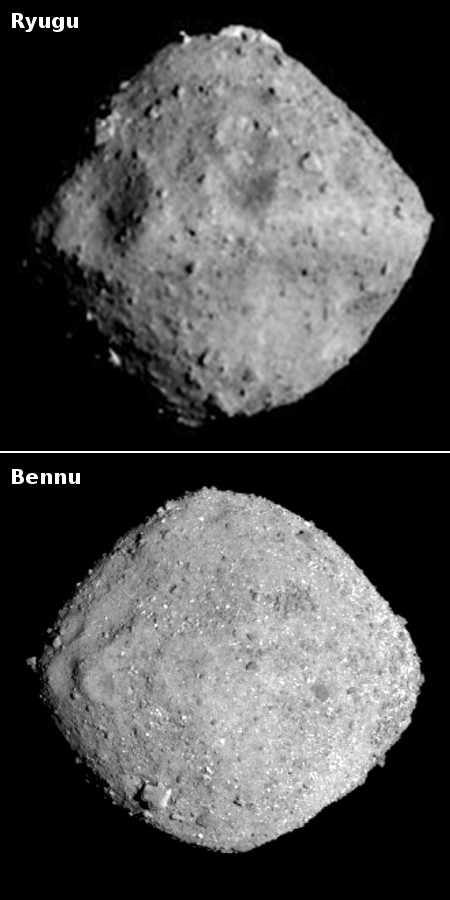
Scientists comparing the spectroscopy of samples returned from the near Earth asteroids Bennu and Ryugu have found they closely resemble the much larger main belt asteroid Polana, suggesting all three formed at the same time and place.
You can read the paper here [pdf] From the press release:
The study compared spectroscopy data from Polana with spacecraft and laboratory data from Bennu and Ryugu samples, discovering similarities in their near-infrared spectrum sufficient to support the theory that they originate from the same parent asteroid. “Very early in the formation of the solar system, we believe large asteroids collided and broke into pieces to form an ‘asteroid family’ with Polana as the largest remaining body,” said SwRI’s Dr. Anicia Arredondo, lead author of the study. “Theories suggest that remnants of that collision not only created Polana, but also Bennu and Ryugu as well.”
While the similarities are great, the paper notes there are differences, possibly from “space weathering, particle size, surface texture, or different compositions.” The scientists believe the differences were caused by the asteroids’ different environments, with the 33-mile-wide and much older Polana in the asteroid belt beyond Mars, and Ryugu and Bennu, both less than a mile wide, orbiting the Sun inside Mars.
It is also possible the asteroids have little to do with each other, and the similar spectroscopy only informs us of some of the more common components of the early solar system.

Proposed Australian spaceports.
Click for original image.
After being forced to change locations because of red tape and the refusal of the local aborigine authorities to sign an agreement, the Australian commercial spaceport startup Space Centre Australia has now obtained a land lease for its new location, dubbed Atakani, on the eastern shore of Cape York.
Space Centre Australia Pty Ltd (SCA) has secured a spaceport land lease, signing a multi-decade agreement with the local Traditional Landowners for approximately 300 km² at Billy’s Lagoon, Cape York. The agreement paves the way for the development of the Atakani Space Centre (ASC).
The Binding Term Sheet, signed with the support of Mokwiri RNTBC, marks the first time an Australian-based spaceport has secured a lease and opportunity of this scale. It ensures Traditional Owner access to country for cultural and ceremonial purposes, governance participation through the soon-to-be-established Luthiggi Corporation, and direct involvement in environmental management, cultural heritage monitoring, and operational activities. A royalty framework will deliver long-term economic benefits in addition to the spaceport’s operational revenue.
At the moment it appears the spaceport’s focus will be attracting suborbital launch companies, with the eventual goal to bring orbital rockets to the site.
China today successfully placed seven satellites into orbit, its Kinetica-1 (or Lijian-1) rocket lifting off from its Jiuquan spaceport in northwest China.
No word on where the rocket’s lower stages crashed inside China. Its state-run press provided almost no information about the launch, except for trumpeting the fact that it lifted off from the launchpad at Jiuquan that China has built for its pseudo-commercial companies. The rocket itself however is built by pseudo-company CAS Space, which is simply a division created by the government-run Chinese Academy of Sciences.
The leaders in the 2025 launch race:
101 SpaceX
47 China
11 Rocket Lab
9 Russia
SpaceX still leads the rest of the world in successful launches, 101 to 80.
An evening pause: Performed on French television in 1966. I suspect they are lip-synching to the record album, but the editing makes this hard to confirm.
Hat tip Diane Zimmerman.
Courtesy of BtB’s stringer Jay. This post is also an open thread. I welcome my readers to post any comments or additional links relating to any space issues, even if unrelated to the links below.

Increasingly irrelevant in the right places
My headline reflects the sense of utter irrelevance of the FAA in announcing its approval of the launch licence for the tenth test launch of Starship/Superheavy (now scheduled for August 24, 2025) as well as its “closing” of its “investigation” into the failure during test flight nine.
As per the FAA in its statement, “There are no reports of public injury or damage to public property. The FAA oversaw and accepted the findings of the SpaceX-led investigation. The final mishap report cites the probable root cause for the loss of the Starship vehicle as a failure of a fuel component. SpaceX identified corrective actions to prevent a reoccurrence of the event.”
The FAA did not “oversee” SpaceX’s investigation. No one at the FAA has the slightest qualifications for doing so. All its bureaucrats did is sit in and watch, and when SpaceX’s engineers completed their work and “identified corrective actions,” the FAA paper-pushers pushed some paper to rubber stamp those conclusions.
Moreover, unlike during the Biden administration, the FAA did not waste any time or money retyping the SpaceX investigation. They simply approved it as is, and issued the launch license. And they apparently instantly agreed to the schedule proposed by SpaceX. In fact, it appears almost as if SpaceX announced the date before the FAA announced the license approval.
Elections matter. And they would matter less if we had had the sense in the past century to not cede so much power to an unelected federal bureaucracy that is really unfit to do the work we gave them. The goal now should be to take that power away from them, and to do it as quickly as it is humanely possible.
It appears at least when it comes to FAA launch licenses, Trump has made some significant progress towards this goal.