
Justin Hayward – Forever Autumn
An evening pause: Performed live 2019.
Hat tip Alec Gimarc.
An evening pause: Performed live 2019.
Hat tip Alec Gimarc.
Courtesy of BtB’s stringer Jay. This post is also an open thread. I welcome my readers to post any comments or additional links relating to any space issues, even if unrelated to the links below.
Sounds good? Right now it is all fantasy.

Click for original image.
Cool image time! The picture to the right, cropped, reduced, and sharpened to post here, was taken on February 26, 2025 by the high resolution camera on Mars Reconnaissance Orbiter (MRO).
The scientists describe these features as “dendritic relief features,” an apt description of the thousands of miles of river-like meandering ridges that orbital images have discovered in the past decade scattered across Mars, as noted in 2016:
The inverted channels are similar to those found elsewhere on Mars and Earth. They are made of sand and gravel deposited by a river and when the river becomes dry, the channels are left upstanding as the surrounding material erodes. On Earth, inverted channels often occur in dry, desert environments like Oman, Egypt, or Utah, where erosion rates are low – in most other environments, the channels are worn away before they can become inverted.
The most dramatic example of these Martian ridge rivers are the fernlike ridges in Antoniadi Crater. The ridges to the right however are almost as striking.
» Read more
Due to its success in quickly redesigning the first stage of its Electron rocket into a hypersonic test vehicle dubbed HASTE, Rocket Lab has now won two very large hypersonic test program contracts from both the American Space Force as well as the United Kingdom.
Rocket Lab has been selected by the U.S. Air Force to participate within its Enterprise-Wide Agile Acquisition Contract (EWAAC), a $46 billion indefinite delivery-indefinite quantity (IDIQ) contract designed for the rapid acquisition of innovative technologies, engineering services, and technical solutions that develops the Air Force’s new capabilities. The program has a contracting period through to 2031 and is designed to be broad in scope, flexible in funding, and agile for maximum use to enable the Air Force to quickly procure services and technologies across various domains.
Further, Rocket Lab has also been selected by the United Kingdom’s Ministry of Defence (UK MOD) for its Hypersonic Technologies & Capability Development Framework (HTCDF), a ~$1.3 billion (£1 billion) framework to rapidly develop advanced hypersonic capabilities for the United Kingdom. As a newly-selected supplier to the HTCDF, Rocket Lab is now eligible to bid to provide services, technologies, and testing capabilities that support the UK’s development of sovereign hypersonic technology.
In both cases Rocket Lab will bid for test contracts using HASTE.
These deals indicate that Rocket Lab has essentially grabbed the business that Stratolaunch had been vying for with its giant Roc airplane and Talon test drop vehicles. Stratolaunch might get some contracts, but it appears the bulk of the work will instead go to Rocket Lab. It also appears that Stratolaunch has also been beaten to this business by the startup Varda, which has also won an Air Force contract for hypersonic testing using its orbital capsules during their return to Earth.
According to one government official, India’s space agency ISRO has now successfully completed a second autonomous docking in orbit using the target and chase spacecraft of its Spadex mission, launched in December 2024.
Between the undocking on March 13 and the second docking operation, Isro had carried out a “rolling” or “rotating” experiment — in late March. … At the time, Narayanan [ISRO chairman], while confirming the success of the operation, had said that more experiments were in store. … “…The satellites have a lot of propellant… I have only told [the teams] one thing, please do everything [on] simulation on ground [first]. Let us be very careful. Let us not make any mistakes as a wealth of data can be generated [through various experiments].”
The rolling experiment, which was likened to the Chandrayaan-3 “hop” experiment the space agency conducted on Moon in terms of learning it provides for future missions, helped Isro validate multiple softwares, ground station control and more.
This second docking further confirms the technology and the ability of ISRO’s engineers to perform it. Originally the plan had been to do only one docking. The two spacecraft were to then undock and go their separate ways, doing other orbital research. Narayanan changed that plan, since this technology is essential for India’s planned space station. The focus is now on multiple test dockings, in a variety of configurations, with more to come.
Early this morning SpaceX successfully launched a cargo Dragon to ISS, its Falcon 9 rocket lifting off from the Kennedy Space Center in Florida.
The first stage completed its fifth flight, landing back at Kennedy. The capsule is on its fifth flight, and is carrying significantly more cargo than previous SpaceX cargo missions because it has had to replace much of the cargo that would have been launched on a Cygnus capsule whose launch was cancelled because it had been damaged during transport.
Furthermore, as part of their updates on this mission NASA officials revealed that Sierra Space’s cargo mini-shuttle, Tenacity, is facing more delays, and is now not expected to launch until late this year. This Dream Chaser spacecraft had begun ground testing early in 2024, with a first launch planned for shortly thereafter. For reasons that have not been explained, that ground testing has now been going on for more than a year, and will apparently continue for most of 2025. My guess is that the spacecraft has experienced engineering problems during that testing, and has required fixes that neither Sierra Space nor NASA wishes to reveal.
The result has been that NASA has had a shortage of cargo vehicles to keep ISS supplied. A significant number of science experiments had to be removed from today’s Dragon to make room for consumerables. NASA officials also stated publicly during this update that it is now definitely considering using Starliner as a cargo vehicle on its next flight, a plan that previously had only been hinted at.
The leaders in the 2025 launch race:
45 SpaceX (with another launch scheduled for later today)
20 China
5 Rocket Lab
5 Russia
SpaceX now leads the rest of the world in successful launches, 45 to 35.
On April 9, 2025 Northrop Grumman’s first Mission Extension Vehicle (MEV-1) successfully undocked from an Intelsat communications satellite five years after attaching itself to it and extending its operational life for that time period.
This was the first autonomous undocking by two commercial spacecraft ever.
MEV-1 has provided five years of life-extension services to IS-901, allowing Intelsat to operate this space-based asset beyond its design life. In 2020, MEV-1 successfully proved docking with IS-901 was possible in the GEO graveyard orbit and brought IS-901 back into operation in GEO. Now that life-extension services are complete, MEV-1 released the IS-901 satellite back into the GEO graveyard and is relocating to the next servicing mission.
The company did not name the satellite for MEV-1’s next servicing mission. Meanwhile the company’s second MEV remains docked to another Intelsat communications satellite, its contract extended to double the amount of time it will provide service to the satellite.
A Russian Soyuz capsule successfully landed in Kazakhstan this morning, bring two Russians and one American back to Earth after a seven month mission to ISS.
The American on board, Don Petit, also celebrated his 70th birthday today, completing his fourth mission in space. According to the article at the link, he did not do well upon landing, requiring significant aid to exit the capsule. The picture released by NASA of him being carried to the medical tent shows him smiling with a thumbs up, but he is clearly unable to walk at this point on his own. That fact by itself is not significant, because many astronauts after missions lasting longer than six months need aid upon return. It does indicate however that this flight is almost certainly Petit’s last one. As that NASA release it notes he “is doing well and in the range of what is expected for him following return to Earth.”
SpaceX early this morning successfully launched a classified reconnaissance satellite for the National Reconnaissance Office, its Falcon 9 rocket lifting off from Vandenberg in California.
The first stage completed its twelfth flight, landing on a drone ship in the Pacific.
The leaders in the 2025 launch race:
44 SpaceX
20 China
5 Rocket Lab
5 Russia
SpaceX now leads the rest of the world in successful launches, 44 to 35.
China today successfully placed a set of six technology test satellites into orbit, its Long March 6 rocket lifting off from its Taiyuan spaceport in northeast China.
No word on where the rocket’s lower stages and four strap-on boosters crashed inside China. Furthermore, the upper stage of the Long March 6 rocket, which reaches orbit, has a history of breaking up and creating clouds of space junk. We have no assurance from China whether they have fixed this issue.
The leaders in the 2025 launch race:
43 SpaceX
20 China
5 Rocket Lab
5 Russia
SpaceX still leads the rest of the world in successful launches, 43 to 35. (Note: this last number is corrected from the previous update, which was one number short.)
Embedded below the fold in two parts.
To listen to all of John Batchelor’s podcasts, go here.
» Read more
An evening pause: Technology that makes it possible for humans to live better lives.
Hat tip Judd Clark, who adds “Ten acres/hour, doing the work of 250 or more hand pickers.”
Enjoy your weekend!
Courtesy of BtB’s stringer Jay. This post is also an open thread. I welcome my readers to post any comments or additional links relating to any space issues, even if unrelated to the links below.
The uncertainty of science: Scientists studying four different core samples drilled by the Mars rover Curiosity have detected abundant amounts of the iron carbonate mineral siderite, suggesting that there is more carbon within Mars’ crust than previously believed.
If that quantity of carbon is confirmed, there might also have been a carbon cycle between Mars’s atmosphere and the liquid water theorized to have once been on the surface. This cycle could also have made the atmosphere both thicker and warmer, conditions necessary for that liquid water to exist on the surface. From the research paper:
[D]ecomposition of siderite occurred in multiple locations and released CO2 into the atmosphere, recycling CO2 that was originally sequestered during siderite formation. Diagenetic carbonate destruction observed elsewhere on Mars, in martian meteorites, and in sandstones on Earth yields nearly identical reaction products to those we found in Gale crater and are observed globally in orbital data. We therefore conclude that in situ, orbital, and terrestrial analog evidence all indicate that postdepositional alteration of siderite closed the loop in Mars’ carbon cycle, by returning CO2 to the atmosphere.
The uncertainties here are gigantic. For these conclusions to be right, the scientists extrapolate without evidence the same amount of CO2 found in these four cores as existing across the entire surface of Mars. That is a very big extrapolation that no one should take very seriously.
Furthermore, this research assumes the geological features we see on Mars were formed from liquid water. More recent orbital data suggests glacial and ice processes might have played a part instead, with one study concluding that Gale Crater was never warm enough for long-standing liquid water, and that ice and glacial processes must have played the larger part in forming what we find there.
The data from these core samples however is intriguing for sure, though it mostly raises more questions about Mars’ past geological history than it answers.

Capitalism in space: In another indication that India’s governments are going full bore for private enterprise in space, two different Indian states this week announced new space policies designed to attract private investment and space startups.
Those two states, Tamil Nadu and Gujarat, are shown on the map to the right. Tamil Nadu announced its new space industrial policy hopes to attract more than a billion dollars in space companies to the state. Gujaret in turn announced its own space policy aimed at attracting $5 billion in investment and 25,000 jobs over the next five years.
It is not surprising that Tamil Nadu has issued this policy, considering that it is the state where India’s new second spaceport, Kulasekarapattinam, is located, and is being built as a launch site for commerical operations. Gujaret is at first glance less obvious, but it houses a major facility of India’s space agency ISRO. It is also one of India’s most industrialized states.
Both however illustrate the impact of the Modi government because of its policy to encourage private enterprise and de-emphasize government control. Not only is the federal government pushing capitalism, the country’s individual states are joining in.
My regular readers will know that I consider NASA’s Aerospace Safety Advisory Panel (ASAP) to be less than useless, repeatedly showing strong biases that allow it to miss major safety issues while causing headaches where no safety problems exist. Those biases consistently favor NASA and the older big space companies while attacking the new space companies like SpaceX.
This week the panel held its quarterly public meeting, and illustrated their uselessness and bias once again. Suddenly they have noticed that ISS has a serious chronic air leak problem due to the stress fractures in the Russian Zvezda module. They also came to the brilliant discovery that ISS is big, and that its de-orbit will have to be done carefully.
Oh my! Will wonders never cease!? These facts have only been documented at length and frequently by numerous inspector general reports and NASA updates over the past half decade. NASA has in fact contracted SpaceX to build a specialized de-orbit spacecraft, larger than a Dragon capsule, to dock with the station and conduct the de-orbit.
NASA didn’t need this safety panel to tell it the obvious.
Meanwhile, the panel suddenly decided it must chime in on budget issues and the possibility of there being major cuts at NASA, something that is entirely outside its area of responsibility. And to no one’s surprise it announced that budget cuts are bad!
Nor did the panelists see any safety issues with putting astronauts in an Orion capsule and flying them around the Moon on the next Artemis launch, even though NASA and its inspector general have both determined that the capsule’s heat shield is unreliable. The panel also had no problem with flying humans in this capsule the very first time its environmental system is tested.
To these political hacks, they see “we see no showstoppers at this time” for this SLS/Orion manned mission.
Instead, as always, the panel focused its criticism and concerns on SpaceX and Starship, labeling its development “the biggest risk” in NASA’s program to get Americans back to the Moon.
The most hilarious aspect of the panelists’ public comments is that they had nothing to say about Boeing’s Starliner, a pattern the panel has followed since Boeing and SpaceX got contracts a decade ago to transport astronauts to and from ISS. Consistently the panel has seen phantom safety risks with SpaceX — where none existed — while ignoring or completely missing Boeing myriad failures. That pattern continues.
NASA does face budget cuts. It would certainly help the agency if every dime wasted on this panel could be funneled into more useful purposes.
An evening pause: Hat tip Rex Ridenoure, who notes, “This musician emulates the style of Knopfler (lead guitarist of the Dire Straits) and Gilmour (lead guitarist for Pink Floyd). Knopfler uses only his fingers; Gilmour uses a pick.”
Courtesy of BtB’s stringer Jay. This post is also an open thread. I welcome my readers to post any comments or additional links relating to any space issues, even if unrelated to the links below.
David Livingston has now posted my appearance on the Space Show from April 15, 2025, available for download here.
As always a fun show. Much of the discussion revolved around NASA’s budget, Jared Isaacman, and the future of the American space effort. The discussion about the consequences of Elon Musk’s recent entrance into the political world on his space effort was especially enlivening.
As a historian I often bring to any discussion of modern politics and our American space effort a perspective that is very alien to modern Americans. I see things as they once were in the United States back before we had a big overbearing federal government that everyone looked to for leadership. Instead, I see the possibilities inherent in a free nation led by the people themselves, not the government, as America was for its first two centuries.
This sadly is not how America functions today, and it is for that reason that as a nation we can no longer get great things accomplished routinely, as we once did.
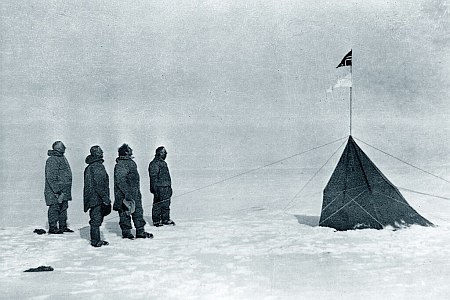
Norwegian Amundsen, first to reach the south pole.
To understand how different the American mindset once was, consider just one example, the 19th century effort by numerous nations and individuals to plant their flag at both the north and south poles. While a handful of private American citizens mounted their own expeditions to reach the north pole, none attempted to do so in Antarctica. At both poles the bulk of the effort was done by other nations, sometimes on expeditions privately funded, and sometimes by expeditions with extensive government aid.
In the U.S. however there was no government program to compete in this race. Nor was their the slightest desire by Americans to create one. The attitude of Americans then was very straightforward. They found the race to get to the poles exciting and fascinating, and thoroughly supported the efforts of the explorers both intellectually and emotionally. They however had no interest in their government committing one dime of their tax dollars on its own campaign.
You see, they did not feel a need to establish American prestige in this manner. So what other nations got to the poles first? What mattered to Americans then was what each American wanted to do, and what Americans wanted to do in the 19th century was to settle the west and build their nation into a prosperous place to raise their children.
And so, the south pole was first reached by a Norwegian, followed mere weeks later by an Englishman. Americans played no major role in that early exploration. Nor did it harm America’s prestige in the slightest that it did not compete there. The nation was growing in wealth and prosperity, its citizens were completely free in all ways to follow their dreams, and everyone worldwide knew it.
America might not be the leader in far-flung exploration, but the world knew it was the leader in something as important if not more so, the idea that a nation and a government could be built on the premise that the citizen is sovereign, and that all law should be based on making that citizen’s life, liberty and the pursuit of happiness primary in all things.
And in the end, it did not really matter that the U.S. did not compete in that race to the poles. » Read more