Falcon 9 upper stage to hit the Moon in August

Falcon 9 impact on Moon in August
Click for original image.

According to astronomer Bill Gray, who also tracks orbital objects, the upper stage of the Falcon 9 that launched Firefly’s Blue Ghost and Ispace’s Hakuto-R2 lunar landers in January 2025 will hit the Moon on August 5, 2026.

For some time, I’ve provided some software tools astronomers can use to identify satellites in their data. I use the US military’s publicly available satellite data for many objects, and compute orbits for high-orbiting objects the military doesn’t track.

This object falls squarely in the latter category. In September 2025, my software for computing orbits analyzed the observations and projected an impact with the moon on 2026 August 5.

While this looked like a pretty solid prediction, I couldn’t be totally sure of it at the time. The motion of space junk is mostly quite predictable; it simply moves under the influence of the gravity of the earth, moon, sun, and planets. We know those with immense precision. If those were the only factors involved, I could probably tell you where and when this object would hit the moon to within a few meters and a fraction of a second.

The problem is that space junk in general, and 2025-010D in particular [the upper stage], is also pushed around by sunlight (“solar radiation pressure”). This is an extremely gentle force, but over months, it can really build up. And it’s not entirely predictable. As an object tumbles, it may catch more or less sunlight, and may reflect some of it sideways. So sunlight is mostly pushing the object away from the sun, but there’s a slight bit of pushing in other directions as well.

With enough data, we can actually figure out where the forces are pushing an object. But they do change a little over time in ways that aren’t perfectly predictable. So I can be sure it will impact near the time and place I’ve predicted, but those varying forces mean that the actual impact will be at least a little off from that time and place. That’s the largest source of uncertainty in all this, and there’s no way to correct for it; we just have to wait and see what actually happens. (But come August, we’ll have a quite precise idea of where it will hit.

At present, Gray predicts the impact will occur at 2:44 am (Eastern) on August 5, 2026. The image above is his present estimate of where it will hit, as seen from Earth. If this prediction holds, the impact itself will likely not be visible from Earth, as it will occur in daylight and at the very western limb of the Moon. This prediction however could change somewhat in the next few months.

When it hits Gray estimates the stage will be moving at about 5,400 miles per hour, or 1.51 miles per second. Expect the science team for Lunar Reconnaissance Orbiter (LRO) to try to image this impact after the fact.

7 comments

Morocco signs the Artemis Accords

The State Department yesterday announced that Morocco has become the 64th nation to sign the Artemis Accords.

Moroccan Foreign Minister Nasser Bourita signed the Accords on behalf of the Kingdom of Morocco on April 29 at a ceremony in Rabat, Morocco. U.S. Deputy Secretary of State Christopher Landau and U.S. Ambassador to Morocco Duke Buchan III witnessed the signing.

It does appear that the success of the Artemis-2 mission around the Moon has prompted a number of smaller third world countries to finally sign the accords. Before the mission there had been a slow-down in new signatories. In only the past two weeks however Latvia, Jordan, and now Morocco have joined. We should expect more in the coming months, because they all want to get in on the game, while the getting is good.

The full list of nations in this American space alliance is as follows:

Angola, Argentina, Armenia, Australia, Austria, Bahrain, Bangladesh, Belgium, Brazil, Bulgaria, Canada, Chile, Colombia, Cyprus, Czech Republic, Denmark, Dominican Republic, Ecuador, Estonia, Finland, France, Germany, Greece, Hungary, Iceland, India, Israel, Italy, Japan, Jordan, Latvia, Liechtenstein, Lithuania, Luxembourg, Malaysia, Mexico, Morocco, the Netherlands, New Zealand, Nigeria, Norway, Oman, Panama, Peru, Poland, Portugal, Romania, Rwanda, Saudi Arabia, Senegal, Singapore, Slovakia, Slovenia, South Korea, Spain, Sweden, Switzerland, Thailand, the Philippines, the United Kingdom, the United Arab Emirates, the Ukraine, the United States and Uruguay.

1 comment

Two launches yesterday

Both SpaceX and Arianespace successfully completed orbital launches yesterday. First, SpaceX placed another 24 Starlink satellites into orbit, its Falcon 9 rocket lifting off from Vandenberg Space Force Base in California. The first stage completed its 13th flight, landing on a drone ship in the Pacific.

Next, Arianespace placed 32 more Amazon Leo satellites in orbit, its Ariane-6 rocket lifting off from France’s French Guiana spaceport in South America. The expendable Ariane-6 launched for the second time in its most powerful configuration, with four side boosters. This was also Arianespace’s second launch this year, so it remains off the leader board below. It is also the second launch in Arianespace’s 18-launch contract with Amazon to launch Leo satellites. The satellites were placed at an orbit of 465 kilometers, which SpaceX has claimed violates its Starlink orbital territory. Amazon has agreed what it is doing is a violation, but says it will continue to do so for this and two more launches.

With this launch, Amazon now has 302 Leo satellites in orbit, out of the 1,616 it needs to launch by July to meet its FCC license requirement. The company’s request for a time extension is presently pending at the FCC.

The leaders in the 2026 launch race:

52 SpaceX
23 China
8 Russia
6 Rocket Lab

For the third straight year SpaceX continues to lead the entire world combined in total launches, 52 to 44.

Russia was also supposed to do a test suborbital launch of its new Soyuz-5 rocket. As of posting I have not been able to confirm whether the launch took place.

8 comments

April 29, 2026 Quick space links

Courtesy of BtB’s stringer Jay. This post is also an open thread. I welcome my readers to post any comments or additional links relating to any space issues, even if unrelated to the links below.

9 comments

Who really was Jay Gould?

The life and legend of Jay Gould

To get to the point, right at the start, Jay Gould was not a “Robber Baron”, nor was he the worst “Robber Baron,” as many journalists of his time as well as many historians in the next century liked to slander him, implying he was unethical, cruel, and routinely used under-handed tactics to destroy others while making himself wealthy. In fact, he was no more a robber baron then the entire class of hard-nosed businessmen who in the 1800s became America’s first generation of today’s billionaires, using the free enterprise system to gather wealth to themselves while building vast industries that employed millions and made the lives of everyone better and more prosperous.

I have just finished reading Maury Klein’s 1997 fine biography of Jay Gould, the Life and Legend of Jay Gould, and was not surprised to learn that Gould was never the evil personification of worst sort of capitalist, as routinely portrayed by our leftist academia for the past century. Instead, I discovered he was no different then all the other leading businessmen of his time, hard-nosed and ruthless when it came to cutting deals, but strongly committed to making the businesses he ran profitable and successful, providing the public a useful product they would be eager to use.

You see, in a free capitalist society, you can’t succeed unless you are willing to be ruthless at times. This doesn’t necessarily mean you routinely use violence, or break the law, or go out of your way to hurt others, but it does mean you defend yourself from attack, and retaliate quickly using legal means when under attack. These rules apply today as they did in Gould’s time. Nothing has changed.

Gould was no different than Cornelius Vanderbilt (whose life I reviewed here). Nor does he differ from John D. Rockefeller, or Elon Musk, or Jeff Bezos, or any one of the thousands and thousands of American businessmen, who from the founding of this country used its free but legal framework to build a nation while enriching themselves.

Gould’s most famous area of success involved his ownership of many railroads, both in the American west as well as the first elevated subways in New York City. He also gained full control over Western Union, and for more than a decade ran a system that provided the entire country and even the world its first instantaneous method of communications. To gain control over these venues involved many battles, some of which required tactics that were harsh, even a bit under-handed, and clever. Sometimes it required payoffs to politicians, or tricky stock deals that once completed left many others sinking in the wake.

A typical anti-Gould newspaper cartoon from 1882

Gould’s tactics however were never much different than those of others of his ilk. And like those others, his overall good management of his companies he controlled, as well as the good treatment of the people who worked under him, garnered strong loyalty and support across these industries. Gould wanted control, but always when he had it he used it to make his product better and more useful.

When he died, it was the people who knew him who had good things to say about him, and it was the journalists who did not who continued to spread the slanders, because it made good copy and sold newspapers. And sadly, for the decades that followed, historians used those news reports — mostly wrong — as their primary sources of information, and thus the legend of an evil Gould was created.

Klein’s biography is a worthy effort to counter this bad history. More Americans should read it, if only to realize their past history was far more admirable than what they have been taught for the past few generations.

Gould’s tactics — and his success — were things he learned very earlier on in life, when he went out on his own.
» Read more

8 comments

Propaganda vs reporting in describing the battle over NASA’s budget

Jared Isaacman before the Senate

NASA administrator Jared Isaacman yesterday appeared before a subcommittee of the Senate Appropriations committee, and as happened last week when Isaacman appeared before a House committee, the reality of what happened at the hearing differed greatly from what most new sources reported.

The main topic of both hearings were the proposed $5.6 billion cut in NASA’s budget, proposed by President Trump. Isaacman has made it clear he does not oppose this cut, stating repeatedly in public that he has plenty of money to do what he wants, that there is much waste and needless spending at NASA that needs reform, and by trimming that out he will find the cash he needs.

As I noted in reporting about that House hearing, I was struck by the lack of hard opposition to those cuts. The Republicans generally made little of the issue, though they seemed generally opposed to the cuts. And though the Democrats as expected blasted the cuts, they did so in a generally subdued manner, only showing passion in noting the elimination to NASA STEM education office. Isaacman’s willingness to push back hard against more spending took the wind out of their demands for more money, and so they muted their protests.

Unfortunately, if you relied on our propaganda press for an honest report of this House hearing, you would have been misinformed. As shown below, that propaganda press distorted this reality to back big government spending without question.

The Senate hearing yesterday followed the exact same pattern. The questioning was generally friendly, and Isaacman aggressively pushed back at the demands for more spending by Democrats. This made their push for more spending more difficult, because Isaacman knows what he is talking about, supports an ambitious space program at NASA, and if he says he doesn’t need the extra money, they look foolish throwing it at him.

Yet, the propaganda press once again tried to spin the hearing to promote more spending. Though this hearing got less coverage, the following two stories were typical:

Only one news source (outside of my reporting here), R&D World, reporting this hearing accurately: Senate largely hearing splits on party lines over proposed $5.6 billion NASA cut

Now, I am not naive. I fully expect Congress to restore most of the proposed cuts to NASA’s budget. At the same time, both hearings suggest that Congress will also afford Isaacman more leeway on how he uses the money. He will be able to cut or reshape major projects. He will be able to shut down some offices that he considers wasteful or redundant. And above all, he will be given the freedom to reform NASA in ways no Congress has allowed in decades.

10 comments

Canada cancels $72 million contract to build constellation to track wildfires

In what appears to be an unexpected decision, the Canadian government this past week suddenly terminated a $72 million contract with the company Spire Global Canada to build a constellation of satellites designed to locate and track wildfires.

According to a Form 8-K filed with the U.S. Securities and Exchange Commission, Spire Global received a written notice on April 23, 2026, from the Minister of Public Works and Government Services (PWGS) terminating the agreement “for convenience,” effective immediately. The Phase B and C contract would have had an aggregate value of $71.8 million, including harmonized sales tax, if all contractual milestones had been achieved. The value of the overall WildFireSat satellite constellation including Phase D for manufacturing, system assembly, and integration is $106 million.
WildFireSat mission setback

This represents a serious setback for the Canadian Space Agency (CSA) and other government departments who are participating in the mission. Only a month ago the project was being touted as high return-on-investment climate mission in the annual Canadian Space Agency 2026–27 Departmental Plan.

The plan had called for a constellation of nine smallsats, with one back-up ready for launch on the ground.

No reason has been given for the cancellation. The Canadian Space Agency merely stated that “The Government of Canada will soon be engaging with industry and begin working closely with stakeholders on how best to advance the continued development of this important mission.” Spire Global meanwhile has until May 7th to apply for settlement costs.

12 comments

SpaceX’s Falcon Heavy launches Viasat communications satellite

Falcon Heavy at lift-off today

SpaceX this morning successfully placed a Viasat communications satellite into orbit, its Falcon Heavy rocket lifting off from Cape Canaveral Space Force Station in Florida.

This was the first Falcon Heavy launch in about eighteen months. The two side boosters completed their 2nd and 22nd flights respectively, landing back at Cape Canaveral. Fairings completed their 18th and 25th flights respectively.

The leaders in the 2026 launch race:

51 SpaceX
23 China
8 Russia
6 Rocket Lab

For the third straight year SpaceX continues to lead the entire world combined in total launches, 51 to 43.

4 comments

Rocket Factory Augsburg submits license application for a Saxavord launch window opening on July 1, 2026

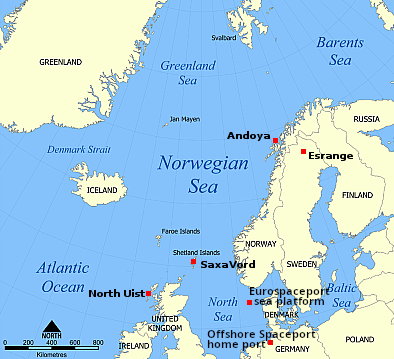
Proposed or active spaceports in North Europe

The German rocket startup Rocket Factory Augsburg has now submitted a new marine license application to allow it to attempt the first launch of its RFA-1 rocket from the Saxavord spaceport on the Shetland Islands in Scotland, with a launch window opening on July 1, 2026.

Rocket Factory had hoped to do this launch in 2024, but lost the first stage mere weeks before launch when it exploded during a final static fire test on the launchpad. Since then the company has undergone a management shake-up and made major changes to operations and its rocket.

To do this launch, however, it needs a new launch license, and that is a major problem. The company’s announcement is filled with numerous vague qualifiers, as it knows getting the bureaucracies in the United Kingdom to move quickly in this matter is nigh on impossible.

This is a legally required step for planning, and a good sign of how far we’ve come – but it’s not a launch date just yet. We applied for this window because we’re working hard to be ready – and we’re getting closer every day.

So: the application means we’re entering a new phase of preparation. Still, as with any first-ever launch, there are uncertainties, and the schedule may evolve. Further specific details around launch timing will be released through the appropriate channels closer to the time. We’ll keep you posted!

In other words, the company will not be surprised if it doesn’t get its license in time for July, and is prepared for delays.

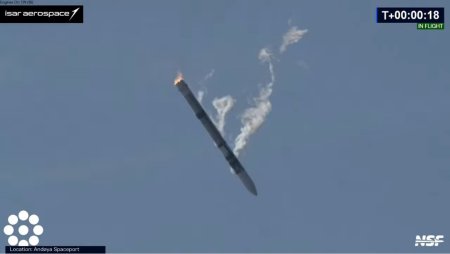
Another German rocket startup, Isar Aerospace, has been trying to launch its Spectrum rocket from Norway’s Andoya spaceport since January, with the launch scrubbed several times due to technical issues. Right now the launch its tentatively scheduled for May, which means the race to achieve the first orbital launch from Europe is tightening considerably.

If I had to place a bet, my money would be on Isar, not Rocket Factory, and the reason would be because I truly doubt the British bureaucracy will issue a license on time. Its track record has been abysmal, sometimes taking years to give an okay. In this case it might not take that long, since Saxavord has gotten all its own permits already (after years of waiting) but no one should be confident it will act with speed. And it is clear that the people at Rocket Factory are not.

0 comments

California Coastal Commission settles SpaceX lawsuit by apologizing and conceding all points

Wants to be a dictator
Wanted to be a dictator; ended up being
a patsy.

SpaceX yesterday settled its lawsuit [pdf] with the California Coastal Commission when the commission agreed to apologize to the company and agree it has no authority to regulate any SpaceX launches at Vandenberg Space Force Base.

The Commission agrees that it may not consider irrelevant factors in performing its function and specifically agrees that it will not take into account the perceived political beliefs, political speech, or labor practices of SpaceX or its officers in considering any regulatory action concerning SpaceX. The Commission acknowledges that Commissioners made statements, including during their October 10, 2024, hearing on the Base’s Falcon 9 launch program, that showed political bias against SpaceX and its CEO and were improper. The Commission apologizes for those statements, as set forth in the signed letter attached as Exhibit C.

The commission also agreed that it has no authority to regulate SpaceX’s launch rate at its launchpads at Vandenberg, and will never again attempt to interfere with these operations.

The SpaceX lawsuit stemmed from the comments made by the commissioners at a meeting in October 2024 when then voted against the military’s plan to allow SpaceX to increase its launch rate at Vandenberg spaceport to up to 50 launches per year. In those comments, the commissioners made it clear that the main reason they were voting against the motion was because they were offended by Elon Musk and his political positions, not because the company was doing anything wrong.

While the settlement does not restrict the commission’s right to regulate off-base actions, or other aspects under its statutory authority, this settlement is a complete victory for SpaceX. The commission members were probably made aware that if they didn’t back down completely, they would be personally liable for a great deal of damages. As a result of this settlement, they are absolved of all liabilities.

11 comments
1 14 15 16 17 18 74