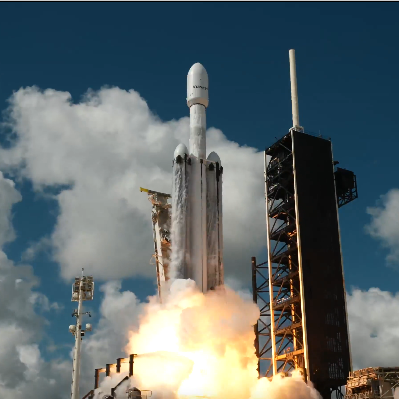
SpaceX files initial paperwork for going public

SpaceX logo

SpaceX yesterday filed the first confidential paperwork the the Securities and Exchange Commission (SEC) for its initial public offering (IPO) of public stock, now targeting a June-July time frame.

The filing was reported by Bloomberg, the Wall Street Journal and Reuters, citing unnamed sources familiar with the matter. SpaceX did not immediately respond to a request for comment. The SEC said it had no comment on the matter. The filing will lead to a sale of shares by June or July, according to the published reports. Confidential filings are used by companies to share information with the SEC and investors before they have to disclose to the broader public.

How much SpaceX plans to raise through a sale of some of its shares are not yet available due to the confidential nature. But CEO and principal shareholder Elon Musk is expected to control a majority of voting shares once the details are revealed. And it could make Musk, already the world’s richest person, that much richer.

SpaceX was valued at $800 billion and xAI $230 billion at their most recent funding round in January according to PitchBook, a research firm that tracks the valuation of private companies. That puts the combined companies’ worth at more than $1 trillion.

SpaceX also now includes X (formerly Twitter) that Musk bought for $44 billion, so the combined company is actually even larger. We still do not know any details, such as the number of shares to be sold as well as the initial sale price. One rumor has indicated that SpaceX wants to reserve 30% for sale to individuals, a number much higher than usual. Other rumors say that Musk is designing the sale to make sure he remains the majority stock-holder and thus in control of all three companies.

Stock experts have predicted this stock sale could garner SpaceX as much as $75 billion in cash, which would give it the resources to not only build its proposed million-satellite data center constellation in orbit but also develop the Starship/Superheavy infrastructure to build its own data center on the Moon. And along the way SpaceX would have the funds to do its own space program to settle Mars.

If SpaceX does raise that much, it will truly become America’s space program, doing far more that NASA and much faster — financed voluntarily by the American people.

11 comments

SLS successfully puts Orion into orbit

SLS less than a minute after launch

NASA’s SLS rocket today successfully launched the Orion capsule, carrying three Americans and Canadian on a planned ten-day mission swinging around the Moon and back to Earth.

During the countdown there were two minor issues, the second of which causes a slight ten-minute delay in the launch. Both were resolved very quickly, though one wonders if NASA can ever do a launch with this rocket without such issues during countdown.

The crew will remain in Earth orbit until tomorrow, checking out the capsule and its systems. Once they have confirmed these are working as expected, they will then fire their engines to head to the Moon.

The live stream can be viewed here.

As this was the first U.S. government launch this year (and the first since 2022), the leader board for the 2026 launch race remains unchanged:

40 SpaceX
16 China
5 Rocket Lab
4 Russia

SpaceX continues to lead the entire world combined in total launches, as it did in both ’24 and ’25.

22 comments

April 1, 2026 Quick space links

Courtesy of BtB’s stringer Jay. This post is also an open thread. I welcome my readers to post any comments or additional links relating to any space issues, even if unrelated to the links below.

4 comments

Court dismisses lawsuit from victims of multiple Boeing 737-Max crashes

Boeing Logo
Corrupt from top to bottom

The Fifth Circuit Court today dismissed the lawsuit by the families of the 346 victims of two Boeing 737-Max crashes, caused by Boeing’s admitted malfeasance and corruption, preventing those families from blocking a sweetheart deal between Boeing and the Justice Department that largely lets Boeing off the hook.

The court’s decision was vile in its own way, as noted by one of their lawyers:

In today’s ruling, the Circuit said that the families’ victims rights challenges to these agreements came too late to allow any remedy. But earlier, in 2023, the Circuit had said that the families’ challenges were “premature.” The fact that the families now will seemingly never receive any remedy is a cruel judicial bait-and-switch, revealing how much work remains to be done to create truly enforcable crime victims’ rights in the criminal justice system. [emphasis mine]

In other words, this court’s rulings over time essentially made it impossible for these victims to ever claim their rights under the Crime Victims’ Rights Act (CVRA).

The background: In 2018 and 2019 two of Boeing’s new 737-Max planes crashed, due to Boeing’s own design. The investigation into the crashes revealed that Boeing knew about these design flaws, lied about it to federal authorities, while doing nothing to fix the identified problems (behavior to which it has admitted). In 2021 Boeing pleaded guilty to malfeasance and corruption charges, and was given three years to clean up its act or face criminal prosecution.

When after three years Justice found Boeing had instead lied again while doing little to fix things, Justice first proceeded with prosecution, only to suddenly back off and make a plea deal that would have Boeing pay and/or invest up to $1.1 billion, about half of which would go to victims’ families.

To understand the opposition by the families to this deal, you need to read what the Justice Department determined about Boeing’s behavior.

A Justice Department investigation uncovered the fact that Boeing had lied to the FAA about the safety of the aircraft—lies that led directly and proximately to the crashes killing 346 passengers and crew. On January 7, 2021, the Justice Department filed a criminal information with a one-count conspiracy charge against Boeing, alleging that “From at least in or around November 2016 through at least in or around December 2018, in the Northern District of Texas and elsewhere, the Defendant, The Boeing Company, knowingly and willfully, and with the intent to defraud, conspired and agreed together with others to defraud the United States by impairing, obstructing, defeating, and interfering with, by dishonest means, the lawful function of a United States government agency.”

The families didn’t simply want money, they wanted justice. They wanted Boeing and its management to be prosecuted for their part in allowing 346 people to die unnecessarily.

At this moment, it appears they won’t get it, because of a similar malfeasance at the Fifth Circuit, which now seems as corrupt and as dishonest as Boeing.

4 comments

Watching the launch of the Artemis-2 mission

Artemis-2 mission flight path
The Artemis-2 flight path. Click for full animation.

The countdown for the launch of the 10-day Artemis-2 manned mission around the Moon continues, with the launch scheduled for 6:24 pm (Eastern) today.

For updates from NASA, go here. So far all is proceeding as planned. A step-by-step outline of the countdown itself can be found here.

A day-by-day detailed description of the planned mission can be found here. For the first day the crew will remain in Earth orbit in order to test the operation of their Orion capsule. To reiterate, the capsule’s life support system has not been flown in space previously, so this first day is critical. If there are any issues, the astronauts are still close to Earth and can return relatively quickly.

If no problems are detected during that first day, on day two the crew will fire the spacecraft’s engines and head to the Moon. At that point everything must function as planned for nine days as they travel out to the Moon, swing around it without going into orbit, and head back to Earth.

The return to Earth remains the most dangerous moment for this flight. During the 2022 unmanned test flight around the Moon, the heat shield design on Orion did not work as planned, with chunks breaking off in a manner that was unexpected and very concerning. NASA spent two years contemplating the issue, and decided to live with the same heat shield design for this mission, since replacing the shield would have delayed the launch at minimum two years. It has adjusted the return flight path in a way it thinks will mitigate the problem. As its engineers are only guessing at what caused the issue and could be wrong — having done no real life tests — we will not know if they are right until Orion splashes down.

We must pray that they are right.

I have embedded NASA’s live stream below.
» Read more

23 comments

March 31, 2026 Quick space links

Courtesy of BtB’s stringer Jay. This post is also an open thread. I welcome my readers to post any comments or additional links relating to any space issues, even if unrelated to the links below.

2 comments

Voyager-2 discovered Neptune to be a planet of quickly changing weather

Neptune's fast changing weather
Click for source.

Cool image time! When Voyager-2 flew past Uranus in 1986, the data showed the gas giant’s weather to be relatively sedate and quiet, with little changing during the fly-by. Scientists expected this: Uranus’s distance from the Sun meant it got little energy to fuel an active climate, with any activity produced by internal heating due to the gravitational pressure of its mass. And Uranus did not produce that much heat internally.

When Voyager-2 passed Neptune three year later, the scientists expected something similar, or even less, due to Neptune’s greater distance from the Sun. Instead, Voyager-2’s data showed Neptune’s weather patterns to be changing constantly and quickly, as illustrated by the three images of the Great Dark Spot to the right, the biggest storm on Neptune at that time and located in the planet’s southern mid-latitudes.

The bright cirrus-like clouds of Neptune change rapidly, often forming and dissipating over periods of several to tens of hours. In this sequence spanning two rotations of Neptune (about 36 hours) Voyager 2 observed cloud evolution in the region around the Great Dark Spot at an effective resolution of about 60 miles per pixel. The surprisingly rapid changes which occur over the 18 hours separating each panel shows that in this region Neptune’s weather is perhaps as dynamic and variable as that of the Earth. However, the scale is immense by our standards — the Earth and the [Great Dark Spot] are of similar size.

In Neptune’s frigid atmosphere, where temperatures are as low as 55 degrees Kelvin (-360 F), the cirrus clouds are composed of frozen methane rather than Earth’s crystals of water ice.

Subsequent observations by the Hubble Space Telescope in 1994 found this Great Dark Spot was gone, replaced by a comparable storm in the northern hemisphere. Further Hubble observations found Neptune’s storms tend to last about two years, fading as they drifted towards the equator. Those observations however also detected storms drifting away from the equator. Other research suggested the storms might be influenced by the Sun’s sunspot cycle.

All of the data post-Voyager-2 remains very coarse and uncertain, as we are looking at Neptune at a great distance. Thus, no theory about what is happening carries much weight, especially because we do not know why Neptune produces so much more internal heat than Uranus, fueling this fast-changing weather. For example, Neptune gets 1/20th of the energy received by Jupiter, yet its atmosphere appears even more active and variable.

2 comments

India’s space agency requests proposals for building landing legs for its next new rocket

NGLV as proposed in November 2025
NGLV (the two rockets in the middle) as proposed
in November 2025. Click for bigger image.

India’s space agency ISRO has issued a request for bids from the country’s commercial aerospace sector to build landing legs for its next new rocket, dubbed the Next Generation Launch Vehicle (NGLV).

The tender, titled “Fabrication of Landing Leg Hardware with materials for Advanced Development Module for In-situ Reusable Technologies (Admire) VTVL (10 units)”, seeks industry participation in developing critical components for a vertical take-off, vertical landing (VTVL) test vehicle under the ADMIRE programme.

…According to ISRO’s tender documents, the selected vendor will be responsible for end-to-end development, including procurement of raw materials, manufacturing, quality control planning, and final delivery of landing leg hardware. The project has been structured into three distinct phases spanning approximately 12 months.

The NGLV rocket was first approved by the India government in September 2024. Since then ISRO has completed the preliminary design of its methane engine, but has also revised the rocket’s design twice, in October 2024 and again in November 2025. This new landing leg contract suggests the agency hopes to do some test hops of a first stage prototype a year from now.

2 comments

A 2nd Starlink satellite since December fails catastrophically

According to reports from two different companies (here and here) that monitor objects in orbit, a Starlink satellite broke apart for unknown reasons on March 29, 2026.

SpaceX yesterday confirmed the incident.

On Sunday, March 29, Starlink satellite 34343 experienced an anomaly on-orbit, resulting in loss of communications with the satellite at ~560 km above Earth. Latest analysis shows the event poses no new risk to the Space_Station, its crew, or to the upcoming launch of NASA’s Artemis II mission. We will continue to monitor the satellite along with any trackable debris and coordinate with NASA and the USSpaceForce.

This is the second time in just over three months that a Starlink satellite has failed suddenly. In mid-December a Starlink satellite began to tumble when fuel began venting from a tank. It burned up in the atmosphere a month later.

Considering that SpaceX has approximately ten thousand Starlinks in orbit, any failures should not be a surprise. You launch that many, some are going to fail. That the company has only had two such failures indicates instead SpaceX’s incredible quality control in manufacturing, as almost every satellite works as expected with no such failure.

3 comments
1 26 27 28 29 30 74