SpaceX completes a largely successful 12th orbital test flight of Starship/Superheavy

Starship and Superheavy in flight

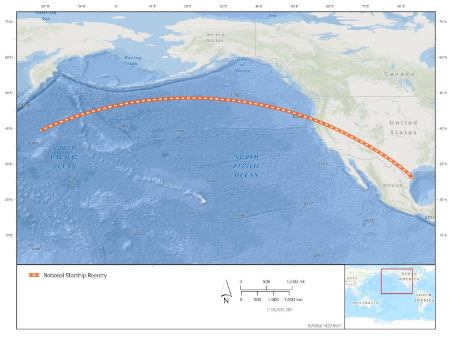
SpaceX today successfully completed its 12th orbital test flight of Starship/Superheavy, with Superheavy lifting off and getting Starship into its preliminary flight path and Starship then firing its engines and getting into a workable orbit that naturally decayed over the Indian Ocean.

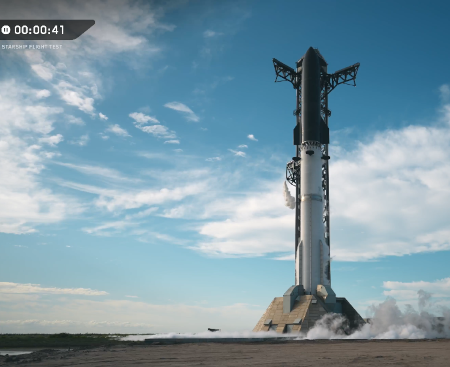
There were issues with several Raptor-3 engines, being used in flight on both Superheavy and Starship for the first time. During launch one Superheavy Raptor-3 engines cut off prematurely, forcing the other 32 engines to compensate for the loss. Then, after stage separation (shown in the screen capture to the right) Superheavy’s boost back burn cut off prematurely. As a result, the booster did not come down off the coast for a soft vertical splashdown as planned, but came down in the Gulf, mostly uncontrolled. It did successfully fire some engines for the landing burn, but that splashdown was hard.

As for Starship, it also had one engine shut down prematurely, requiring the other five engines to burn about 90 seconds longer to get the ship up to an acceptable orbit. Because of these engine issues, the engineering team decided to forgo a test restart of one Raptor-3 engine.

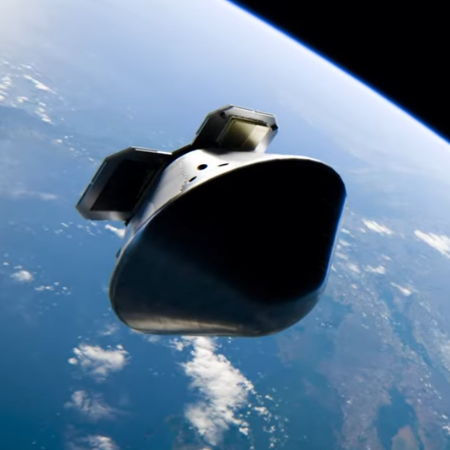
Starship then successfully deployed 20 dummy Starlink satellites, followed by two operational Starlink satellites that were modified expressly to provide visual observations of Starship and its heat shield while it is space. Only a few minutes later engineers were able to broadcast those observations, showing Starship as seen from nearby.

Starship then successfully executed its planned maneuver leading to a soft splashdown in the Indian Ocean.

Overall this sets the stage for a quick follow-up. Expect new test flights over the summer and fall, coming almost monthly. The company has made it clear it wants to do a two-week refueling mission with two Starship before the end of the year, as well as begin using Starship to deploy the bigger upgraded Starlink version 3 satellites.

Though this flight did not complete a full orbit, the rocket got Starship into an acceptable orbital path, allowing it to do most of the orbital testing desired. I consider this a success for the 2026 launch race:

60 SpaceX
28 China
8 Russia
7 Rocket Lab

For the third straight year SpaceX leads the entire world combined in total launches, 60 to 51.

40 comments

May 22, 2026 Quick space links

Courtesy of BtB’s stringer Jay. This post is also an open thread. I welcome my readers to post any comments or additional links relating to any space issues, even if unrelated to the links below.

1 comment

Isaacman rearranges the deck chairs on the Titanic of NASA

NASA logo

NASA administrator Jared Isaacman today announced major bureaucratic changes at NASA designed to make the agency’s work more “mission centric”, to use his words.

To improve our operational efficiency, we must evolve the organization to be more ‘mission centric’, with specialized centers properly resourced to support current and future requirements. To do this, we will separate lines of authority between preparing and supporting the workforce and executing the mission.

Center Directors will continue reporting to the Associate Administrator, focused on empowering the workforce and maintaining the facilities and critical capabilities at their Centers. Mission Directorates will now report to the Administrator with the primary focus on leveraging Center resources, industry, and international contributions to execute on the mission as urgently and efficiently as possible. We will also take this opportunity, where appropriate, to consolidate departments, flatten org structure and enhance HQ by rotating operational expertise into critical functions.

Isaacman’s memo is long, and involves a lot of reshaping, including an attempt to give specific research focus to each of NASA’s existing centers, while consolidating several departments at NASA headquarters to make operations more efficient. A good summary can also be found here.

Overall, Isaacman’s changes seem logical and smart. At the same time, I’ve seen new NASA administrators do the same time after time, without actually accomplishing any real change. In a sense this is no different than rearranging the deck chairs on the Titanic as it sinks. You aren’t really fixing the problem, you are making believe you are doing so.

To really fix NASA will require major cuts, with whole centers and bureaucracies eliminated. If NASA is going to depend on the private sector to get things done — which is very clearly doing at this point — it doesn’t need its present large labor force. All it needs is a trim small bureaucracy in Washington to manage the contracts it hands out as it lets the commercial industry develop and build the rockets, spacecraft, and interplanetary bases the U.S. requires.

Isaacman is not willing or able to do this, however. He might want to (though nothing he has said suggests he does) but even if he did Congress will not let him. It wants NASA funded to keep those pork-laden unproductive jobs alive in their numerous congressional districts.

And so, the deck chairs get rearranged.

5 comments

Watching SpaceX’s 12th Starship/Superheavy orbital test flight

After yesterday’s scrub, SpaceX has now rescheduled the 12th test orbital launch of Starship/Superheavy for later today, with a launch window opening at 5:30 pm (Central).

The upcoming flight will debut the next generation Starship and Super Heavy vehicles, powered by the next evolution of the Raptor engine and launching from a newly designed pad at Starbase.

The flight test’s primary goal will be to demonstrate each of these new pieces in the flight environment for the first time, with each element of the Starship architecture featuring significant redesigns to enable full and rapid reuse that incorporate learnings from years of development and test.

I have once again embedded below several different live streams of the flight.
» Read more

17 comments

Starlab gets another investor

Starlab design as of December 2025

The consortium building the Starlab space station today announced that the investment firm 1789 Capital has made a “strategic investment” in the station’s construction, though neither would state the amount of that investment.

Starlab Space Stations and 1789 Capital announced 1789 Capital’s strategic investment in Starlab. The investment reflects mounting confidence that Starlab — the U.S.-led joint venture, next-generation commercial space station — represents a durable and commercially grounded cornerstone of the post-International Space Station (ISS) low-Earth orbit (LEO) economy.

…“America built the space age and must lead the next one,” said Omeed Malik, founder and president, 1789 Capital. “We invest in the next chapter of American exceptionalism, and Starlab is turning that vision into reality.” The firm’s investment in Starlab reflects its thesis that critical infrastructure — from the digital to the orbital — represents a generational opportunity where national interest and investor returns are aligned.

When asked, Starlab’s press office simply said “We are not disclosing the value at this time.” This has been the company’s policy when it comes to private investment. In January 2026 it announced another major investor without disclosing the amount invested.

Nonetheless, this new investment strengthens Starlab’s overall position, even if that support is tentative. In my rankings below of the five stations under development, Starlab, Vast, and Axiom remain essentially tied for first place..
» Read more

0 comments

Using Webb astronomers think they have detected daily weather changes on exoplanet

The data confirming explanet's existence from 2014 paper
Figure 1 from the 2014 paper confirming exoplanet’s existence.

Using the Webb Space Telescope’s infrared spectroscopic data astronomers believe they have detected the daily weather changes on exoplanet WASP-94A b, a hot gas giant about half the mass of Jupiter that orbits its star every four days.

Observations revealed that mornings and evenings on WASP-94A b have extremely different weather patterns: Mornings are riddled with clouds made of magnesium silicate, a common mineral found in rocks, while the evening has clear skies.

The star itself is about 700 light years away, and is known to have two exoplanets circling it.

The scientists proposed two explanations for their data. Either strong winds are clearing the air in the evening, or the clouds are the equivalent of morning fog on Earth that naturally dissipates as the day brightens.

Note that there is great uncertainty with these results, as we are only getting a very limited view from 700 light years away. In a sense, our knowledge of these exoplanets is comparable to what we knew of our own solar system’s planets prior to the space age. Once we got our first close looks at the planets almost everything we thought we knew beforehand turned out to be either wrong or misguided, due to the limited nature of the data.

1 comment

Zvezda module on ISS is leaking once again

According to a report today at Ars Technica, the Zvezda module on ISS is once again leaking station air, despite recent repairs to the stress fractures in its hull that had appeared in recent months to halt the air loss.

After a couple of sources reported this to Ars, NASA confirmed the issue on Thursday. On May 1, after Russian cosmonauts unloaded cargo from the Progress 95 cargo spacecraft, Roscosmos noted a “slow pressure drop” in the PrK module.

“Teams performed data analysis, which indicated a loss of about one pound per day,” NASA spokesperson Josh Finch told Ars. “Roscosmos allowed the pressure in the transfer tunnel to gradually decrease while monitoring the rate. The area now is being maintained at a lower pressure, with small repressurizations as needed. There are no impacts to station operations, and NASA and Roscosmos are coordinating on next steps.”

A loss of one pound of air per day is comparable to the leak rate back in 2019, as shown in the lower right corner of the graphic below. It is also one third the loss rate seen for much of the following five years, which is I suppose good news.

Figure 3 from September Inspector General report
Figure 3 from September 2024 Inspector General report, showing Zvezda’s location on ISS, as well as the station’s leak rate at that time.

At the same time, it suggests once again that every docking to Zvezda puts stress on its hull, and apparently causes either new cracks or the reopening of old ones. In such a situation, a catastrophic failure of the module remains a possibility that cannot be dismissed. NASA closes the hatch between the Russian and American halves of the station whenever there is a docking, but that is only band-aid covering a much more serious problem.

Without question ISS’s life span is impacted by this issue. The sooner the U.S. can replace it with at least one or two of the private commercial stations under development, the better.

10 comments

Rocket Lab launches radar satellite for Japanese company Synspective

Rocket Lab early today successfully completed its ninth launch (out of a 27-launch contract) for the Japanese radar satellite company Synspective, its Electron rocket lifting off from one of its two launchpads in New Zealand.

The leaders in the 2026 launch race:

59 SpaceX
28 China
8 Russia
7 Rocket Lab

For the third straight year SpaceX leads the entire world combined in total launches, 59 to 51.

2 comments

Rocket Lab wins $90 million Space Force contract to build two geostationary satellites

Rocket Lab yesterday announced it has been awarded a $90 million contract by the Space Force to build two geostationary satellites for the military’s “space doman awareness” constellation.

Though Rocket Lab has built and launched a number of low Earth orbit (LEO) satellites for both commercial and military customers, these two satellites will be the first in geosynchronous orbit.

Rocket Lab will serve as prime contractor and end-to-end mission provider, responsible for spacecraft design and manufacture, integration of the in-house Heimdall optical payload produced by Rocket Lab Optical Systems, launch integration onto a government-furnished launch vehicle, and on-orbit operations for up to five years following commissioning. The two satellites will be built on Rocket Lab’s Lightning bus, adapted for the thermal, radiation, propulsion, and station-keeping demands of GEO.

Though Rocket Lab is mostly considered a rocket company, it has done an excellent job diversifying its capabilities so as to sell aerospace products across a range of areas. This contract continues that successful trend.

0 comments

Starship/Superheavy launch scrubbed at T-40 seconds

Starship at that hold today

Though SpaceX mission controllers tried several times to restart the countdown when it went into an automatic hold at T-40 seconds due to some technical issues, they eventually decided to scrub the Starship/Superheavy launch today.

At present they expect to try again tomorrow, with a launch window opening at 5:30 pm (central). Expect updates later today or tomorrow.

One trivia fact noted during today’s broadcast. With its new more powerful Raptor-3 engines, Superheavy produces about 18 million pounds of thrust at launch. That is more than twice that of either the Saturn-5 rocket (seven million pounds) or the SLS rocket (8.8 million pounds). And remember, everything about Starship/Superheavy is intended to be reused, with Superheavy already proving its ability to do so.

23 comments

May 21, 2026 Quick space links

Courtesy of BtB’s stringer Jay. This post is also an open thread. I welcome my readers to post any comments or additional links relating to any space issues, even if unrelated to the links below.

1 comment
1 3 4 5 6 7 74