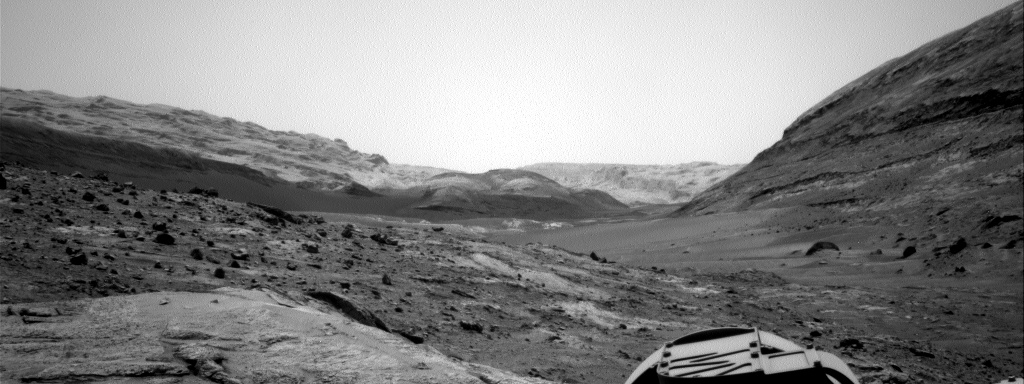
The barren hills west of Jezero Crater

The barren Martian hills west of Jezero Crater
Click for full panorama.

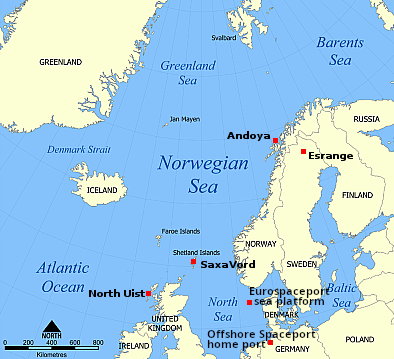
Overview map
Click for interactive map.

Cool image time! The panorama above, cropped and reduced to post here, was created on April 5, 2026 using 46 pictures taken by one of the high resolution camera’s on the Mars rover Perseverance. It also attempts to show this terrain in natural color.

The blue dot on the overview map to the right marks Perseverance’s present location. The green dot indicates where I think the rover was when the panorama was taken. (Note: I think the press release incorrectly lists the Sol number for these dates, but as I am not sure I can only guess.) The yellow lines indicate approximately the terrain seen in the full panorama.

As the press release notes, “the panorama offers one of the richest geological vistas of the rover’s mission, revealing a windswept landscape of diverse rock textures.” It also appears this is the direction the rover is presently headed.

I ask my readers to once again look at this panorama. It shows an utterly barren terrain. There is no life here, and if there ever was it was gone billions of years ago and never did much to shape the landscape. While some at NASA and in the planetary community like to tout the possibility of life on Mars in order to lobby for funding, the reality we see says there is none, and that life will only appear on Mars when humans finally arrive there to build new human societies.

5 comments

Intuitive Machines buys British ground station company

The lunar lander startup Intuitive Machines is now in the process of buying the British ground station company that operates antennas used for deep space communications in both Britain and the U.S.

Intuitive Machines announced May 14 that it entered into an agreement to acquire Goonhilly Earth Station Ltd. and its American subsidiary, Comsat. Intuitive Machines will pay 37 million pounds ($49.6 million) for Goonhilly, split equally between cash and stock, according to a Securities and Exchange Commission filing. The deal is expected to close in the third quarter pending regulatory approvals in the U.S. and U.K.

Goonhilly operates a ground station in Cornwall, England, that includes 30- and 32-meter antennas that have been used for lunar and deep-space communications. Through Comsat, it operates teleports in Southbury, Connecticut, and Santa Paula, California, that have dozens of antennas.

This antenna deal gives the company added flexibility in its future lunar missions. It also gives it a capability it can sell to both the European Space Agency as well as NASA. NASA for example is looking to accelerate in the next few years the number of unmanned lunar landers it will buy from the commercial sector. It also is looking for commercial options to improve its communications capabilities for those missions. Intuitive Machines is now better placed to compete for this work.

2 comments

Northrop Grumman completes successful test of new nozzle for its solid-fueled boosters

Unexpected debris falling from rocket at about T-1:00
Nozzle failure during February 12, 2026 Vulcan launch

Northrop Grumman on April 15, 2026 successfully completed a test of a new nozzle design of a GEM solid-fueled booster, the strap-on booster whose nozzle failed on two previous ULA Vulcan rocket launches.

On April 15, the company said Northrop Grumman performed a successful static fire test of a Graphite Epoxy Motor (GEM) 63XL Solid Rocket Booster (SRB). A spokesperson told Spaceflight Now on Thursday that the test served to “demonstrate nozzle design enhancements which were already in work and an advanced propellant technology for future solid rocket motors across their portfolio.”

“The information gathered from this test, along with findings from the investigations will provide critical data to validate analytical models and support Vulcan’s return to flight,” the spokesperson said.

At the moment the Pentagon has grounded all Vulcan launches because of this nozzle issue, and has given several planned Vulcan payloads to SpaceX instead. ULA hopes to resume normal Vulcan flights using GEM boosters before the end of the year, but it also hopes to launch Vulcan sooner without the boosters. It is right now preparing a boosterless Vulcan to do a launch for Amazon, placing an as yet undetermined number of Leo satellites into orbit. It is also possible it will do the same with AST SpaceMobile’s Bluebird satellites.

3 comments

Virgin Galactic releases ’26 first quarter financials; stock at new low under $3

The suborbital tourist company Virgin Galactic, that promised much over two decades and delivered little, this week released its ’26 first quarter financial statement, claiming its situation is “strong” with the completion of its “new SpaceShips”.

Two details however contradict this conclusion. First, revenue in the quarter were only $200K, down from $500K earned in the first quarter of 2025. Second, the company’s stock is now trading at under $3 per share, a far cry from the high of $62, when Richard Branson sold the bulk of his holdings and got out when the getting was good. It is also a quarter of the stock’s initial value when first issued in 2019.

The company hopes to resume flights with these new spacecraft later this year, but whether there is any substantial interest in suborbital tourism remains unknown.

Hat tip to BtB’s stringer Jay.

6 comments

China launches five classified satellites

China today successfully placed five classified satellites into orbit, its Kinetica-1 rocket (also called Lijian-1) lifting off from its Jiuquan spaceport in northwest China.

No word from China’s state-run press where the rocket’s lower stages crashed. The rocket itself is built by pseudo-company CAS Space, which is wholly controlled by a government agency.The leaders in the 2026 launch race:

56 SpaceX
27 China
8 Russia
6 Rocket Lab

For the third straight year SpaceX leads the entire world combined in total launches, 56 to 48.

SpaceX scrubbed a Starlink launch this morning, rescheduling it to tomorrow. It also hopes to launch a cargo Dragon to ISS this afternoon, a launch that has twice in the past week been scrubbed due to weather.

0 comments

May 14, 2026 Quick space links

Courtesy of BtB’s stringer Jay. This post is also an open thread. I welcome my readers to post any comments or additional links relating to any space issues, even if unrelated to the links below.

  • Video of the launch of Venera 10 on May 14, 1975
    The lander operated for 65 minutes on the surface of Venus, taking the second picture ever of that surface. It worked in conjunction with Venera-9, which launched a week earlier and took the first picture ever of Venus’s surface.
17 comments

Brain terrain on Mars?

Brain terrain on Mars?
Click for original picture. For full image go here.

Cool image time! The picture to the right, cropped and expanded to post here, was taken on April 2, 2026 by the high resolution camera on Mars Reconnaissance Orbiter (MRO). Labeled simply as a “terrain sample”, such images are usually taken not as part of any specific research project, but to fill a gap in the camera’s schedule. The camera team needs to take pictures at a regular cadence to maintain its proper temperature.

When they have such a gap, they try to find interesting things to photograph, and usually succeed. In this case we are looking at what I think the scientists dub “brain terrain,” a feature unique to Mars that is thought related to near surface ice and its sublimation, though at present the origins of brain terrain remain murky. The scale is approximately 100 meters across the width of this picture.

However, the location of this brain terrain makes any conclusions about its origin difficult.
» Read more

3 comments

Japanese company NEC initiates its own orbital tug project

Having won a grant from Japan’s $6.6 billion strategic fund (designed to encourage private enterprise in space), the Japanese company NEC Corporation has now begun work on its own commercial orbital tug, which it dubs an Orbital Transfer Vehicle (OTV).

Moving forward, NEC plans to conduct market feasibility studies, conceptual design, and demonstrations for OTVs by the end of fiscal year 2027 to clarify the required functions and other specifications. Following this, NEC plans to begin development of a demonstration model in fiscal year 2028, with the goal of launching it and conducting in-space demonstrations in fiscal year 2032, and aims to bring the technology to practical use in the future.

While the overall goal makes sense, the timetable seems far too slow. By the time NEC is ready with its operational OTV in 2032, at least a half dozen tugs will have been in operation for at least three to five years. Already several tugs have flown missions, with several more in the pipeline. Moreover, these companies have found less demand for tugs than expected, and have been repurposing their technology to other purposes.

Regardless, it does appear Japan is beginning to use this strategic fund as intended, to encourage the development of a private space industry, independent of its government space agency JAXA.

1 comment

Europa Clipper and Juice make simultaneous UV light observations of interstellar comet 3I/Atlas

Overview of November observations
Overview of November 2025 observations.
Click for original image.

By viewing interstellar comet 3I/Atlas when it was between the Jupiter probes Europa Clipper and Juice (on their way to Jupiter) in November 2025, the science teams for both were able to get a 360 degree view of the comet in ultraviolet wavelengths.

“As the comet passed between Juice and Europa Clipper, we were able to informally coordinate observations between the two spacecraft,” said Dr. Kurt Retherford, the principal investigator of Juice-UVS and Europa-UVS. “Crucially, we observed hydrogen, oxygen and carbon emissions. These elements are produced when gases escaping the comet’s nucleus break apart into atoms when exposed to sunlight.”

…“Observing the interstellar comet was some exciting bonus science. The resulting rare and unique dataset includes gas emissions and scattered dust,” said SwRI’s Dr. Philippa Molyneux, co-deputy principal investigator for the Juice-UVS instrument. “This was the first time we’ve had simultaneous direct views of a comet’s coma of escaping gas from two directions. Europa Clipper showed us the night side of the comet, with a great deal of scattered dust, while Juice imaged mostly glowing gas on the day side.”

…The researchers found higher levels of carbon emissions from 3I/ATLAS than expected early on, especially in comparison to typical comets from our solar system, corroborating similar findings through other observations about the interstellar comet’s origin and composition. Observing the trends of emissions over several days revealed how the ratios of these molecules changed and how the comet evolved during its journey through our solar system.

These results confirm once again that while Comet 3I/Atlas is from outside our solar system and has some unique features, it is still remarkably similar to ordinary comets found within our solar system.

0 comments

Pharmaceutical company to use Varda’s capsules to manufacture heart drugs in space

Varda's W-5 capsule after landing today
Varda’s fifth capsule after landing on January 29, 2026

The pharmaceutical company United Therapeutics Corporation has purchased space on an unspecified number of future Varda’s recoverable capsules so that it can manufacture pulmonary drugs in space.

Through the collaboration, Varda and United Therapeutics will conduct pharmaceutical processing of small molecule medicines for pulmonary disease aboard Varda’s orbital manufacturing and reentry platform during multiple missions to low Earth orbit.

The companies will utilize microgravity’s influence on the structure and crystallization properties of therapeutic compounds in pursuit of novel formulations that may improve stability, bioavailability, and other delivery characteristics. The first compounds to be analyzed onboard Varda spacecraft will likely be focused on therapies for patients living with life-threatening pulmonary diseases.

Varda has a deal in Australia to land 20 more capsules through 2028. This deal helps fill the payload space on those capsules.

As I have noted repeatedly, there is money to be made manufacturing drugs in weightlessness for later sale back on Earth, a reality that NASA has blocked on ISS for decades. Varda is now grabbing that market, which is also why a lot of investment capital has become available for a whole slew of proposed competing recoverable capsule companies.

1 comment

Chinese pseudo-company launches its expendable Zhuque-2 rocket

The Chinese pseudo-company Landspace successfully placed an experimental payload into orbit today (May 14th in China), its expendable Zhuque-2 rocket lifting off from the Jiuquan spaceport in northwest China.

Video of the launch (found by BtB’s stringer Jay) can be seen here. Zhuque-2 was the first methane-fueled rocket to reach orbit, but it is not reusable, as is Landspace’s larger Zhuque-3 rocket that has made one failed attempt to land its first stage. The company hopes to try again before the summer.

The leaders in the 2026 launch race:

56 SpaceX
26 China
8 Russia
6 Rocket Lab

For the third straight year SpaceX leads the entire world combined in total launches, 56 to 47.

0 comments
1 7 8 9 10 11 74