Curiosity looks closely at the broken slab that had been stuck on its drill bit

The rock Atacama
Click for original image.

As expected, the science team for the Mars rover hasdecided before moving on it would take a close look at the 28 pound slab of rock that had been stuck on its drill bit and when finally dropped free broken into several pieces when it hit the ground.

The top picture to the right, cropped and reduced to post here, shows that entire rock, labeled Atacama by the science team. The two insets below are close-ups of the delicate layering at the rock’s left edge as well as the drill hole itself. From team’s update today:

The highest-priority activities after liberating the drill included imaging the drill with Mastcam and ChemCam RMI, and imaging into the now-empty drill hole with MAHLI (the image above). The science team made the most of the freshly-broken surfaces created when Atacama fell back to Mars, and the freshly-exposed sand once hidden underneath Atacama.

The exposed sand is off camera, to the right. Expect a paper published about that sand, buried likely for millions of years, sometime in the next year or so.

The delicate flutes at the rock’s left edge are somewhat common rock features seen by Curiosity, made possible by Mars’ thin atmosphere and its one-third Earth gravity. On Earth the gravity and weather generally destroys such things. On Mars the lack of violent weather and light gravity allows them to form, and the thin wind even helps in their formation.

1 comment

SpaceX and Google negotiating deal to launch data centers into space

Though few details have been confirmed, according to the Wall Street Journal SpaceX and Google are in advanced negotiations to launch data centers into space.

We don’t know if these data centers will be part of a SpaceX/Google partnership, or whether Google is merely negotiating a SpaceX launch deal to place its own data centers in orbit. Nor do we know if this deal will use SpaceX’s Falcon rockets, or is aimed at using Starship when operational. Neither would surprise me. Nor would it be surprising if both occur.

The story is in linked to SpaceX’s impending initial public stock offering (IPO), expected to the biggest in history.

10 comments

OHB joins Dassault’s project to build a reusable mini-shuttle

Vortex
Vortex-S with service module attached. Click for original image.

The German aerospace company OHB has now joined with France’s Dassault Aviation in its project to build Vortex, a reusable mini-shuttle that could be used to supply cargo to the future commercial space stations presently under development.

An initial subscale demonstrator of the spaceplane, called the VORTEX-D, is being developed by the company with support from the French Ministry of the Armed Forces. During a 25 June 2025 hearing of the French National Assemblyโ€™s Committee on National Defence and the Armed Forces, it was revealed that the demonstrator is expected to be launched in 2028 and has a total project cost of โ‚ฌ70 million, with Dassault providing more than half of the funding and the remainder coming from the French government.

The VORTEX-S is expected to follow the VORTEX-D demonstrator. This larger, more complex variant will be developed in partnership with OHB following the finalisation of the 11 May agreement, as the companies seek to secure ESA backing for the project. According to the release announcing the partnership, discussions are also underway with other major European space companies to โ€œexpand the team.โ€

Dassault will remain the lead contractor, building the mini-shuttle. OHB will build the service module. The hope is that later versions of Vortex could also ferry crews to and from space.

This project started in 2023, and initially hoped to do the first test mission to ISS in 2026. That test flight is now targeting 2029, with later missions slipping beyond 2031 and now targeting missions to one of the new stations replacing ISS.

4 comments

Two overnight launches from SpaceX and China

Both SpaceX and China successfully completed launches since yesterday. First, SpaceX launched a new group of satellites for the National Reconnaissance Office, its Falcon 9 lifting off from Vandenberg Space Force Base in California. For security reasons, the number of satellites launched was not revealed.

The first stage completed its 9th flight, landing on a drone ship in the Pacific.

Next China launched another set of Qianfan (SpaceSail) internet satellites into orbit, its Long March 6A rocket lifting off from its Taiyuan spaceport in northeast China. Though China’s state run press did not reveal the number of satellites launched, past Long March 6A launches of this constellation have placed 18 satellites into orbit. If so, there are now 155 Quinfan satellites in space, out of a planned constellation of as many as 10,000. The first phase of the constellation however only requires 648, which China hopes to reach before the end of the year.

The state-run press also did not reveal where the rocket’s lower stages (using very toxic hypergolic fuels) crashed inside China.

The leaders in the 2026 launch race:

56 SpaceX
25 China
8 Russia
6 Rocket Lab

For the third straight year SpaceX leads the entire world combined in total launches, 56 to 46.

SpaceX hopes to complete another launch later today, carrying a Dragon cargo capsule to ISS (on its sixth flight), but weather might force a scrub. UPDATE: Scrubbed due to weather, rescheduled for May 13, 2026.

0 comments

May 11, 2026 Quick space links

Courtesy of BtB’s stringer Jay. Reader Nate P also sent me the second link. This post is also an open thread. I welcome my readers to post any comments or additional links relating to any space issues, even if unrelated to the links below.

7 comments

Springtime on the residual icecap of the Martian south pole

Weird hatchwork at the Martian south pole
Click for original image.

Cool image time! The picture to the right, cropped and rotated so that north is to the top, was taken on March 28, 2026 by the high resolution camera of Mars Reconnaissance Orbiter (MRO).

It shows what the science team labels a “south polar residual cap site.” The location is about 200 miles from the Martian south pole, well within the south polar ice cap. A second picture of this same spot was taken only a few days later, and was labeled “bright and dark fans on patterned ground.” With the second image the science team added their nickname for this location, “Troy,” which makes referencing it easier.

The hatchwork is the mystery here. In fact, the scientists have been monitoring this geology since 2020 to see if there have been any changes, either long term or seasonally. Almost certainly they have spotted seasonal changes, as indicated by the hatchwork itself and explained below, but I don’t access to the higher resolution images that would show any major modifications on a larger scale.
» Read more

1 comment

Psyche approaches Mars

Mars as seen by Psyche
Click for original image.

The asteroid probe Psyche is now approaching Mars for a May 15, 2026 fly-by that will slingshot it out to the metal asteroid Psyche in 2029.

The image to the right, cropped and expanded to post here, was taken on May 3, 2026 when the spacecraft was still about three million miles away.

The observation was acquired by the multispectral imager instrumentโ€™s panchromatic or broadband filter, with an exposure time of just 2 milliseconds. Even with this very short exposure time, the crescent is extremely bright and parts of the image are oversaturated. The light seen here is sunlight reflected off the surface of Mars and also scattered by dust particles in its atmosphere. Because the quantity of dust in the atmosphere can vary rapidly over time, the anticipated brightness of the crescent was hard to predict before this early image was acquired.

The dustiness of Mars leads to sunlight being scattered by its atmosphere, making the crescent appear to extend farther around the planet than if it had no atmosphere (as with our Moon).Of note, on the right side of the extended crescent, there appears to be a gap, which coincides with the planetโ€™s icy north polar cap. The cap is currently in winter and mission specialists hypothesize that seasonal clouds and hazes may be forming in that region, possibly blocking the atmospheric dustโ€™s ability to scatter sunlight like it does elsewhere around the planet.

Though the spacecraft had had a thruster issue last year, all seems well at this time.

10 comments

China launches Tianzhou freighter to Tiangong-3 station

China today (May 11th in China) successfully launched the tenth Tianzhou freighter to its Tiangong-3 space station, its Long March 7 rocket lifting off from its coastal Wenchang spaceport.

China hopes to keep this cargo freighter in orbit for a full year, as part of its effort to reduce the number of cargo missions per year while expanding the capabilities of its spacecraft and station.

The leaders in the 2026 launch race:

55 SpaceX
24 China
8 Russia
6 Rocket Lab

For the third straight year SpaceX leads the entire world combined in total launches, 55 to 45.

0 comments

Vast signs deal with Lithuania

Haven-1 with docked Dragon capsule
Artist rendering of Haven-1 with docked
Dragon capsule

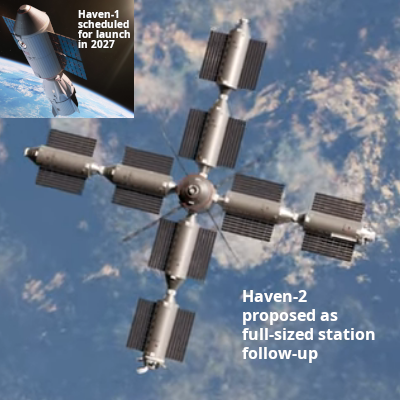
The space station startup Vast earlier this week signed an agreement with Lithuania to work together on future space missions, either to ISS or its Haven-1 single-module station scheduled for launch next year.

Under the agreement, Vast and Innovation Agency Lithuania will explore opportunities for joint scientific research activities either in the International Space Station National Lab or Haven-1, scheduled to be the worldโ€™s first commercial space station, launching in 2027. The partnership also includes plans to further develop educational programs in Lithuania and deepen engagement with local industry.

This deal is similar to Vast’s earlier deals with the European Space Agency, the Czech Republic, Colombia, Uzbekistan, Japan, and the Maldives. All are structured so that should Haven-1 reach orbit and be proven operational and safe for occupancy, these countries could consider sending their own astronauts on missions there. All thus show there is an international market for a private space station, a market that Vast is working hard to capture.

In other space station news, Voyager Technologies, the lead company building the Starlab station, released its 2026 first quarter fiscal report, indicating a solid financial position resulting from its diversification into military-based space applications. Though the report notes that “Starlab does not generate revenue today, nor is expected to generate revenue in the near term,” the company’s overall strength lays a strong foundation for that station’s eventual construction.

In my rankings below of the five stations under development, these two stations remain essentially tied for first place, with Axiom a close third.
» Read more

3 comments

Katalyst completes final ground testing of its Swift rescue spacecraft

Katalyst's proposed Swift rescue mission
Katalyst’s proposed Swift rescue mission.
Click for original image.

The orbital servicing startup Katalyst has now successfully completed the final ground testing of its Swift rescue spacecraft, dubbed LINK, that it hopes will be able to catch the Gehrels-Swift Telescope and raise its orbit, thus saving the telescope.

During vibration testing at NASA Goddard, engineers mimicked the shaking the spacecraft will experience during its launch from a Northrop Grumman Pegasus rocket. In the footsteps of Swift itself and NASAโ€™s upcoming Nancy Grace Roman Space Telescope, the Katalyst team also used NASA Goddardโ€™s Space Environment Simulator for thermal vacuum testing.

Once the air was pumped out of this 27-foot-wide chamber, LINK experienced space-like hot and cold temperature extremes. The team also practiced firing the satelliteโ€™s three xenon-powered ion thrusters and deployed one of the arms.

After some more testing in Arizona, the spacecraft will be integrated in June onto Northrop Grumman’s Pegasus rocket — the last one in its inventory — and launched later that month.

Katalyst has never done this before. It was preparing LINK as a demo mission when NASA requested bids for saving Swift. It proposed reconfiguring LINK for that purpose, and won the contract in September 2025, only eight months ago.

If this mission succeeds it will be a big feather in Katalyst’s cap.

9 comments
1 9 10 11 12 13 74