
Dave Matthews Band – Corn Bread
An evening pause: Performed live 2007.
Hat tip Clark Jerrell.
An evening pause: Performed live 2007.
Hat tip Clark Jerrell.


Click for original image.
Cool image time! The picture to the right, rotated, cropped, reduced, and enhanced to post here, was taken on August 16, 2025 by the high resolution camera on Mars Reconnaissance Orbiter (MRO). In mid-March it was featured as a captioned image by MRO’s science team. From their caption:
When they form, impact craters dig up material from below the surface and throw it outwards into what geologists call an ejecta blanket. The fastest ejected material travels the furthest so material from different depths can end up at different distances from the crater.
This HiRISE image shows a pedestal crater in Arcadia Planitia that has material of different brightness and color at various distances from the crater. This could tell us more about the material that’s buried below the surface here, but the situation is complex.
The caption however fails to mention the most interesting two aspects of this crater’s ejecta blanket. One, it suggests strongly that there was a lot of near surface ice at impact that melted to produce this splash apron.
Second, and even more intriguing, the 3,100-foot-wide unnamed crater is located smack dab in the middle of the candidate landing zone on Mars for SpaceX’s Starship spacecraft, as shown by the overview map above. The white dot marks the location of this crater, while the red dots mark the four prime landing sites, as suggested by scientists in a 2021 paper [pdf], based on conclusions drawn from two workshops organized by SpaceX and these scientists. The other dots are other MRO images of this region, and include a number of potential secondary landing sites.
This zone is in the northern lowland plains of Mars, in a mid-latitude region where near-surface ice is plentiful. The splash apron of this crater provides further evidence of that near surface ice.

As per the provisions in last year’s reconciliation budget bill (dubbed for propaganda reasons by Trump the “One Big Beautiful Bill Act”), the FAA was authorized to begin charging fees (another word for taxes) on the mass of each launch payload. The agency last week announced it is now doing so.
More information here.
For 2026, that fee is 25 cents per pound of payload, capped at $30,000 per launch or reentry. The fees would fund work on improving integration of launches and reentries into the national airspace system directed by an FAA reauthorization act in 2024.
Though the amount per launch is small compared to the cost of the launch itself, this new tax is expected to provide ample funds to allow the FAA to expand its licensing operations to meet the growing launch industry. The real challenge will be whether the bureaucracy can stay focused on its main task of serving the public, or use the money to build a new bureaucratic empire aimed at garnering power over the private sector. History suggests we should be pessimistic, and expect the latter.
In the meantime, rocket companies are simply going to apply this new tax to the makers of their payloads, who in turn will have their customers pay the cost.
ULA last night successfully launched another 29 Amazon Leo satellites into orbit, its Atlas-5 rocket lifting off from Cape Canaveral Space Force Station in Florida.
ULA is in the process of retiring the Atlas-5 rocket. It now has only eight Atlas-5 rockets left in stock, with two reserved for Leo launches and six for Boeing’s Starliner manned capsule (though there is a good chance some if not all of the Starliner launches will be switched to other payloads). Because its Vulcan rocket, intended to replace Atlas-5, is presently grounded, the company appears to be accelerating Atlas-5 launches, with this launch only about 24 days after the previous launch.
With this launch, Amazon now has 270 Leo satellites in orbit, out of the 1,616 it needs to launch by July to meet its FCC license requirement. Because it is not expected to meet that requirement, the company has asked for a time extension, which the FCC is presently considering.
As this was only the third launch by ULA in 2026, the leader board for the 2026 launch race remains unchanged:
50 SpaceX
23 China
8 Russia
6 Rocket Lab
For the third straight year SpaceX continues to lead the entire world combined in total launches, 50 to 43.
An evening pause: Hat tip Wayne DeVette.
Courtesy of BtB’s stringer Jay. This post is also an open thread. I welcome my readers to post any comments or additional links relating to any space issues, even if unrelated to the links below.
Link here. For an article in a mainstream media outlet the writing is remarkable in its general accuracy and understanding of the larger context. It is also quite thorough, covering all aspects of AST SpaceMobile’s business model and how it stacks up against its main competitor, SpaceX’s Starlink.
According to the article, the company still hopes to get as many as 45 of its large new Bluebird satellites in orbit by the end of this year, though it admits the New Glenn failure now makes that goal more difficult. As the article notes:
AST SpaceMobile is continuing to manufacture, assemble and test satellites in Midland, and it will soon ship three new BlueBird satellites for launch on a yet-to-be-announced rocket. [emphasis mine]
That unnamed rocket is likely the Falcon 9, but at some point AST must find other rockets, as there is likely a limit to how many launches SpaceX can provide. Both ULA’s Vulcan rocket and Blue Origin’s New Glenn are both presently grounded because of launch failures, and other than SpaceX’s Falcon-9 and Falcon Heavy they are the only American rockets capable of launching the Bluebirds. It is also doubtful AST can buy flights on Europe’s Ariane-6 rocket. Though that rocket has had trouble garnering customers because of its high cost, its operator, the European Space Agency’s (ESA) commercial agency Arianespace, has also been very slow to ramp up operations. Even if AST was willing to pay a premium, Arianespace would likely not be able to fit extra launches into its schedule.
Overall, this situation illustrates a great opportunity. There is a strong demand for rockets from the satellite industry that the present rocket industry — excluding SpaceX — has been unable to meet.
SpaceX’s Starlink internet service will once again be available in Papua New Guinea after its court this week overturned a ban that had been imposed by a government bureaucracy.
In early 2024, the [Ombudsman] Commission blocked licensing efforts for Starlink, arguing that existing regulations may not be adequate to manage potential risks to public interest and safety.
But in her National Court ruling last week, Judge Susan Purdon-Sully strongly criticised the Ombudsman Commission for its move to halt Starlink’s license process. Finding no breach of PNG’s leadership code, nor evidence of corruption, the judge said the Ombudsman’s concerns were more administrative, meaning its directive to NICTA had been “an unconstitutional exercise of power”.
Meanwhile, the prime minister again urged Starlink to work collaboratively with state-owned Telikom PNG to “ensure a coordinated rollout that complements national infrastructure priorities”.
The article describes in detail several recent natural disasters where the lack of Starlink was a critical component in rescue and repair operations. The country also has large rural areas where Starlink is the only method for reaching the rest of the world quickly. There was thus apparently great political pressure to end this ban.
According to a report today at Europeanspaceflight.com, the European Space Agency (ESA) paid Arianespace €51.65 million ($60.6 million) for a December 2024 launch using the Vega-C rocket that the Italian company Avio produces.
That flight was one of the last ones managed by Arianespace. In November 2025 ESA completed the transfer of ownership back to Avio, so that the company now manages and sells its own rocket, rather than have a middle-man government agency run things and take a cut.
Since then Avio has won three separate launch contracts, one from Taiwan for $81 million, another from Brazil for $35.6 million, and a third from Airbus for $84.4 million (see here).
Based on these numbers, it appears that Avio is doing much better selling this rocket directly to the market than having Arianespace and ESA run things for it. It is not only generally getting slightly more revenue per launch (about $67 million average compared to $60.6 million under Arianespace), but it is keeping all the profits, rather than having the Arianespace government bureaucracy take a percentage.
These numbers however won’t hold in the coming years. In the U.S. in the next year at least two reusable rockets — Rocket Lab’s Neutron and Stoke Space’s Nova — are coming on line, and will drive these launch prices down. Furthermore, new smallsat rockets being developed in Germany (two), Spain, India (two), South Korea, and Australia should do the same.
At the moment however Avio is benefiting from the present state of the market, though even that advantage is threatened because it has had to delay the next Vega-C launch due to a technical issue.
Regardless, these numbers give us a strong sense of the present competitive launch costs in today’s market, averaging about $60 million per launch. Before SpaceX came along, that price generally exceeded more than $100 million, and often as high as $200 to $500 million. No more. SpaceX has forced competition on the industry, and the result has been a notable drop in price, with more to come.
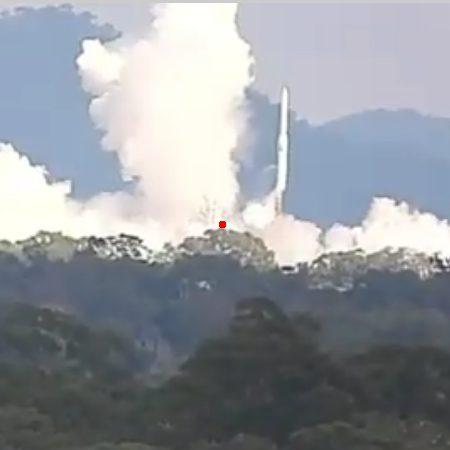
Click for video, cued to just before launch. The red
dot marks the launchpad location.
The Australian rocket startup Gilmour Space on April 24, 2026 released the results of its investigation into the launch failure seconds after liftoff of its Eris rocket in July 2025.
Our investigation found that approximately nine seconds after ignition, one of the four first-stage hybrid rocket motors experienced a loss of thrust. A second motor exhibited similar behaviour at around 17 seconds, reducing vehicle performance and bringing the mission to an early end.
Analysis identified two independent failure modes originating from the oxidiser pump subsystem. Electrical and thermal faults were observed in the electric pump motors and associated inverters, including components sourced from an external supplier. We now have a clearer understanding of the underlying causes.
The company hopes to try again later this year, but to do so it will need license approval from Australia’s bureaucracy, and such approvals have not been quick.
Hat tip BtB’s stringer Jay.
In a move that should surprise no one at this point in Trump’s second term, yesterday President Trump informed all 24 members of the National Science Board, the committee that runs the National Science Foundation (NSF), that they have been fired.
“On behalf of President Donald J Trump, I am writing to inform you that your position as a member of the National Science Board is terminated, effective immediately,” reads a 24 April email from Mary Sprowls of the presidential personnel office to each NSB member. “Thank you for your service.”
The article at the link, from the journal Science, takes the typical one-sided propaganda press anti-Trump view, interviewing only those who oppose Trump and spending most of its time screaming “He’s destroying science!”
A wider view would ask this: Is there a reason that the president of the United States, elected by the American people, might have reasons to question the management of this board? At the moment the federal government is running a deficit that is back-breaking, and this board publicly criticized Trump’s effort to rein in spending when he proposed a 55% cut in NSF’s budget. If they are not going to cooperate with their boss, then maybe they should leave, and not let the door hit them as they head out.
The Science article also included this howler: “the mass firing is the latest indication that the White House is ignoring the board’s authority and dictating policies at NSF.” Um, who elected them? No one. In fact, they were appointed by the president himself, and he is the only one with the constitutional authority to decide these matters.
Expect court suits of course, with some lower level unelected judge somewhere attempting to take over running the executive branch by demanding these board members remain in power, defying the elected president of the U.S.
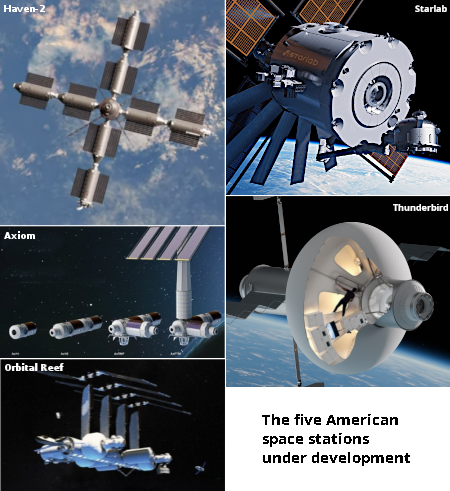
The startups building the commercial space stations Haven-1 and Starlab this week made deals that will further strengthen their positions both to win future NASA contracts while also making their own operations more functionally viable.
First, Vast, which hopes to launch its Haven-1 single module demonstration station next year and follow it up with its full Haven-2 station (as shown to the right), signed a deal with former NASA astronaut Sunita “Suni” Williams, making her the fifth astronaut to join the company’s astronaut advisory committee.
Former NASA astronaut and U.S. Navy Captain Sunita “Suni” L. Williams has joined Vast as an Astronaut Advisor. She joins Vast’s esteemed group of Astronaut Advisors led by Lead Astronaut Andrew Feustel, including Garrett Reisman, Megan McArthur, and former JAXA astronaut and Vast Japan General Manager Naoko Yamazaki.
It is clear each one of these former government astronauts sees the possibility of flying again to Vast’s Haven-1 station, which the company hopes to have occupied four times for two weeks during its three year mission. They are also hoping to be part of the much larger Haven-2 station to follow.
Vast in turn is now assembling a staff of very experienced professional astronauts it can use to lead all these proposed missions.
Next, Voyager Technologies, the lead company in the consortium building the single-module large Starlab station that will launch on Starship, signed an agreement with Yonsei University in Seoul, South Korea. While initially the deal will have the university do research at Voyager’s research facility in Ohio, it also lays the groundwork for the univesity to eventually get access on Starlab, once launched.
For Voyager this deal helps show NASA that there is a real market for these private stations, something NASA administrator Jared Isaacman has expressed doubts about.
In my rankings below of the five stations under development, the first three stations remain essentially tied for first place.
» Read more
SpaceX this morning successfully placed another 25 Starlink satellites into orbit, its Falcon 9 rocket lifting off from Vandenberg Space Force Base in California.
The first stage completed its 15th flight, landing on a drone ship in the Pacific.
The leaders in the 2026 launch race:
50 SpaceX
23 China
8 Russia
6 Rocket Lab
For the third straight year SpaceX continues to lead the entire world combined in total launches, 50 to 42.
The Indian rocket startup Skyroot has now finished assembling its Vikram-1 rocket, and is about to ship it to its launch site at the Sriharikota spaceport on the east coast of India.
At Sriharikota, the rocket moves into final assembly and a round of system checks before a launch window is locked in the coming months. This is the last stretch before liftoff. Countdown operations, testing and integration now shift fully to the launch site.
One of the company’s founders said the most critical testing has been completed, with launch campaign activities set to begin at the spaceport.
The company is presently targeting a launch in June. If Vikram-1 reaches orbit successfully, Skyroot would become the first Indian private company to design, build, and launch its own rocket, and would be well positioned to win launch contracts from smallsat companies, competing directly with Rocket Lab and its Electron rocket.
This success would also help accelerate the Modi government’s effort to transition from a space industry controlled entirely by its government space agency ISRO to a private industry run by competing indepedent companies.
In a press release posted last week Sierra Space proudly announced that its Tenacity Dream Chaser mini-shuttle has completed its pre-launch ground vibration tests at the Kennedy Space Center in Florida, but instead of moving the mini-shuttle to a local facility where it could be integrated with its rocket for launch, the company announced it was shipping it back “to Colorado for final modifications and mission-specific upgrades.”
Normally when a spacecraft, satellite, or any payload passes these last ground tests, it is ready for launch, and it immediately begins integration onto the rocket that will carry it into space. That Sierra Space is not doing this strongly suggests Tenacity did not pass with flying colors, and that some issues were identified that need correction.
Note too that this spacecraft had been delivered for these tests in early 2024, and had been expected to pass them then and be launched that year. Instead, months passed with no word, then its launch was postponed indefinitely, and then NASA canceled Sierra’s contract to provide cargo to ISS.
Now, two years later Tenacity is still not ready for launch. Though the company says the ground tests are now complete, I suspect otherwise. I suspect there is some fundamental issue with the spacecraft that they are hiding because to reveal it would be devastating to Sierra’s public reputation.
Until we know more however this is pure speculation on my part. What we do know however is that this mini-shuttle has not done what was promised, and increasingly appears to be a lemon that will never do it.
Both China and Russia completed launches today. First China put a Pakistani Earth observation satellite into orbit, its Long March 6 rocket lifting off from Taiyuan spaceport in north China. China’s state-run press made no mention of where the rocket’s lower stages, using very toxic hypergolic fuels, crashed inside China.
Next Russia launched a Progress cargo capsule to ISS, its Soyuz-2 rocket lifting off from Baikonur in Kazakhstan. The freighter will dock with ISS in two days.
The leaders in the 2026 launch race:
49 SpaceX
23 China
8 Russia
6 Rocket Lab
For the third straight year SpaceX continues to lead the entire world combined in total launches, 49 to 42.
As part of the first phase of development of the proposed Golden Dome defensive system, the Space Force revealed this week that it has awarded twelve companies contracts worth $3.2 billion to develop the first prototype designs.
The service awarded other transaction authority (OTA) agreements — worth up to a combined $3.2 billion — to the vendors in late 2025 and early 2026, according to a Space Systems Command press release. Under the contracts, the companies will develop prototypes of a space-based architecture that can shoot down enemy missiles after they’re launched.
The companies that received OTAs are Anduril, Booz Allen Hamilton, General Dynamics Mission Systems, GITAI USA, Lockheed Martin, Northrop Grumman, Quindar, Raytheon, Sci-Tec, SpaceX, True Anomaly and Turion Space Corp.
The twelve companies have very different capabilities, suggesting the Space Force is hoping to get a lot of different ideas and proposals that will not only give it options but could also provide it multiple methods for destroying in-coming missiles.
As promised, the Soyuz-2 launch site at France’s French Guiana spaceport was destroyed in a controlled explosion yesterday.
I have embedded video of the explosion below.
The remaining infrastructure at the site—including the assembly and testing complex, railway lines, liquid oxygen storage facilities, and fueling systems—will be transferred to MaiaSpace, a French startup affiliated with Arianespace. The company plans to reuse up to 80% of the existing infrastructure for its own launch vehicle program.
MaiaSpace is not “affliated with Arianespace.” It is a wholly owned subsidiary of ArianeGroup, the company that makes the much larger rocket Ariane-6. The company hopes MaiaSpace’s smaller Maia rocket can capture some of the smallsat business presently owned by Rocket Lab and SpaceX.
The Russians had almost a dozen launches scheduled from this launchpad, worth more than a billion dollars in revenue, when Putin decided to invade the Ukraine in 2022. Russia immediately became a pariah to the rest of the work. That revenue instantly vanished and the companies found other launch providers.
Europe meanwhile gave control of French Guiana back to France, which owns it. France in turn has now been leasing out the unused launchpads there to new rocket startups. Though some pie-in-the-sky academics lobbied to preserve the Soyuz launchpad for “historical reasons”, the French had no desire to do so. Better to make money.
» Read more
Embedded below the fold in two parts.
To listen to all of John Batchelor’s podcasts, go here.
» Read more
An evening pause: Recorded 1963. It was a very different world.
Hat tip Cotour.