Rocket Lab prepares for second test launch of Electron rocket

Capitalism in space: Rocket Lab’s second test Electron rocket has arrived at the company’s New Zealand launch facility in preparation for the rocket’s second flight.

They hope after several weeks of check-out they will be able to announce a launch date. The launch, though intended entirely as a test, will still carry three commercial cubesats, which Rocket Lab hopes to place in orbit.

For the Google Lunar X-Prize contestant Moon Express this launch is critical. They must launch by the end of March to win the prize, and are dependent on Electron as their rocket.

0 comments

Launch by SpaceX of mysterious Zuma payload delayed indefinitely

The expected Falcon 9 launch this past week of the mysterious Zuma government payload, built by Northrop Grumman but linked to no government agency, has been postponed indefinitely because of a fairing issue identified during testing for a different customer.

This delay also suggests that this may be an issue that will delay more than one launch, which could effect SpaceX’s effort to achieve 20 launches in 2017.

3 comments

Off caving

Because I am off on a caving project this weekend in the mountains where there is no internet service, I will not be able to approve comments or post anything until I return on Sunday.

The next few days should be most interesting, as there are SpaceX and ULA launches scheduled. The SpaceX launch tonight will place a secret government satellite in orbit while trying to land its first stage. The ULA launch on Saturday will be the last launch for its Delta 2 rocket, which the company is retiring because it costs too much to operate.

5 comments

Mars rover update: November 16, 2017

Summary: Curiosity does drill tests, crosses Vera Rubin Ridge. Opportunity finds evidence of either ice or wind scouring on rocks in Perseverance Valley.

Curiosity

For the overall context of Curiosity’s travels, see Pinpointing Curiosityโ€™s location in Gale Crater.

Curiosity looks up Vera Rubin Ridge, Sol 1850

Since my last update on September 6, Curiosity has continued its travels up and across Vera Rubin Ridge, a geological bedding plain dubbed the Hematite Unit. The panorama above, created by reader Phil Veerkamp, shows the view looking up the ridge slope. If you click on it you can see the full resolution image, with lots of interesting geological details.

The panorama below, also created by Veerkamp, shows the view on Sol 1866, two weeks later, as the slope begins to flatten out and the distant foothills of Mount Sharp become visible. (If you click on the image you can see a very slightly reduced version of the full resolution panorama.) This image also shows the next change in geology. From orbit the Hematite Unit darkens suddenly at its higher altitudes, and Curiosity at this point was approaching that transition. The rover is now, on Sol 1876, sitting on that boundary, where they will spend a few days making observations before moving on.

Curiosity on the Hematite Unit, Sol 1866

null

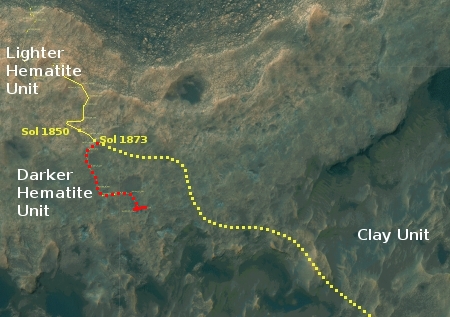
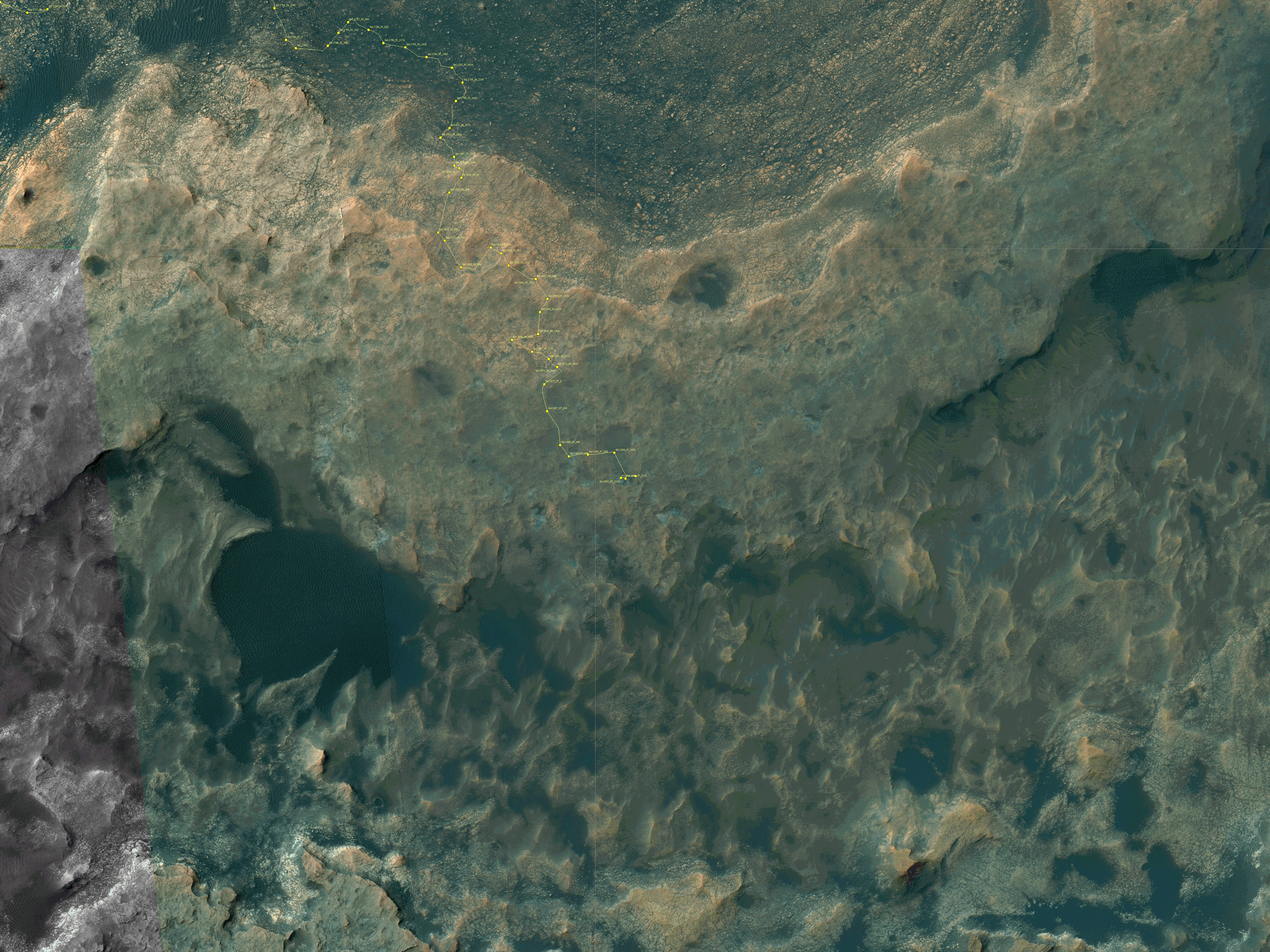
The image on the right shows Curiosity’s approximate position, about halfway across the Hematite Unit and with the rover’s approximate future route indicated, as shown in this October 3, 2016 press release.

In the two months since my last rover update the Curiosity engineering team has spent a lot of time imaging and studying the Hematite Unit. They have also spent a considerable amount of time doing new tests on the rover’s drill in an effort to get around its stuck feed mechanism in order to drill again. Only yesterday they took another series of close-up images of the drill in this continuing effort.

As indicated by the October 3 2016 press release, the rover still has a good way to go before it begins entering the distant canyons and large foothills. While they should leave the Hematite Unit and enter the Clay Unit beyond in only a few more months, I expect it will be at least a year before they pass through the Clay Unit and reach the much more spectacular Sulfate Unit, where the rover will explore at least one deep canyon as well as a recurring dark feature on a slope that scientists think might be a water seep.

Opportunity

For the context of Opportunity’s recent travels along the rim of Endeavour Crater, see my May 15, 2017 rover update.
» Read more

0 comments

Another LIGO black hole merger detected

Astronomers have announced another black hole merger detected by the LIGO gravitational wave observatory.

Dubbed GW170608, the latest discovery was produced by the merger of two relatively light black holes, 7 and 12 times the mass of the sun, at a distance of about a billion light-years from Earth. The merger left behind a final black hole 18 times the mass of the sun, meaning that energy equivalent to about 1 solar mass was emitted as gravitational waves during the collision.

This event, detected by the two NSF-supported LIGO detectors at 02:01:16 UTC on June 8, 2017 (or 10:01:16 pm on June 7 in US Eastern Daylight time), was actually the second binary black hole merger observed during LIGOโ€™s second observation run since being upgraded in a program called Advanced LIGO. But its announcement was delayed due to the time required to understand two other discoveries: a LIGO-Virgo three-detector observation of gravitational waves from another binary black hole merger (GW170814) on August 14, and the first-ever detection of a binary neutron star merger (GW170817) in light and gravitational waves on August 17.

4 comments

Petroglyphs found depicting the earliest leashed dogs?

Archaeologists have found petroglyphs in Saudi Arabia that could be the earliest depiction of dogs being held by leashes.

Carved into a sandstone cliff on the edge of a bygone river in the Arabian Desert, a hunter draws his bow for the kill. He is accompanied by 13 dogs, each with its own coat markings; two animals have lines running from their necks to the manโ€™s waist.

The engravings likely date back more than 8000 years, making them the earliest depictions of dogs, a new study reveals. And those lines are probably leashes, suggesting that humans mastered the art of training and controlling dogs thousands of years earlier than previously thought.

The dating however remains uncertain. The carvings could be much younger.

0 comments

Haze on Pluto lowers its global climate temperature 54ยบ F

Using data collected during New Horizons’ fly-by, scientists have found that the planet’s atmosphere is 54ยบ F colder than predicted, and from this they theorize that the presence of haze in that atmosphere is what cools it.

Plutoโ€™s atmosphere is made mostly of nitrogen, with smaller amounts of compounds such as methane. High in the atmosphere โ€” between 500 and 1,000 kilometres above the surface โ€” sunlight triggers chemical reactions that transform some of these gases into solid hydrocarbon particles.

The particles then drift downward and, at around 350 kilometres above Plutoโ€™s surface, clump with others to form long chemical chains. By the time they reach 200 kilometresโ€™ altitude, the particles have transformed into thick layers of haze, which the New Horizons spacecraft saw dramatically blanketing Pluto.

Zhang and his colleagues compared the heating and cooling effects of the atmosphereโ€™s gas molecules to those of its haze particles. Earlier studies have suggested that the presence of gas molecules, such as hydrogen cyanide, could help explain why Plutoโ€™s atmosphere is so cold. But Zhangโ€™s team found that including haze was the only way to get their model to match the temperatures that New Horizons measured as it flew by the dwarf planet.

This theory remains unproven. Moreover, there are other explanations proposed for the cold atmosphere by other scientists. It will take new instruments and future probes to resolve the question.

The post has been corrected. My math in calculating the conversion from Celsius to Fahrenheit was initially faulty. Thanks to reader Kirk for spotting the error.

6 comments

Interstellar object resembles asteroid

Astronomers who have been observing the interstellar object that zipped past the Sun last month have concluded that it mostly resembles asteroids seen in our own solar system.

From its changing brightness, the team inferred that U1 is highly elongated with rough dimensions 30m x 30m x 180m. About twice the height of the Statue of Liberty, the 6:1 aspect ratio of U1 is โ€œsimilar to the proportions of a fire extinguisher โ€” although U1 is not as red as that,โ€ says David Jewitt (UCLA), the first author of the study.

โ€œWith such an elongated shape, U1 probably needs a little cohesive strength to hold it together. But thatโ€™s not really unusual,โ€ remarked study coauthor Jayadev Rajagopal (National Optical Astronomy Observatory). Commenting on its size, rotation, and color, Rajagopal mused that, โ€œthe most remarkable thing about U1 is that, except for its shape, how familiar and physically unremarkable it is.โ€

I wonder if they are still tracking it.

4 comments

250,000 Dominoes

An evening pause: I haven’t posted one of these in awhile, and this one is a doozy, including three new US domino records: largest domino field, largest domino structure, and largest overall domino project in America. It took 19 builders from 5 countries 7 days (over 1,200 combined hours) to build it.

As I have noted before, I welcome suggestions for evening pauses. If you have suggested before, please suggest again! And if you have never done so but have something you want to suggest, comment here (without mentioning the suggestion itself) and I will provide you info on how to submit your suggestion.

5 comments

India and China to reduce launch costs

Capitalism in space: In response to the announcement by Chinese officials that they aim to reduce their launch costs in order to attract more commercial business, Indian officials announced that they plan to do the same in order to compete.

Interestingly, the reduced price that China revealed, $5,000 per kilogram, remains about twice that of SpaceX’s estimate per kilogram price for a launch using a reused first stage.

1 comment

NASA completes first high altitude supersonic test of Mars 2020 rover parachute

NASA successfully completed its first high altitude supersonic test of the parachute that the Mars 2020 rover will use as part of its landing operation.

The rocket carried the payload as high as about 32 miles (51 kilometers). Forty-two seconds later, at an altitude of 26 miles (42 kilometers) and a velocity of 1.8 times the speed of sound, the test conditions were met and the Mars parachute successfully deployed. Thirty-five minutes after launch, ASPIRE splashed down in the Atlantic Ocean about 34 miles (54 kilometers) southeast of Wallops Island. “Everything went according to plan or better than planned,” said Clark. “We not only proved that we could get our payload to the correct altitude and velocity conditions to best mimic a parachute deployment in the Martian atmosphere, but as an added bonus, we got to see our parachute in action as well.”

The parachute tested during this first flight was almost an exact copy of the parachute used to land NASA’s Mars Science Laboratory successfully on the Red Planet in 2012. Future tests will evaluate the performance of a strengthened parachute that could also be used in future Mars missions. The Mars 2020 team will use data from these tests to finalize the design for its mission.

There is a nice video of this test flight at the link.

At first glance one wonders why they need to do these tests, since the parachute system is going to be almost identical to the one used by Curiosity in 2012, and that worked perfectly. However, they really aren’t testing the parachute but the system to fly and test future parachutes at the high altitudes that mimic Martian conditions. With this test technology working and available, it will make it possible to test all kinds of parachute designs for use on Mars, even Rogollo hang-glider chutes.

14 comments

Astronomers find habitable Earth-mass planet 11 light years away

Worlds without end: Astronomers have found an Earth-mass planet 11 light years away, orbiting a quiet red dwarf star in the habitable zone.

Unlike Proxima Centauri, which periodically has large flares which make its Earth-sized planet less hospitable to life, this red dwarf, Ross 128, is more stable.

Many red dwarf stars, including Proxima Centauri, are subject to flares that occasionally bathe their orbiting planets in deadly ultraviolet and X-ray radiation. However, it seems that Ross 128 is a much quieter star, and so its planets may be the closest known comfortable abode for possible life.

Although it is currently 11 light-years from Earth, Ross 128 is moving towards us and is expected to become our nearest stellar neighbour in just 79 000 years โ€” a blink of the eye in cosmic terms. Ross 128 b will by then take the crown from Proxima b and become the closest exoplanet to Earth!

3 comments

China successfully launches two satellites

China’s Long March 4C rocket successfully placed two satellites in orbit today, a weather satellite and a commercial data relay satellite.

This was China’s 11th launch in 2017, well below the 20 they achieved in 2016, the drop caused by two launch failures earlier this year that resulted in an almost four month pause in launches.

At present the race for the most launches in 2017 stands as follows:

17 Russia
16 SpaceX
11 China
10 Arianespace (Europe)
7 ULA
5 Japan
4 India
3 Orbital ATK

Overall, the United States leads with 26 launches, its most since 2000.

0 comments
1 903 904 905 906 907 1,764