
The Sun fizzles in April
NOAA’s Space Weather Prediction Center today posted its monthly update of the ongoing sunspot cycle of the Sun. I have posted the new graph for April below the fold.
» Read more
Long essays or op-ed length commentaries on the issues of the day or on topics of special interest.
NOAA’s Space Weather Prediction Center today posted its monthly update of the ongoing sunspot cycle of the Sun. I have posted the new graph for April below the fold.
» Read more
The financial foolishness in Congress, by Republicans this time, continues. In making its budget recommendations for NASA, the report [pdf] of the House Appropriations Commerce, Justice, Science, and Related Agencies subcommittee also demands that NASA immediately choose one commercial company for its commercial space program. (Hat tip to Clark Lindsey for spotting this.)
The number of ways this action is counter-productive almost can’t be counted.
» Read more
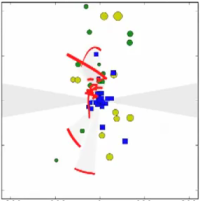
A new study by astronomers has found a vast structure of satellite galaxies and star clusters aligned perpendicular to the Milky Way and extending outward above and below the galaxy’s nucleus by as much as a million light years.
In their effort to understand exactly what surrounds our Galaxy, the scientists used a range of sources from twentieth century photographic plates to images from the robotic telescope of the Sloan Deep Sky Survey. Using all these data they assembled a picture that includes bright ‘classical’ satellite galaxies, more recently detected fainter satellites and the younger globular clusters.
“Once we had completed our analysis, a new picture of our cosmic neighbourhood emerged”, says Pawlowski. The astronomers found that all the different objects are distributed in a plane at right angles to the galactic disk. The newly-discovered structure is huge, extending from as close as 33,000 light years to as far away as one million light years from the centre of the Galaxy.
An animation illustrating this galactic distribution is posted below the fold. You can read the actual preprint paper here.
The problem with this polar alignment with the Milky Way’s core is that the theories for explaining the distribution of dark matter do not predict it.
» Read more
Mexico has passed its own very strict climate change law.
The new law contains many sweeping provisions to mitigate climate change, including a mandate to reduce emissions of carbon dioxide by 30% below business-as-usual levels by 2020, and by 50% below 2000 levels by 2050. Furthermore, it stipulates that 35% of the country’s energy should come from renewable sources by 2024, and requires mandatory emissions reporting by the country’s largest polluters.
Some predictions:
» Read more
Orbital Sciences has released an updated launch schedule for its Antares rocket and Cygnus capsule.
The significance?
» Read more
The uncertainty of science: A new study has found no evidence of dark matter within 13,000 light years of the Sun, something that had not been expected.
According to widely accepted theories, the solar neighborhood was expected to be filled with dark matter, a mysterious invisible substance that can only be detected indirectly by the gravitational force it exerts. But a new study by a team of astronomers in Chile has found that these theories just do not fit the observational facts. This may mean that attempts to directly detect dark matter particles on Earth are unlikely to be successful.
These findings will be as controversial as the now abandoned faster-than-light neutrino results last fall. Here, however, the new data is likely going to be more robust, which will cause the entire astrophysical community some real conniptions.
» Read more
A Senate panel today proposed shifting the responsibility for building weather satellites from NOAA to NASA.
It is very unclear from this article why the Senate panel proposed this shift. They claim it will save money but I don’t see how.
What I can guess is that there is probably a turf war going on in Congress over this money. For example, shifting these weather satellites to NASA almost certainly means that the Goddard Space Flight Center in Maryland will get more money, which is almost certainly why Senator Barbara Mikulski (D-Maryland) is for it.
One thought however: NASA generally focuses on individual missions, not long term operational stuff like weather. I suspect it probably is not a good idea to give this work to NASA.
The same article above also outlined the panel’s proposals for other areas of NASA’s budget. To me, the key issue is the budget for commercial space. The White House requested $830 million. The Senate panel has instead proposed $525 million.
» Read more
There are really only two important stories today concerning space exploration. The story that is getting the most coverage is the big news that the space shuttle Discovery is making its last flight, flying over Washington, DC, as it is delivered to the Smithsonian for permanent display.
Of these stories, only Irene Klotz of Discovery News seems to really get it. This is not an event to celebrate or get excited about. It is the end of an American achievement, brought to a close probably three to five years prematurely so that the United States now cannot even send its own astronauts to its own space station.
The other news, actually far more important, has gotten far less coverage, and includes three different stories all really about the same thing.
» Read more
Though I am a bit late in covering this story (due to moving, unpacking, Passover, and an unexpected visit to the dentist), NOAA’s Space Weather Prediction Center on April 9 released its monthly update of the ongoing sunspot cycle of the Sun. The most recent graph is below the fold.
In order to understand the context of this new graph, however, it is necessary to make a correction and clarification.
» Read more
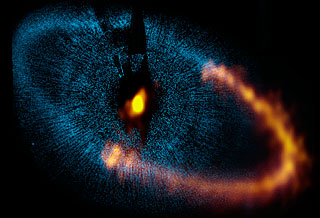
New observations from the new ground-based submillimeter ALMA telescope in Chile have given astronomers a clearer picture of the ring/disk of debris orbiting the nearby star Formalhaut. Moreover, the data suggests that two planets that are shepherding that ring are smaller than previously thought, no larger than a few times the size of the Earth.
» Read more
For the next two days posting will be light. I am in Chicago visiting family for Passover, the annual Jewish holiday celebrating the release of the Jews from slavery in Egypt. During the Seder meal, Jews read the Haggadah, which retells the story of the Jewish slavery in Egypt and their escape, with the idea of reminding each person what is like to be a slave, and then to be free. As it says in the Haggadah,
In every generation each individual is bound to regard himself as if he had gone personally forth from Egypt.
Tonight, this is what Jews do. It would be nice if all people reflected on this and did the same.
In writing this short post on the efforts of Lockheed Martin and Orbital Sciences to launch rockets for the small satellite market, Clark Lindsey made this comment:
It costs around $50 million to launch a Orbital Sciences Minotaur 4, which can put 1,730 kg into LEO while the Lockheed’s Athena 2 will cost around $65 million to put 1,712 kg into LEO. SpaceX currently posts charges $54M – $59.5M for launching to LEO 10,450 kg (equatorial) and 8,560 kg (polar). If SpaceX is able to sustain these prices in routine operation, it will obviously result in some disturbance to the launch industry.
Let’s deconstruct these numbers again, this time listing them by the cost per kilogram:
» Read more