Blowing in the wind
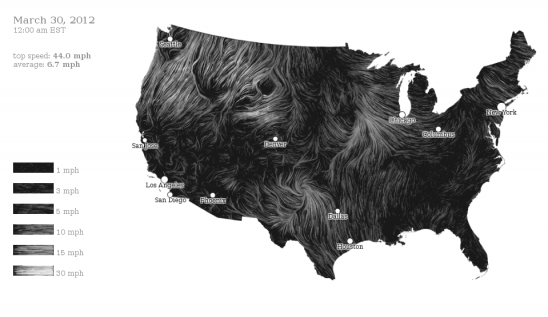
Want to see where the wind is blowing? Check out this website, which shows an animated map of the wind patterns blowing across the continental United States, continually updated.
Long essays or op-ed length commentaries on the issues of the day or on topics of special interest.
Want to see where the wind is blowing? Check out this website, which shows an animated map of the wind patterns blowing across the continental United States, continually updated.
Lunar Reconnaissance Orbiter recently celebrated its 1000th day of imaging in orbit around the Moon, snapping images and cataloging the Moon’s geology.
Only a week before the science team posted a spectacular oblique view of Ryder Crater. The image is visible below the fold, along with a close-up of the crater’s strange hump-backed boulder-strewn floor.
» Read more
A report issued today illustrates once again to me that those running our space program in both Congress and the Obama administration have a profound lack of common sense or basic intelligence:
The NASA Advisory Council (NAC) – a body that provides the NASA Administrator with counsel and advice on programs and issues of importance to the Agency – has insisted a human exploration plan, or at least a destination, should be selected as soon as possible.
This request specifically applies to the Space Launch System (SLS), the heavy-lift rocket mandated by Congress that will use the Orion capsule. SLS is also the same rocket system that is costing the taxpayers $3 billion per year, and is expected to cost between $18 to $60 billion total by the time it flies its first operational mission in about nine years. The advisory council also noted that
While the vehicle hardware development is now moving forward at full speed, specific destinations – or a roadmap – is still lacking from NASA’s exploration plan.
It took nine different committees plus a central committee formed from the original nine committees to come to this Earth-shattering conclusion.
To put it in plain English, Congress and the Obama administration have committed billions of taxpayer dollars to the construction of a rocket and manned capsule without ever putting much thought into the specific mission they want to send that rocket and capsule on.
» Read more
In hearings Wednesday, several members of Congress suggested that NASA force the new competing commercial space companies to combine their efforts in order to save money.
Rep. Frank Wolf (R-Va.) asked NASA Administrator Charles Bolden during a March 21 hearing on the agency’s 2013 budget the same question he asked of the White House’s chief science adviser last month: would NASA’s partnership with commercial companies to develop astronaut transports be cheaper if the companies competing for NASA funds combined their efforts into a single “all for one and one for all” project?
Similarly, Senator Kay Bailey Hutchison (R-Texas) made the same stupid argument in her continuing effort to keep the funding of the Space Launch System, the rocket-formerly-called-Constellation, as high as possible, at the cost of cutting everything else in NASA if necessary.
If you needed any evidence that members of Congress are ignorant idiots, you only need read the comments of these elected officials at these hearings to get your proof. Wolf or Hutchison as well as several others from both parties very clearly haven’t the slightest idea what these various space companies are building. Nor do they have the faintest notion of the difficulties entailed in building these manned space vessels.
» Read more
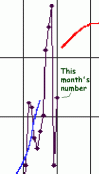
Late last week NOAA’s Space Weather Prediction Center released its monthly update of the ongoing solar cycle sunspot activity, covering February 2012. Though I am slightly late in posting it, as I do every month, you can now see the full graph below the fold. I have also created a close-up of the graph’s relevant area, shown on the left, because it is hard to decipher what is happening on the full graph.
Since the Sun began it ramp up to solar maximum back in 2009, the pattern has been consistent, two steps forward, one step back. First there are several months in a row in which the number of sunspots show a steep rise, followed immediately by several months in which the sunspot numbers decline just as steeply, though by not as much. All told, since 2009 we have seen this pattern repeat four times.
February’s numbers have continued that pattern.
» Read more
The director of Russia’s manned program told the press today that the Russians do not have that a signed contract with NASA to fly astronauts to ISS after 2015, despite NASA’s announcement that such an agreement exists.
If true, NASA’s management has committed a very serious error which will cost the U.S. a great deal of money in the coming years, especially if there are significant delays in getting the new commercial companies online to provide the U.S. an American capability for ferrying humans to orbit.
» Read more
One year ago today Japan was hit with one of the most powerful earthquakes in recorded history, followed almost immediately by one of the most powerful tsunamis in recorded history. Since then, that nation and its people have done an incredible job recovering from that disaster, proving once again that there really is no limit to what humans can do.
The video below is their thank you to the rest of the world for the help and support brought to Japan by people everywhere. As they say, “Arigato.”
I say, bless you all for never giving up.
Kepler today released an updated catalog of candidate exoplanets observed during the space telescope’s first sixteen months of observations. In this release, they list more than a thousand new exoplanet candidates, almost two hundred of which are Earth-sized. Among the new exoplanet candidates, twenty-five are in the habitable zone!
Now for some details.
» Read more
Climate scientist Richard Lindzen of MIT spoke before a public meeting of the House of Commons in Great Britain yesterday. You can read his entire speech here [pdf]. Please do. He know his stuff. More important, he begins his presentation by immediately accepting these points:
He then notes that while none of these points are controversial among serious climate scientists, none of these facts are a cause for alarm.
The evidence is that the increase in CO2 will lead to very little warming, and that the connection of this minimal warming (or even significant warming) to the purported catastrophes is also minimal. The arguments on which the catastrophic claims are made are extremely weak – and commonly acknowledged as such. They are sometimes overtly dishonest. [emphasis mine]
Updated and bumped: I will be discussing this story on the the John Batchelor Show tonight, February 17, Friday, 12:50 am (Eastern), and then re-aired on Sunday, February 19, 12:50 am (Eastern).
———————————————————————-
Someday, humans will be traveling far from Earth in large interplanetary spaceships not very different than the International Space Station (ISS). Isolated and dependent on these ships for survival, these travelers will have no choice but to know how to maintain and repair their vessels whenever something on them should break.
And things will break. Entropy rules, and with time all things deteriorate and fail.
Each failure, however, is also a precious opportunity to learn something about the environment of space. Why did an item break? What caused it to fail? Can we do something to prevent the failure in the future? Finding answers to these questions will make it possible to build better and more reliable interplanetary spaceships.
ISS is presently our only testbed for studying these kinds of engineering questions. And in 2007, a spectacular failure, combined with an epic spacewalk, gave engineers at the Johnson Space Center a marvelous opportunity to study these very issues.
» Read more
The solar scientists at the Marshall Space Flight Center significantly downgraded their prediction today for the upcoming solar maximum.
Unfortunately, the Marshall scientists don’t archive their previous predictions, merely changing the text of their webpage periodically. However, I have archived most of these predictions as they have changed. Here they are:
» Read more
There will be a lot of screaming and howling in the coming days about the proposed 2013 NASA budget [pdf], released today by the Obama administration. Though I have many bones to pick about this budget proposal, a longer view of the budget suggests it is merely a reflection of the transitions going on both in NASA and the federal government.
First, some bullet points:
» Read more