The link between sunspots and climate

In a preprint paper published today on the Los Alamos astro-ph website and accepted for publication in the Journal of Atmospheric and Solar-Terrestrial Physics, Norwegian scientists have found a strong correlation between the length of the solar sunspot cycle and the Earth’s temperature during the following cycle. From the abstract:

Relations between the length of a sunspot cycle and the average temperature in the same and the next cycle are calculated for a number of meteorological stations in Norway and in the North Atlantic region. No significant trend is found between the length of a cycle and the average temperature in the same cycle, but a significant negative trend is found between the length of a cycle and the temperature in the next cycle. This provides a tool to predict an average temperature decrease of at least 1.0 β—¦ C from solar cycle 23 to 24 for the stations and areas analyzed. We find for the Norwegian local stations investigated that 25–56% of the temperature increase the last 150 years may be attributed to the Sun. For 3 North Atlantic stations we get 63–72% solar contribution. [emphasis mine]

You can download a copy of the paper here [pdf].

Their paper finds that if a particular sunspot cycle is longer with less activity, the climate will show significant cooling during the next cycle.

The paper makes several important points:
» Read more
12 comments

“I feel duped.”

The man duped is Fritz Vahrenholt, a former global warming advocate and leftwing environmentalist in Germany. The words were spoken in a long and detailed interview in Der Spiegel. Read it all, as it demonstrates without question that Vahrenholt has done his research about the complexities of climate research as well as the flaws and dishonesty contained within the IPCC reports. However, he gets to the nub of the matter when he is asked why he has taken on the role of a climate skeptic with such passion.
» Read more

1 comment

The Sun goes bust

It is that time of the month again. Today NOAA’s Space Weather Prediction Center today released its monthly update of the ongoing solar cycle sunspot activity, covering January 2012. I have posted the graph below the fold.

For the second month in a row the Sun’s sunspot activity plunged. The drop in activity has been so steep that it has cancelled out almost two thirds of the activity rise that occurred during the last half of 2010. In fact, the drop brings the Sun’s sunspot count back to numbers comparable with March of last year, hardly a sign of a fast ramp up to solar maximum, which is what solar scientists have come to expect the Sun to do. Instead, the Sun’s activity during this ramp up has fluctuated wildly, going up strongly for several months and then dropping precipitously for another few months. These wild swings have now repeated themselves four times since the fall of 2010.
» Read more

2 comments

Birthday bleg

Behind the Black officially premiered July 1, 2010, and has been up and running now for twenty months. I make it a point to post often and regularly on issues of space, science, technology, politics, and history, subjects that interest me personally. Except for one short period a year ago when family matters kept me away from the computer for several days, I have managed to update the webpage frequently every day during that entire time.

Because of this, traffic to the site has steadily grown. For this I thank you, my readers, especially those who love to add their own two cents to the webpage in the comments. While I certainly do not agree with all those who comment, I very much appreciate the open and intelligent nature of the discussion.

During that time I have resisted begging for contributions. Though I added a tip jar link to the webpage about three months ago (located in the right column below the search box), I have made very little note of it because shilling for dollars seems crass, and I feel that if I am doing a good job people will naturally look for it in order to donate to the webpage to keep it going.

However, today is my birthday, so I feel I have the right to do some self-promotion. Moreover, for the past fifteen years I have made my living as a freelance science writer. The business, however, is changing, and I am finding that I am becoming increasingly reliant on the income I make from at my own website over that earned by selling articles to magazines.

Thus, if you are a regular reader of Behind the Black, please consider giving the website a donation, no matter how small. Not only would I appreciate it greatly, it will help make it possible for this website to continue and grow.

9 comments

Lobbying to save commercial space

Jeff Foust reports today that the long delayed final FAA reauthorization bill also includes language that will extend until 2015 the restrictions on the FAA’s ability to regulate commercial space.

How nice of them.

When the Commercial Space Law Amendments Act (CSLAA) passed in 2004 I wrote in my UPI column Space Watch that I thought it was a bad idea and would cause great harm to the commercial space industry. All the law accomplished was hand power to the FAA and Congress to restrict commercial activities in space, without providing the industry any real benefit. Even with this extension space commercial companies remain at the mercy of Congressional action or FAA regulation, neither of which is really interested in helping this new industry.

The bad elements of the bill are finally beginning to come to light.
» Read more

1 comment

The head of Russia’s space agency makes news again

The following stories are all the result of statements made by Vladimir Popovkin, the head of Roscosmos, the Russian Federal space agency, during a radio interview yesterday.

This is the same guy that only a few weeks ago was throwing accusations at the U.S. for the failure of Phobos-Grunt.

What should we make of these statements? First, everything Popovkin says is aimed at fund-raising. Whatever his background, he is a political appointee whose job is to generate interest and funding for Russia’s space program. Everything he says in public must be weighed against this reality. That he first tried to shift the blame to the U.S. for Phobos-Grunt’s loss was an effort to absolve his program from any blame and thus reduce the possibility that the Russian government might cut his funding. Now that his agency has gotten approval of its insurance payment for the failure, however, he is free to say otherwise.

Second, these announcements give us a clear indication of where the Russia space effort is heading, and that effort looks both thoughtful and intelligent.
» Read more

0 comments

Romney puts forth his space plans at a rally in Florida

In a campaign rally Friday in Florida, Mitt Romney put forth his perspective on the state of the American space program, and what he plans to do about it.

The speech is about 16 minutes long. It is worth listening to it in its entirety.

In it, Romney outlined the reasons he thinks a robust space program is important: defense, innovation, exploration, and the ability to respond to potential natural threats from space. Having done so, however, he then refused to outline any specific actions he would take to address these issues, saying instead that once in office he will bring together the right kinds of space experts who will then advice him on the right kind of plan to achieve all these important goals.

I appreciate his refusal to pander. At the same time, his vagueness does not make me enthusiastic. Moreover, he is only offering us the same thing we have seen numerous times before, another blue ribbon panel study outlining a plan. It would make me far happier if he already understood better the problems of the space program, and could articulate the actions he wishes to take, as Gingrich did.
» Read more

5 comments

The full Gingrich speech on space

As noted by one commenter, the full Gingrich speech on space is available here on C-SPAN.

I have now listened to the whole speech, and can say without hesitation that everything I wrote in my previous post was correct. Gingrich is knowledgeable about space, science, and history. He is basing his proposals on past successful models where the U.S. government did nothing but buy the product developed by private individuals or companies. These proposals actually continue as well as accelerate the Obama administration’s efforts. And he is not proposing a giant pork program.

His proposal to have a moon base by 2020 is unquestionably campaign talk that won’t happen. Nonetheless, this proposal is aimed at energizing the American aerospace industry by focusing the government’s goals, which will then need to be purchased by the government from private companies. He also made it very clear he wants to shrink the NASA bureaucracy, reducing its budget while devoting ten percent of that savings (equal to billions of dollars) for prizes. The example of a $10 billion tax-free prize for the first to get to Mars was only for illustration. As he said,

The model I want us to build is largely is the model of the ’20s and ’30s, when the government was actively encouraging development but the government wasn’t doing anything. The government was paying rewards, it was subsidizing the mail. … We had enormous breakthroughs in aviation in the ’20s and ’30s at very little cost to the government because lots of smart people [outside the government] did it.

I beg everyone to listen to this speech, in its entirety. It illustrates a thoughtful man who understands history. Gingrich might not be a perfect man, and he certainly is not the perfect candidate for President, but don’t tell me what you think of him if you refuse to listen to him. For two decades too many people have eagerly expressed opinions about him without really listening to what he has actually said or done. And what he says here is reasonable, intelligent, and certainly worthy of consideration.

8 comments

Gingrich’s speech on space

In the days ahead there is going to be a lot of talk about Newt Gingrich’s proposals for space exploration. I think it important that people actually see and listen to the entire speech before discussing it. Here is the longest clip I can find on youtube, covering the first seven and a half minutes. I think it is complete, but unfortunately, I can’t be sure. It doesn’t appear to include his remarks about awarding space prizes, and when it ends Gingrich does not appear to be finished. When I find a longer clip I will post it.

Several points immediately come to mind:
» Read more

5 comments

It doesn’t exist

Fomalhaut b

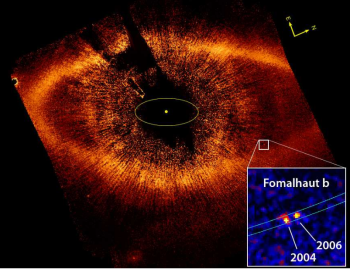
In a preprint paper published today on the Los Alamos astro-ph website, astronomers have concluded that the exoplanet orbiting the star Formalhaut might not exist. This planet, the first exoplanet ever thought to be directly imaged in visible light, was first described in a paper published in 2008, and was actually tracked in its orbit over several years, as shown in the image on the right.

The new research used the Spitzer Space Telescope to see if the planet’s heat could be detected in infrared wavelengths. Unfortunately, the scientists found nothing.
» Read more

0 comments

Studying the Moon by starlight

The Moon's south pole by starlight

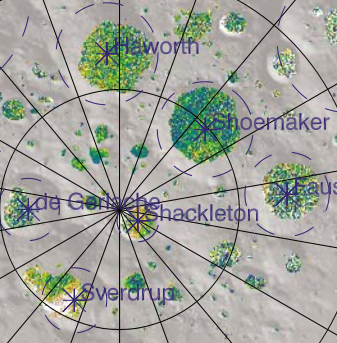
In a paper published today in the Journal for Geophysical Research, Planets, the science team for Lunar Reconnaissance Orbiter describe how they have used starlight to peer into the permanently shadowed craters of the Moon’s north and south poles. Looking only during the lunar night, they measured the dim albedo of the Moon from reflected starlight. From this very weak signal they were able to cull two interesting facts about these very cold and very dark places.

  • The ground at the bottom of these craters is more porous than the surrounding unshadowed terrain.
  • There is evidence in the spectroscopy of 1 to 2% water frost in these craters.

» Read more

0 comments

Underground again today

glass plate

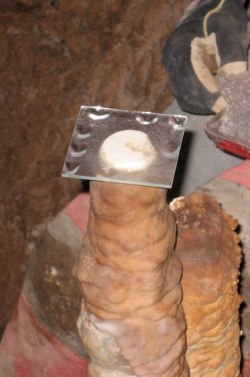
Posting will be light today, as I am joining University of Arizona PhD student Sarah Trube and several other Arizona cavers on a cave trip to collect water samples in a southern Arizona cave. This is in connection with research Sarah is doing to analyze the chemistry of cave dripwater and how it leads to the formation of cave speleothems. Moreover, she is tracking water flow and attempting to link it to climate and weather variations over time.

I noticed Sarah’s water collection equipment on my first Tucson-area cave trip back last January. In one case she had attached a tube to the bottom of a stalactite which fed the dripwater into a bottle. In another case she placed glass plates on top of stalagmites to allow the dripwater to drip onto the plate and then evaporate. Last month I joined her on one of her collection trips, where she gathered glass plates for later analysis in the lab. Though the plates had not been in cave more than a few months, you could easily see a thin layer of calcite deposit on their surface.

Below the fold is an image of Sarah gathering dripwater during an earlier trip.
» Read more

2 comments
1 107 108 109 110 111 139