More caves on Mars

And damn, do I want to rappel into them!

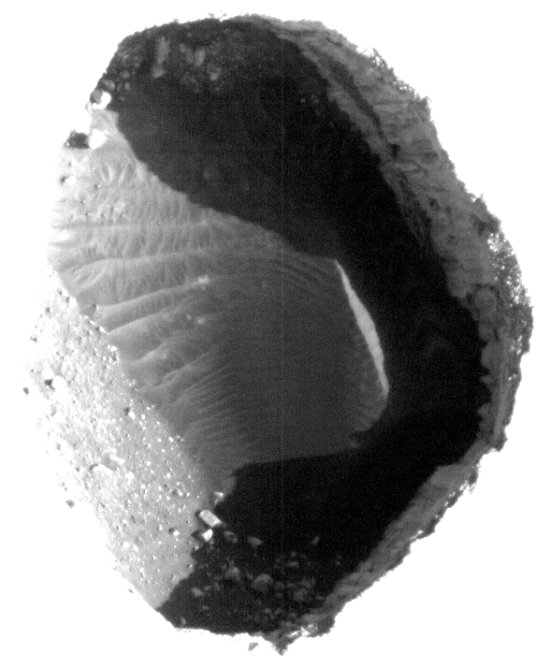
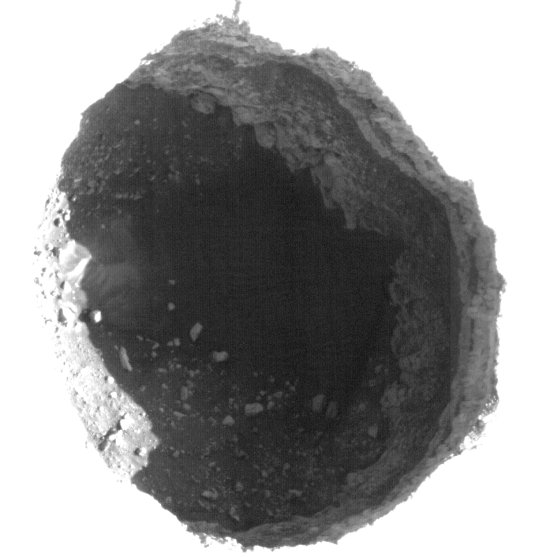
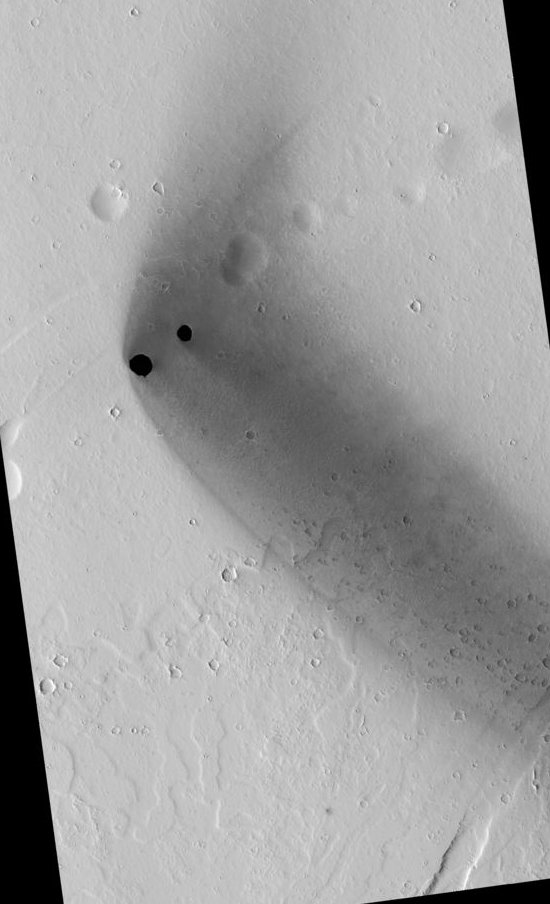
This week’s release of images from the HiRISE camera on Mars Reconnaissance Orbiter included these spectacular photos of two deep pits, approximately 180 and 310 meters in diameter and located aligned with a series of depressions that suggest additional passages at their base.

The first image shows the pits in the context of the surrounding terrain. From the caption:

These pits are aligned with what appears to be larger, degraded depressions. The wispy deposit may consist of dark material that has been either blown out of the pits or from some other source and scattered about by the local winds.

wide shot of pits

The next two images are heavily processed close-ups of each pit in order to bring out the detail within. From the caption:

The eastern most and smaller of the two pits contains boulders and sediment along its walls and brighter aeolian dune sediments on its floor. The larger, western most pit contains sediment and boulders with faint dune-like patterns visible on the deepest part of the floor. Both pits have steep eastern walls and more gently sloped western walls that transition gradually into the pit floor. Steep resistant ledges containing boulders that overhang and obscure the pit floors form the eastern walls.

The smaller pit, with dunes on floor

The larger pit

3 comments

When journalism runs wild…

A commenter to one of my other posts, ZZMike, asked this question today: ” What is NASA’s Secret Astrobiology Announcement?” and quoted this from another website, “Science fans across the Internet are eagerly awaiting an announcement from NASA’s astrobiology team. All NASA will say about the press conference is that it will “discuss an astrobiology finding that will impact the search for evidence of extraterrestrial life.”

Unfortunately, Mike, this great discovery is not the big news that everyone is hoping for, such as the discovery of life on Mars. Instead, it is about the discovery that a certain microbe can eat and digest arsenic, using it as one of the six vital basic components of life (carbon, hydrogen, nitrogen, oxygen, sulfur, phosphorus) in place of phosphorus. This is very significant since it tells us that alien life could very well be far more alien than previously imagined.

What makes this story interesting, however, is not the discovery itself (which is important). Instead, because NASA was so vague in its press announcement it allowed a large number of irresponsible reporters and bloggers to go nuts trying to guess what the story was about. When these rumors began to get out of control, the magazine Science finally sent out a notice to journalists noting the specific paper and discovery so that they at least would know in advance what the conference was about.

As Mike above as well as several other people noted to me in emails, I had written nothing about this story on behindtheblack. This was intentional. Without knowing what the conference was about, I wasn’t going to speculate about it. Once I knew, I still remained silent because the story was under embargo by Science and I respect these embargos. Now that the embargo has been lifted, I can speak.

What I want to speak about is the danger of speculation, especially among journalists. This is a serious problem today. Too often journalists speculate off the cuff, without knowing a goddamn thing about the subject, And all too often, they are downright wrong, and help contribute to misinforming the public. The result: the field of journalism has a terrible reputation with the public. No one trusts what journalists tell us. Worse, this lack of trust is helping fuel the ignorance and anger that seems to be rising in society, as no one knows what to believe about some of the most important issues of our time.

Journalists need to stop doing this. Rather than fantasize what they don’t know, journalists need to focus on what they do know. If they do that, they will significantly help repair the sagging reputation of their field.

2 comments

Congress, Obama, and NASA fiddle while manned space burns

The space war continues to heat up again. In a hearing today in the Senate, several senators complained loudly that NASA isn’t implementing the details of the September authorization act.

What clowns. These same senators haven’t provided NASA (or anyone) with a budget. They have also given NASA an authorization bill that does not provide the agency with enough money while simultaneously demanding that things be done faster. And they’ve done this at a time the federal government is almost bankrupt. Moreover, the bill requires that NASA build things that the Obama administration doesn’t want to build (though in truth, the Obama administration itself is so confused that no one, including them, knows what they are going to do).

All in all, the whole thing is a mess.

As I’ve said earlier, it’s all pork. Even if NASA gets the money laid out in the authorization bill, it will accomplish nothing except spread some cash around to several congressional districts. Nothing will get built. And in the process of sending that money to new aerospace companies NASA will do much to squelch their creativity and innovation.

Better to cut it all, and let the aerospace industry sink or swim on its own. It will almost certainly do better that the government at this point. In fact, how could it do worse?

2 comments

A hint that the Republicans might be wimping out again

It’s stories like this that fill me with dispair: House Majority Leader-designate Eric Cantor (R-Virginia) says that Republicans will keep some provisions of Obama’s healthcare law intact. Key quote:

Provisions that Republicans will seek to retain include the barring of insurance companies from refusing coverage to patients with a pre-existing condition and allowing young people to stay on their parents’ insurance plans until age 26.

You would think the numerous demonstrations, the loud townhall protests, and finally, the election results themselves would have given Cantor a hint of what the public really wants: total and complete repeal of this stinker of a bill.

Cantor’s desire to keep the pre-existing condition clause will only make the entire insurance business unprofitable. When I lived in New York and the state legislative passed a similar bill, more than half of all insurance companies immediately abandoned the state, as they understood that no one had any reason to buy health insurance, until they actually got sick. And without the premiums from healthy people, the companies knew they would have no resources left to pay the expenses of those who were sick. (See my 1994 article on this subject for the magazine The Freeman.)

As for the clause allowing young people to stay on their parents’ plan until 26, all this will do is force insurance companies to drop all coverage for children, as this union did in New York.

Either way, what gives Eric Cantor and the Republicans (or the Democrats before them) the lordly wisdom to determine how this particular business (or any) should be run? Freedom demands that these business transactions should be left to the market, the insurance companies, and their customers, not to the whims of politicians.

0 comments

TSA security harasses a mother over her breast milk

TSA security in Phoenix harassed this mother over her request that her breast milk not be sent through the x-ray machine, as per TSA’s own regulations. Though eventually backing down, the security personnel make her wait so long she misses her flight. The whole event, recorded on surveillance tapes that the woman demanded and got from the TSA, is so outrageous you have to watch it, even though it is long.

1 comment

The unimaginative Union of Concerned Scientists does it again

According to the Union of Concerned Scientists (UCS), the reusable X-37B — in orbit at the moment and expected to return to Earth in the near future — has no compelling use.

“It’s hard to think of what could make that mission compelling,” [UCS scientist Laura] Grego told SPACE.com. “It doesn’t protect you from antiaircraft fire, and the element of surprise doesn’t really work in your favor if you’re launching on Atlas V [rocket].”

In reading this article, it is fascinating how completely unimaginative the scientists from the Union of Concerned Scientists seem. Nor do I find this surprising. For the last few decades this organization has opposed almost every new aerospace engineering project that might actually have made possible the human exploration of space. It’s as if these scientists feared new ideas and grand achievement. Sadly, the UCS had great influence with policy makers in the 1970s, 1980s, and 1990s, and thus helped limit the American government’s space program capabilities during that time period.

Fortunately, the UCS’s influence has waned in recent years. Though the American government space program might be dying, it is because of budget limits and a lack of leadership by the Obama administration, not the unimaginative thinking of the UCS. Furthermore, their lack of imagination — which once seemed so culturally dominant — seems to no longer influence the rest of society. The happy result is the creative innovation coming from many new private aerospace companies.

The UCS meanwhile reminds me of an old curmudgeon, who won’t keep quiet but everyone still ignores.

0 comments

Martian stream gullies

The image below from Mars Reconnaissance Orbiter shows gullies remarkably similar to gullies formed on Earth by flowing water, thus providing striking evidence that at some time in the past liquid water did flow on the Martian surface, something that is not possible now. Key quote from the caption:

The gullies shown in the subimage (approximately 710 x 1100 yards) have well developed alcoves, deeply incised channels, and large depositional fans, and are similar to terrestrial landscapes sculpted by surficial water.

The gullies shown in the subimage experienced several periods of activity, as evidenced by older channels cut by younger ones or by their deposits. The current and recent Martian temperatures and atmospheric conditions would not allow for water to be stable at the surface for extended periods of time: it is so cold that the water would freeze, and then it would sublime quickly, because the air is very thin and dry. These gullies could have formed under a different climate, or maybe by repeated bursts of transient fluids. Current leading hypotheses explaining the origin of gullies includes erosion from seepage or eruption of water from a subsurface aquifer, melting of ground ice, or dust-blanketed surface snow.

gullies in Sisyphi Planum

0 comments

Killing bats to save them!

In a wonderful example of government stupidity, environmental officials in Wisconsin want to try to “exclude” bats from caves in order to prevent the spread of white nose syndrome.

Some quick background: White nose syndrome appeared in upstate New York about four years ago, killing about 90 percent of the bats affected. It has since spread down the east coast following bat migration patterns as they travel during the summer months. (While human activity might spread the syndrome as well, the evidence all points to the bats as the primary vector.) A newly discovered fungus that is seen on all affected bats, for which the syndrome is named, is the prime suspect for killing them, as it disturbs them during hibernation, causing them to wake more frequently, burn up their reserves,and thus starve to death.

Wisconsin officials, in their infinte wisdom, have decide that the way they will save the bats of their state will be to declare the fungus an invasive specie. They will then be empowered to do anything they can to prevent its spread. And how will they do this? By preventing bats from entering caves and bringing the fungus with them.

Let me say that again: Wisconsin environment officials want to “exclude bats from caves” in order to save them. The result of course will be a biological genocide, since without access to caves during the cold hibernation period the bats will surely die.

If you don’t believe me, see this press release. To quote:

The third proposed rule adds provisions to NR 40.04 and 40.07 relating to early detection and prevention of the spread of the disease due to human activities, including the decontamination of clothes and equipment that have been used in mines or caves, and limited access of bats or people to caves or mines. [emphasis mine]

If you still don’t believe me, read the state’s actual proposed management plan [pdf]. To quote page 5:

Under the proposed rules, the department may ask any person who owns, controls, or manages property here a cave or mine may be present to install and properly maintain physical barriers to limit access to the cave or mine by either individuals or bats, in accordance with a plan approved by the department. The department is seeking funding to assist with the installation of barriers, and therefore cost to those parties who install such barriers should be negligible. Additionally, commercial caves will have the option to exclude bats from their cave(s) with the help of the department, allowing them to remain open for tourism, and resulting in no loss of tourism dollars. [emphasis mine]

Moreover, this plan will give these officials the power to enter private property without the landowners’ permission.

Cavers have been trying to explain to the Wisconsin officials that this entire approach is madness. So far, these pleas have had very little effect. You can see their efforts here.

This whole story might be one of the best examples of why it is always bad idea to concentrate a lot of power in the hands of government. Better to spread the power around among a lot of private landowners, as then you also spread the stupidity around as well, and reduce the chances that the only approach taken is the worse approach.

0 comments

Driving vs flying

After a twelve hour drive from Chicago, I am finally home. It might seem silly to make this trip by car when the plane is faster, but since Sept 11 I have found it actually makes more sense to drive when the trip is 12 hours or less. First, a door to door plane flight will take about 6 hours, so you don’t save that much time. Second, by driving I have access to a car in Chicago, and don’t need to rent something. Three, the total cost is significantly less, especially since we save two airfares.

And finally, neither I nor my wife Diane have to submit ourselves to TSA abuse. I consider myself a free American, and don’t take kindly to government officials abusing their power unconstitutionally. If the airlines haven’t yet realized that this security madness is losing them business, it ain’t my problem.

2 comments

Sightseeing on Mars

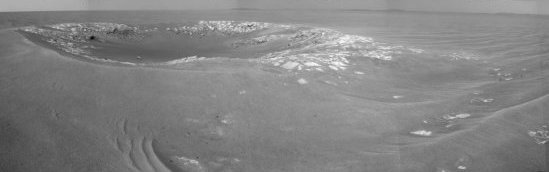
Those who visit this website regularly know that I repeatedly post images from the various Mars orbiters and rovers. I do this not only because the images have scientific interest or that they are cool, but because it is simply fun to sightsee, even if it is done by proxy using a robot many millions of miles away. Here are two more images of the sights of Mars.

The first is a mosiac image of a small crater that the rover Opportunity strolled past on November 9 in its four year journey to Endeavour Crater.

small crater on Mars

What always amazes me about the images that Opportunity has taken as it travels across the Martian desert is how totally lifeless this desert is. You would be very hard-pressed to find any desert on Earth like this. On Earth, life is everywhere, even in deserts with their harsh environment. Moreover, life on Earth has reshaped the surface drastically. Environmentalists like to whine about the havoc humans wreck on nature, but the truth is that all life does this continually. Plants and trees help soften the terrain. Animals (not just humans) mold the surface to their needs.

On Mars, however, all one sees is wind-strewn sand across barren bedrock. What this suggests is that, if there is life on Mars, it is well buried, not very visible, and possibly quite rare. It will thus be difficult to spot.

The second image is another one of those Martian collapse features, where some form of fluid flow under the surface washed out the supporting material. causing the surface to eventually collapse. In this case, however, the collapse left at least one natural bridge. Based on the scale (25 cm = 1 pixel), this bridge is about 80 feet wide and 100 feet long. (To calculate its height requires more mathematical skills than I have.)

Boy, wouldn’t this be a magnificent thing to hike under and across!

Natural Bridge on Mars

1 comment

A snowstorm in space

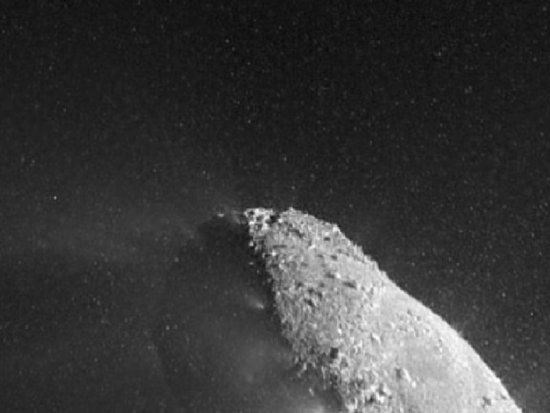
Almost literally, the probe Deep Impact flew through a snowstorm when it flew past Comet Hartley 2 on November 4. Below is one of the best pictures from the moment. More images can be found here. Key quote:

[The images] revealed a cometary snow storm created by carbon dioxide jets spewing out tons of golf-ball to basketball-sized fluffy ice particles from the peanut-shaped comet’s rocky ends. At the same time, a different process was causing water vapor to escape from the comet’s smooth mid-section. This information sheds new light on the nature of comets and even planets.

Comet Hartley 2

Note that all the close-up images taken by Deep Impact are going to be slightly out of focus, as the camera was launched with a defect.

1 comment

Shades of foam and failed o-rings?

A fourth crack has been found on Discovery’s external tank. How this will affect Discovery’s November 30 launch remains unknown. There will a briefing on Monday to discuss the status of the schedule. This quote however gives me the willies:

External tank crack repairs are not unusual. Some 29 stringer cracks were found in 18 previous tanks, according to an official familiar with their history. Four have now been found in Discovery’s tank, ET-137, and three were found in a tank scheduled for use by the shuttle Atlantis next summer, ET-138. Doublers were used in 23 repairs.

There is a saying that we always fight the last war. After the Challenger accident NASA made great effort to prevent another o-ring failure in the solid rocket boosters, and ignored the foam falling from the external tank. After the Columbia accident, NASA then made great effort to prevent another piece of foam from hitting an orbiter.

Unfortunately, it appears that NASA may now be ignoring this crack problem. Even though they have been able to repair past cracks, for this many cracks to occur this often should cause alarm bells to ring throughout the agency, forcing a look at the problem in toto. Instead, it appears management has been making catch-as-catch-can repairs.

What makes this situation even more difficult is the factory that makes the external tanks has shut down. No new tanks are available. Thus, there are not many options for flying these last few shuttle missions except by using the already existing tanks, and repairing them as needed.

Like I said, this is beginning to give me the willies.

4 comments
1 125 126 127 128 129 139