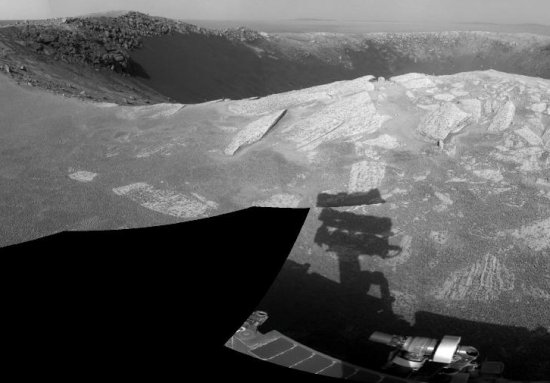
Opportunity takes a rest stop at a crater

In its 14 mile multi-year trek to Endeavour Crater — now about half completed — the Mars rover Opportunity has stopped to take a short rest stop at a small crater.

The crater, dubbed “Santa Maria Crater” by the scientists who operater Opportunity, is about the size of a football field. What makes it especially interesting are the sharp rocks piled up on its rim, as they are probably debris ejected from the crater at impact. Since this material probably came from deep below the Martian surface, it is also likely to hold information about the Martian geological past, thereby making it a prime research site.

Santa Maria crater

0 comments

A Martian eclipse

The hubbub about this week’s lunar solstice eclipse was, from my perspective, mostly manufactured press blather. For those who had never seen a lunar eclipse, it was a spectacular experience, but there really was nothing scientifically or technically unique about the fact that it happened to occur on the solstice.

However, below is an eclipse that is definitely unique both technically and scientifically. Scientists using the Mars rover Opportunity have filmed an eclipse on Mars, showing the Martian moon Phobos crossing in front of the Sun. Consider the engineering accomplishment: not only did they need to be able to calculate exactly when this would happen at a very particular spot on the Martian surface, they had to have a camera there able to take the movie. And they had to operate it from Earth!

0 comments

Avoiding the facts in the climate debate

Yesterday the New York Times published a long article by Justin Gillis describing the work of Charles Keeling, the scientist who first measured the increase in carbon dioxide in the Earth’s atmosphere. The article is very much worth reading, as it does a generally reasonable and detailed job of giving the history, background, and importance of Keeling’s research.

Unfortunately, the flaws of Gillis’s article illustrate the difficulty of debating climate change science, or maybe any political issue, in our times. Though Gillis does make an effort to give the skeptical scientists their fair due, he is so convinced they are wrong that his article in the end fails to address the basic areas of disagreement on which the entire climate debate today hinges. In fact, by avoiding some of the debate’s most basic issues, Gillis ends up creating barriers which make an honest analysis of the issues impossible.

That this seems to happen in almost all political debates today is distressing, at the least. How can we honestly face our problems if we refuse to face all the facts on which those problems hang?

Let’s consider the specific areas where Gillis’s demonstrates a large blind spot:

1. One of the fundamental facts that throws a wrench in all global warming theories is the fact, recognized by all climate scientists, that in all past global warming events, the Earth’s climate warmed before the levels of carbon dioxide rose. In other words, an increase in carbon dioxide in the atmosphere did not cause global warming. Instead, the warming encouraged the increase in carbon dioxide.

An honest appraisal of the science of climate change would always recognize this puzzling but very significant data point. Gillis, however, fails to mention it. Nor is Gillis alone in this failure. Almost all global warming advocates as well as their willing helpers in the press routinely ignore this important detail. Yet, that climate scientists can’t explain this fact is one of primary reasons many are skeptical of the disaster scenarios put forth by global warming advocates.

As I say, an honest discussion of this subject would always recognize this point.

2. As his primary evidence that the Earth is now warming from the increase of atmospheric carbon dioxide, Gillis has this to say:

In 2007, a body appointed by the United Nations declared that the scientific evidence that the earth was warming had become unequivocal, and it added that humans were almost certainly the main cause. Mr. Gore and the panel jointly won the Nobel Peace Prize.

This “body” is of course the IPCC. That Gillis is strangely reluctant to actually name this organization in his article suggests he knows its reputation is seriously damaged. Rather than face this fact and deal with it, however, he prefers to ignore it, and in the process help his readers avoid this fact as well.

Yet, the IPCC reports have known problems. They contain some fundamental factual errors, as well as citing as evidence numerous press releases from environmental advocacy groups, hardly a reliable source of information. This is not to say that the IPCC reports should be dismissed wholesale, but for Gillis to depend on them as his sole source of proof of global warming without recognizing these problems is not only inappropriate, it discredits everything he writes. It also suggests that he relies more on the prestige of the organization who issued the report, rather than the science behind it. His further reference to Al Gore and the Nobel prize is further evidence of this reliance on authority.

Once again, an honest appraisal of the present state of the global warming debate would gladly face all these facts, and describe them for the reader.

3. Gillis makes the unfortunate decision to call anyone who questions the science of global warming a “contrarian.” The use of this denigrating term, comparable to the use of the term “denier”, suggests that Gillis has a closed mind about the subject, and has no interest in finding out anything about the skeptical view.

An honest appraisal of the debate, however, would avoid these kinds of loaded terms. It is perfectly fine to note the weaknesses of the skeptical position. It is not acceptable to use ad hominem attacks to discredit them.

All in all, the three examples above encompass all of the basic problems we face in almost all our political debates today:

  • First, the refusal to face some inconvenient facts.
  • Second, the willingness to rely on authority or prestige, rather than the facts themselves.
  • And third, the willingness to use ad hominem attacks to discredit anyone who disagrees with you.

Until we stop doing these foolish things, we will find it impossible to discuss or solve our problems reasonably, and with good will.

3 comments

The Sun is blank

For the first time since October 10, and only the third time since August, the Earth-facing side of the Sun is blank, showing no sunspots. All told, 2010 has only been blank 13% of the time, for a total of 46 blank days, with only 12 days left in the year. These numbers contrast sharply with 2009, when the Sun was blank 71% of the time, or 260 out of 365 days.

It is very clear that the solar minimum is now over, and that the Sun ramping up to its next maximum. Blank days should soon cease (today might very well be the last for years), and the number of sunspots should continue to increase through approximately 2013, when astronomers now expect the maximum to peak.

It will be a weak maximum, however, likely accompanied with cold weather. At least, this has been the pattern for the last ten centuries, based on the best data that scientists have. When the Sun produces sunspots, the Sun gets hotter, and though that increase in radiation appears slight, it seems enough to warm the Earth’s climate. This is what appears to have happened around the year 1000, during what climate scientists call the Medieval Warm Period.

And when the Sun goes blank, or produces fewer sunspots, the Sun dims, and the Earth’s climate cools. This is what happened in the 1600s and 1700s, when the Little Ice Age gripped much of the Earth. It also happened in the first two decades of the 1800s, the last time the Sun produced as few sunspots as it is now, and when at least one year was called “the year without a summer”. Interestingly, that cold period at the beginning of the 1800s was also a period of intense volcanic activity, which threw a lot of dust and material into the atmosphere and thus helped contribute to the cooling of the Earth.

The last half of the 20th century, however, has not seen that much volcanic activity, which has made the atmosphere today clearer than any time in the past five decades. It has also been a time of increased solar activity, with most of the solar maximums peaking at generally higher numbers. No wonder scientists have detected evidence of a slight warming in the climate.

However, that warming appears to be ending, and it is doing so at the same time the Sun is going spotless. Though we don’t yet fully understand the mechanics of how these two events are linked, it behooves us to pay close attention. No climate prediction or computer model will mean anything if it does not.

Meanwhile, solar scientists remain unclear about the causes behind the solar cycle’s ebbs and flows. They have a reasonable idea that the cycle is caused by the Sun’s magnetic dynamo as it flips from one polarity to another. But why this happens is still subject to debate.

More importantly, it remains a complete unknown how long the next sunspot minimum will be. The Sun could spring back to life, as it did in the 1850s, producing lots of sunspots. Or sunspots might fade out for a few additional decades, as they did in the 1600s.

Sadly, based on the state of our science today, this is a question that probably no one will be able to answer — until we actually see it happen.

2 comments

Looking into a lunar cave

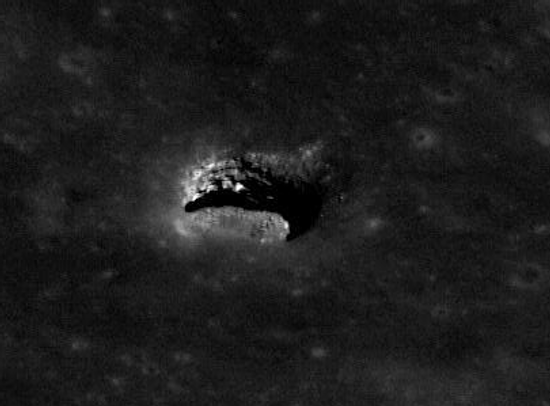
NASA engineer James Fincannon emailed me the image below, cropped from this Lunar Reconnaissance Orbiter scan. It shows a side view of the same lunar pit previously discussed by me in July (here and here).

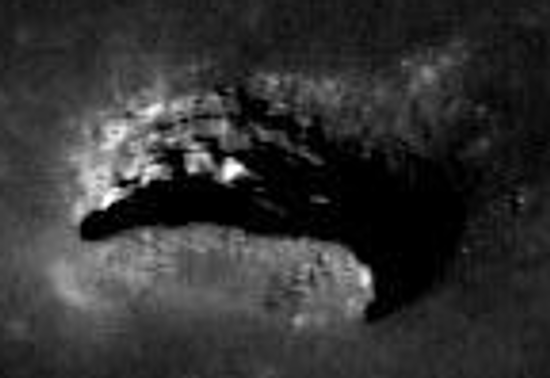
This image below was almost certainly ordered up by LRO scientists after seeing the images above so that they could get a look at the pit’s walls. I have further cropped it and blown it up so we can get a really good look too! See the second image below.

In this side view, we are looking across the top of the pit at the far wall and floor. On that far wall you can see what look like three coarse horizontal layers, below which is a deeply shadowed floor layer that is probably either cave passage or a significant overhang. Further processing will probably be bring out some further details and hopefully answer this question.

In a previous post, I had noted that this wall is probably about 200 feet deep. This new image thus gives any experienced rock-climber or caver a very nice sense of what a rappel down the side of that pit would be like. To me, it reminds me of some of the open-air cave pits I’ve rappelled into in New Mexico.

Update: I should note that that overhang/cave entrance at the bottom of the pit is probably at least 30 feet high. An impressive entrance, indeed.

Also, lunar scientist Paul Spudis emailed me with these comments:

[The pit] is very similar to some tube systems that I have studied in Hawaii. The wall units are exposed lava flows. They are probably all from the event which made this flow — a single flow can be made up of multiple flow units, hence, the apparent “layering.”

Of course, getting into an open pit and then moving through open void lava tubes that radiate from it are two different things. In terrestrial tube systems, many tubes are open and accessible but sometimes they are not. They can be blocked up by frozen lava or rubble from adjacent tube collapse.

Unfortunately, I don’t think we’re going to know what the situation on the Moon is until we get there. However, I must say, this particular area looks very promising.

Side view of pit

closeup

4 comments

More evidence that the rim of Shackleton crater is valuable real estate

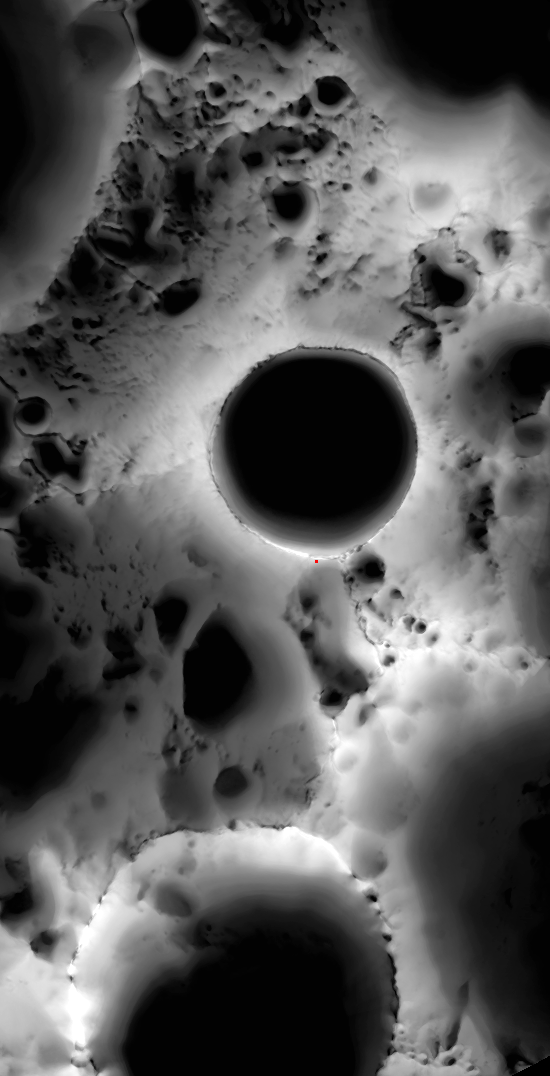
The image below was produced by Lunar Reconnaissance Orbiter by assembling data from numerous images over six months. The levels of brightness and darkness indicate the percentage of time in which an area is sunlight. The red dot just below the rim of Shackleton shows the approximate location of the south pole.

As you can see, the rim of Shackleton Crater nearest the south pole is illuminated by the sun most of the time, while the nearby crater floor never gets sunlight. This data confirms what Japanese scientists found using their lunar probe, Kaguya. The south pole has the ideal combination of locations with nearly continuous bright sunlight (to provide power) and nearly continuous darkness (where explorers will likely find significant amounts of frozen water), making this is an excellent location to build that first lunar base. And from the image you can see that the Shackleton Crater rim is not the only spot near the south pole with these conditions.

Also, if you look at the close-up image of Shackleton’s rim that I posted here, you will see that there is plenty of room to land and set up residence.

illumination map of lunar south pole

3 comments

The flight of Falcon 9/Dragon: Doing it right

For those that want to relive the experience of success, SpaceX has posted a short highlight video of last week’s successful test flight of Falcon 9/Dragon capsule.

It is difficult to overstate the importance or magnifience of this achievement, accomplished not by a government but by a private company. As SpaceX rightly brags on its website:

This marks the first time a commercial company has successfully recovered a spacecraft reentering from Earth orbit. It is a feat previously performed by only six nations or government agencies: the United States, Russia, China, Japan, India, and the European Space Agency.

What I find even more telling is how quickly SpaceX got this done. The first launch attempt of their first rocket, Falcon 1, took place in March of 2006. About that same time they began work on Falcon 9, and were able to successfully fly its first mission only four years later. Contrast that with NASA. President Bush proposed building a replacement for the shuttle in 2004, and six years later all NASA could do was fly a mockup of Ares I/Orion, not the actual article. And that leaves out NASA’S numerous previous attempts to build a shuttle replacement that spent billions, and never did more than produce pretty powerpoint presentations.

SpaceX’s speed of operation (a sure sign of efficiency) is reminiscent of the early days of the space age. Then, NASA might have laid out the overall plan, but everything was built by private companies, all used to fighting for profits and market share. None could afford a leisurely pace, nor could they afford to do things badly. If they did either, their business would suffer. As a result, the United States was able to go from having no ability to put anything in orbit to putting its first man in space in less than three years, and was able to follow that up with the first manned lunar mission only seven years later.

8 comments

The greed for power, or why it is always better to do without government help

In an article today on spaceref.com “NASA: It’s Our Space Station – Not Yours,” Keith Cowing has some harsh words for NASA and its management of the research on ISS. Based on what he witnessed at a NASA meeting, it appears that NASA wants to retain control over all research on the space station, while denying access to outside other researchers. Key quote:

In addition to prohibiting the ISS National Laboratory contractor from getting its hands on human-based research, Mark Uhran also stated that any proposal that proposed to do anything with spacecraft systems or engineering would be similarly deemed non-responsive. In other words two of the most interesting things you can do on the ISS – the sorts of thing you’d want a larger research base to focus on (assuming you are really interested in outside participation) are off limits due to executive fiat.

Where is NASA’s justification for limiting the ability of the private and educational sectors from making full utilization of the amazing capabilities that are offered by the ISS? Answer: NASA made it up. Truth be known, NASA was dragged kicking and screaming into supporting this National Laboratory concept. Congress had to enact a law to make them do it.

None of this surprises me. NASA is a government agency, and as a government agency it is going to protect its turf, come hell or high water. It is for this reason I think it a bad idea for the new space rocket companies to take any NASA money, up front. If they do, NASA will immediately use those funds as a club to force these new companies to do things as NASA wishes, rather than being free to compete and innovate on their own. In other words, NASA will use the funds to maintain control of all space exploration.

Better the new companies build their rockets and spaceships on their own, and then sell these new inventions to NASA or whoever else wants to use them. Let the profits pay for the work, not the needs and regulations of a government agency.

Not only will this free competiton produce a lot more creativity and innovation, it will almost certainly help to reduce the cost of space travel, as these companies fight to gain market share. And most importantly, it will frame the future exploration of space in the context of freedom rather that a state-run endeavor.

And isn’t freedom the principle that the United States of America stands for?

1 comment

The last remant of a supernova

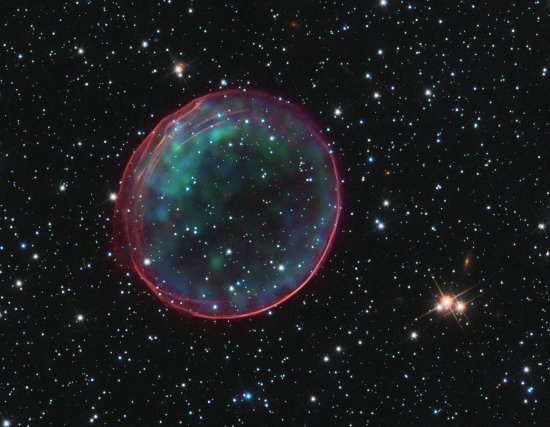
Time for some astronomical sightseeing! This image, produced from data taken by both the Hubble Space Telescope and the Chandra X-ray Observatory, shows what astronomers call a supernova remnant. The bubble, located in the Large Magellanic Cloud 160 thousand light years away, is thought to be 23 light years across and expanding about 11 million miles per hour. It is thought that the supernova itself took place around 1600. That we have no record of it is probably because it was only visible in the southern hemisphere, where few records of such events were being kept at that time. More here, including the image using only Hubble data as well as a video animation that is quite stunning.

Supernova remnant

0 comments

Clouding the climate picture

Two seemingly conflicting research papers, both focusing on how the formation of clouds might affect, or be affected by, global temperatures, actually end up combining to show that the worldโ€™s climate models canโ€™t be trusted. In other words the basic science of predicting climate change remains seriously flawed.

At issue in both papers is how much and under what circumstances clouds help to warm or cool the planet. Do they reflect solar energy back into space or hold it within the atmosphere like a blanket โ€“ and by how much? The answer is crucial to determining where global temperatures will be heading in this century โ€“ and what if any policies the worldโ€™s governments should be adopting to deal with the situation.

The latest research, appearing this week in the journal Science, is the work of Andrew Dessler of Texas A&M University. In it he examines the weather-satellite databases covering atmospheric conditions over the past 10 years, looking for discernible patterns where changes in temperature have resulted in changes in cloud cover, or vice versa.

In particular, Dessler chooses El Niรฑo and La Niรฑa events in the Pacific Ocean. El Niรฑo, which occurs every three to seven years, is accompanied by an enormous finger of warm water extending eastward along the tropical Pacific, all the way to South America and first appearing around year end. La Niรฑa, which also erupts periodically, produces the opposite effect โ€“ a large zone of colder-than-normal water stretching across the Pacific. Both events tend to attract attention, because they usually generate severe weather affecting large areas of North and South America and elsewhere.

El Niรฑo and La Niรฑa are ideal subjects for climate researchers. They both develop quickly and produce, respectively, recognizable spikes and troughs in temperatures. For example, scientists studying the relationship of clouds to temperature can observe changes in cloud cover over the Pacific that precede, coincide with, and follow El Niรฑo and La Niรฑa and then use those changes to estimate how cloud cover affects or is affected by air temperature.

As Dessler describes in the Science paper, he did find evidence of what he calls a small positive feedback, meaning that clouds may prevent some solar heat from radiating into space, thereby warming the planet. He also doesnโ€™t rule out the possibility of a small negative feedback, but says it probably isnโ€™t large enough to overcome other factors contributing to warming.

But Dessler includes several assertions in his text that completely debunk the idea that climate science is โ€œsettled,โ€ as asserted by former Vice President Al Gore and a host of others. For example, early on in the paper, Dessler acknowledges that โ€œthe most complex and least understoodโ€ of climate-feedback mechanisms is cloud feedback. And later on, he admits that โ€œwhat we really want to determine is the cloud feedback in response to long-term climate change. Unfortunately, it may be decades before a direct measurement is possible.โ€

The earlier paper, published in the summer of 2010 in the Journal of Geophysical Research, by Roy Spencer and William Braswell of the University of Alabama at Huntsville, goes much farther in challenging the cloud-temperature link. The global warming community has tried for years to discredit Spencerโ€™s work and to brand him as a โ€œdenier,โ€ partly because for more than a decade he has produced findings that call into question the reliability of the host of earthbound instruments used to collect global temperature data.

Such accusations have been entirely unfair, because even Spencer, in his eminently readable and informative blog, has asserted from time to time that he isnโ€™t sure whether the climate is changing and human activity is responsible. What gets him into trouble with the conventional wisdom is his emphasis on whatโ€™s wrong with current climate science and what remains unknown โ€“ and though itโ€™s a short list, itโ€™s formidable:

  • โ€œEveryone agrees that the net effect of clouds is to cool the climate system on average. But the climate models suggest that the cloud feedback response to the addition of [carbon dioxide] to our current climate system will be just the opposite, with cloud changes acting to amplify the warming.โ€ [Ed. To put it more simply, clouds cool the climate, except when they are used in global warming climate models.]
  • โ€œWhile we know that evaporation increases with temperature, we donโ€™t know very much about how the efficiency of precipitation systems changes with temperature.โ€
  • โ€œThere [is] a variety of processes … which can in turn alter the balance between evaporation and precipitation, which will then cause warming or cooling as a result of the humidity change โ€“ rather than the other way around.โ€

[Ed. Concerning the second and third quotes: Since water vapor in the atmosphere is by far the most powerful greenhouse gas, far more important than carbon dioxide, not understanding its detailed relationship with temperature means no model can do a reliable job of predicting the climate.]

In their paper Spencer and Braswell likewise look at the relationship between clouds and temperature. In an extremely detailed and โ€“ even to climate researchers โ€“ dense examination of the same satellite database, the two authors present an argument that separates the phenomenon of cloud formation from anything relating to temperature changes. As Spencer comments in his blog, regarding the feedback data, โ€œeven the experts in the field apparently did not understand them.โ€

But even interested lay readers can glean the gist of Spencer and Braswellโ€™s findings simply by looking at the graphs they present, which contain jumbles of data points suggesting a complete disconnect between cloud formation and temperatures. This is a strong indication that we donโ€™t know which is the cause and which is the effect, though most climate researchers assume temperature is the cause and clouds are the effect. At best, the researchers conclude, thereโ€™s evidence for a slight negative feedback โ€“ clouds causing cooling when temperatures rise โ€“ but overall there appears to be no link between the two phenomena over long periods.

โ€œI cannot remember a climate issue of which I have ever been so certain,โ€ as Spencer wrote about this finding on his blog.

The debate over the cloud-temperature link is bound to go on, but these two papers should make one thing clear: Until the connection between cloud formation and temperature is established or debunked once and for all, the models being used to predict future climate cannot be trusted. So perhaps when the new Congress looks at climate-related issues its members might want to consider them in this context.

3 comments

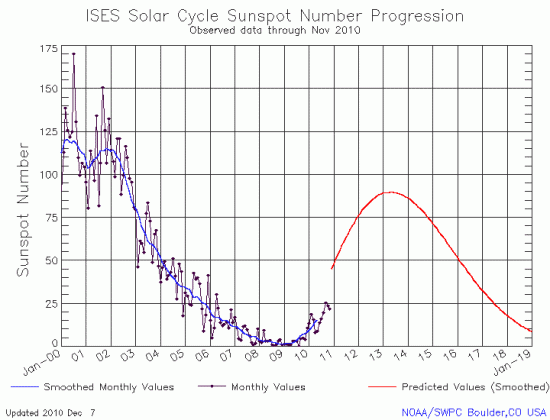
The November sunspot graph – still low and below expectations

NOAA’s Space Weather Prediction Center today published its monthly update of the Sun’s developing sunspot cycle (see below). The graph shows the slow rise in sunspots (blue/black lines) in comparison with the consensis prediction made by the solar science community in May 2009 (red line).

Novembe sunspot graph

As I noted last month, the rise in sunspots as we ramp up to the next solar maximum has definitely slowed, which indicates clearly that we are heading towards the weakest solar maximum in more than two centuries. And as I have noted repeatedly on this website as well as on the John Batchelor Show, that means very cold weather!

0 comments

‘A million climate change deaths each year’

Global warming activists today released a report claiming there will be “a million climate change deaths each year” by 2030.

Wanna bet? This article from AFP is typical of what I call press release journalism. The unnamed author shows no skepticism, and simply regurgitates what these activists told him without question. I for one would love to see this so-called report, as I suspect it has more scientific holes than a hunk of swiss cheese.

Update: I just did a quick scan of this so-called “peer-reviewed” report, and it is a piece of junk. (You can see the report’s press release here. The report can be downloaded here [pdf]) Its data is compiled from UN political workshops, not scientific research. Moreover, it uses the 2007 IPCC report as its fundamental source, even quoting some of that report’s now discredited research, such as its claim that the glaciers in the Himalayas will be gone in mere decades.

0 comments
1 124 125 126 127 128 139