
Stringspace Jazz Band – Hit The Road Jack
An evening pause: It’s Friday. May we all hit the road and have some fun.
Hat tip Alton Blevins.
An evening pause: It’s Friday. May we all hit the road and have some fun.
Hat tip Alton Blevins.

This party has got to be replaced
With the announcement today that the No Labels third party, made up of disaffected moderates from both parties (with the majority from the Democratic Party side), will field a 2024 presidential ticket in November, most news reports are doing what this AP report does, focus on the impact that candidacy will have on the Trump-Biden match-up.
Biden supporters worry No Labels will pull votes away from the president in battleground states and are critical of how the group won’t disclose its donors or much of its decision-making.
The executive director of the group MoveOn, which is aligned with Democrats, said a No Labels ticket would help Trump win. “Any candidates who join the No Labels presidential ticket will be complicit in making it easier for Donald Trump and MAGA extremists to win a second term in the White House,” Executive Director Rahna Epting said in a written statement.
Third Way, another group that is aligned with Democrats and opposes a No Labels ticket, noted No Labels was moving forward without having first found a candidate.
Americans need to look at this a different way. » Read more
Link here. This Nasaspaceflight.com article provides an excellent update on the status of the development of Stoke’s Nova rocket, which will have a radical new engine design in its upper stage, using a ring of small nozzles rather than one single central one. That design will allow the upper stage to return to Earth for reuse, something that no other rocket now in use at present can do.
Stoke Space recently carried out the first test of the full-size 30-thruster version of the innovative engine that the company is producing for its in-development second stage. This will be an integral part of its future Nova rocket, which aims to be a fully reusable medium lifter.
The engine test took place on Feb. 26 and follows the engine’s first test flight on its prototype vehicle, Hopper 2, in September 2023. Although fitted with only 15 chambers for that flight, Hopper 2 flew for 15 seconds, achieved a maximum altitude of 30 feet, traversed to a landing site, and touched down softly.
The article includes a lot of interesting technical details about this upper stage and what engineers are learning about this radical engine design. Worth reading. At present Stoke is the only company other than SpaceX attempting to make its upper stage fully reusable. If successful it will jump ahead of everyone else.
No launch schedule however for its new rocket was revealed in this report, so it might be awhile, if ever, before any of this bears fruit.
Two of the more radical Democrats in Congress, Jamie Raskin (D-Maryland) and Robert Garcia (D-California), have issued a public letter [pdf] to SpaceX, accusing the company of not having the “appropriate guardrails and policies in place to ensure your technology is neither acquired nor used illegally by Russia.”
The letter then demands SpaceX answer a number of detailed questions, such as the number of thefts SpaceX has detected, what does the company do to prevent such thefts, and how the company is acting to adhere to the present federal sanctions against Russia. It demands answers by March 20, 2024.
SpaceX has made it very clear it is doing what it can to prevent the use of stolen Starlink terminals, not only in the war situation in the Ukraine but elsewhere. It is not in the company’s interest to allow such thefts.
This letter therefore is just another effort by the Democrats to harass Elon Musk, because Musk has also made it clear he personally no longer supports the agenda of today’s Democratic Party. These two politicians likely intend to use whatever answer they get from SpaceX to further attack the company, and even institute sanctions against it.
Welcome to the new America, where politicians can routinely abuse their power to harass any private citizen who disagrees with them.
The budget bill that Congress has just passed and awaits signature by the president included a very short extension of commercial space “learning period” that supposedly prevents heavy safety regulation by the FAA of the new commercial space industry.
That learning period was first established in 2004, and has been extended several times since. This new bill extends that period until May 11, 2024, only two months, supposedly to allow Congress time to pass a new commercial space act.
The truth is that, at present, the Biden administration has long since abandoned that learning period exemption, and has been applying a much stricter safety regulatory framework from space companies than required by law, as best illustrated by its treatment of SpaceX’s Superheavy/Starship launches. The FAA now expects all launches to function perfectly, even if testing a prototype, and should anything not go perfectly it treats the failure the same as an airplane mishap that requres any investigation to get full government approval before further launches can resume.
Unless there is a change in leadership in Washington, it is very likely we shall see few new American rocket companies from here on out. The existing companies with lots of money and power will survive, but under this heavy regulatory atmosphere it will be hard if not impossible for new companies to get established.
The board of directors of the rocket startup Astra have finally agreed to a cut-right price offer from the company’s two founders to buy the company and take it private once again, rather than declare bankruptcy.
The company announced Thursday that its board had accepted an offer from its CEO, Chris Kemp, and its CTO, Adam London, to purchase the remaining Astra stock at a price of $0.50 per share. The deal is expected to close in the second quarter of 2024, at which time Astra will cease trading on the Nasdaq.
This offer was significantly less than their first offer in November, when Kemp and London offered to buy the company for $1.50 per share, suggesting the company’s value has declined significantly in the interim as its cash assets declined. This decline suggests that any recovery will be difficult and long, and could easily fail.
Freedom is wonderful in that it allows for the greatest amount of creativity, competition, and achievement, from everyone. It also carries great risk that everyone must face. Astra has now illustrated the risk. Not all creative gambles are going to succeed.
Sierra Space yesterday confirmed that its first Dream Chaser reusable mini-shuttle Tenacity, being readied for a hoped-for April launch, successfully completed vibration testing last month.
Key accomplishments in this first critical phase of pre-flight testing included: the completion of Sine Vibration Testing (in all three axes or directions), a Separation Shock Test that simulates the separation of the Dream Chaser from Shooting Star and a test that involved deploying the spaceplane’s wings. These tests evaluated Dream Chaser’s performance under the stresses of launch, operation in orbit and ability to communicate with the International Space Station (ISS).
What I find revealing about the press release at the link is that it really adds nothing from a NASA press release from a month ago. Then NASA said that Tenacity was about to move to a vacuum chamber for environmental testing. According to this new press release, that move has still not occurred and the environmental test still must begin.
That engineers didn’t move Tenacity to environmental testing while they were reviewing the vibration test data suggests there was something in that test data that prevented it. It appears that unstated issue is resolved, but it caused a pause in testing.
As a result, it appears that an April launch is unlikely delayed by a month or more, assuming my attempt to read between the lines is correct.
An evening pause: Performed live 1971.
Hat tip Ice Pilot.

The seal of UNLV. The motto means “All
things for god’s country,” a motto UNLV
no longer follows.
Last month a group of Hamas anti-Semitic bullies invaded a classroom at the University of Nevada-Las Vegas (UNLV) and shut down the lecture about black holes by a physics professor, simply because that professor, Asaf Peer, happened to be Israeli.
Peer, from Israel’s Bar-Ilan University, actually invited the activists to remain to learn about black holes and then discuss “unrelated issues” after his lecture. But the demonstrators continued their antics, leading to the UNLV police to be called in.
When the police arrived, they refused to remove or silence the protesters so the lecture could continue. Instead, they decided that the First Amendment gave this mob the right to silence whomever they wanted. The police further decided that for Peer’s “safety,” his lecture must end and they would “escort” him off campus.
This led Professor Asaf Peer … to ask “What about my freedom of speech?”
How naive of Peer. Doesn’t he know that in today’s America, the First Amendment only guarantees the left the right to speak and shout and harass and riot and even kill? It also gives the left, and only the left, the right to silence and blacklist and ban any other speech, and if that doesn’t work it gives the left to right to use force and violence to shut up any dissent.
Or to put it more simply, their violence is speech, your speech is violence.
At the University of Nevada-Las Vegas, it is very clear this is how university officials and the police interpret the Bill of Rights.
» Read more

Click for original image.
Cool image time! The picture to the right, cropped, reduced, and sharpened to post here, was taken on January 3, 2024 by the high resolution camera on Mars Reconnaissance Orbiter (MRO), and shows what the camera team describes merely as “landforms.”
In truth, these features, as well as almost everything in the surrounding terrain beyond the edge of this picture, are possibly the weirdest geological features on Mars. The two mounds, no more than fifteen feet high at the most, resemble pimples. The rough ground to the north actually appears to be some flow that worked its way around the mounds, as indicated by the arrows. The crack to the southeast of the two mounds appears to be an extension of a fault line that cuts through the center of the larger mound, suggesting the mound is some form of eruption belching out of that fissure.
That the latitude is 42 degrees north, these weird features all suggest some form of ice-based volcanic activity, because the ground here is probably impregnated with ice.
As for the bridge connecting the two mounds, who knows what caused it?
» Read more
On March 5, 2024 Michelle Dopak filed a lawsuit against SpaceX for sexual discrimination and retaliation, claiming the company paid her less than male workers, refused to promote her, and ignored her complaints about sexual abuse by her married manager that eventually led to a pregnancy.
Dopak said in the suit that in 2020, her manager offered her $100,000 to have an abortion, which she declined. She is suing the company for an unspecified amount of damages. Reuters was first to report the existence of the lawsuit. Dopak accused SpaceX of colluding with her former manager by allowing him to transfer $3.7 million in SpaceX stock out of his name to evade child support payments, according to the lawsuit obtained by Business Insider.
This suit is one now of several discrimination suits against the company. Unlike the others, however, if Dopak’s accusations prove true it would be the most damaging of all, since she claims the company itself took action against her to protect this manager. The other suits appear more frivolous on their face, issued by individuals claiming to have been fired by SpaceX for their opinions, when the facts strongly suggest they were more interested in causing trouble at the company then doing their job, and thus deserved to be fired.
A New Jersey man was arrested on December 4, 2023 while driving a vehicle carrying more than two hundred Starlink terminals, and later charged with trafficking 675 Starlink terminals that he obtained illegally using “stolen credit card accounts or hacked Starlink billing accounts.”
The man, 35-year-old Kelvin Rodriguez-Moya, was stopped by police Dec. 4 while driving 223 Starlink terminals in a pickup truck and trailer after leaving a residence in Lawrence Township, New Jersey, a criminal complaint said. The terminals had shipping labels addressed to multiple different names at the same address.
Lawrence Township police had been tipped off about a suspiciously large number of Starlink terminals being shipped to that home, the complaint said. Detectives then witnessed Rodriguez-Moya loading a FedEx shipment of terminals onto the truck and trailer.
SpaceX is working with the police to determine how Rodriguez-Moya obtained so many terminals. I suspect it was because so much of Starlink operations are automated. The computer programs that issue terminals to new customers aren’t smart enough to notice such things.
This case might also help explain the stories in both Russia and Botswana of unauthorized terminals being sold.
Link here. In the past week or so Blue Origin has done three tanking tests of its assembled engineering test rocket, simulating fueling of a New Glenn rocket on the launchpad, and now intends to roll that test vehicle back to its rocket assembly building.
From here, it is most likely that the rocket will be prepared for the next round of testing, which will include a static fire of the seven first-stage BE-4 engines. This test will mark the first time that Blue Origin’s BE-4 engines will ignite while integrated with a New Glenn first stage. It will also be the first time that the new launch pad supports an engine firing.
The company continues to aim for a first test launch of New Glenn before the end of the year, and these tests strengthen the likelihood that this schedule is realistic.
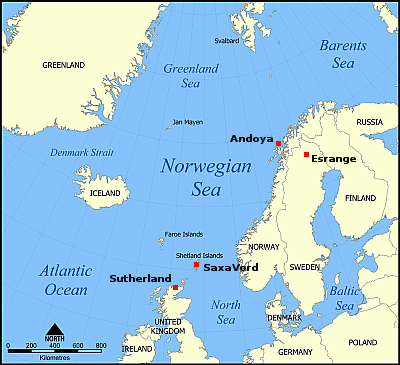
Proposed spaceports surrounding Norwegian Sea.
The government of the United Kingdom announced yesterday that it will directly invest £10 million in the Saxavord spaceport being built on one of the Shetland Islands, as shown on the map to the right.
Coming in addition to around £40 million of private investment, the government funding will allow SaxaVord to accelerate its capital works programme to ensure it is ready to support the first orbital launch.
That capital works program was forced to shut down last year when red tape at the Civil Aviation Authority (CAA) delayed the licensing of Saxavord. It could be this grant has been issued partly to repay the losses the spaceport company experienced due to those bureaucratic delays. The timing kind of reinforces this speculation, as only yesterday Saxavord got its spaceport license approved, though other approvals remain pending.
All this news suggests strongly that the first test flight at Saxavord by the German rocket startup Rocket Factory Augsburg will occur later this year, as promised.
Meanwhile, the other spaceport in Sutherland must be wondering if it can get similar government aid, or if the government is now playing favorites.
An Irish company, SUAS Aerospace, has announced a investment capital round to raise €5 million in order to establish a spaceport in Ireland by 2027.
The company has been lobbying for this spaceport since at least May 2023. It is based on the southern coast of Ireland at a facility dubbed the National Space Centre. This would likely be close to where the spaceport would be located, though this is unconfirmed.
SUAS Aerospace was founded in 2019 and is supported by the Enterprise Ireland. With initial investment of €1.1 million to date, SUAS has secured significant partnerships with major European Companies including Skyrora, T Minus Engineering, Pangea Aerospace and is part of a successful consortium awarded a €5m grant from Horizon Europe to develop interoperable (plug and play) rocket engine testing infrastructure for Europe.
I wonder if Ireland’s bureaucracy will be easier to work with than Great Britain’s.
In a tweet yesterday SpaceX announced an update on its Starship webpage, outlining its plans for the third orbital test launch of its heavy-lift Starship/Superheavy rocket, with March 14, 2024 listed as the hoped-for launch date.
The update began with these cautionary words, “pending regulatory approval,” and then went on to describe details of the test flight:
The third flight test aims to build on what we’ve learned from previous flights while attempting a number of ambitious objectives, including the successful ascent burn of both stages, opening and closing Starship’s payload door, a propellant transfer demonstration during the upper stage’s coast phase, the first ever re-light of a Raptor engine while in space, and a controlled reentry of Starship. It will also fly a new trajectory, with Starship targeted to splashdown in the Indian Ocean. This new flight path enables us to attempt new techniques like in-space engine burns while maximizing public safety.
I suspect the change in the splashdown location, from northeast of the main island of Hawaii, was instigated by the FAA for those “public safety reasons”. From SpaceX’s perspective, this is an easy give, as a slightly shorter flight makes little difference for this test, and it allows the company to test that Raptor engine by firing that de-orbit burn.
Will the flight occur on March 14th? The odds are high, partly because this SpaceX announcement is designed to put pressure on the bureaucrats at the FAA to finish their paperwork already. At the same time, bureaucrats sometimes love to stick it to private citizens, just for fun. We shall see.
Embedded below the fold in two parts.
To listen to all of John Batchelor’s podcasts, go here.
» Read more
An evening pause: From the Youtube page:
Ann-Margret set to the Champs’ eternal hit “Tequila”. Scenes from “Viva Las Vegas” (1964), “Bye-Bye Birdie” (1963), “Made in Paris” (1966), “The Swinger” (1966) and “The Tiger and the Pussycat” (1967).
Hat tip Judd Clark.
The Democratic Party
The reaction by Democratic Party politicians and pundits to the Supreme Court ruling on March 4, 2024 — voiding the effort by Colorado to throw Donald Trump off its ballot — reveals some very fundamental realities that must be faced by all Americans. To put it bluntly: These Democrats have no intention of accepting a victory by Donald Trump in the upcoming election, even if he should win by a majority so vast that no amount of election rigging can disguise it.
The first reaction to that decision was a major tell. Jean Griswold is the secretary of state of Colorado who had taken Trump off the ballot, claiming he was an insurrectionist even though that was merely her opinion as Trump has not only never been convicted of that crime, he has not even been charged with it. Immediately after the court rejected her actions unanimously, she tweeted the following:
I am disappointed in the U.S. Supreme Court’s decision stripping states of the authority to enforce Section 3 of the 14th Amendment for federal candidates. Colorado should be able to bar oath-breaking insurrections from our ballot.
Spurred by her blind hatred of Trump, Griswold’s refusal to deal with reality here is disturbing, to say the least. First, the court made it very clear, unanimously, that the states don’t have this authority when it comes to federal elections. That she as a lawyer could not recognize the plain legal arguments here that were agreed to by even the most radical leftists on the court indicates how blind she has become to reasonable disagreement.
Second, Griswold clearly thinks she by herself, based on nothing but her opinion, has the right to determine who is or is not an insurrectionist. In a country where by law and a very long tradition all people are innocent until proven guilty, by what law does she think she has that right?
The bottom line is that Griswold reveals the mindset of the Democrat Party. They are mentally unprepared to accept a Trump election victory, no matter what, and will do anything to block his victory.
This mindset is further revealed by this CNN article published today, attempting to figure out other ways in which the Democrats can block a victory by Trump.
» Read more

The uncertainty of science: The picture to the right, cropped, reduced, and sharpened to post here, was taken by the Hubble Space Telescope and released on March 4, 2024 by the PR department of the European Space Agency (ESA) as part of its Hubble Picture of the Week program. It shows what the press release claims is a spiral galaxy about 55 million light years away, seen edge on.
In this image NGC 4423 appears to have quite an irregular, tubular form, so it might be surprising to find out that it is in fact a spiral galaxy. Knowing this, we can make out the denser central bulge of the galaxy, and the less crowded surrounding disc (the part that comprises the spiral arms).
If NGC 4423 were viewed face-on it would resemble the shape that we most associate with spiral galaxies: the spectacular curving arms sweeping out from a bright centre, interspersed with dimmer, darker, less populated regions. But when observing the skies we are constrained by the relative alignments between Earth and the objects that we are observing: we cannot simply reposition Earth so that we can get a better face-on view of NGC 4423!
This picture provides a great example of the amount of assumptions that are often contained in astronomical observations. Though the data strongly suggests this is spiral, we must remember this is merely an educated guess, based on that central bulge and the dust lanes visible along the galaxy’s profile. There is actually no guarantee that this is so. As the press release also notes, astronomers are constrained by our viewpoint, and cannot change that viewpoint to get a better view to confirm this guess. For all we know, a face on veiw of this flat galaxy would reveal it has no spiral arms, but instead is mottled and chaotic, a rare type that does exist.
Astronomers do the best they can, but it is important that they (and we) always recognize the limitations.