December 13, 2024 Zimmerman/Batchelor podcast
Embedded below the fold in two parts.
To listen to all of John Batchelor’s podcasts, go here.
» Read more
Embedded below the fold in two parts.
To listen to all of John Batchelor’s podcasts, go here.
» Read more
An evening pause: This was first posted in February 2019. As I noted then,
The video replays her singing the same thing three times. There is a good reason, as she almost appears to have begun singing as a lark, and the acoustics of the church astonish her. The repeats help bring out this amazing quality.
I always open the Christmas-Hannukah holiday season with this truly glorious piece of music, as it speaks to both religions. And it is one magnificent song, sung here magnificently.
May all my readers have a glorious weekend.
Robert Pratt and I taped a four segment podcast discussing the future of NASA and American space industry with the coming of the new Trump administration for his Pratt on Texas radio/podcast show. It is now available here.
I have also embedded it below.
» Read more

Click for high resolution panorama. For original images, go here and here.
After spending more than three and a half years exploring the floor of Jezero Crater, the rover Perseverance has finally reached the top of the crater’s western rim, and is about to begin exploring the mountainous and potentially rich mining region to the west.
The panorama above, created from two pictures taken by Perseverance’s right navigation camera on December 11, 2024 (here and here), has been cropped, reduced, enhanced, and annotated to post here. It looks west into that mountainous region, with the yellow lines on the overview map to the right indicating the approximate view. The blue dot on that map marks Perseverance’s present position, on top of Lookout Hill, the name the rover team has given to that spot on the rim.
The low resolution of the region beyond the grey strip is unexplained. For some reason the rover team has not yet updated the interactive map showing Perseverance’s travels with the many high resolution pictures that Mars Reconnaissance Orbiter (MRO) has taken of this region, in anticipation of Perseverance’s travels there. I expect however this will change shortly.
Witch Hazel Hill is the first target beyond the rim, where there is an outcrop 330-feet-high with many layers. The rover will then head downhill and south to check out a spot that the scientists believe might show features existing from before Jezero Crater was formed. The rover will then head back up to the rim further south to look at an outcrop of blocks that might actually be ejecta from another much larger Martian impact.
These blocks may represent ancient bedrock broken up during the Isidis impact, a planet-altering event that likely excavated deep into the Martian crust as it created an impact basin some 745 miles (1,200 kilometers) wide, 3.9 billion years in the past.
Jezero sits on the northwestern rim of Isidis.
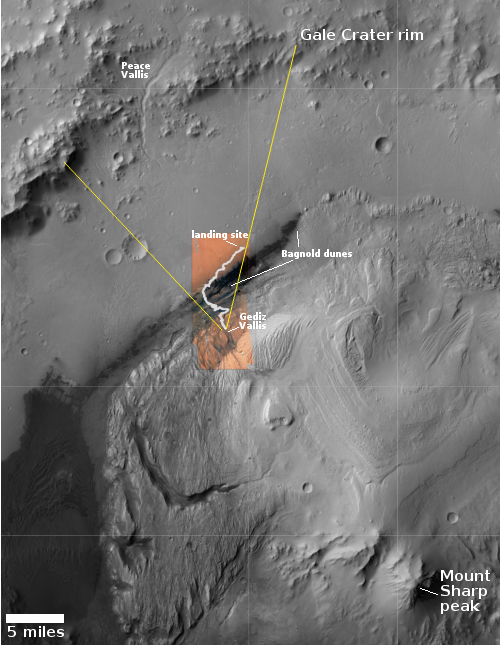
According to an update yesterday from the rover team, the Mars rover Curiosity has finally begun to round the corner of the northern nose of the long ridge dubbed Texoli that forms the western wall of Gediz Vallis, the slot canyon that the rover has been exploring since August 2022.
The picture to the right, reduced, sharpened, and annotated to post here, was taken on December 10, 2024 and shows the view looking west. The red dotted line indicates the planned route. As the rocky ground indicates, travel forward in the near term will be interesting. As noted in the update:
While we want to head southwest, we had to divert a bit to the north (right of the image shown) to avoid some big blocks and high tilt. The path is very constrained in order to avoid driving over some smaller pointy rocks, scraping wheels along the sides of blocks, or steering into the side of blocks that might cause the steering to fail. And we also needed to worry about our end-of-drive heading to be sure the antenna will be clear to talk to Earth for the next plan. We ended up relying on the onboard behavior to help us optimize everything by implementing a really interesting and curvy 24-meter path (about 79 feet).

Stoke’s Nova rocket
The rocket startup Stoke Space revealed yesterday that it has completed a static fire test of the first stage engine it will use on its Nova rocket, shown in the graphic to the right.
The test, which was not the first for this engine, proved out several new technologies.
Stoke Space called the test significant for several reasons. It’s the first hotfire of the company’s Block 2 (flight layout) stage 1 engine, and this engine architecture — called full-flow staged combustion (FFSC) — is considered particularly challenging. Only two entities in the world — Stoke and SpaceX — have successfully developed FFSC engines. … Stoke’s stage 1 engine is a liquified natural gas/liquid oxygen engine capable of producing 100,000 pounds of thrust. The duration of the test was not revealed.
It was the first time Stoke has tested on its new vertical test stand in Moses Lake. The company’s testing philosophy is that you must “test like you fly,” and it believes vertical testing is key to engine development.
Nor is the first stage engine the only technological innovation. Nova’s second stage uses a radical design whereby the engine releases its thrust through a ring of small nozzles on the outside perimeter of the stage, rather than a single central nozzle. This design is what the company hopes will allow it to return that upper stage intact for reuse.
The four year old company has raised $100 million in investment capital, but has also faced environmental red tape from the Space Force for its launch facility at Cape Canaveral. It had previously targeted 2025 for the first test flights of Nova, but that schedule appears unlikely because of this red tape.
In a letter [pdf] sent yesterday to a local judge, SpaceX requested that a special election be held in Cameron County on whether its Starbase facilities in Boca Chica should be incorporated as a city.
To continue growing the workforce necessary to rapidly develop and manufacture Starship, we need the ability to grow Starbase as a community. That is why we are requesting that Cameron County call an election to enable the incorporation of Starbase as the newest city in the Rio Grande Valley.
Incorporating Starbase will streamline the processes required to build the amenities necessary to make the area a world class place to live—for the hundreds already calling it home, as well as for prospective workers eager to help build humanity’s future in space. As you know, through agreements with the County, SpaceX currently performs several civil functions around Starbase due to its remote location, including management of the roads, utilities, and the provision of schooling and medical care for the residents. Incorporation would move the management of some of these functions to a more appropriate public body.
The letter went on to list the many other things SpaceX is already doing to benefit the area, including many of the environmental requirements imposed on it by the FAA and Fish & Wildlife.
At this moment there has been no response from the judge or Cameron County. I suspect there will be no objection, and this vote will take place in the near future. I also expect it will pass, because SpaceX employees now make up almost the entire population of Boca Chica.
An evening pause: The music is by Joe Hisaishi, from Hayao Miyazaki’s 2004 animated film Howl’s Moving Castle.
Hat tip Judd Clark.
Courtesy of BtB’s stringer Jay. This post is also an open thread. I welcome my readers to post any comments or additional links relating to any space issues, even if unrelated to the links below.
You could leave now for all I care: Mike Whitaker, who has been director of the Federal Aviation Administration (FAA) under the Biden administration and who has apparently been the main source of that agency’s increased red tape that has almost destroyed the new rocket industry that had been emerging during the first Trump administration, announced today that he is stepping down next month.
Mike Whitaker announced his pending resignation in a message to employees of the FAA, which regulates airlines and aircraft manufacturers and manages the nation’s airspace. He became the agency’s administrator in October 2023.
Since then, the challenges confronting Whitaker have included a surge in close calls between planes, a need for stricter oversight of Boeing. antiquated equipment and a shortage of air traffic controllers at a time of high consumer demand for air travel.
The article at the link is from PBS, so of course it makes this federal bureaucrat appear a hero. Instead, he was a disaster for America’s space industry, forcing unnecessary delays in SpaceX’s Starship/Superheavy program, imposing new regulations that claimed to streamline the launch licensing process but did exactly the opposite, and generally forcing FAA regulators to take a fearful attitude to any new technology, so much so that it became almost impossible for that new technology to launch.
As for the aviation industry, Whitaker’s term did little to change things. For example, he did nothing to shut down the DEI programs at major airline and airplane companies that were causing the hiring of unqualified people.
All I can say is good riddance.
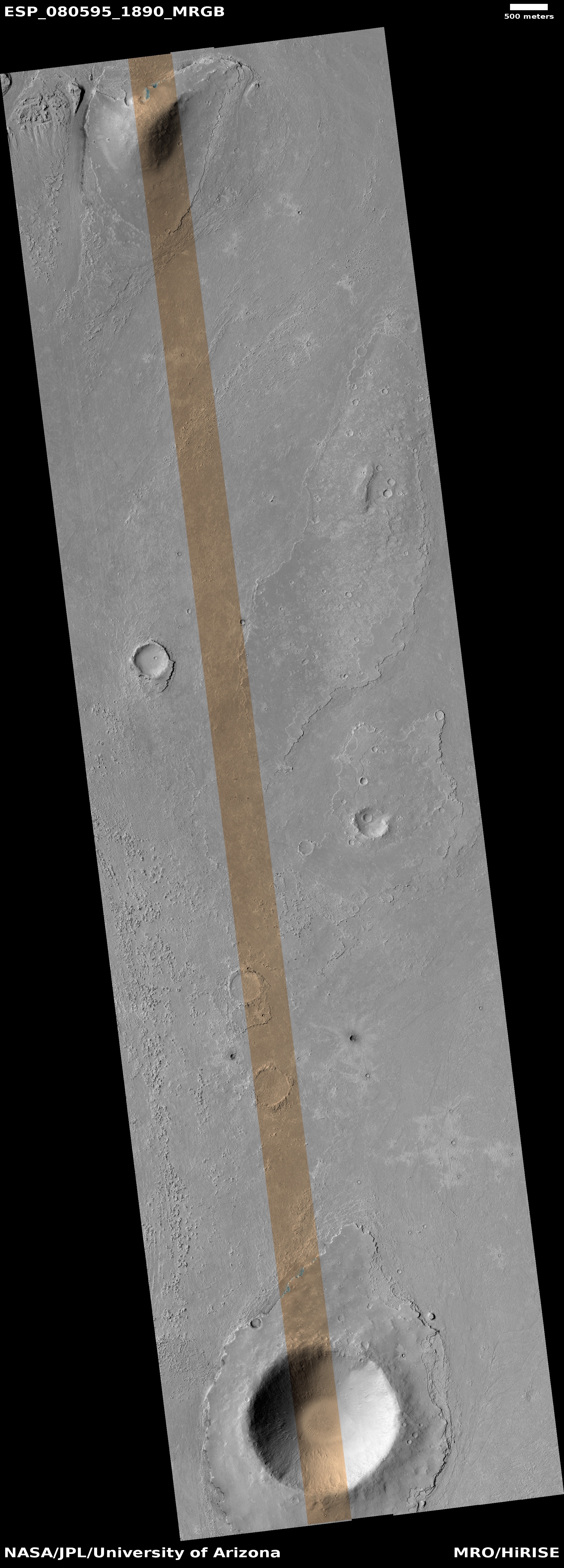
Cool image time! The picture to the right, rotated, cropped, reduced, and sharpened to post here, was taken on July 17, 2024 by the high resolution camera on Mars Reconnaissance Orbiter (MRO). Labeled merely as a “terrain sample,” it was likely taken not as part of any specific research project, but to fill a gap in the camera’s schedule in order to maintain its proper temperature.
When the camera team does this, they try to pick interesting targets. In this case, they targeted this 400-foot-high pointy-topped hill. The smoothness of its slopes suggest this hill is made up largely of packed dust, possibly a hardened former dune. This hypothesis seems strengthened by the erosion on the eastern slopes, which appears to be areas where that packed sand has worn or blow away.
Think of sandstone in the American southwest. It is made of sand that has hardened into rock, but wind and water and friction can easily break it back into dust particles, resulting often in the spectacular and weird geological shapes that make the southwest so enticing.
But is this sand?
» Read more
Using data collected from Juno’s multiple fly-bys of the Jupiter moon Io, scientists now hypothesize that the moon does not have a global underground ocean of magma, feeding its many volcanoes, but that instead each volcano is fed its lava from a separate magma chamber.
The graphic to the right illustrates the present conclusion. You can read the paper here [pdf]. From the press release:
The Juno team compared Doppler data from their two flybys with observations from the agency’s previous missions to the Jovian system and from ground telescopes. They found tidal deformation consistent with Io not having a shallow global magma ocean.
“Juno’s discovery that tidal forces do not always create global magma oceans does more than prompt us to rethink what we know about Io’s interior,” said lead author Ryan Park, a Juno co-investigator and supervisor of the Solar System Dynamics Group at JPL. “It has implications for our understanding of other moons, such as Enceladus and Europa, and even exoplanets and super-Earths. Our new findings provide an opportunity to rethink what we know about planetary formation and evolution.” [emphasis mine]
The highlighted words indicate the significance of this data. It possibly suggests that the underground oceans of water that have been theorized for these other moons — where life could possibly exist — might be mistaken. Instead, they might have smaller pockets of water, similar to Io’s many magma chambers.
Everything here however is uncertain, including these new conclusions about Io. We just don’t have enough data from any of these moons to make any definitive conclusions.