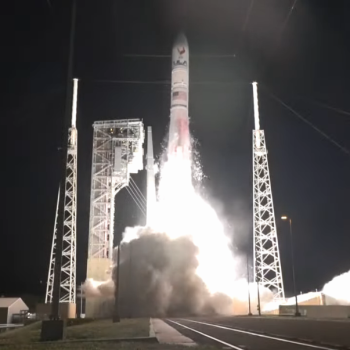
Orbital tug startup Impulse Space buys three SpaceX Falcon 9 launches

The orbital tug startup Impulse Space announced yesterday that it has signed a contract with SpaceX for three Falcon 9 launches in order to fly its Helios orbital tug as well as its smaller Mira tug on several commercial missions.

The first launch, planned for mid-2026, will be the first flight of Helios. The transfer vehicle will transport the company’s smaller Mira vehicle, carrying a commercial optical payload, from low Earth orbit to geostationary transfer orbit on the Victus Surgo mission for the Space Force and Defense Innovation Unit. Impulse Space received a $34.5 million contract for Victus Surgo and another mission, Victus Salo, Oct. 3. Impulse Space said the schedule and payloads for the other two Helios launches will be determined later.

This development signals a major shift in the nascent orbital tug industry. Up until now the varous tug companies would buy launch space on rockets as secondary payloads. This I think is the first time a tug company has purchased the rocket itself as the primary payload, giving it the ability to control the rocket in order to make its tug operations more precise for all of its customers.

1 comment

Rocket startup ABL abandons its effort to build a rocket

The rocket startup ABL, which had one failed launch attempt and a second failure during a static fire test, announced yesterday in a long tweet on X that it is abandoning its effort to build a rocket and will instead use its assets to provide products to the military.

[W]e have made the decision to focus our efforts on national defense, and specifically on missile defense technologies. We’ll have more to share soon on our roadmap and traction in this area. For now, suffice to say we see considerable opportunity to leverage RS1, GS0, the E2 engine, and the rest of the technology we’ve developed to date to enable a new type of research effort around missile defense technologies.

In other words, they are repurposing their RS1 rocket for missile technology.

The company’s announcement claims this decision is partly because the competition from established companies diminished its opportunity to gain market share, but I think its real problem was twofold. First, failure breeds failure. ABL’s rocket failures, combined with its very slow response after each failure, probably caused a shrinkage in investment capital. For example, one of its biggest investors had been Lockheed Martin, which had signed ABL up for a big launch contract. ABL’s failure to get its rocket off the ground however had Lockheed switch rocket companies, signing a new launch deal with Firefly in 2024. ABL had thus lost its biggest customer.

Second, as a new company with a rocket under development, it probably faced heavy regulatory burdens getting new launch licenses. The FAA under its “steamlined” Part 450 regulations probably required new license applications every time the company realized it needed to redesign something, and that red tape made it difficult to move forward.

In any new industry one must expect a shake-out to occur whereby many of the startups fail or get absorbed by others. This is natural. It is unfortunate however that government regulation has become an unnecessary and unnatural factor in this shake-out.

0 comments

New thermal protection system developed by Sierra Space

Sierra Space yesterday announced that it has developed in partnership with Department of Energy’s Oak Ridge National Laboratory in Tennessee a new thermal protection system (TPS] that it expects will give its Dream Chaser mini-shuttles a heat shield that can be reused frequently and fast.

The TPS tiles are made of a proprietary composite material that’s as strong as carbon fiber but with the added high-temperature stability of ceramic materials. The composite tiles have low-density thermal protection properties that are vital for insulative protection and stable flight dynamics. Atmospheric re-entry exposes spacecraft to speeds of more than Mach 17 (About 13,000 mph or 21,000 kph) with temperatures reaching higher than 3,100 degrees Fahrenheit (1,704 degrees Celsius).

These new tiles are based on the shuttle tiles, but apparently use carbon fibers to strengthen them so they are more robust and require less replacement. The shuttle tiles were much too fragile, requiring significant replacement after each launch. That fragility also caused the destruction of Columbia on its return to Earth in 2003, because the tiles were damaged badly when hit by foam coming off the shuttle during launch.

1 comment

SpaceX scraps its land swap offer to Texas

SpaceX has decided to scrap its land swap offer to Texas, whereby the company would have given the state 477 acres of wildlife land it owns elsewhere in exchange for ownership of 43 acres of state park land adjacent to its Boca Chica facility.

In a Sept. 26 letter seen by Bloomberg News, SpaceX Vice President Sheila McCorkle told the Texas Parks and Wildlife Department that the company “is no longer interested in pursuing the specific arrangement.”

In exchange for SpaceX getting the 43 acres, the company would have given the state some 477 acres of its land near Laguna Atascosa National Wildlife Refuge, around 10 miles away. The land could have given Texans access for hiking, camping and other recreational purposes, the Texas Parks and Wildlife Commission said. In March, the commission approved the deal.

Environmental activists worry their fight’s not over with SpaceX and Musk, who has achieved newfound political power through his close ties to President-elect Donald Trump. “We’re concerned that he has something bigger and more disruptive to the beach and to the wildlife in mind,” Bekah Hinojosa, a representative from the South Texas Environmental Justice Network, an advocacy group, said in an interview. [emphasis mine]

The blind opposition of these leftist activists to Musk and anything he does has merely caused them to cut off their nose to spite their face. SpaceX’s proposal would have given the public a much larger wildlife area that was also far enough away from Boca Chica to allow its use all the time. Now the state is stuck with 43 acres of state park land that is going to be useless whenever Starship/Superheavy launches.

The lawsuits against this swap claimed it violated the Texas constitution. My guess is that SpaceX decided it wasn’t worth fighting this battle. Or maybe it is now playing hardball in negotiations. These activists do not have the support of the local community, which wants SpaceX’s operations to be successful. By scrapping the plan now SpaceX might be acting to force the Texas legislature to change the law to make the land swap legally acceptable.

1 comment

SpaceX and Amazon take their lawsuits against the NLRB to a higher court

NLRB logo

Both SpaceX and Amazon have now brought their lawsuits questioning the very constitutionality of the National Labor Relations Boards (NLRB) enforcement structure to the Fifth Circuit of the U.S. Court of Appeals.

The two companies—founded by the world’s two richest men—will each square off against the [NLRB] that protects workers’ unionizing rights during separate oral argument sessions at the US Court of Appeals for the Fifth Circuit on Nov. 18.

The Fifth Circuit has played a central role in the intensifying constitutional attacks on the NLRB. District courts in Texas, one of three states covered by the Fifth Circuit, have granted the only preliminary injunctions to block agency proceedings based on constitutional arguments.

A lower court judge has already ruled in favor of SpaceX’s lawsuit [pdf], stating that “Under binding precedent, this Court is satisfied that SpaceX has demonstrated a substantial likelihood of success on its claims that Congress has impermissibly protected both the NLRB Members and the NLRB ALJs [administrative law judges] from the President’s Article II power of removal.”

The arguments by both Amazon and SpaceX were greatly strengthened by the Supreme Court’s decision in June 2024, ruling that the SEC’s use of administrative law judges is unconstitutional. Much of that ruling’s logic applies directly to this NLRB case.

1 comment

Blue Origin links the first and second stages of New Glenn for the first time

New Glenn finally stacked
Click for original image.

After more than a decade of development and five years overdue, Blue Origin earlier this week finally intergrated the two stages of its New Glenn rocket in preparation for its first launch.

The picture to the right shows the rocket stacked horizontally in Blue Origin’s rocket facility in Florida.

The company still has to roll the rocket out to the launchpad, raise it to a vertical position, and conduct at least one dress rehearsal countdown ending in a short static fire test of the first stage’s seven BE-4 engines. At the moment the company is targeting a November launch.

New Glenn is expected to make its maiden flight sometime in November, taking off from Launch Complex 36 at Cape Canaveral Space Force Station, which is next door to KSC. The flight will carry one of the company’s new Blue Ring spacecraft on a National Security Space Launch certification flight known as DarkSky-1 and sponsored by the Defense Innovation Unit.

The original payload for this launch, two small NASA Mars orbiters, had been pulled because Blue Origin couldn’t get the rocket ready in time for its October launch window. Blue Ring is Blue Origin’s own orbital tug and satellite platform, and this flight is probably intended to get it certified for national security payloads.

The fast development of Blue Ring might give us a hint as to the changes to Blue Origin’s culture since Bezos replaced its previous CEO, Bob Smith, with Dave Limp in September 2023. Blue Ring was announced only one month later, and in just over a year it is now ready for its first launch. Such speedy development has not been the way at Blue Origin for years, if ever. If Limp has been able to instill that urgency across the entire company, then we shall some very exciting achievements from Blue Origin indeed in the next few years.

2 comments

AST Spacemobile signs multi-launch agreement with Blue Origin

The direct-to-cell satellite company AST Spacemobile announced yesterday that it has signed a multi-launch agreement with Blue Origin to use its New Glenn orbital rocket to place approximately sixty of its second generation BlueBird satellites into orbit in the 2025-2026 time frame.

The next-generation Block 2 BlueBirds are designed to deliver up to 10 times the bandwidth capacity of the BlueBird satellites in orbit today, accelerating the goal to achieve 24/7 continuous cellular broadband service coverage. The service will target approximately 100% U.S. nationwide coverage from space with over 5,600 coverage cells, with beams designed to support a capacity of up to 40 MHz, enabling peak data transmission speeds up to 120 Mbps, supporting voice, full data and video applications. The Block 2 BlueBirds, featuring up to 2,400 square foot communications arrays, will be the largest ever commercially deployed in low Earth orbit once launched, surpassing the current record held by AST SpaceMobile’s BlueBird 1-5 and BlueWalker 3, each ~700 square feet in size.

The Block 2 BlueBirds are designed to be compatible with all major launch vehicles. Blue Origin’s launch vehicle, the New Glenn, offers a seven-meter fairing enabling twice the payload volume of five-meter class commercial launch systems, and is well-suited to launching up to 8 of the largest-ever Block 2 BlueBirds.

According to this, the contract is for approximately 7 to 8 New Glenn launches. It also notes the large capacity of New Glenn apparently gives it an advantage over the rockets available from both SpaceX and ULA. If (the operative word) Blue Origin can finally get this rocket off the ground soon, it will then finally provide some real competition to SpaceX.

We shall see. New Glenn is five years behind schedule, and all signs suggest the company continues to move at a relatively slow pace compared to its competitors. It has said it wants to do the first New Glenn launch before the end of the year, but that remains uncertain.

0 comments

FAA forming new committee to revise its launch licensing regulations

The timing is interesting: The FAA yesterday announced that it wishes to form a committee of “members of the commercial space industry and academia” to revise its Part 450 launch license regulations that were introduced in 2021 supposedly to streamline the process but have instead served to squelch innovation and new rocket startups significantly.

“The FAA is seeking to update the licensing rule to foster more clarity, flexibility, efficiency, and innovation,” said FAA Associate Administrator for Commercial Space Transportation Kelvin B. Coleman. “Making timely licensing determinations without compromising public safety is a top priority.”

The Part 450 rule was developed to streamline the regulations, reduce the number of times an operator would need to come to the FAA for a license approval and decrease the need for the FAA to process waivers, among other goals.

The committee will consist of members of the commercial space industry and academia and will focus on nine topics, including flight safety analyses, system safety, and means of compliance. It is expected to submit a report with recommended changes to Part 450 rule by late summer 2025. The FAA would then use the recommendations to plan future rulemaking actions. [emphasis mine]

The highlighted words are a lie. While established rockets might have benefited — allowing more launches, Part 450 has practically squelched new development because it forces companies to undergo lengthy reviews every time they attempt to introduce any new technology or redesign to their rockets. SpaceX’s experience with Starship/Superheavy is only the tip of the iceberg, because the company is big enough that it has been able to survive these reviews and push on. Almost all of the new rocket startups that were on the verge of launching in 2020, before Part 450 went into effect, have either delayed launches for years or gone bankrupt.

The FAA hopes to conduct the first meeting of this new committee by the first week in December. It apparently realizes that the Trump administration is going to demand a major change in Part 450 (possibly a complete repeal), and the agency wishes to get ahead of this to maybe fix things.

1 comment

NASA begins search for new headquarters building

NASA yesterday announced that — because its present lease expires in August 2028 — it is seeking proposals for a new headquarters building in the Washington, DC region.

NASA is asking for responses from members of the development community, local and state jurisdictions, academia, other federal agencies, commercial aerospace partners, and other interested parties to help inform its decision.

Needs for a new headquarters includes approximately 375,000 to 525,000 square feet of office space to house NASA’s workforce. The desired location is within walking distance to a Washington Metropolitan Area Transit Authority station. In addition, the new location also needs parking options, as well as convenient access to food establishments.

It seems to me that this is an ideal opportunity to reduce the size of NASA’s management structure. Since the agency has largely accepted the idea of capitalism in space, whereby it builds almost nothing but instead gets what it needs in the private sector, much of its large overhead and staffing that presently exists and was created when NASA attempted to do it all is now unneeded and is actually redundant. Rather than replace and expand NASA’s present headquarters, which appears to be the agency’s goal, the Trump administration should shrink its size, significantly.

Not only would the taxpayer save money, NASA would be further forced to use the private sector for its needs, thus fueling the growth of that aerospace industry. And for those laid off, they will likely have no trouble getting jobs in this new energized private sector.

All in all, such a reduction would be a win-win, for everyone.

9 comments

China launches Tianzhou cargo freighter to its Tiangong-3 space station

China today successfully launched a new Tianzhou cargo freighter to its Tiangong-3 space station, its Long March 7 rocket lifting off from its coastal Wenchang spaceport.

The leaders in the 2024 launch race:

114 SpaceX
53 China
13 Russia
12 Rocket Lab

American private enterprise still leads the rest of the world combined in successful launches 132 to 79, while SpaceX by itself leads the entire world, including American companies, 114 to 97.

1 comment

November 14, 2024 Quick space links

Courtesy of BtB’s stringer Jay. This post is also an open thread. I welcome my readers to post any comments or additional links relating to any space issues, even if unrelated to the links below.

  • ESA touts its plans to build a low cost, super heavy-lift reusable rocket
    The space agency asked two European rocket companies to propose concepts, from which ESA will then decide what to do. Or to put it another way, ESA is still designing and owning the rocket instead of getting the product from the private sector. This rocket will therefore be the same kind of failure that Ariane-6 has been, expensive, inefficient, and uncompetitive.
5 comments
1 277 278 279 280 281 2,915