NASA confirms Europa Clipper launch on October 10, 2024 with questionable transistors

NASA yesterday confirmed that it has decided to go ahead with the October 10, 2024 launch of its $5+ billion Europa Clipper mission to Jupiter, despite the installation of transistors on the spacecraft that the agency knows are not properly hardened for that harsh environment.

Those transistors were built by a German company as part of equipment used by the spacecraft’s electrical system. Apparently that company hired a subcontractor to furnish the transistors, which failed to make them to the right specifications. Subsequent testing found that it is quite likely that at least some of the transistors will fail when Europa Clipper reaches Jupiter orbit.

It appears that NASA decided that the issue risk was small enough for the mission to achieve its minimal expected results, and decided the cost of delay and bad publicity replacing the transistors before launch would be worse than the limited science payoff and bad publicity that would take place years hence, when those transistors fail.

Remember this story in in 2030 when Europa Clipper enters Jupiter orbit and begins to experience problems.

3 comments

SpaceX launches 21 Starlink satellites

SpaceX this morning successfully placed another 21 Starlink satellites into orbit, its Falcon 9 rocket lifting off from Cape Canaveral in Florida.

The first stage completed its fifteenth flight, landing on a drone ship in the Atlantic.

The leaders in the 2024 launch race:

87 SpaceX
37 China
10 Rocket Lab
9 Russia

American private enterprise now leads the rest of the world combined in successful launches 102 to 56, while SpaceX by itself leads the entire world, including American companies 87 to 71.

1 comment

Arianespace successfully completes the last launch of Avio’s Vega rocket

Tonight the last launch of the Vega rocket, built by the Italian company Avio and managed by Arianespace, successfully lifted off from French Guiana, placing a European Earth observation satellite into orbit.

The launch was delayed several years because of a failure during a previous launch that required a major redesign of an engine. Further delays took place when Avio literally lost the tanks for the rocket’s upper stage, and had to improvise a solution (which has never been explained fully).

The rocket will now be replaced by the Vega-C, which after several more launches will be entirely owned and managed by Avio, which will market it to satellite customers without any significant participation of the government middleman Arianespace.

This was only the second launch by Europe in 2024, so the leader board of the 2024 launch race does not change.

86 SpaceX
37 China
10 Rocket Lab
9 Russia

American private enterprise still leads the rest of the world combined in successful launches 101 to 56, while SpaceX by itself leads the entire world, including American companies 86 to 71.

0 comments

September 4, 2024 Quick space links

Courtesy of BtB’s stringer Jay. This post is also an open thread. I welcome my readers to post any comments or additional links relating to any space issues, even if unrelated to the links below.


  • China touts an image taken by its Tianwen-1 Mars Orbiter
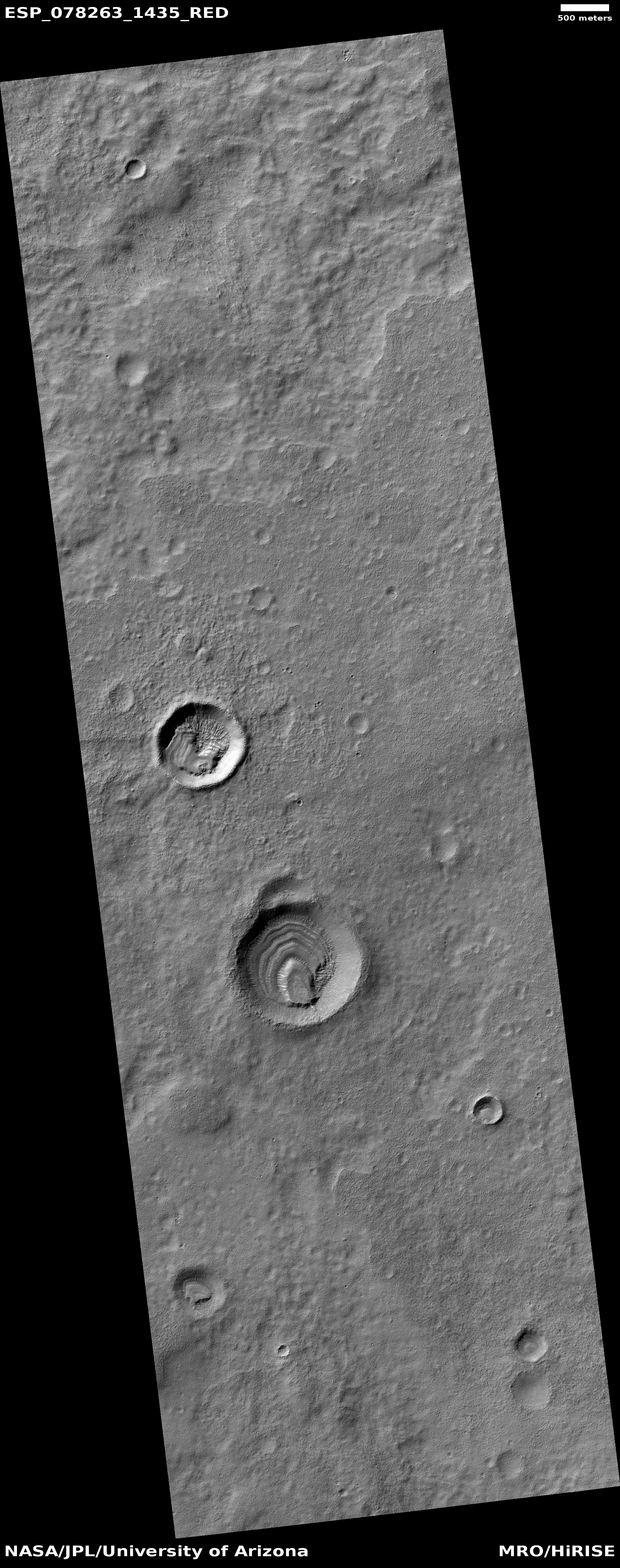
  • The location is in the high latitudes of the southern cratered highlands, and not surprisingly shows a scattering of craters. It was spring when the picture was snapped, so the mantle of CO2 dry ice that covers these high latitudes in the winter is beginning to sublimate away. The terrain itself looks like it is heavily impregnated with ice as well.

0 comments

A channel of ice, water, or lava?

A channel of ice, water, or lava?
Click for original image.

Cool image time! The picture to the right, rotated, cropped, reduced, and sharpened to post here, was taken on July 16, 2024 by the high resolution camera on Mars Reconnaissance Orbiter (MRO). It shows one small section of a Martian canyon approximate 750 miles long and dubbed Elysium Fossae.

The canyon walls at this spot rise about 3,300 to 3,800 feet from the canyon floor. The canyon itself is thought to be what geologists call a graben, initially formed when the ground was pulled apart to form a large fissure.

That’s what happened at this location, at least to start. This canyon is on the lower western flank of the giant shield volcano Elysium Mons. The cracks, which radiate out outward from the volcano’s caldera, likely formed when pressure from magma below pushed upward, splitting the surface.

That formation process however does not fully explain everything.
» Read more

0 comments

European rocket startup Maiaspace to begin tests of upper stage engine in ’25

The European rocket startup Maiaspace, a subsidary of ArianeGroup, has announced it will begin static fire tests of the upper stage engine for its Maia rocket in 2025, with a planned first launch before the end of that year.

The first stage of Maia is intended to be reuseable, and has been under development by ArianeGroup for the European Space Agency (ESA) for years.

The rocket’s first stage will essentially be the Themis reusable booster demonstrator, which is also being developed by ArianeGroup under an ESA contract. Initial hop tests of the Themis demonstrator had been expected to begin this year at the Esrange Space Center in Sweden. However, the first test of the demonstrator is now not expected until 2025. MaiaSpace will, as a result, have very little wiggle room in its schedule if it is to conduct an inaugural launch attempt next year.

Transitioning this first stage to a wholly private operation will certainly speed up its development, but the transition will take time.

0 comments

Sierra Space completes acoustic testing of Shooting Star cargo module that will fly on first Dream Chaser launch

Sierra Space today announced that it has successfully completed acoustic testing of the Shooting Star cargo module that will fly on first ISS mission of its Tenacity Dream Chaser mini-shuttle.

During the Direct Field Acoustic Test (DFAN), the test team placed stacks of purpose-built loudspeakers – each one a highly-engineered acoustic device – in 21-ft-tall columns surrounding the spacecraft. Their goal was to test whether the structural elements of Shooting Star could withstand the acoustic environment of a launch on a Vulcan Centaur rocket. Over a four-day period, test engineers blasted the spacecraft with a controlled sound field that was 10,000x higher intensity than the volume of a typical rock concert, recreating the sonic intensity of a launch. Shooting Star withstood acoustic levels greater than 140 dB for several minutes at a time, proving its flight worthiness.

The press release however made no mention as to when the launch will actually take place. Sierra first got the contract to build Dream Chaser in 2016, and was supposed to make its first flight in 2020. That launch has been repeatedly delayed, and is now four years behind schedule. Supposedly it was to take place this year on the second launch of ULA’s Vulcan rocket in the spring of 2024, but was removed from that launch because of delays in preparing Tenacity for launch.

As of today, no new launch date has been announced, and though Sierra says Tenacity will be ready for launch by the end of this year, don’t expect it to happen before 2025.

3 comments

Private company launches small test rocket from privately run sea-based platform

The rocket startup Evolotion Space on August 31, 2024 successfully launched a small test rocket from privately run sea-based platform operated by the Spaceport Company, a startup in itself.

The launch itself did not appear to reach space, but was instead designed to test both the rocket and the sea platform’s operation.

The experiment occurred approximately 30 miles south of Mississippi in the Gulf of Mexico. The test served to validate The Spaceport Company’s sea-based launch equipment and ground support equipment, said the company’s CEO and founder Tom Marotta. β€œEmerging hypersonic technologies require additional and larger test ranges to accommodate higher cadence testing campaigns,” he said. β€œWith this new commercial facility, we will alleviate the burdens on government ranges and enable at-sea test environments that existing land-based ranges are unable to provide.”

The solid-fueled rocket meanwhile is being developed by Evolution to initially do hypersonic testing for the military.

0 comments

NASA asks space industry for proposals on using the shelved Janus probes on mission to Apophis

NASA has now put out a request for proposals from the space industry for refitting the two Janus planetary probes, whose asteroid mission was shelved when its launch as a secondary payload was delayed due to problems with the Psyche primary payload, as a mission to the asteroid Apophis in connection with its April 13, 2029 close approach to the Earth.

NASA has been studying this new mission goal since early 2023, but apparently had failed to come up with a plan. It is now asking the private sector for suggestions on getting it done, including finding the funding for any plans.

3 comments

Russia claims its next unmanned Moon mission, Luna-26, is on schedule

Phase I of China/Russian Lunar base roadmap
The original phase I plan of Chinese-Russian lunar
base plan, from June 2021.

According to Russia’s state-run press, its next unmanned Moon mission, Luna-26, is on schedule for a planned launch in 2027, though that press also claims the launch may happen in 2026 instead.

The problem with this claim is that Russia had for years said that this lunar orbiter would launch by 2025. As expected, the mission has not launched on time, as have all of Russia’s 21st century lunar exploration plans. For example, the previous lunar mission, the Luna-25 lunar lander, was originally supposed to land on the Moon in 2021, was not launched until 2023, and ended up crashing on the Moon when the spacecraft did not function properly during a engine burn in lunar orbit.

In the first phase of the so-called China-Russian partnership to explore the Moon, is shown by the 2021 graph to the right, China continues to do all the heavy lifting, and do so pretty much on the schedule predicted. Russian meanwhile continues to do what I predicted back in 2021, get nothing done on time and when launched have problems.

0 comments
1 316 317 318 319 320 2,915