
June 21, 2023 Zimmerman/Batchelor podcast
Embedded below the fold in two parts.
To listen to all of John Batchelor’s podcasts, go here.
» Read more
Embedded below the fold in two parts.
To listen to all of John Batchelor’s podcasts, go here.
» Read more
An evening pause: I’ve posted several covers of this great song by other artists, as well as a different and earlier reunion performance by Simon & Garfunkel (which is no longer available). Here they are again, because the originals are always the best.
Hat tip Doug Johnson.
Courtesy of BtB’s stringer Jay.
Skyrora has been around since 2018, but has yet to reach orbit. We shall see if this development leads to that first orbital launch.
The tests achieved 10MB download speeds.
The lack of any schedule is not good, suggesting the final work required is going to take a longer than expected. This might also be why France and Arianespace have suddenly begun signing launch contracts with independent rocket startups. They realize they need to do whatever they can to generate some alternatives.
It appears the French company acts as broker, finding rockets for payloads wanting to fly. China is now allowing it to sell space on CAS-Space’s rockets as well.
From Jay: “You can drop this story if you want. I included it since the people on Twitter are ragging on it.” I agree, the tweet is a joke, and thus deserves ragging. If by including it here we encourage more such ragging of NASA and Boeing then my job here is done.

Greta Thunberg speaks!
How dare you! On June 21, 2018, Greta Thunberg informed us — as shown in her tweet to the right — that we only had five years left to stop using fossil fuels, and if we didn’t “climate change will wipe out all of humanity.”
I am hardly the only person to note this example of global warming fraudulence. Numerous reporters have also gleefully noted it, with this essay today at American Thinker by Andrea Widburg probably the most damning, not so much for noting the ignorant rantings of this uneducated high school drop-out whom the left made their icon of knowledge and top global warming expert, but for the list she provides of the endless number of other failed doomsday predictions by global warming activists and politicians.
That list was compiled in 2019, and thus it did not yet include Thunberg’s absurd prediction. Nor did it include the endless string of additional false doomsday predictions that this crowd has continued to issue in the years since, all of which I guarantee without any uncertainty will all fail, just as their hundreds of past doomsday predictions have failed.
You see, the point of those predictions was not to educate, but to instill fear, so as to then justify a power grab by the government. As Widburg concludes:
» Read more

Click for original image.
While much of surface of the Martian equatorial regions is comprised of volcanic flood lava, the place where it is most obvious and evident is on the flanks of the three giant volcanoes of the Tharsis Bulge. Here, lava did not simple spout from surface vents to flood low-lying large areas, filling those depressions quickly almost like water. Instead it issued from vents on the slopes of those mountains, or from their calderas at their peaks, and flowed downhill almost like tsunamis of magma.
The picture to the right, rotated, cropped, reduced, and sharpened to post here, is a great example. Taken on March 11, 2023 by the high resolution camera on Mars Reconnaissance Orbiter (MRO), it shows the foot of one such flow, frozen in place as it oozed down hill from the Arsia Mons, about 300 miles away to the northwest.
» Read more
The French space agency CNES today signed agreements with two different European smallsat rocket startups, Spain’s PLD Space and Germany’s Rocket Factory Augsburg (RFA), allowing each to launch from France’s old launchpad in French Guiana that was used in the 1970s by its long abandoned Diamant rocket.
From the RFA press release:
Until now, the launch pad in Kourou has only been used by CNES for its Diamant rocket in the 1970s. Now the launch complex is to be given a new purpose, in the tradition of opening access to space through innovative and groundbreaking ventures. As such, RFA is one of the first NewSpace companies to be given the opportunity to use it. The new launch pad will be upgraded and equipped in the coming years with the aim of being used for launches from 2025.
These agreements are part of a slew that have come out of Europe in the past year or so that all indicate that the European Space Agency (ESA) and its partners have finally abandoned any attempts to build rockets, and are instead looking to private enterprise to do it for them. First Germany encouraged private rocket startups, independent of Arianespace and ESA. Then Spain followed with PLD Space. Then Arianespace, the commercial arm of ESA that for decades built all rockets for ESA, announced it was making agreements with these startups to have them launch payloads instead.
These new deals today indicate that France has now joined the rush to private enterprise, which is a very significant development as France as always been the leader in having ESA build its own rockets through Arianespace. It appears it is now looking away from government-run space.
All these actions are also suggest a dim future for ArianeGoup’s Ariane-6 rocket, built under the old system but with an attempt to give private enterprise more power, with ArianeGroup, not Arianespace, owning and controlling it. Its design however was dictated largely by ESA, thus resulting in a rocket that is too expensive and therefore not competitive.
The long term result will be greater competition, both in Europe and worldwide, which in turn is going to fuel a renaissance in rocket development, which in turn is going to speed the exploration and colonization of the rest of the solar system.
Hat tip to BtB’s stringer Jay.
Until today it was unclear whether the successful first suborbital launch of Rocket Lab’s Electron rocket on June 17, 2023 carried a payload. Now we know it did:
The launch took place at NASA’s Wallops Flight Facility in Virginia and demonstrated the Multi-Service Advanced Capability Hypersonic Test Bed, or MACH-TB, program’s first suborbital flight of a hypersonic payload.
MACH-TB is led by the Pentagon’s Test Resource Management Center and the Naval Surface Warfare Center’s Crane Division. The team selected Leidos as the program’s prime integrator last September, and California-based space company Rocket Lab is one of 12 subcontractors supporting the effort.
It appears the Pentagon program that funded MACH-TB is a different program — from a different Pentagon office — from the one that is funding the next suborbital hypersonic test using Electron. Nor is this unusual for the military. The duplication of these Pentagon programs, with multiple bureaucracies, says a lot more about the utter waste and incompetence and corruption in DC than it does about hypersonic suborbital testing.
For Rocket Lab however this duplication is great news, as it provides the company at least two different customers for its suborbital rocket.
On June 15, 2023 FAA announced that it has at last reduced the airspace restrictions for some launches out of Cape Canaveral, thus allowing more launches while reducing the disruption to commercial airline traffic.
The move is part of broader efforts to address the conflicts between launches and commercial aviation, particularly in Florida’s congested airspace. In April, the FAA released a set of factors when considering whether to allow a launch to proceed or ask the launch company to identify alternative windows for the launch.
Among those factors are the timing of the launch, particularly relative to holidays or other special events that cause increases in air traffic, and the duration of the launch window. “The FAA encourages commercial space operations to take place during nighttime hours (to the extent practicable) when other flight operations tend to be reduced,” the guidelines state.
I say “at last” because SpaceX have been pushing for this reduction for years. It knows its rockets will fly very reliably, and even if a rare failure forces their destruction, the territory threatened is much smaller than what was once considered necessary in the past. It just took years to get the federal bureaucracy to recognize these facts.
With an announced contract with Intelsat today, Northrop Grumman has now obtained contracts for all three of its robotic servicing pods that will be launched on its Mission Servicing Vehicle in 2025.
Intelsat ordered the third and last pod available on the debut mission of the company’s new servicing spacecraft, called Mission Robotic Vehicle (MRV).
Australian communications satellite operator Optus was the first customer to sign up for the Mission Extension Pods, which are propulsion jet packs that add six years to the life of geostationary satellites. Intelsat in April said it purchased one of the pods, followed by today’s announcement that it ordered a second one.
The MRV is an upgrade from Northrop Grumman’s earlier robot, the Mission Extension Vehicle (MEV), which proved that it could autonomously rendezvous and dock with the nozzle of a defunct satellite and provide it with a new thruster and fuel so as to extend its life. With the MRV, multiple revised versions of the MEV are essentially launched at the same time.
In what has become a very rare event, Russia’s state-run press today announced that Roscosmos has won a launch contract for its Soyuz-2 rocket from the United Arab Emirates (UAE).
“On June 27th at 3:34 p.m. UAE time [2:34 Moscow time], [UAE’s] MBR Space Centre will launch its maiden mission, PHI-Demo, from Russia’s Vostochny Cosmodrome using the Soyuz-2 rocket as part of the Payload Hosting Initiative,” the media office said in a statement.
The statement says that the initiative, jointly led by MBRSC [UAE’s space agency] and the United Nations Office for Outer Space Affairs (UNOOSA), is aimed at providing space access and hastening the sustainable progression of novel space technologies.
The satellite will be a secondary payload on the launch of a Russian weather satellite.
It seems this UN office wants to help the Russians, and is working to encourage other nations to use its rockets to get into space. Because of Russia’s invasion of the Ukraine, it has lost all of its international launch business. UNOOSA is apparently working to recover Russia some of that business.
The UAE meanwhile appears to be trying to light the candle from both ends, working extensively with NASA and American private companies while also attempting to partner with Russia and China.
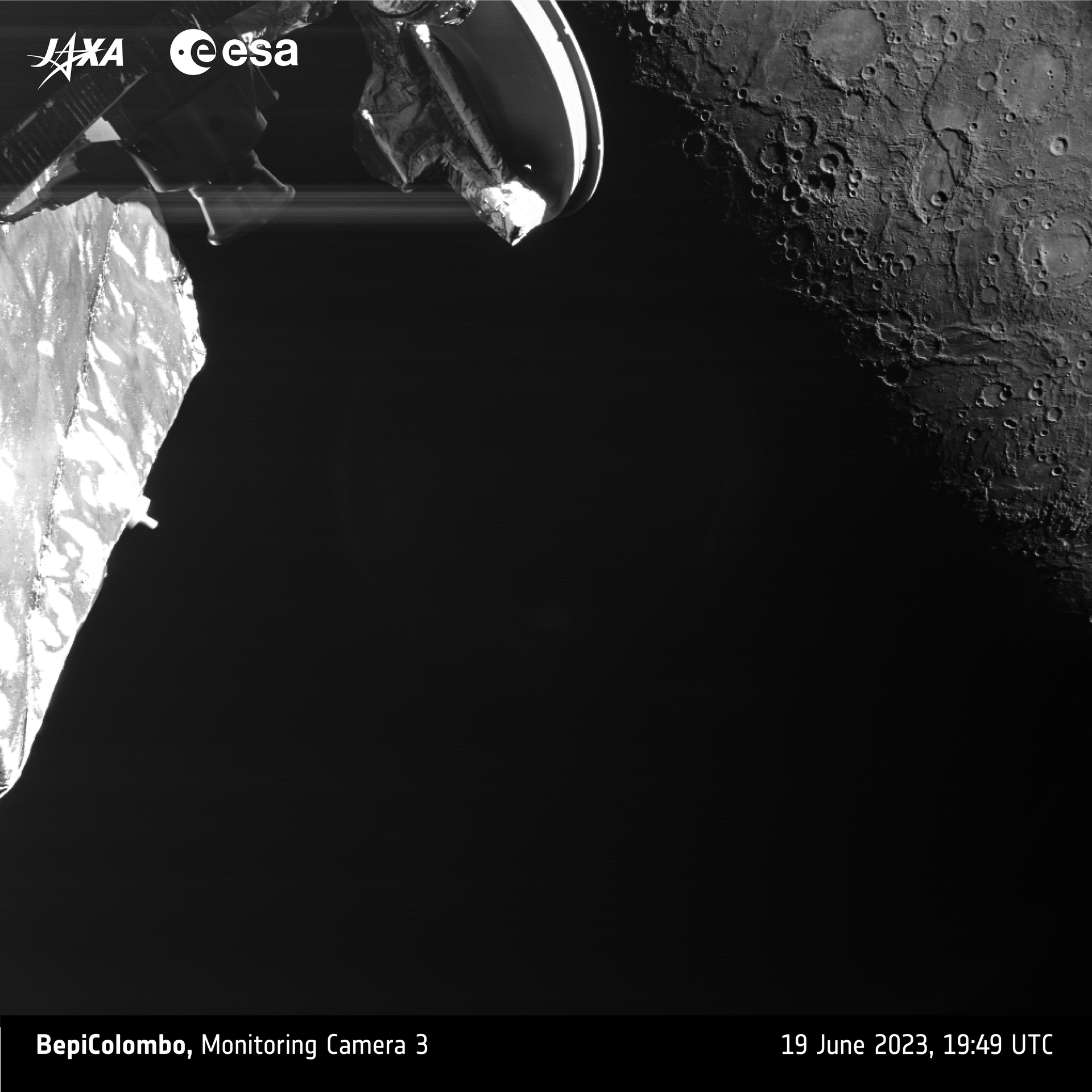
Click for original image.
On June 19, 2023, the European Mercury orbiter BepiColumbo made the third of six planned flybys of Mercury on its way to orbit around that planet in 2025.
The closest approach was only 146 miles above the planet’s surface. Though no pictures were taken at that point because it was Mercury’s night side, as the spacecraft moved away it used one of its monitoring cameras, designed primarily to monitor the spacecraft itself, to look back at the planet. The picture to the right, cropped, reduced, and sharpened to post here, is one of the first taken. From its caption:
The image was taken at 19:49 UTC (21:49 CEST) by the Mercury Transfer Module’s monitoring camera 3, when the spacecraft was about 2536 km from the planet’s surface. Closest approach took place at 19:34 UT (21:34 CEST) on the night side of the planet at about 236 km altitude. The back of the Mercury Planetary Orbiter’s high-gain antenna and part of the spacecraft’s body is also visible in front of Mercury in this image.
Despite the dark nature of the image, several interesting geological features are seen in beautiful detail. Of particular interest is Beagle Rupes, a 600 km-long scarp that snakes over the surface. In this view it is seen cutting through a distinctive elongated crater named Sveinsdóttir, which likely got its shape from an impactor striking the surface at an angle.
The next flyby will occur on September 5, 2024.
An evening pause: Performed on Saturday Night Live on May 22, 1978.
Hat tip Judd Clark.
Courtesy of BtB’s stringer Jay.
This is thirty minute presentation, which concludes that though there was a failure of the software, in the end the failure was due to management errors, including changing the landing site without doing sufficient simulations.
Sounds good, eh? Don’t bet on it. The company is almost a billion dollars in the hole due to the extra costs incurred because the project’s failure, with no sign yet of any income in the near future.
This will be the first Delta-4 Heavy launch in almost three years. More significant, it will be ULA’s first launch in 2023, a number that is even lower that its low launch numbers of recent years. At this pace it will be a challenge for ULA to match its lowest launch counts of five, from ’19 and ’21. UPDATE: Scrubbed, reschedule 24 hours later.
The source’s whining about this is amusing, but it also suggests once again the culture and management at Blue Origin is not the best.
Except for Russia and the UAE, all are small time third world nations with no space infrastructure. Many have also not made a commitment, simply opened discussions. Russia will contribute little, and the UAE has a conflict as it also wants to participate in Artemis. U.S. law makes participating in both very very difficult, if not impossible.
Either the professor was misinformed, or he revealed illegal negotiations by Biden’s NASA that NASA didn’t want revealed. If the latter, there was probably a frantic call made to China by the White House, begging them to censor this information, and China gladly obliged.

Failure theater: This week Texas’ Republican governor Greg Abbott signed a new law that formally abolished all diversity, equity, and inclusion offices at the state’s public universities and schools.
“An institution of higher education may not establish or maintain a diversity, equity, and inclusion office or hire or assign an employee of the institution, or contract with a third party, to perform the duties of a diversity, equity, and inclusion office,” states the legislation, Senate Bill 17, which takes effect at the start of the spring semester of the 2023-24 academic year.
Exceptions spelled out include “academic course instruction,” “research or creative works by an institution of higher education’s students or faculty,” and activities by student groups.
The new law also bans “ideological oaths,” or DEI statements, for hiring and enrollment. [emphasis mine]
Hooray! The unicorns have come out and the world is now good and pure. All racist teaching at Texas universities will now forever cease!
Bah. This law was first proposed in May. At that time I wrote the following:
» Read more

Click for original image.
Cool image time! The picture to the right was taken on June 17, 2023 by Curiosity’s high resolution camera, looking back down Gediz Vallis and out across the distant floor of Gale Crater, far below. The white dotted line shows the route within this image where Curiosity had previously traveled inside this canyon, coming up around that shadowed mesa and then off to the west to try to get to terrain that it had earlier retreated because it was too rough on the rover’s wheels. Its subsequent path to the spot where this picture was taken was off to the left of the image, out of view.
This picture illustrates well the steepness and roughness of the mountainous canyon through which Curiosity presently travels. The small mountains visible on the floor of Gale Crater, about sixteen miles away, are no more than 450 feet high. The floor of the crater is 1,900 feet below where Curiosity present sits.
» Read more
Using its Long March 6 rocket, China today launched what its state-run press called a “new experimental Earth-observation satellite,” lifting off its Taiyuan interior spaceport.
No word on whether the rocket’s first stage crashed near habitable areas, or whether it used parachutes to control its descent.
The leaders in the 2023 launch race:
41 SpaceX
24 China
8 Russia
5 Rocket Lab
American private enterprise still leads China in successful launches 46 to 24 in the national rankings, and the entire world combined 46 to 40, with SpaceX by itself still leading the rest of the world, excluding other American companies, 41 to 40.
An evening pause: What is most important about this performance is that Williams was doing the conducting on his 90th birthday. The only sour note of this performance is the idiotic masks they made some members of the orchestra wear. Obviously, a horn player can’t give anyone an infection, but a violin player can. Note too how all the VIPs on the front of the stage (such as Steven Spielberg) were also immune from COVID and didn’t need masks either. What fools and hypocrites.
Hat tip Phil Berardelli.

Cool image time! Today’s cool image begins with the overview map to the right. The white dot marks its location, on the western edge of Amazonis Planitia and about 1,000 miles east of the giant shield volcano Elysium Mons.
This is a region of numerous flood lava events that appear to cover the knobby mountainous terrain that was once here. We know that past terrain was knobby because in the black outline just south of this picture the knobs are everywhere, short peaks sticking up from a very flat flood lava plain. The region is also on the northern edge of the dry equatorial regions of Mars, at 27 degrees north latitude. It is likely there is little near surface ice here.
These details will help explain the cool image itself.
» Read more

Modern Democratic Party segregation
“Segregation today, segregation tomorrow, segregation forever!” On June 5, 2023 federal Judge Mark Pittman of the Northern District of Texas ruled [pdf] that a race-based development agency, dubbed the Minority Business Development Agency (MBDA) and created under Biden administration, was patently illegal under both the U.S. Constitution and numerous civil rights laws, and must cease awarding grants based on race.
The ruling was in response to a lawsuit [pdf] filed for three individuals by the Wisconsin Institute for Law & Liberty (WILL), one of whom, Christian Bruckner, was specifically told by the local office of MBDA “…that it could not help him because of his race.” The lawsuit notes that:
» Read more

Jim Free, apparently hostile to commercial space despite
running the NASA manned program dependent on it
Eric Berger on June 16, 2023 wrote up a careful analysis of comments made by NASA official Jim Free, who is in charge of its Artemis manned program, when he appeared on June 7, 2023 before the Aeronautics and Space Engineering Board and Space Studies Board in Washington, DC.
During that appearance, in which Free provided an update on the program’s status, including admitting that the manned lunar landing will not happen in 2025 but in 2026 — something that everyone in the space industry has known for years but NASA had been denying — Berger then noted this further comment by Free:
Oddly, Free also questioned the value of the contract mechanism that NASA used to hire SpaceX and its Starship lander. “The fact is, if they’re not flying on the time they’ve said, it does us no good to have a firm, fixed-price contract other than we’re not paying more,” he said.
Free did this after trying to place the entire blame for the launch delay on SpaceX, made worse by the regulatory delays being imposed on it by the FAA.
Berger than proceeded to outline in great detail why fixed-price contracts work far better than cost-plus contracts — also known widely in the space industry and detailed myself in Capitalism in Space. To sum up, cost-plus contracts produce very little but cost gobs of money, while fixed-price contracts save money while guaranteeing results. He then asked, “What’s going on here?” and answered it as follows:
» Read more