Massive landslide in Martian canyon

Massive landslide in Martian canyon
Click for original image.

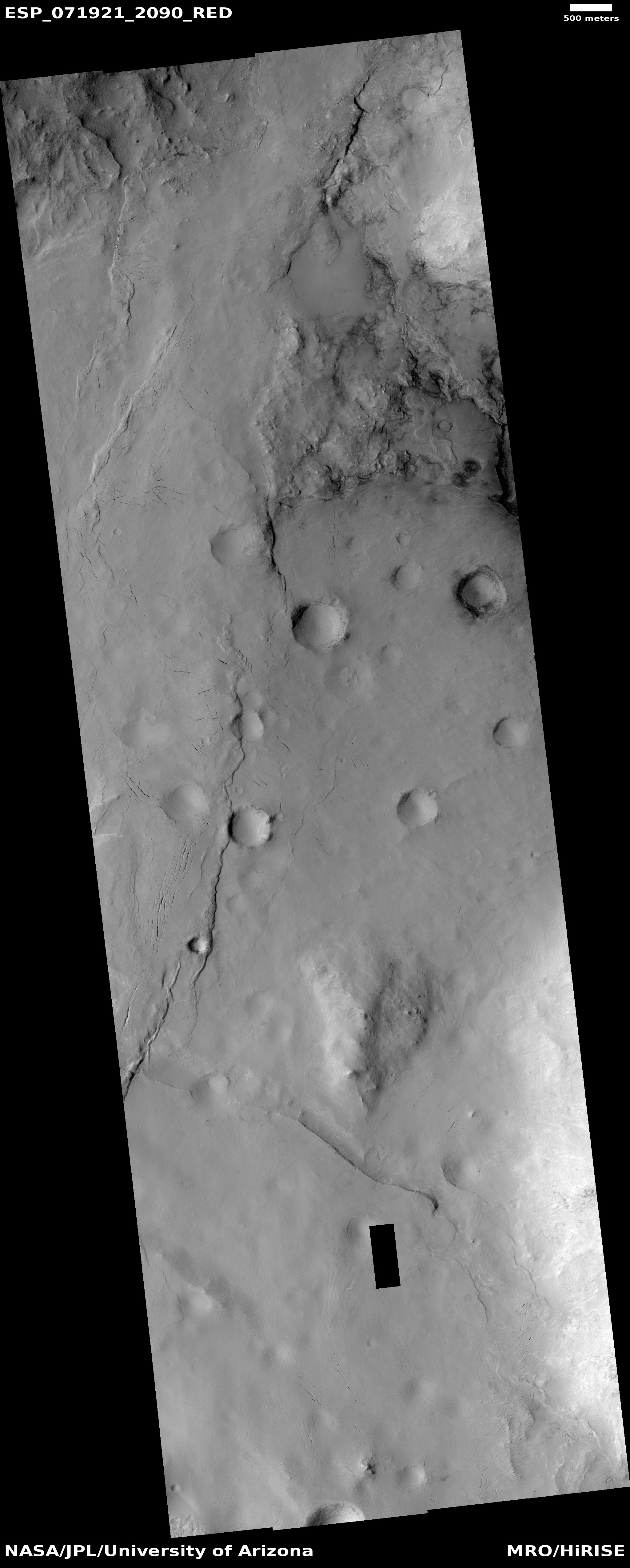
Cool image time! The picture to the right, cropped, reduced, enhanced, and annotated to post here, was taken on September 5, 2023 by the high resolution camera on Mars Reconnaissance Orbiter (MRO).

The image shows a gigantic landslide collapse on the southern interior wall of a long meandering canyon on Mars dubbed Bahram Vallis. The collapse was what scientists call a mass wasting event, in which the entire section of cliff wall breaks off and moves downward as a large unit. In this case the falling section, a half mile wide and long, got squeezed near the bottom, piling up rather than flowing out into the canyon floor.

At this particular location the canyon is 2.4 miles wide, with cliff walls about 1,700 feet high. Imagine when this piece broke off: In one instance a giant section of mountain about a half mile long fell about a thousand feet. Even in Mars’ thin atmosphere the sound must have been thunderous.
» Read more

1 comment

South Korea is in final negotiations to cancel two Russian launch contracts

As has been expected since the beginning of Russia’s invasion of the Ukraine, South Korea is in the process of canceling two Russian launch contracts, with the negotiations apparently now in the final stages.

“The Korea Multipurpose Satellite 6 and the next-generation mid-size satellite Compact Advanced Satellite 500-2, both developed by Korea, were initially scheduled to be launched into space using Russian launch vehicles, but due to the war between Russia and Ukraine and the subsequent international sanctions against Russia, there were uncontrollable circumstances that prevented the use of Russian launch vehicles,” the Ministry of Science and ICT said in a statement.

“Since then, Korea has been negotiating with Russia on the terms of termination of the satellite launch contract and it is currently being finalized.”

South Korea has already found a different rocket for the first satellite, scheduled for launch on Arianespace’s Vega-C rocket when it resumes flights in April 2024 (after completing upgrades resulting from a December 2022 launch failure). As for the second satellite, no public decision has yet been announced, though contract bidding has been on-going.

Meanwhile South Korea is accelerating development of its own Nuri rocket, which it has successfully launched two times already.

Russia in turn no longer has any international customers for its rockets. Its invasion of the Ukraine has cost it hundreds of millions of dollars of lost business, all of which will likely not return for decades.

0 comments

Astrobotic resumes suborbital test flights of assets purchased from Masten bankruptcy

The startup lunar landing company Astrobotic has resumed flights and testing of the suborbital spacecraft built by the company Masten Space Systems and obtained when that company went bankrupt.

Astrobotic announced Oct. 10 that it completed the first campaign of test flights by Xodiac, a vertical-takeoff, vertical-landing vehicle, since acquiring it and other Masten Space Systems assets last year. Xodiac conducted four flights from Mojave, California, hovering just off the ground to test plume-surface interactions ahead of future lunar landing missions, supporting research by the University of Central Florida.

Xodiac was built several years ago by Masten Space Systems, based in Mojave, and made more than 150 low-altitude flights for a variety of technology demonstration investigations. However, the company filed for bankruptcy in July 2022 and its assets acquired by Astrobotic that September for $4.5 million.

Xodiac is now part of Astobotic’s Propulsion and Test Department, which includes other assets from Masten Space Systems as well as many of its former employees, who say they have picked up where they left off before the bankruptcy.

Astrobotic has also resumed development work on a larger Masten suborbital spacecraft, Xogdor, also designed to launch and land vertically, but actually reach space.

Because Astrobotic is mostly focused on developing lunar landers, Masten’s technology is perfect for refining that capability for landing on the Moon. It is also ideal should Astrobotic decide to develop a reusable rocket for launch from Earth.

1 comment

October 10, 2023 Quick space links

Courtesy of BtB’s stringer Jay.

  • Sierra Space reiterates its commitment to Orbital Reef and its contracts with NASA
  • Based on the statement, which makes no mention of Blue Origin, this suggests that the rumors about a break-up between Sierra Space and Blue Origin on this project were really referring to Blue Origin getting kicked out, which will be especially embarrassing for Jeff Bezos as he and his company were the originators of the Orbital Reef space station concept.


6 comments

Broken Martian ice sheets?

Overview map

Broken Martian ice sheets?
Click for original image.

Cool image time! The picture to the right, rotated, cropped, reduced, and sharpened to post here, was taken on August 11, 2023 by the high resolution camera on Mars Reconnaissance Orbiter (MRO). The picture was what the camera team call a “terrain sample,” which usually means the picture was taken not as part of any specific research request, but because there was a gap in the camera’s schedule, and in order to maintain the camera’s temperature the team then picks something to fill that gap.

Because of the relative randomness of such pictures, they sometimes show little of immediate interest. More often than not, however, the camera team chooses well, and snaps something cool.

In this case they achieved the latter. The white dot on the overview map above marks the location, inside the 2,000-mile-long northern mid-latitude strip I dub glacier country. Everything in this region seems covered with glacial and ice debris, and this picture is no different. Rather than a glacier however we have what looks like a broken ice sheet, surrounded by that utterly unique and as-yet unexplained Martian geological feature dubbed brain terrain.

0 comments

October 12 Falcon Heavy launch of Psyche probe faces bad weather

At present there is only a 20% chance that the Falcon Heavy launch of NASA’s Psyche asteroid probe will occur on October 12, 2023 at 10:16 am (Eastern) as planned out of Cape Canaveral.

The launch window only extends until October 25, 2023, after which the entire project would have to be redesigned, requiring a significant delay.

SpaceX has become very adept at threading the needle when weather restricts its Starlink launch abilities, but it has less flexibility with Psyche. To increase its chances it has scrubbed a planned Starlink launch this week from Cape Canaveral in order to give the Falcon Heavy launch more launch opportunities.

Regardless, the live stream can be accessed here.

0 comments

Aerojet Rocketdyne satellite power units are chronically failing

According to space insurers, problems on power units built by Aerojet Rocketdyne on four different satellites are going to cost the industry about $50 million in claims this year.

According to multiple insurance sources, Yahsat’s Al Yah 3, Avanti Communications’ Hylas 4, and Northrop Grumman’s two Mission Extension Vehicles (MEV-1 and MEV-2) are operating with reduced power to their thrusters following a problem with onboard Power Processing Units (PPUs).

The PPUs from Aerojet Rocketdyne provide the electrical power their thrusters need for station-keeping in geostationary orbit (GEO). One of the sources said Al Yah 3, Hylas 4, and MEV-2 have each lost one of two onboard PPUs since the issue emerged in 2022. The youngest of these spacecraft, MEV-2, launched in 2020.

While the article at the link focuses on the impact to space insurers for these additional claims, what I see are serious quality control problems at Aerojet Rocketdyne, now part of the company L3Harris after a summer acquisition. The new management of L3Harris better aggressively address this, or else it will find its $4.7 billion acquisition a big waste of money.

0 comments

SpaceX blasts FAA for claiming falling satellites could by 2035 kill someone every two years

In a letter response to an FAA report to Congress issued last week, SpaceX has strongly criticized the FAA for claiming falling satellites from the many big constellations being launched now could by 2035 kill someone every two years.

The FAA’s report actually claimed that some of the risk of death from these satellites would come from space junk impacting airplanes. From the report:

“Some debris fragments would also be a hazard to people in aircraft. Projecting 2019 global air traffic to 2035 and assuming that a fragment that would injure or kill a person on the ground also would be capable of fatally damaging an aircraft, the probability of an aircraft downing accident (defined in the Aerospace report as a collision with an aircraft downing object) in 2035 would be 0.0007 per year.”

As SpaceX’s response correctly notes, this claim of a threat is absurd. Not only do the satellites from these constellations always burn up in the atmosphere — making the risk zero — the chances of a collusion that the FAA claims are still so infinitesimal they should not have been considered worth mentioning. SpaceX also noted that the FAA’s analysis was based on obsolete Iridium satellites from the 1990s that are no longer being launched, not the kind of satellites and the preventive actions modern satellite companies take in flying them.

It appears this report is just another example of the full court press of the administrative state against not just SpaceX but all of private enterprise. By exaggerating the risk of space debris, the FAA is trying to justify more regulation and restrictions in an effort to garner more power to itself at the expense of freedom.

8 comments

Another Russian module develops leak on ISS

For the third time in less than a year, a Russian spacecraft at ISS has developed a coolant leak, this time in Russia’s newest module to ISS, Nauka.

The Nauka radiator actually has been in space for over a decade waiting for Nauka to arrive so whether there is any commonality to the failures is difficult to assess. Roscosmos acknowledged the leak, but said the module itself is working fine and there is no cause for concern.

The previous two leaks were on a Progress freighter, and later on a Soyuz capsule. Though Nauka was only launched to ISS in 2021, its development began in the 1990s and was originally scheduled for launch in the early 2000s. Because of the delays this radiator was launched to ISS ahead of the module, in 2012. It sits outside the module where it can release its excess heat into space.

The Russians say that the leak is in a backup coolant system, but according to a statement by Anatoli Zak quoted at the link, this statement is too vague. At the moment the location of the leak remains unknown.

2 comments

Michael Knowles – Celebrating Columbus

An evening pause: I posted this two years ago, and think it should be seen again. As I wrote then,

On this day when all should be celebrating Christopher Columbus and his willingness “sail beyond the sunset,” to use a phrase from Tennyson, this short video give us an accurate picture of the man, his times, and his achievements. It also puts the lie to the bigoted, hateful, leftist slanders that have been used in recent years to poison his legacy.

1 comment

ArianeGroup demands more money from ESA for Ariane-6

ArianeGroup is now in negotiations with the European Space Agency (ESA) to get a significant increase in the money ESA is pays for the new as-yet unlaunched Ariane-6 rocket.

A few weeks before a space summit which will take place on November 7 in Seville, [ArianeGroup] is negotiating a very clear reassessment of support for the operation of Ariane 6. [It] is asking 350 million euros per year from the States members of the ESA. That’s an incredible increase of 150%.

The problem for ArianeGroup and ESA is that Ariane-6 is expendable (a joint decision by ESA and ArianeGroup back in 2015 that was then a bad mistake), and thus is too expensive. It can’t compete in the modern launch market with SpaceX, and has thus had trouble finding customers.

As a result, ESA will likely pay out these big bucks for the next few years, but the situation creates a big opening for the new European startup rocket companies (PLD, Rocket Factory Augsburg, Isar, and HyImpulse) that are right now developing new small rockets. Like SpaceX in 2010, they have an opportunity to undercut the established government rockets of ESA, and grab market share. To do this however they need to become operational as soon as possible.

Since there are strong signs that ESA is looking to help these new companies, we should see some interesting competitive action in European rocketry in the next few years.

Hat tip to BtB’s stringer Jay.

3 comments
1 490 491 492 493 494 2,916