
November 20, 2020 Zimmerman/Batchelor podcast
Embedded below the fold in two parts
» Read more
Embedded below the fold in two parts
» Read more
Capitalism in space: Rocket Lab has announced that the company’s first effort to recover a 1st stage of its Electron rocket during a November 19th launch was a complete success.
On Rocket Lab’s latest launch Nov. 19, the rocket’s first stage made a controlled reentry after stage separation, then released a drogue and a main parachute before splashing down about 400 kilometers downrange from its New Zealand launch site, where it was recovered by a boat.
The recovery itself went as planned. “The test was a complete success,” Peter Beck, chief executive of Rocket Lab, said in a call with reporters Nov. 23. “The stage splashed down completely intact. What it proved to us is that this is a feasible approach, and we’re really confident that we can make Electron a reusable launch vehicle from here.”
Eventually they plan to snatch the stage out of the air using a helicopter prior to hitting the water, but are presently focusing instead on developing the proper thermal protection and attitude control systems for the flight back to Earth. They are presently taking that first stage apart and analyzing what worked and didn’t work in protecting it during that flight.
According to Beck, they will do another splashdown recovery early in ’21 to refine things. They also hope to reuse some of the recovered components from both splashdown tests on later flights.
The uncertainty of science: Astronomers, using new data from the Gemini North ground-based telescope, have found that a star that brightened in 1670 and was labeled a nova is much farther away than previously thought, which means that 1670 eruption was far too powerful for a nova, but not powerful enough to make it a supernova.
By measuring both the speed of the nebula’s expansion and how much the outermost wisps had moved during the last ten years, and accounting for the tilt of the nebula on the night sky, which had been estimated earlier by others, the team determined that CK Vulpeculae lies approximately 10,000 light-years distant from the Sun — about five times as far away as previously thought. That implies that the 1670 explosion was far brighter, releasing roughly 25 times more energy than previously estimated [4]. This much larger estimate of the amount of energy released means that whatever event caused the sudden appearance of CK Vulpeculae in 1670 was far more violent than a simple nova.
“In terms of energy released, our finding places CK Vulpeculae roughly midway between a nova and a supernova,” commented Evans. “[T]he cause — or causes — of the outbursts of this intermediate class of objects remain unknown. I think we all know what CK Vulpeculae isn’t, but no one knows what it is.”
Recent research has also suggested that the cause of the eruption was not from the interaction of a binary system with one normal star and a white dwarf, as believed for decades, but possibly a binary system with a brown dwarf, or a red giant star, or two normal stars. All are remain possible, none however have been confirmed.
Capitalism in space? New FAA documents suggest that government regulators are not happy with the rapid and spectacular development by SpaceX of its Super Heavy/Starship rocket at Boca Chica, Texas, and are eager to impose restrictions and delays.
The issue revolves around revisions to SpaceX’s original FAA approval for its work at Boca Chica because the company has switched from flying Falcon 9 and Falcon Heavy rockets to developing and flying Starship and Super Heavy. While the FAA has been cooperative in issuing the necessary revisions, other agencies have raised red flags.
But the most important document of the bunch is the written reevaluation signed by the FAA on May 22. The file spans 26 pages, was required for SpaceX to receive its suborbital launch license from the FAA on May 28, and incorporates concerns from state and federal environmental agencies.
In the reevaluation, the Texas Parks and Wildlife Department and the US Fish and Wildlife Service took issue with several aspects of SpaceX’s plans and ongoing activities. Those criticisms targeted the “fluid nature” of the company’s construction projects, excessive road closures to Boca Chica Beach (which Brownsville locals prize), around-the-clock work that may affect nocturnal threatened or endangered species, prototype explosions, and sprawling wildfires the company has triggered.
The FAA responded to each concern in the document, ultimately determining “there are no significant environmental changes, and that all pertinent conditions and requirements of the prior approval have been met or will be met” with SpaceX’s suborbital test-flight plans.
However, SpaceX does not yet have the FAA’s go-ahead to launch any Starships to orbit from Boca Chica.
In its replies to concerns noted by other agencies — some of which call for a new EIS [environmental impact statement], which could take years to complete (an eternity in Musk time) — the agency repeatedly noted it is working with SpaceX to draft an “environmental review” of those plans.
Should Joe Biden and the power-hungry and controlling Democrats take control of the executive branch of the federal government, expect the FAA’s desire to help SpaceX to quickly end.
Due to the discovery of a faulty valve on a Soyuz rocket being prepared for launch in French Guiana, Roscosmos has delayed today’s Soyuz rocket launch from Plesetsk, Russia, until December 3rd to allow engineers to inspect similar valves on that rocket.
This quote from Dmitry Rogozin, head of Roscosmos, from the first link, describing the problem, is somewhat amusing:
“The ‘faulty valve’ would be launched with the rocket, and it would return to Earth being just a heap of mishap metal, that would be the problem. There are always some flaws, but in our case, they cost too much. Happily, the low-quality detail was timely detected by the quality control system. However, in general, I do note a sharp decline in our suppliers’ responsibility and quality of their work,”
It appears the quality control problems with Russia’s aerospace industry are continuing. No one, including the Russians, should be surprised by this, as that industry has no competition to stimulate quality work and force bad companies out of business. Instead, everything is managed by Roscosmos from on top, with much of that management designed to eliminate competition entirely and protect the companies that presently exist..
An evening pause: A 12-string arrangement of Hans Zimmer’s movie score.
Hat tip Mike Nelson.
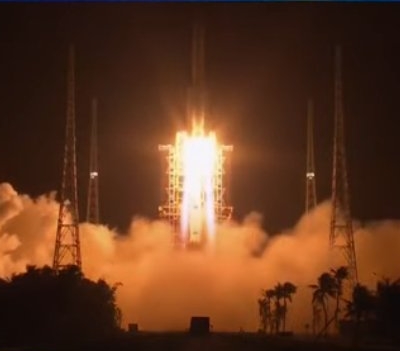
Screen capture from launch live feed
The new colonial movement: China today successfully used its Long March 5 rocket to launch its Chang’e-5 on the first lunar sample return mission since the 1970s.
If all goes well, the return capsule will return to Earth with its sample on December 15th.
China provided a live stream, in English, which I have embedded below the fold.
The leaders in the 2020 launch race:
31 China
21 SpaceX
12 Russia
5 ULA
5 Rocket Lab
The U.S. still leads China 34 to 31 in the national rankings.
» Read more
In the last few weeks the Democratic Party governments that control the state and city of New York imposed new and incredibly oppressive new rules, clamping down hard on the freedoms of their citizens, as well as the ability of visitors and tourists to come there.
The justification used by Democrats Governor Andrew Cuomo and Mayor Bill de Blasio for these new edicts against freedom? Both claimed that an increase to 3% of what they called “the positivity rate” required more restrictions. This increase comes from increased detection of COVID-19 due to increased tests, but it does not mean there has been a significant rise in actual illness.
You need only look at the graph below to understand how unnecessary these new restrictions are.
» Read more

Click for full image.
Cool image time! The photo to the right, cropped and reduced to post here, was taken on August 15, 2020 by the high resolution camera on Mars Reconnaissance Orbiter (MRO). It shows a truly strange bunch of blocks beside a clean flow neatly organized in almost straight parallel lines.
What is going on? This location is at 38 degrees south latitude, a latitude where scientists have found a lot of features that resemble water ice glaciers, generally protected from sublimating away by a thin layer of dust and debris.
A first guess is that the smooth glacial flow at the lower right is disturbing the glacial material next to it, causing it to rip apart and break up. At the same time, the hollowed look of these glacial blocks suggests that the ice below that protective debris layer is also slowly sublimating away, causing the surface to sink.
The wider shot below helps confirm this impression.
» Read more
In a meeting that is essentially unprecedented, the leaders of Israel and Saudi Arabia met yesterday evening in Saudia Arabia.
Israeli Prime Minister Benjamin Netanyahu traveled to Saudi Arabia Sunday night to meet with Crown Prince Mohammed bin Salman. The meeting is the first known encounter between senior officials from the enemy states. Yossi Cohen, Israel’s chief spy and head of the Mossad, also attended the meeting, as did U.S. Secretary of State Mike Pompeo.
Netanyahu reportedly kept his trip a secret from alternate Israeli Prime Minister Benny Gantz and foreign minister Gaby Ashkenazi.
Prior to the election, and at about the time that the UAE and Bahrain had signed peace accords with Israel, there were rumors that Saudi Arabia would follow suit, but only after the re-election of Trump. While the Arab country’s covert relations with Israel in recent years have been generally improving, such a public agreement would have signaled a major change, including a public admission that the Saudis were no longer tying their diplomatic relations to Palestinian demands.
I suspect the two leaders met to discuss whether that a public agreement now makes sense, given the strong possibility of an anti-Israeli and anti-Saudi American government under Joe Biden (who has already said he wishes to reinstate the Iran deal and reopen ties with that country).
In other words, as expected, a Joe Biden victory might very well cause the cancelling of this major peace deal. I hope not, but it would be understandable for Saudi Arabia, faced with an invigorated hostile Iran to the north, now getting aid from the U.S..
A new study published in the journal Nature has found that people who are either asymptomatic or undergoing a secondary illness of COVID-19 are simply not infectious, and don’t give the virus to others.
In other words, it appears that the only time people can infect others is when they have the virus for the first time, and only when they are symptomatic. Lock downs and the use of masks by the healthy accomplish nothing. All you need to do is quarantine the symptomatic patient, as human societies have been doing for centuries and centuries.
To once again emphasize this point, wearing masks if you are healthy and not sick protects no one. Social distancing if you are not sick protects no one. Shutting down businesses, such as reducing capacities at restaurants so they can’t make a profit, protects no one. Curfews protect no one.
When you see someone on a hiking trail, it is not necessary to run ten feet off the trail, put a mask on, and bow your head away in fear and terror of that other person. That they are on the trail guarantees they are not sick. They can’t infect you. And that you are there also means you can’t infect them.
Burn the mask. Smile. Live like a human again. And most of all, stop being afraid all the time.
This very long quote from the study’s discussion section, with the important points highlighted, makes these conclusions very clear:
» Read more
Capitalism in space: SpaceX today successfully launched an oceanography satellite using its Falcon 9 rocket from the company’s California launch site at Vandenberg Air Force Base..
The first stage, making its first flight, successfully landed back on land near the launch site.
This was also SpaceX’s 21st successful launch in 2020, tying their record from 2018 for the most launches in a single year by a private company, ever. That record should be broken tomorrow, with their next Starlink launch.
The leaders in the 2020 launch race:
30 China
21 SpaceX
12 Russia
5 ULA
5 Rocket Lab
The U.S. now leads China 34 to 30 in the national rankings.
An evening pause: Another guitar piece, but of a very different kind from yesterday’s.
Hat tip Mike Nelson. Note also that this pause was taken from Rumble, an alternative to Youtube. I encourage those who wish to suggest evening pauses to always see if they can find something there first. Reliance solely on Youtube is not healthy, and the competition will do everyone good.
The toll on the elderly caused by the COVID-19 panic rises, and not because they have caught COVID-19.
According to an Associated Press story this week, an estimated 40,000 nursing home residents have died prematurely since March, resulting in a 15 percent increase in “excess deaths” at those facilities. “Nursing home watchdogs are being flooded with reports of residents kept in soiled diapers so long their skin peeled off, left with bedsores that cut to the bone, and allowed to wither away in starvation or thirst,” the AP reported. Adult children are shocked to find their once-healthy, active parents near death and in excruciating pain due to neglect.
One Tennessee woman recounted her heartbreak at seeing her mother for the first time in months: “The 79-year-old had dropped about 20 pounds, her eyes sunken and her legs looking more like forearms. Doctors at the hospital said she was malnourished and wasting muscle. There were bedsores on her backside and a gash on her forehead from a fall at the home. Her vocabulary had shrunk to nearly nothing and she’d taken to pulling the blankets over her head.”
Tens of thousands of similar accounts flood social media; a group of senior citizens staged a protest last month outside their Colorado nursing home, begging for permission to see their loved ones. One sign read, “I’d rather die from COVID than loneliness.”
I am sorry, but I am of same mind. When I am very old I would want to be able to see my loved ones, even at the risk of getting sick. But then, that has always been the case. The elderly are very vulnerable to any contagious disease. Yet, until this madness, we recognized that life must go on, and that the family must come first.
Not seeing relatives and keeping these helpless old people in the equivalent of solitary confinement is not kind, and in fact is downright cruel. And apparently it has led to a reduced level of care in many institutions, because no one from the family has been present to make sure that care is proper. (From experience with both our parents, if you don’t make your presence felt with the long-term care facility, your parents will not get proper care. They will get ignored.)
But no, we need to cancel Thanksgiving, and Christmas, and all family gathering. And we need to now close restaurants early, at 10 pm, because it is in that specific hour that COVID-19 becomes truly contagious and dangerous.
The uncertainty of science: Using Curiosity data a team of scientists are now suggesting that some of the features the rover has seen were created during mega flood within Gale Crater, and this data also requires a rethinking of the present theories of the crater’s geological history.
This case includes the occurrence of giant wave-shaped features in sedimentary layers of Gale crater, often called “megaripples” or antidunes that are about 30-feet high and spaced about 450 feet apart, according to lead author Ezat Heydari, a professor of physics at Jackson State University.
The antidunes are indicative of flowing megafloods at the bottom of Mars’ Gale Crater about 4 billion years ago, which are identical to the features formed by melting ice on Earth about 2 million years ago, Heydari said.
The most likely cause of the Mars flooding was the melting of ice from heat generated by a large impact, which released carbon dioxide and methane from the planet’s frozen reservoirs. The water vapor and release of gases combined to produce a short period of warm and wet conditions on the red planet.
The press release above focuses on the catastrophic floods, but the research paper itself is really much more focused on the need to rethink present hypotheses for explaining the observed geology in Gale Crater. This report notes that they are finding patches of material that could not have been laid down as seen, based on those past theories, and proposes the catastrophic flood event as a possible solution.
In reading the paper however it is evident that even this new hypothesis is based on a limited amount of data, and thus can have holes punched in it as well. This is not to say that the paper is invalid, only that it must be taken with some skepticism. The data being obtained at Gale Crater simply incomplete. Curiosity is following only one path, and has not even left the foothills of Mount Sharp. In order to gain a wider and fuller understanding geologists need to study the entire crater floor, as well as the geology on the mountain.

This is an actual Democrat’s
respond to Trump’s 2016 victory
For four years, since his election, Donald Trump has been met with a never-ending wave of hatred, hostility, and downright total opposition by the Democratic Party and its many very partisan supporters in the mainstream press, the academic community, and in the general public.
If you are conservative, I am sure you’ve all seen it. Not only has it been impossible these past four years to have a reasonable conversation with Democrats about Donald Trump, your opinions and thoughts are routinely treated with insulting contempt and scorn when you tried. Trump was a racist and evil, despite there being no credible evidence to that effect, and if you tried to find out what the evidence was for such a slander you were immediately slandered and called the same.
Trump himself has faced this same level of irrational hate continuously since his election. And it is irrelevant that he often descends to the same tactics. In the climate created by the left since the Obama administration legitimized the use of slander in political discourse, what other choice did he have if he wished to survive?
Lies in fact has too often comprised the only tactic used by the Democratic Party and the left since Trump’s arrival. » Read more
The new colonial movement: During a NASA planetary science conference on November 10th, an official of India’s space agency ISRO revealed that they have been forced to delay their first mission to Venus, dubbed Shukrayaan, till 2024.
T. Maria Antonita of the Indian Space Research Organisation (ISRO) detailed the status of the mission to scientists drafting a new 10-year plan for NASA’s planetary science program. Shukrayaan will be India’s first mission to Venus and will study the planet for more than four years.
ISRO was aiming for a mid-2023 launch when it released its call for instruments in 2018, but Antonita told members of the National Academies’ decadal survey planning committee last week that pandemic-related delays have pushed Shukrayaan’s target launch date to December 2024 with a mid-2026 backup date (optimal launch windows for reaching Venus occur roughly 19 months apart).
It appears they are using this extra time to consider a larger launch rocket, which would allow them to increase the orbiter’s capabilities.
According to a Russian news report yesterday, air is still leaking from the Zvezda module of ISS, despite the permanent repair of the crack earlier this week.
Earlier, the crew locked the hatches into the intermediate chamber. The Mission Control asked whether the crew had measured the pressure before the hatch into that chamber was opened. The crew reported that the pressure went down considerably in the smaller part of the compartment while it remained isolated from the rest of the station by an airtight hatch. “The pressure in the intermediate chamber went down from 723 mm of the mercury column to 685 millimeters,” Ryzhikov said.
The report is poorly written, and is unclear on the exact date this air test was done. It is therefore possible the test was done prior to the permanent repair.
If however the air is still leaking, this suggests there might be more than one leak point in that part of Zvezda. According to this same story, the two Russian astronauts during their spacewalk on November 18th took pictures of the exterior area of Zvezda where the leak is located, and noted no exterior damage.
All these facts point to a very serious problem. If there was no exterior damage, it means the leak was probably not caused by a micrometeorite hit (though closer more extensive observations as well as a review of the photos might still conclude otherwise). The fact that the leak is continuing after the permanent repair suggests there is another leak, in the same part of Zvezda. That section is also a docking port, and would have experienced the most stress during the several dozen dockings that have occurred since Zvezda was launched in 2000.
These facts therefore suggest stress damage and aging as the cause, which means the problem will only get worse no matter what method is used to seal any future leaks.
One quick solution that would work, at least for awhile, would be to close the hatch on this intermediate chamber, and do no more dockings to it. This at least would seal the station from atmosphere loss, and reduce the stress on this section of Zvezda. Whether Progress freighters, which use this port, can use another port, or will have a more limited ability to dock, is not clear, however.
Embedded below the fold in two parts.
» Read more
Capitalism in space: Rocket Lab today successfully used its Electron rocket to 30 smallsats into orbit from its launchpad in New Zealand.
They also did their first launch test of their planned method for recovering the first stage for reuse. In their case the first stage will use parachutes to slow its descent, and will then be grabbed by a helicopter to be brought back to land. On this launch they were only testing the parachute portion of this plan, and allowed the stage to land in the water, where they then recovered it.
The leaders in the 2020 launch race:
30 China
20 SpaceX
12 Russia
5 ULA
5 Rocket Lab
The U.S. now leads China 33 to 30 in the national rankings.