
June 30, 2018 Zimmerman/Batchelor podcast
Embedded below the fold in two parts.
» Read more
Embedded below the fold in two parts.
» Read more
Capitalism in space: The second test flight of a private Japanese smallsat rocket company, Interstellar Technologies, today failed immediately at launch.
A rocket developed by a Japanese startup company burst into flames seconds after a failed liftoff Saturday in northern Japan.
The MOMO-2 rocket, developed by Interstellar Technologies, was launched in Taiki town on Hokkaido, Japan’s northernmost main island. It was supposed to reach as high as 100 kilometers (62 miles) into space. Television footage showed that the 10-meter (33-foot) pencil rocket lifted only slightly from its launch pad before dropping to the ground, disappearing in a fireball. Footage on NHK public television showed a charred rocket lying on the ground.
The incident caused no injuries.
Rocket science is hard. Competition and freedom carries risks. This company might not be dead, but this failure is definitely a significant setback.
Posted from Belize.
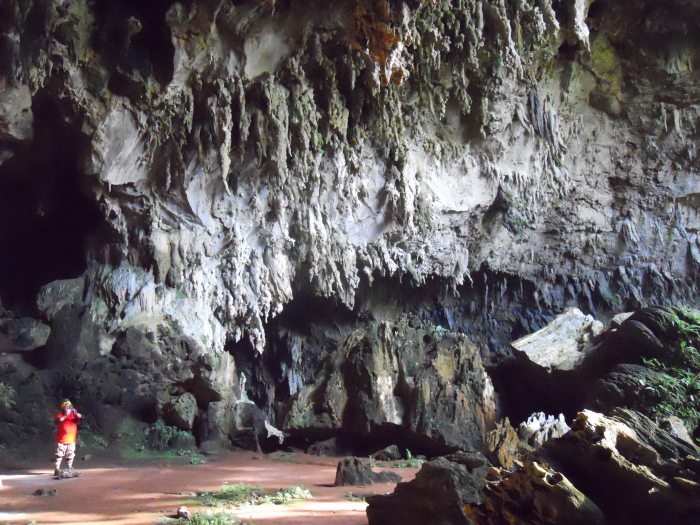
Today I am flying to Belize for a week long caving expedition. This will be the third trip there as part of a project to complete the mapping of a well known and very spectacular cave located in St. Herman’s Blue Hole National Park
As I did on the previous two trips, first in May 2016 and second in February 2017, I will continue to post on Behind the Black, though my posting will generally occur in the evening when we get back from the caves. I will also do at least one Batchelor appearance from Mayan Mountain Lodge in San Ignacio, where we will be staying. The lodge has been gracious enough with each visit to let me use their office and phone.
I very much want to finish the map this trip. The local cave guides, who depend on keeping the caves in pristine condition so that they can show off their beauty to tourists, need the map to help protect the cave. They will be helping with the survey, as they have previously. As I noted after my first trip in 2016,
Because Belize’s law puts the ownership of all caves under the jurisdiction of the Institute of Archaeology, which generally lacks the resources to protect them all, this work by the tour guides is essential. For example, Barton Creek Cave is a major tourist river cave that requires a canoe to see. Though the property surrounding the entrance is privately owned, the landowner, Mike Bogart, cannot prevent access to the cave to others. He offers tours, using the canoes he provides, but others can do the same and access the cave by canoeing up the river past his property. They need only get a government permit.
Thus, under this socialized system, with no single owner responsible for each cave, the only way the caves can be protected is for the tour guides and operators to band together to protect the caves themselves. In fact, their effort to flag the trails these past few weeks was begun expressly because they all saw the damage that uncontrolled visitation was causing, and wanted to stop it
Hopefully, their effort will bear fruit, and the caves and their guides’ livelihoods will prosper for years to come. And if the cave maps we Americans produce can help contribute to that success, then my short trip to Belize will have accomplished a lot more than provide me a few days of vacation pleasure.
On to Belize! The image below, of one of the many caves there, will give you a taste of their beauty.
An evening pause: Don’t ask me to explain. The youtube website is in spanish, but it sure seems to be some wild finale performed at the end of the school year, performed with only the kind of energy teenagers can bring to it.
And the teacher in the lead ain’t bad either.
Hat tip Jim Mallamace.
More corruption at Justice: IT specialist Imran Awan, while working for many Democrats in Congress, solicited a bribe from at least one IT vendor.
Democratic IT aide Imran Awan solicited a bribe from an IT vendor in exchange for contracting opportunities with the office of then-Rep. Gwen Graham, the vendor alleged to The Daily Caller News Foundation, adding that Imran spoke to him in detail about his alleged financial fraud schemes in the House.
The Department of Justice knows of the source — the longtime owner of a major House IT company — and what he is prepared to testify, a high-level official in Jeff Sessions’ DOJ with knowledge of the investigation confirmed. But the vendor said no law enforcement ever even tried to interview them. [emphasis mine]
Read it all. The vendor also was aware of the falsification of invoices to funnel money and equipment to the Awan family illegally. Yet, no one from Justice has ever felt the need to gather that evidence.
One more detail: Graham is running for Florida governor. If you are in Florida, expect a lot of corruption should she win.
Fascist California: The California Supreme Court has upheld a handgun law that requires that each gun microstamp an identification on any bullets it fires, something that remains technologically impossible and has essentially banned the sale of new handguns in the state.
The gun law, passed in 2007, is supported by police organizations that say the stamps would help officers to determine the source of bullets found at crime scenes. It requires that new brands of semiautomatic pistols introduced for retail sale in California carry markings in two places that would imprint the gun’s model and serial number on each cartridge as it is fired.
The law didn’t take effect until 2013, when the state certified that there were no patent restrictions on the technology. But gun manufacturers have not sold any new models of semiautomatic handguns in California since then, and in 2014 a gun group sued to invalidate the law, saying its standards could never be met.
A state appellate court allowed the suit to proceed, relying on an 1872 California statute that declared, “The law never requires impossibilities.” On Thursday, however, the state’s high court dismissed the suit and said the law would remain on the books, even if it was difficult to enforce.
…The ruling effectively ends the case, but other gun organizations have sued in federal court, claiming the law is unconstitutional. Their case is pending before the Ninth U.S. Circuit Court of Appeals and could ultimately reach the U.S. Supreme Court.
For now, no new models of semiautomatic handguns will be marketed in California, said Larry Keane, general counsel for the National Shooting Sports Foundation, which challenged the law in state court. He said the number of handgun models sold in California has dropped by about 50 percent since the state certified the micro-stamping law in 2013. “California will experience a slow-motion handgun ban,” Keane said. He said sales would “never go up because no new model can meet the impossible requirement.”
This entire story demonstrates perfectly why I call California fascist. While the law does not ban handguns, something that would likely be politically unacceptable, its succeeds in doing so by demanding gun-makers meet an impossible standard, thus forcing them to abandon sales in California.
The story also illustrates the fundamental dishonesty of the left. They want to ban guns, but they can’t do it in a straight-forward manner. So they create a dishonest law to do it for them. Expect more laws like this in Democratically-controlled states, nationwide.
New data suggests that the many meandering canyons on Mars were partly formed by rain.
Although Mars is cold and dry today, channels on its surface look as if running water shaped them, leading researchers to think the planet was warm and wet in the past. But scientists have struggled to determine whether that water fell from the sky as rain or seeped upward from the ground.
To discern the water’s source, Hansjoerg Seybold at the Swiss Federal Institute of Technology (ETH) Zurich and his colleagues analysed the geometry of Martian valley channels. The channels branch off at relatively narrow angles, as do waterways in arid landscapes on Earth, such as the US Southwest. More-humid landscapes with a lot of groundwater — the Amazon rainforest, for example — host river channels that branch at wider angles.
The discovery bolsters the idea that the Martian channels were carved by surface runoff rather than by water percolating from below.
The paper itself is behind a paywall, so it is unclear whether they included in their analysis the consequences of Mars’s lighter gravity. Regardless, this result is intriguing, even if it has a lot of uncertainty.
Capitalism in space: SpaceX early this morning successfully launched Dragon to ISS using its last Block 4 Falcon 9.
Both the first stage and Dragon were used components. As planned, they did not recover the first stage.
The leaders in the 2018 launch standings:
18 China
12 SpaceX
7 Russia
5 ULA
4 Japan
The U.S. and China are once again tied at 18 in the national standings.
At the moment the 2018 worldwide totals for launches is 54, and this is only for the first half of the year. As I predicted in my January review of 2017’s launch totals, we continue to trend to having more than 100 launches in 2018, the first time this has happened since before the fall of the Soviet Union. Then, the numbers were inflated because the Soviets launched a lot of out-of-date spy satellites more out of habit than practicality, which is why, when the Soviet Union fell, the launch totals dropped precipitously. Now, the numbers reflect the real commercial market in space, and suggest real sustained growth, largely fueled by SpaceX’s forcing of lower launch prices.
An evening pause: Hat tip Wayne DeVette.
Link here. Two different news sources of from opposite sides of the political spectrum come up with the same short list of five names:
Hardiman and Kethledge were also on Trump’s shortlist from which he picked Neil Gorsuch, and Hardiman’s background then made him, for me, a weak choice.
Kethledge was not given much attention in the previous nomination discussion, but the link above takes a quick look at one of his court decisions that suggests he could be a “wild card.” This is the kind of appointment I fear, because all too often such appointments immediately shift leftward, like Souter and Kennedy, once appointed.
It is clearly early in this process. More information will surely be forthcoming on these, and maybe other candidates.
Federal police today removed the protesters and their tent city that was blocking the entrance to the ICE building in Portland.
Though the action was generally peaceful, and did not interfere with protesters and tents not located on federal property, eight people were arrested.
What bothers me most about these protests is their hypocrisy and ignorance. The immigration law that the Trump administration is following was passed during the Bush administration, and was administered in much the same way by Obama. The only significant thing that Trump is doing different is that he has not been releasing illegals on their own recognizance.
Thus, the outrage by these protesters is purely partisan, has nothing really to do with any issue of right and wrong, and is aimed at gaining power, nothing more. That it is based on pure ignorance and an obvious and irrational hatred of Trump makes it even more disgraceful.
Engineers have designed a cheap and simple prototype nerve gas detector using both Legos and an iPhone.
The rig features a sliding plate of upside-down Legos with rows of small holes that can be filled with nerve agent samples, which are then placed in a chemical cocktail. The chemicals will change color and fluoresce with even the smallest amount of a nerve agent in the sample.
“Unfortunately, it can be difficult to see differences in the level of fluorescence with the naked eye in the field,” said Xiaolong Sun, a post-doctoral research fellow who helped develop the device’s sensors. The Lego box operates as a portable darkroom with a UV light to activate the chemical fluorescence. Once the light is turned on, an iPhone placed on top of the box is able to take photos of the sample through a small hole drilled through the Legos.
A photo of the sample can then be sent by text or email to someone at a lab with a computer to identify the type of nerve agent and how much of an agent there is with a color scale and software developed by graduate student Alexander Boulgakov.
What is clever about this is its simplicity. If only more engineers on government projects would think like this.
Scientists have determined, using Cassini data, that there are complex carbon molecules spewing from the tiger stripes on Saturn’s moon Enceladus.
Putting it all together, the scientists concluded that the Cassini spacecraft was encountering dust particles rich in carbon in large, complex “macromolecular structures”. The only place this material could have come from was the interior of Enceladus, from which ice, dust and gas is jetting out in geyser-like plumes. These plumes are fed by vapours escaping from a sub-surface ocean.
“So this is a direct sample of the Enceladus ocean,” Khawaja says.
What exactly the newly discovered organic materials are is open for debate, although Khawaja believes they most likely are made of large numbers of ring-like structures cross-linked by hydrocarbon chains. An important hint comes from the fact that the organic-rich grains don’t contain much water, implying that the materials in them don’t easily mix with water. Khawaja hypothesises that they formed deep inside Enceladus, then rose to the top of its underwater ocean, where they formed a thin film akin to an earthly oil slick.
Just to be very clear, they have not discovered life. What they have found however increases the chances that there is life within Enceladus’s underground ocean.
Footage showing the first stage from yesterday’s Long March 2C launch crashing into a city has now been released.
The Chinese government issues warnings and even evacuates areas calculated to be under risk of impact during these interior launches, but it appears that many locals stick around to film the event. I have embedded below the fold this most recent footage.
The fuel from the first stage of the Long March 2C is very toxic, so China is increasingly facing a bad PR problem they don’t want. They are using their space program, much like the Soviets did, to highlight China’s new first world status. Images of an out-of-control rocket crashing into populated areas does not serve that purpose well. Expect them to accelerate their efforts to either develop reusable first stages, and to abandon this launch site.
» Read more
In reviewing the motor controller problem that caused a launch scrub earlier this week, Rocket Lab has decided to cancel further launch attempts during the present launch window ending July 6.
In a statement, Rocket Lab said “the motor controller behaviour was similar to that previously identified during wet dress rehearsal operations in April.”
“This issue was analysed and corrective measures [put] in place, however a similar issue presented during yesterday’s pre-launch operational checks. All systems had previously performed nominally during a wet dress rehearsal on 16 June.”
A motor controller is a device that governs commands given to selected hardware and software systems throughout the launch vehicle.
My guess is that they are now worried about a systemic problem with the motor controllers, since the same problem has now occurred on two different units, and it has been an intermittent problem as well.
Embedded below the fold in two parts.
» Read more
An evening pause: Performed live 1996 on Ellis Island, New York.
Hat tip Danae.
In celebration of today’s eighth anniversary of my first post on Behind the Black, I have now begun my annual fund-raising campaign.
That first post described the opening of the recently recovered return capsule of Japan’s Hayabusa asteroid sample return mission. The mission had been plagued by technical difficulties. Yet engineers had managed to get it back to Earth, and this was their first attempt to see if it had captured any asteroid material. In the end the spacecraft had managed to capture a tiny amount of minuscule particles.
At this moment, eight years later, Hayabusa-2 is approaching another asteroid, Ryugu, is working perfectly, and if all goes right, will return with far more material.
If you want me to be able to report on these upcoming events, on Ryugu, on Mars, on the Moon, and most especially in the political halls of Washington and elsewhere that unfortunately dictates much of what happens in space, please consider donating or subscribing to Behind the Black, as described in the box above. Anything you contribute will help, even the smallest amount.
Satellite photos indicate that North Korea has been upgrading its nuclear research facility, despite its public claims that it is eliminating its nuclear program following Kim Jong Un’s meeting with Trump earlier this month.
The satellite photos indicate that North Korea is quickly progressing on several adjustments to the Yongbyon Nuclear Scientific Research Center.
The improvements include a new cooling water pump house, multiple new buildings, completed construction on a cooling water reservoir and an apparently active radiochemical laboratory. It is unclear whether the reactor is still in operation, the report said.
38 North notes that North Korean nuclear officials are expected to proceed with “business as usual” until Kim orders official changes to procedure.
News reports have focused so far on the defusing of North Korea’s anti-American propaganda machine, but that’s just empty words. Upgrading this nuclear facility tells us what they really plan on doing.
The leftist losing streak continues: Supreme Court justice Anthony Kennedy has announced that he is retiring from the court.
In a statement, the Supreme Court said the 81-year-old Kennedy will step down effective July 31. The judge called it “the greatest honor and privilege to serve our nation in the federal judiciary for 43 years, 30 of those years in the Supreme Court.” Kennedy wants to spend more time with his family, even though they were content with him staying on the court.
He also sent a letter to Trump on Wednesday notifying the president of his decision.
Kennedy, though leaning conservative, has often been the court’s swing vote, and has frequently voted with the court’s leftists. He will be replaced with a far more conservative justice, which will likely give the conservatives in the court its first real majority in decades.
Note that while many news reports will scream about an upcoming battle over the new nominee, this will be smoke and mirrors. Democratic opposition to the confirmation of Neil Gorsuch forced the Republican leadership to abandon the filibuster for Supreme Court picks. All the Republicans need is a majority to get a confirmation, and they have that.
This article provides Trump’s list of candidates