
February 9, 2024 Zimmerman/Batchelor podcast
Embedded below the fold in two parts.
To listen to all of John Batchelor’s podcasts, go here.
» Read more
Very brief descriptions, with appropriate links, of current or recent news items.
Embedded below the fold in two parts.
To listen to all of John Batchelor’s podcasts, go here.
» Read more
Courtesy of BtB’s stringer Jay. This post is also an open thread. I welcome my readers to post any comments or additional links relating to any space issues, even if unrelated to the links below.
Located at Goldstone in California, it is being used to prove that NASA’s Deep Space Network can be modified for receiving and sending data from and to planetary probes.
The theory is based solely on computer simulations, and thus should be treated with skepticism.
Verne is considered by most to be the first modern science fiction writer.
Posted early because I am off to be a volunteer at this year’s annual Night to Shine event, founded by Tim Tebow.

It never pays to antagonize your customers: Paypal announced last week that it is laying off 2,500 workers, a reduction of its work force by about 9%, repeating a similar round of layoffs one year ago.
In other words, the company has shrunk by almost 20% since January 2023. The article notes the following financial issues:
Shares of the payments giant have plunged more than 20% over the past year as earnings faltered and the company lowered its full-year guidance for adjusted operating margin. PayPal named [Chief Executive Officer Alex Chriss] last year to replace Dan Schulman.
PayPal was an early disrupter in the payments industry, but rivals including Apple Inc. and Zelle have since crowded the space, leaving PayPal struggling to keep pace. At least four analysts downgraded the stock this month, citing a range of concerns from rising competition to pressure on profitability.
What the article ignores is the blackballing and censorship by Paypal under the leadership of Dan Schulman that directly antagonized its customer base.
» Read more
Link here. The article outlines the perspective of the banking community to the sale, relative to the three potential known purchasers, Blue Origin, Cerberus, and Textron.
[M]ost contended that a deal should have been finalized years ago, as SpaceX now dominates the global rocket launch market and has grabbed share from ULA’s best customer, the U.S. military. The sticky part of a sale, those bankers said, is the need for new ownership that can both streamline ULA and invest in further innovation.
The price is another sticking point: Bankers suggested ULA’s owners initially sought more than $4 billion for the company, but the consensus of a reasonable winning bid was in the range of $2 billion to $2.5 billion. As one banker emphasized to me, there’s more competition among heavy launch vehicles like Vulcan today than there was a decade ago, and the rocket’s only just getting going now.
First, it appears that Textron has already dropped out. Second, the reason the sale was delayed was solely the fault of Blue Origin, as delays in delivering its BE-4 rocket engine to ULA caused the first launch of the Vulcan rocket to be delayed years. The sale couldn’t happen until that rocket was proven flightworthy.
The analysis between Blue Origin and Cerberus makes it hard picking either as the likely winner. It suggests that while Blue Origin, as a rocket company, might be able to more quickly take advanage of the ULA’s assets, Cerberus would be a better managerial fit, more able to trim the fat and make ULA more competitive. For sure, Blue Origin shows no ability to trim fat or work fast.
The bankers also indicated a dark horse could still appear.
Hat tip to BtB’s stringer Jay.
The four astronauts on Axiom’s third commercial manned mission to ISS successfully splashed down safely today in the Atlantic off the coast of Florida, with SpaceX recovery crews quickly picking them and the capsule Freedom up from the water.
The crew, made up of three European passengers and one Axiom employee, spent 21 days in space, about 17 on ISS. Axiom sold the tickets, and then purchased the ride from SpaceX and the time on ISS from NASA.
Russian media sources have recently claimed that Starlink terminals are being sold illegally to Russians for use in the Ukraine and in Russia near the Ukraine border, where they will supposedly work. SpaceX has now denied that claim.
[A]ccording to a report from Russian media outlet ComNews, vendors have been selling the equipment because it allegedly works near the country’s borders and in Ukraine, including the Russian-occupied regions of Donetsk and Luhansk, along with Crimea.
That’s contrary to the official Starlink map, which shows the internet access restricted in Russian-occupied areas. Still, as evidence, ComNews cites the online pages of several vendors, including one that notes the Starlink dish can be used in the “CBO,” a reference to Russian military operation in Ukraine. Although the Russian military has a ban on using Starlink equipment, some volunteer military troops have been buying it up.
The terminals are supposedly obtained secretly through Dubai. The SpaceX denial on X noted that they would deactivate any unauthorized terminal and that…
Starlink also does not operate in Dubai. Starlink cannot be purchased in Dubai nor does SpaceX ship there. Additionally, Starlink has not authorized any third-party intermediaries, resellers or distributors of any kind to sell Starlink in Dubai.
This story however does raise the long-standing question of how SpaceX can control the use and ownership of its terminals. Once shipped to a legal customer, what is to stop that customer from selling that terminal to anyone who can then ship it and sell it to some third party in a blocked region? SpaceX can probably identify the location of its terminals, and if one is found not to be where it should be, deactivate it. But could smugglers eventually block SpaceX from getting this location data?
Russia early today successfully completed its first launch of 2024 by launching a classified military satellite, its Soyuz-2 rocket lifting off from its military Plesetsk spaceport in the northeast of Russia.
The launch placed the satellite in a polar orbit. Though this likely means the rocket’s lower stages crashed in very remote areas of the Arctic, either in Russia or over the Arctic Ocean, no word on if they hit the ground near habitable areas.
The 2024 launch race:
11 SpaceX
8 China
2 Iran
1 India
1 ULA
1 Japan
1 Rocket Lab
1 Russia

Click for original image.
Cool image time! The picture to the right, rotated, cropped, reduced, and sharpened to post here, was taken on September 27, 2023 by the high resolution camera on Mars Reconniassance Orbiter (MRO). Dubbed a “terrain sample” by the science team, this picture was likely chosen not as part of any specific research project but to fill a gap in the camera schedule so as to maintain that camera’s proper temperature.
When the team needs to do this they try to pick interesting targets. In this case the location is the region of many many parallel north-south fissures that extend for more than 800 miles south of the giant but relative flat shield volcano Alba Mons. These fissures are grabens, cracks formed when underground pressure pushed the ground up and caused it to spread and crack.
What attracted me to this picture is the ridgeline. It struck me as a wonderful place to hike. I have even indicated in red the likely route any trail-maker would pick to go from the valley below up onto the ridge, and then along its knifelike edge to the south. The height of the cliff down to the east valley averages about six hundred feet, guaranteeing beautiful scenery the entire length.
» Read more

Holden (R) with his father Raul, being interviewed
on television following the slander. Click for video.
Bring a gun to a knife fight: This is follow-up to my story only two days ago about the defamation and slander of 9-year-old Holden Armenta by Deadspin Senior Writer Carron Phillips. Both had falsely accused this innocent child of racism because he attended a game wearing facepaint with the red and black colors of the Kansas City Chiefs, like numerous fans have done for decades. My story was about a GiveSendGo fund-raising campaign still on-going to send Holden to the Super Bowl in Las Vegas this coming weekend to see his team play, in person.
On that same day the boy’s parents filed a lawsuit against Deadspin and its parent company, G/O Media, accusing both of defaming both Holden and themselves, and demanding actual and punitive damages.
You can read the complaint here [pdf]. It is a heart-breaking document to read, especially when it describes the painful consequences to Holden because of Phillips’ vicious and false attack.
» Read more

Click for original image.
Cool image time! The picture to the right, reduced and sharpened to post here, was taken by the Hubble Space Telescope as part of a survey of twelve different galaxies that have long tails. In this case, the galaxy is named Arp-Madore 1054-325, and the tail that trails off in the upper left is caused by the gravity of the nearby neighboring galaxy, which I think is the patch of stars just below it. Within it are many star clusters where new stars are forming. From the caption:
A team of astronomers used a combination of new observations and archival data to get ages and masses of tidal tail star clusters. They found that these clusters are very young — only 10 million years old. And they seem to be forming at the same rate along tails stretching for thousands of light-years. “It’s a surprise to see lots of the young objects in the tails. It tells us a lot about cluster formation efficiency,” said lead author Michael Rodruck of Randolph-Macon College in Ashland, Virginia.
Before the mergers, the galaxies were rich in dusty clouds of molecular hydrogen that may have simply remained inert. But the clouds got jostled and bumped into each other during the encounters. This compressed the hydrogen to the point where it precipitated a firestorm of star birth.
In some ways this galaxy portends one possible future of the Milky Way, after it collides with the nearby Andromeda galaxy in the far future.
The orbit of a defunct European Space Agency (ESA) Earth-observation satellite, ERS-2, is expected to decay later this month, with most of the satellite burning up in the atmosphere but some pieces surviving to hit the ground.
The satellite will break apart when it hits an altitude of about 50 miles (80 km), according to the FAQ [from ESA]. Most of the resulting fragments will then burn up in the atmosphere. Don’t worry too much about the ones the make it down to the surface, for they’ll contain no toxic or radioactive substances, according to ESA.
The article and the FAQ both go out of their way to minimize the risks. Both are correct. However, the risk of this debris hitting anyone, though very very very VERY small, still exists.
Though no money has yet been allocated to build it, and India’s space agency ISRO has only begun design work, it has now apparently decided to name the space station the Bharatiya Antariksh Station.
They tentatively hope to launch a test module in 2028 to do unmanned rendezvous and docking tests, with assembly beginning in 2028 and completed by 2035.
None of this schedule is certain of course. ISRO has been proposing this space station since 2017. Nothing has ever come of those plans.
Only now does this seem more likely, with India’s effort to shift its space effort from a government-owned and run program to a competitive commercial industry.
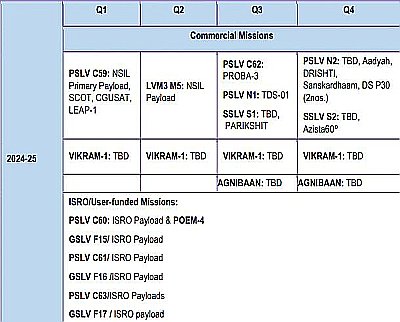
According to India’s space bureaucracy IN-SPACe, that nation has planned as many as 19 launches through March 2025.
The image to the right shows the manifest that IN-SPACe released. That agency is tasked with encouraging India’s private and independnt space industry, and it claims that 30 missions in total are planned, with half by commercial companies. This number however includes payloads and suborbital test missions, not just orbital launches. Based on the manifest to the right it appears that 19 of these missions are launches, with six being entirely private launches. One of those private launches, the first of Agnikul’s commercial Agnibaan rocket, will be suborbital.
It thus appears that in 2024 India hopes to complete 14 orbital launches. If so, this would double that nation’s previous record of seven launches in a single year. This schedule is very aspirational, with those six entirely commercial launches likely not all happening as planned.
The asteroid 2002-VE, discoverd in 2002, is in a solar orbit that makes it a quasi-moon of Venus. This means that the asteroid and Venus are in very similar orbits around the Sun, with 2002-VE shifting back and forth periodically from within Venus’s orbit to outside it.
An official name for 2002-VE has now been approved by the International Astronautical Union, and the history of that name, Zoozve, is a silly one. It appears a podcaster had misread the name on a poster of the solar system that was on the wall of his 2-year-old son’s bedroom. (You can see the poster here). He read “2”s as “Z”s, so that instead of seeing “2002VE” he read it as “Zoozve”.
Since then he has been campaigning to make this misreading official, and has finally succeeded.
NASA engineers have now completed vibration testing of Sierra Space’s Tenacity mini-shuttle, set to launch on a Vulcan rocket later this year.
Reading between the blather in the NASA press release at the link, it appears that testing was successful, proving that the Dream Chaser spacecraft can survive the vibrations of launch. This conclusion by me however remains unconfirmed. Engineers are now preparing the mini-shuttle for environmental testing.
Next up, Dream Chaser will move to a huge, in-ground vacuum chamber that will continue to simulate the space environment Dream Chaser will encounter on its mission. The spaceplane will be put through its paces, experiencing low ambient pressures, low-background temperatures, and dynamic solar heating.
Previously the launch date had been targeting April 2024, according to ULA officials. It now appears, from the vagueness of recent reports, as well as the actual testing now in progress, that the launch date has slipped. They appear to be targeting the first half of 2024, but are as yet unwilling to commit to a date.
The uncertainty of science: Using computer modeling based on orbital data obtained from the orbiter Cassini, scientist now believe the Saturn moon Mimas may have a young underground ocean.
[I]n 2014, a team that included Lainey and that was led by Radwan Tajeddine, an astronomer then at the Paris Observatory, analysed images taken by NASA’s Cassini spacecraft, which explored Saturn and its moons between 2004 and 2017. By studying how the 400-kilometre-wide Mimas wobbled in its orbit around Saturn, the researchers concluded that it had either a buried ocean or a rugby-ball-shaped core. As more scientists studied how an ocean could have formed and evolved, it became harder to explain the geology of Mimas without invoking an ocean.
In the 2024 study, Lainey and his colleagues seem to have nailed the case. They went further than they had in 2014, by analysing not just the orbit’s wobble but also how Mimas’s rotation around Saturn changed over time. The team combined Cassini observations with simulations of Mimas’s interior and its orbit to conclude that there must be an ocean 20–30 kilometres below Mimas’s surface.
The journal Nature published the paper, and the link above goes to an article in Nature describing the results, with a headline “The Solar System has a new ocean — it’s buried in a small Saturn moon.” This is very poor journalism, but very typical these days from Nature. Nowadays that journal routinely pushes the results it publishes with great certainty, even if the data is quite uncertain.
And these results are quite uncertain. They are based on computer simulations using orbital data only. No data from Mimas itself is involved. While that orbital data and computer models might suggest an underground ocean that is very young, that is the best it does, “suggest.” Without question this conclusion is very intriguing, but it should not be treated as a discovery, only a theory that still needs confirmation with much better data.
SpaceX early on February 8 successfully launched a NASA ocean research satellite, dubbed PACE, its Falcon 9 rocket lifting off from Cape Canaveral.
The first stage landed successfully back at Cape Canaveral, completing its fourth flight.
The 2024 launch race:
11 SpaceX
8 China
2 Iran
1 India
1 ULA
1 Japan
1 Rocket Lab
Embedded below the fold in two parts.
To listen to all of John Batchelor’s podcasts, go here.
» Read more
Courtesy of BtB’s stringer Jay. This post is also an open thread. I welcome my readers to post any comments or additional links relating to any space issues, even if unrelated to the links below.
Jay writes, “Rumor is that there are only five BE4 engines built after the last two were used.” If so, there will be serious shortage once ULA starts launching Vulcans at the rate it plans, twice a month.
Neither detection is as yet confirmed.
This is essentially their version of Dream Chaser. It is also nothing more than a powerpoint presentation. Based on past Russian performance, the odds of it getting built are slim to none.
It is named Resilience, and will fly on their second lunar landing mission, Hakuto-R2.
My 2018 post on that launch can be read here.
While neat, NASA found the jetpack impractical and abandoned it. It was simpler to do ordinary tethered spacewalks then deal with the jetpack’s added weight and complexity
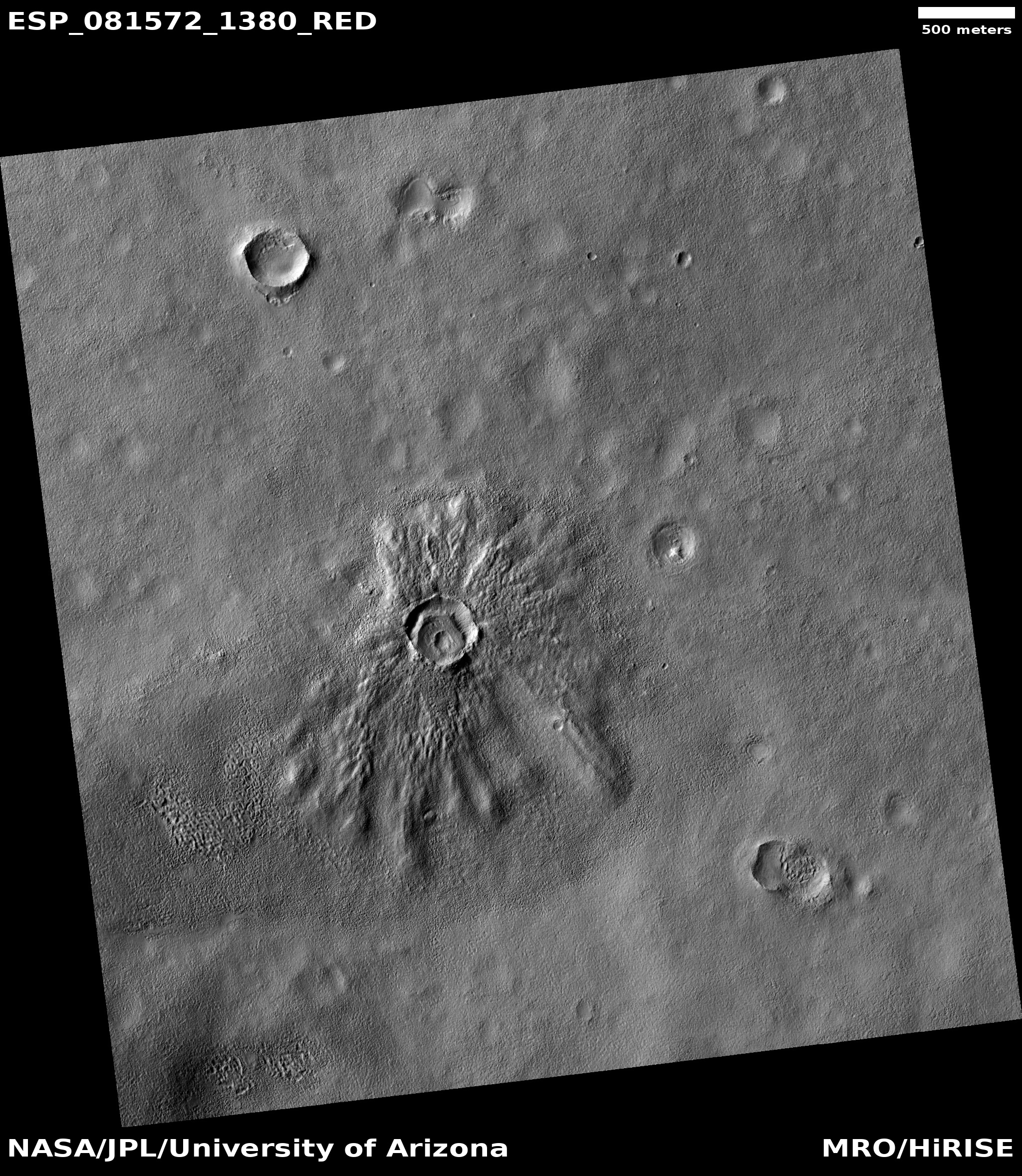
Click for original image.
Cool image time! The picture to the right, cropped, reduced, and sharpened to post here, was taken on December 21, 2023 by the high resolution camera on Mars Reconnaissance Orbiter (MRO). The science team labeled it a “fresh crater”, but that description I think is misleading, as it implies a recent impact.
The crater does not look like a fresh impact crater to me. Such things on Mars usually appear very dark, as the impact dredges up dark material. This crater is not dark. More significant is the crater itself. The small 300-foot-wide inner crater, surrounded by a circular plateau and all sitting inside the larger 1,200-foot-wide crater is completely unique compared to any impact crater I have ever seen. Impacts in soft material, such as ice-impregnated ground, can cause concentric ripple rings, but they don’t look like this.
Instead, this crater more resembles the caldera of a volcano, where subsequent eruptions can produce overlapping depressions at the volcano peak. (See for example this picture of Olympus Mons.)
Moreover, the crater sits on top of a peak approximately 300 feet high. While impacts in ice-impregnated ground on Mars can produce splash aprons as seen here, the crater usually sits at about the same elevation as the surrounding terrain, not at the top of a peak. This peak suggests the apron was forned not by a splash but repeated flows coming down from the top.
» Read more