Zhurong found Mars drier than expected and less eroded than the Moon

According to a new paper, Chinese scientists using data from their Zhurong Mars rover have found little or no evidence of water in the immediate underground, while also finding the surface less eroded than the surface on the Moon.

A layer of regolith covers the surface of Mars, which is the result of geologic processes that occurred over millions to billions of years. Compared to the observations from satellites, the Zhurong rover of China’s first Mars mission (Tianwen-1) had a closer look at the properties of the regolith layer in the explored region within southern Utopia Planitia. There is evidence that the exposed materials might be related to aqueous activities. Local landforms on the surface suggest the possible presence of buried volatiles, like water ice. The radar instrument (RoPeR) on board the rover can expose subsurface structures and the dielectric properties of the regolith layer at high-resolution, to assess their composition. The loss tangent results suggest that water ice is not the main component of the local martian regolith at some depth. The scattering distribution of radar profile along the traveling path and heterogeneous subsurface features show more diverse surface processes and weaker space weathering effects on Mars than those on the airless Moon.

Since Zhurong landed in the equatorial regions, its data about the lack of water simply confirmed other data from orbit and from other rovers/landers. Though there are features even here that suggest the presence of water, that water made those features a long time ago, and is now gone.

The data suggesting the regolith is less eroded than the Moon, however, is a surprise, and counter-intuitive.

4 comments

ESA to issue contract for new lander for its Franklin Mars rover

According to the head of the European Space Agency (ESA), it plans to issue a contract for new lander for its Franklin Mars rover in the next few months, replacing the Russian lander that was lost when ties with that country were broken after it invaded the Ukraine.

Josef Aschbacher, the director general of the European Space Agency (ESA), says the agency will soon release a contract opportunity to design the ExoMars mission’s lander, to replace the Russian one lost when their partnership severed in 2022. “We will issue a contract for the development of the lander, and this will go out soon, in the next few months or so,” Aschbacher told Space.com July 1, hours after the Euclid “dark universe” mission launched here. “This is all in full preparation.”

Aschbacher’s wording is vague enough to leave open the possibility that ESA is considering hiring one of the many private companies from the U.S. and Japan to build it. It is also possible it is waiting to see if India’s Chandrayaan-3 lands successfully on the Moon after its launch this week. If so, India could possibly get that contract.

The present targeted launch date for Franklin is 2028, so there is plenty of time for another lander to be built.

2 comments

To raise cash Astra will sell off some of its stock

Short of cash, Astra officials have now decided to sell about $65 million worth of the company’s existing stock.

In a filing with the U.S. Securities and Exchange Commission published after the markets closed, Astra said it had signed a sales agreement with Roth Capital Partners under which it will sell up to $65 million of its stock in an “at-the-market” offering, where shares are sold at the going market rate.

Net proceeds from the stock sale, the company said, would go towards working capital and general corporate purposes. That includes development of its next-generation launch vehicle, Rocket 4, as well as continued production of its Astra Spacecraft Engine electric thrusters.

The stock sale comes as the company was running low on cash. Astra reported having $62.7 million in cash as of the end of the first quarter, with a net loss of $44.9 million. The company reported no revenue in the first quarter.

The $65 million figure is based on the present value of the stock. If the market price drops, a good possibility, the company will raise less.

2 comments

Voyager Space’s space station will use India’s manned capsule as ferry

Voyager Space, which is one of three consortiums building private space stations for NASA, has now signed a deal with India to begin work that would make possible using India’s Gaganyaan manned capsule as a ferry to Voyager’s Starlab space station.

Gaganyaan is presently under development. India hopes it will fly its first manned mission by 2025. Meanwhile, this international deal is not the first for Voyager. It has also signed launch contracts with India to use its two smaller rockets to launch payloads, as well as signed a development deal with Europe’s Airbus.

0 comments

NASA gives up on finding a new asteroid target for Janus

Without funding for its own launch vehicle, and unable to find a new asteroid target that can be reached by any future planned NASA launch, NASA has decided to shelf the Janus asteroid mission, putting the spacecraft into storage.

Designed to send twin small satellite spacecraft to study two separate binary asteroid systems, Janus was originally a ride-along on the Psyche mission’s scheduled 2022 launch. Psyche’s new October 2023 launch period, however, cannot deliver the two spacecraft to the mission’s original targets, and Janus was subsequently removed from the manifest.

The spacecraft will remain in storage, and might be revived at some point in the future, should another mission’s launch allow it to reach some other asteroid.

2 comments

NASA awards new spacesuit contracts

NASA yesterday issued two relatively small spacesuit contracts to the two companies it already has hired to develop different spacesuits, one for the Moon (Axiom) and the other for orbital spacewalks (Collins).

The new contract awards provides each company $5 million to begin design work for adapting their suits for the other tasks, with the goal aimed at having two different suits for Moonwalks and spacewalks, from two different companies. For the companies, having suits that work both in orbit and the Moon will enhance their product. For Axiom, it will also allow it to develop its own suit it can use on its own space station.

The original contracts awarded Axiom $228.5 million for its Moonsuit, and Collins $97.2 million for a new orbital suit. NASA has previously spent about a billion dollars and fourteen years trying to build its own new orbital spacesuit, and had failed to create anything.

2 comments

July 10, 2023 Quick space links

Courtesy of BtB’s stringer Jay.

  • DARPA’s Blackjack smallsat test constellation reduced from 20 to 4 satellites
  • The project, started in 2017, was to prove smallsat could provide the military what it needed faster and cheaper. It appears DARPA has concluded, after launching four satellites, that such a technology test program was no longer needed. Commercial space has proved the point, hands down, far faster than the government.


Your host is under the weather today, so no political column. Hopefully I’ll feel better later tonight or tomorrow.

0 comments

The inconceivable scale of Mars’ canyons

Overview map

Today’s cool image takes us to one of Mars’ biggest canyon systems that while linked to Valles Marineris, the biggest Martian canyon of them all, is considered a separate canyon system because it is made up of a labyrinth of criss-crossing canyons instead of a single major canyon line.

In fact, its name is Noctis Labyrinthus, as shown on the overview map to the right. In many ways its complex pattern is reminiscent of the chaos terrain seen mostly in Mars’ mid-latitudes, but there are major differences. The rectangle marks the area we shall zoom into below to show these differences as well as to feebly illustrate the grand scale of these canyons.

First, the formation of these canyons is closely linked to the volcanic events that formed the three giant volcanoes to the west. They are also strongly linked (in ways not yet fully understood) with the suspected catastrophic floods that drained from Noctis, through Valles Marineris, and out into the northern lowland plains to the east, eons ago when this dry equatorial region could have been wet.
» Read more

4 comments

New Australian government cancels $1.2 billion program to launch four government satellites

The new Australian Labor government has canceled a $1.2 billion program funded by the previous government to pay for four satellites to provide both civilian and military data from orbit.

The cut will primarily affect the NSMEO program, which was to have four satellites launched between 2028 and 2033 to give Australia a new stream of information from space. While the goal was primarily for civil use, maritime situational awareness data — crucial for keeping an eye on Australia’s sovereign waters — was also part of the project. Also, the weather and earth observation capabilities would have had clear military applications.

Instead the new government has decided to continue the previous policy of using the space capabilities of “its international partners.”

It is unclear whether this decision is good or bad. If the money was to be spent buying these satellites from new Australian satellite companies, it could have helped jump start that nation’s satellite industry. If the plan had instead been to have the government design and build the satellites, then it likely would have merely been a government jobs program that would have cost a lot and accomplished little. In the latter case the new government would thus be shutting down a wasteful program. In the former it prevents a new private industry from forming.

4 comments

Orbex to expand facilities in Scotland and Denmark

The British rocket startup Orbex today announced that it is expanding its factory and office space in its facilities in Scotland and Denmark, the former at its facility it leases at the new spaceport in Sutherland.

The company is adding an extra 1,500 square metres of factory and office space to its existing 4,750 square metre estate in Forres, Scotland and Copenhagen, Denmark. The additional space will increase the company’s launch vehicle production and propulsion system manufacturing capacity and add an extra software laboratory and an avionics clean room space with ISO 8 and ISO 9 sections. The additional capacity in Forres is just 3km from its test site at Kinloss, allowing for quick turnaround between the two sites, as Orbex ramps up its testing in the countdown to launch.

The press release doesn’t give any information about the expansion in Denmark. I wonder if it is occurring as a hedge against the kind of bureaucratic delays in the UK that destroyed Virgin Orbit. Orbex’s Prime rocket is presently under construction in Scotland, with its first launch planned for this year out of Sutherland. Whether it can get a launch permit promptly is doubtful, based on the fifteen months it took Britain’s Civil Aviation Authority (CAA) to approve Virgin Orbit. Orbex applied for the launch license in February 2022 (seventeen months ago) and so far there is no word from CAA about its approval.

Other Scandinavian spaceports are under construction in Sweden and Norway, which suggests establishing facilities in Denmark could strengthen Orbex’s ties to these new spaceports, especially in Sweden as both Sweden and Denmark are members of the European Union. Norway meanwhile as strong trades ties to the EU. Orbex has also signed a deal with Arianespace to launch ESA payloads, and it could be those launches could occur in French Guiana.

It seems wise if Orbex prepares for launch problems in the UK. Today’s announcement could be signalling that preparation.

2 comments

ISRO to transfer ownership of its smallsat SSLV rocket to a private company

India’s space agency ISRO has now announced that it is planning to transfer full ownership of its new smallsat SSLV rocket to a private company, with that transfer conducted through open bidding.

The Indian Space Research Organisation (ISRO) will soon transfer its Small Satellite Launch Vehicle (SSLV) to the private sector, after conducting two development flights of the rocket that seeks to provide on-demand services to put satellites weighing up to 500 kg in a low-earth orbit. The space agency has decided to opt for the bidding route to transfer the mini-rocket to the industry, a senior official said. “We will be transferring the SSLV completely to the private sector. Not just the manufacturing, but full transfer,” the official said.

The article does not provide a source, so this story is at present unconfirmed. It does fit with the overall policy of the Modi government, but it also clashes with the power structure in India’s vast bureaucracy that is resisting that policy. It is very possible that the story has been leaked as part of that struggle, likely by bureaucracy to gin up opposition prior to the transfer being implemented.

Up to now under the Modi government’s efforts to force ISRO to give up power, the assets of ISRO that have been used to generate commercial profits — such as its rockets — have generally been transferred to a new separate bureaucracy created by ISRO dubbed NSIL. NSIL supposed to operate like a private company, but it is wholly owned by the government, and is thus structured to retain control within that government.

If this news story is correct, the Modi government is about to bypass NSIL and force ISRO to sell off SSLV. If so this is excellent news, though the devil will certainly be hidden in the final details of the sale.

0 comments

SpaceX launches 22 Starlink satellites using a first stage for 16th time

SpaceX tonight successfully launched 22 Starlink satellites, its Falcon 9 rocket lifting off from Cape Canaveral using a first stage for a record sixteenth time, all achieved with a period of just over three years.

The stage successfully landed on its drone ship in the Atlantic. In addition, the two fairing halves each successfully completed its ninth flight.

In those three years this one first stage flew almost as many times as all of the launches of Russia (24), ULA (20), and Europe (20). Somehow, with those sixteen launches I think SpaceX has fully gotten its full value for what it spent building and refurbishing that stage.

To understand how routine SpaceX has made all this, when that first stage landed tonight there were no cheers at SpaceX, at all. There was just routine silence, as the launch crew proceeded with what has become an entirely routine procedure.

The leaders in the 2023 launch race:

46 SpaceX
25 China
9 Russia
5 Rocket Lab

American private enterprise still leads China in launches 52 to 25, and the entire world combined 52 to 43, with SpaceX by itself leading the rest of the world, excluding American companies, 46 to 43.

14 comments

China launches classified technology test satellite

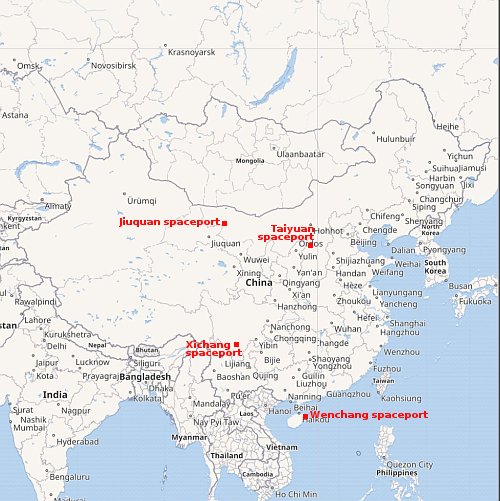
According to China’s state-run press, it used its Long March 2C rocket to launch a satellite to test “internet technologies” today, lifting off from its interior Jiuquan spaceport in the northwest of China.

This is all that press told us. Nor did it say where the rocket’s first stage crashed in China, whether it used parachutes to control its descent, or whether it came down uncontrolled near habitable territories.

The leaders in the 2023 launch race:

45 SpaceX (with a planned Starlink launch tonight)
25 China
9 Russia
5 Rocket Lab

American private enterprise still leads China in launches 51 to 25, and the entire world combined 51 to 43, with SpaceX by itself leading the rest of the world, excluding American companies, 45 to 43.

1 comment

July 7, 2023 Quick space links

Courtesy of BtB’s stringer Jay.


  • Blue Origin to launch Iranian satellite?
  • The article, unfortunately behind a paywall, is about Iran getting an extension from regulators to launch a long delayed communications satellite. Its headline adds “Blue Origin launch in 2024,” which is the real story. As Jay correctly notes, “What on Earth are they talking about? Using Blue Origin to launch an Iranian satellite? Are they out of their minds? Iran is our enemy.” In searching the web, I could only find one hint (which I can no longer find) that Blue Origin offered to do the launch (though it still lacks a rocket to do so), but no indication that any deal with Iran was ever signed.


  • China predicts it will reach 70 launches in 2023, a new record
  • With only 24 launches in the first half of the year, China would almost have to do that number twice over in the second half to meet this target. Since it historically has launched at a much higher pace in November and December, this is not impossible, though still difficult.


  • Europe shifting more launches to SpaceX due to Ariane-6 delays
  • The article lists six payloads that have or will likely switch to the Falcon 9. That’s a lot of money suddenly flowing to SpaceX, from $200 million to $500 million, depending on price per launch. And it is all happening because Europe first denied the importance of reuseability and second moved too slowly in trying to compete. As Jay notes, “SpaceX did not choose to become a monopoly.”

4 comments

Puzzling crater on alien Mars

Puzzling crater on alien Mars
Click for original image.

Today’s cool image once again illustrates that the things that orbiters photograph on the Martian surface are not always what they seem at first glance. The picture to the right, cropped, reduced, and sharpened to post here, was taken on March 23, 2023 by the high resolution camera on Mars Reconnaissance Orbiter (MRO). It shows what the scientists label as “layering” in this small mile-wide crater.

That layering, seen on both the interior and exterior slopes of its circular rim, is what makes this crater puzzling. It suggests this crater was not formed by an impact, but by volcanism. The layers suggest repeated eruptive events. That the crater sits above the surround plain by about 100 feet strengthens this conclusion.

And yet, a look at the overview map below suggests this conclusion is premature.
» Read more

1 comment

SpaceX launches another 48 Starlink satellites

Using its Falcon 9 rocket, SpaceX today successfully launched another 48 Starlink satellites, lifting off from Vandenberg Space Force Base.

The first stage completed its twelfth flight, landing softly on a drone ship in the Pacific. The two fairing halves completed their fourth and seventh flights respectively.

The leaders in the 2023 launch race:

45 SpaceX
24 China
9 Russia
5 Rocket Lab

In successful launches, American private enterprise now leads China 51 to 24 in the national rankings, while SpaceX by itself leads the entire world combined, excluding American companies, 45 to 42.

8 comments

Taiwan wants and needs Starlink, but local law is blocking a deal

After three years of discussions, negotiations between Taiwan and SpaceX to provide Starlink to that nation broke off in 2022 because of a local Taiwanese law that requires local ownership of at least 51%.

SpaceX would not agree to these conditions, and ended the negotiations. In response, Taiwan has been struggling to get its own communications satellite into orbit, with limited success.

To address that vulnerability, the Taiwan Space Agency (TASA) intends to launch its first self-made low-Earth orbit communication satellite in 2026 and at least one more by 2028, Director General Wu Jong-shinn said. Taiwan also will have rockets capable of carrying payloads weighing over 100 kilograms, he added in an interview.

Since the country doesn’t yet have those rockets, this plan remains dependent on foreign launchers. Moreover, to be effective in low-orbit will require not two satellites but a constellation of 20 to 30. Taiwan is years from being to launch such a constellation.

It seems Taiwan is cutting off its nose to spite its face by not changing this ownership law. Its entire internet access is dependent on 14 undersea cables, and China has already demonstrated the ability to destroy these cables when it cut two in February. No foreign operation is going to give up its ownership to make a deal in Taiwan.

7 comments

Students complete first suborbital launch from new Nova Scotia spaceport

Students today completed the first suborbital launch from the new Nova Scotia spaceport being run by Maritime Launch Services.

The launch was completed by Arbalest Rocketry, a rocketry team from Ontario’s York University. It in turn is part of a nationwide Canadian student program called Launch Canada involving “over 1000 students nationwide from over 25 universities and colleges.”

Maritime hopes to offer both a launchpad and a rocket to satellite companies. It has deals with rocket startups in both the Ukraine and the United Kingdom, whereby satellite companies can come to Martitime and get full launch services.

1 comment

Large mass of granite unexpectedly detected on Moon

Using archival data from four lunar orbiters (two American and two Chinese), researchers have unexpectedly detected evidence suggesting the existence of a large 20-mile-wide mass of granite under a lunar volcanic caldera.

“We have discovered extra heat coming out of the ground at a location on the Moon believed to be a long dead volcano which last erupted over 3.5 billion years ago. It’s around 50km across, and the only solution that we can think of which produces that much heat is a large body of granite, a rock which forms when a magma body – the unerupted lava – below a volcano cools. Granite has high concentrations of radioactive elements like uranium and thorium compared to other rocks in the lunar crust, causing the heating we can sense at the lunar surface”.

Except for some small grains found in Apollo lunar samples, granite has not been found anywhere in the solar system except on Earth. This discovery, if confirmed, will strengthen the theory that the Moon was once part of the Earth and was created from the impact of a second large body.

11 comments
1 263 264 265 266 267 1,449