Chandrayaan-3’s Vikram lander separates from its propulsion module; Luna-25 in lunar orbit
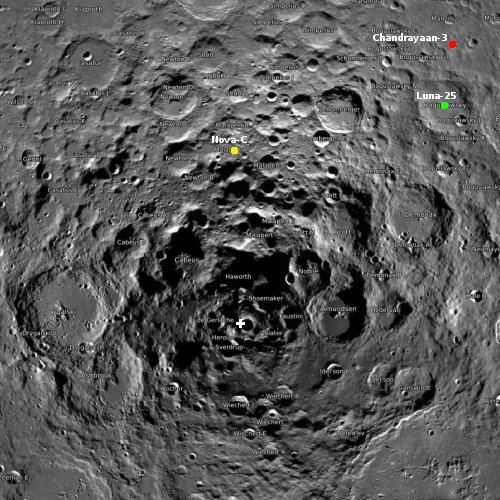

Click for interactive map.

The two probes aiming to land in the high southern latitudes of the Moon in the next week are now both in lunar orbit and preparing for their planned landings.

First India’s Chandrayaan-3: With its propulsion module having completed the job of getting Chandrayaan-3 from Earth to lunar orbit, the Vikram lander today separated from that module in preparation for firing its own engines on August 23, 2023 and landing on the Moon.

Vikram needs to make several orbital adjustments before that landing attempt.

Second, Russia’s Luna-25 probe entered lunar orbit yesterday, where it will spend the next few days making its own orbital adjustments before attempting its landing on August 21st.

Vikram carries a small rover, Pragyan. Luna-25 is only a lander, though it has a scoop and will do analysis of the lunar soil below it. Neither is landing “near the south pole”, as most news sources are saying. They are landing at latitudes comparable to landing in the Arctic on Earth, on the northern coast of Alaska. As such, neither will find out anything about the question of remnant ice in south pole’s permanently shadowed regions.

5 comments

SpaceX launches another 22 Starlink satellites from Cape Canaveral

SpaceX tonight successfully launched another 22 Starlink satellites into orbit. its Falcon 9 rocket lifting off from Cape Canaveral at 11:36 pm Eastern.

The first stage completed its thirteenth flight, landing on a drone ship in the Atlantic. The two fairings completed their 10th and 11th flights, respectively. As of posting the satellites had not yet deployed.

SpaceX has another launch scheduled only hours hence, at midnight (Pacific) from Vandenberg Space Force Base in California, aiming to put another 22 Starlink satellites in orbit using a first stage flying for its fifteenth time.

Until that second launch, the leaders at this moment in the 2023 launch race are as follows:

56 SpaceX
35 China
11 Russia
6 Rocket Lab
6 India

In successful launches, American private enterprise now leads China 64 to 35 in the national rankings, and the entire world combined 64 to 57. SpaceX by itself trails the rest of the world combined (excluding American companies) 56 to 57, but this will become a tie if the second launch occurs as planned.

0 comments

Two-thirds of all approved cancer drugs do nothing for patients

A long term study in Sweden of 22 cancer drugs that its government had approved for rapid use before being tested fully has found that two-thirds provided absolute no benefit to patients.

The Gothenburg team examined 22 cancer drugs approved for reimbursement in Sweden over the last 10 years, examining studies that tested their ability to improve quality of life or lengthen lifespans. On average, these reports examined the drugs for 6.6 years.

Results revealed only seven of the 22 drugs had at least one study which showed a clear benefit for cancer patients. Randomized controlled trials on the other 15 failed to show any tangible benefits for people with cancer. Only one drug in the study showed an ability to both improve the quality of life and extend lifespans for patients.

โ€œWe have shown that the majority of the drugs launched with limited evidence still lack clear evidence of how they actually affect survival and quality of life in patients,โ€ says Gabriella Chauca Strand, a doctoral student at Sahlgrenska Academy at the University of Gothenburg and the lead author of the study, in a university release.

This sentence from the university’s press release was even more striking:

Only one of the drugs had scientific evidence of both increased life expectancy and improved quality of life for its indication.

Essentially, 95% of these approved drugs were failures. Most did nothing and were worthless, despite the Swedish government paying huge amounts of money buying them. A few either improved the quality of life (but failed to keep the patient alive) or kept the patient alive longer (but made their lives miserable).

Does this sound familiar? Doesn’t make you wonder about the drug approval process in the U.S., especially after the disaster of the emergency approval of the COVID shots that we know now not only failed to prevent infection, were actually very harmful to many.

6 comments

August 16, 2023 Quick space links

Courtesy of BtB’s stringer Jay.


2 comments

An avalanche in the West Virginia of Mars

An avalanche in the West Virginia of Mars
Click for original image.

Cool image time! The picture to the right, rotated, cropped, and reduced to post here, was taken on June 27, 2023 by the high resolution camera on Mars Reconnaissance Orbiter (MRO).

I have cropped it to focus on this one hill, about 900 feet high (though the elevation data from MRO is somewhat uncertain at this resolution), because of that major landslide on its northern slopes. At some point in the past a major piece of the exposed bedrock at the top broke off and slide about halfway down the mountain, almost as a unit, settling on the alluvial fill that comprises the bottom half of the hill’s flanks.

The bedrock surrounding the peak is also of interest because of its gullies, all of which were created by downward flowing material. Was it ice? Water? Sand? Or maybe a combination of two or three? If water or ice was involved it was a very long time ago, as this location is in the dry equatorial regions of Mars. There is little known near-surface ice here.
» Read more

1 comment

Scientists discover in Alaska the largest dinosaur track site in U.S.

New dinosaur track site in Alaska
Click for original image.

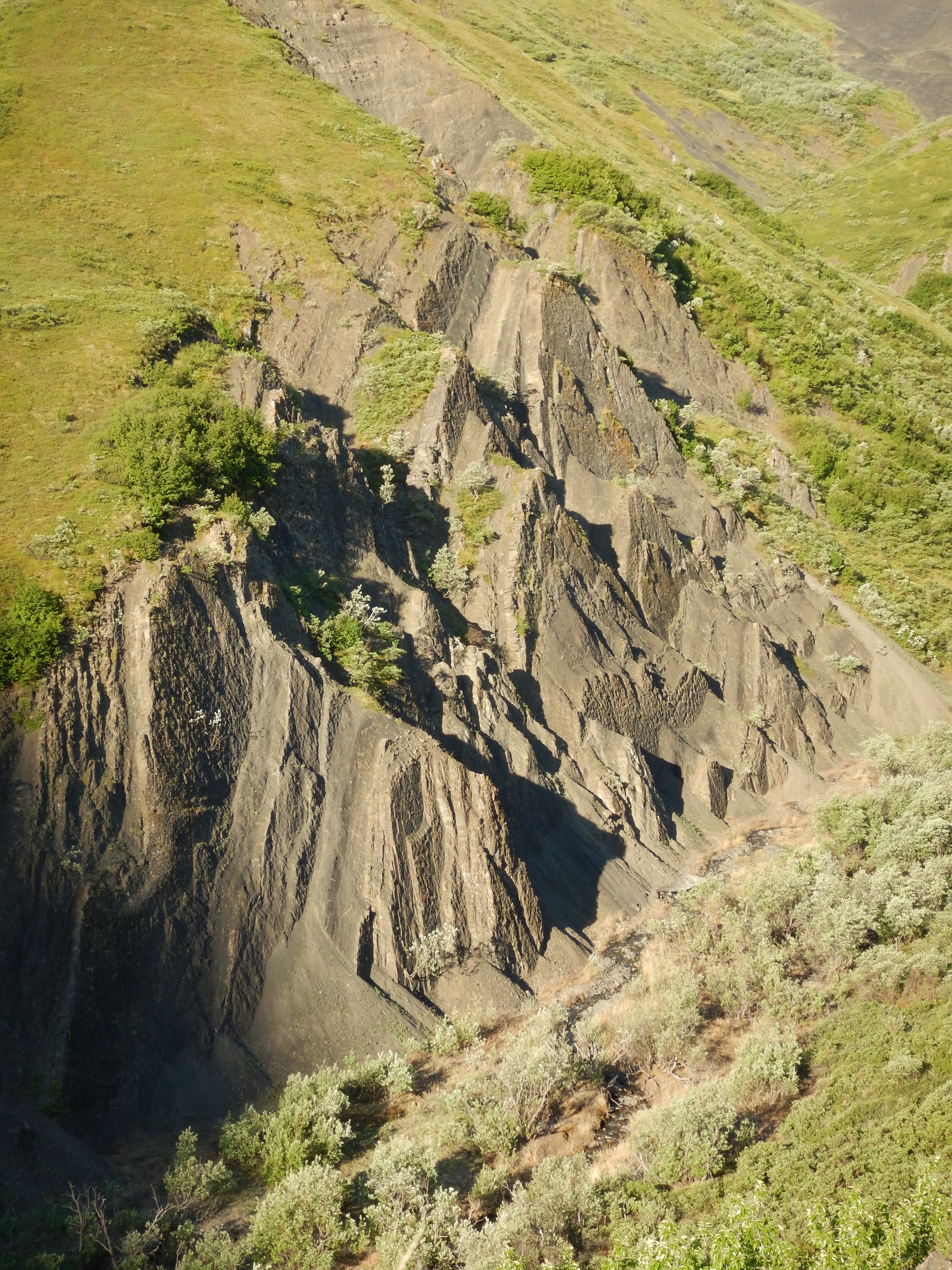
Paleontologists have discovered in Alaska a new dinosaur track site that appears to contain numerous exposed tracks on what is now a series of vertical walls covering an area larger than a football field.

The picture to the right shows the entire site. The darker flat walls that appear to be dimpled are the track sites, with the dimples the actual tracks.

Researchers at the University of Alaska Fairbanks made the discovery following a seven-hour hike into the Denali National Park and Preserve, and it is now the home of the largest known single dinosaur track site in the US state.

Like a geological triple-decker (or more) sandwich, the 20-story-high structure, pushed vertical due to tectonic plate convergence, reveals a cliff face of layer upon layer of preserved prints throughout time. โ€œItโ€™s not just one level of rock with tracks on it,โ€ said Dustin Stewart, the paperโ€™s lead author and a former UAF graduate student. โ€œIt is a sequence through time. Up until now, Denali had other track sites that are known, but nothing of this magnitude.โ€

The scientists think these now vertical walls, when horizontal in the past, marked a major water-hole location visited by numerous dinosaurs and other species.

4 comments

SpaceX report on first Starship/Superheavy launch failure submitted to FAA

Though we don’t know exactly when this was done, SpaceX has submitted to the FAA its final report on its investigation into the launch failure during the first Starship/Superheavy test launch in April, and now awaits the FAA’s response.

Now comes the FAA’s review of SpaceX’s investigation, fulfilling the agency’s role as the regulator charged with ensuring public safety during commercial launch operations. “When a final mishap report is approved, it will identify the corrective actions SpaceX must make,” an FAA spokesperson told Ars. “Separately, SpaceX must modify its license to incorporate those actions before receiving authorization to launch again.

Do not expect that response to be fast, or accepting. I predict the FAA will demand a lot more investigation and changes from SpaceX, actions that will take time to implement and be approved. Furthermore, I fully expect the FAA to take at least two months to review the SpaceX report before it issues those demands. As I have been predicting since May, there will be no Superheavy/Starship launch this year.

2 comments

Astra scrambling to find investors as its cash reserves dwindle

Despite a major reorganization, including laying off a quarter of its workforce, Astra now appears to be scrambling to find new investors even as its available cash reserves shrink.

The companyโ€™s financial runway is diminishing even as the company finds new sources of capital, such as a loan announced Aug. 4 that will provide Astra with $10.8 million and plans announced in July to sell up to $65 million in Astra stock in an โ€œat-the-marketโ€ transaction. The company forecasted an adjusted EBITDA loss of $25 million to $29 million in the third quarter, ending the quarter with $15 million to $20 million of cash and equivalents on hand.

One analyst on the call expressed frustration with those projections, asking Astra executives for the โ€œupsideโ€ of the companyโ€™s plans. Kemp emphasized the backlog of orders for its thrusters, which Astra said Aug. 4 was valued at $77 million, as well as orders from the U.S. Space Force and the Defense Innovation Unit for the Rocket 4.

However, he suggested the companyโ€™s efforts to focus on thruster production were intended to buy time for Astra as the company looks for new investors. The company said Aug. 4 it was working with PJT Partners, an investment bank, to identify โ€œpotential strategic investments in the Astra Spacecraft Engine businessโ€ that would bolster its finances. โ€œWe are actively focused on finding investors in these two businesses,โ€ he said, noting that the companyโ€™s launch and spacecraft propulsion business lines are distinct and โ€œin different phases of their development.โ€

Essentially the company is approaching a make-or-break moment. What I think is likely to happen is it will either go bankrupt, or be purchased outright by a new big-money investor who will take over the company entirely, replacing its present management with new people.

1 comment

Russia considering flying Proton rockets after 2025

According to a story today in Russia’s state-run TASS news outlet, the Khrunichev design bureau that builds Russia’s Proton rocket is in negotiation with Kazahkstan to use all the remaining Proton rockets available, even if that requires additional launches after 2025, the date Roscosmos had previously announced as when all Proton launches will cease.

The Khrunichev Center (part of the state-run space corporation Roscosmos) is actively working on future cooperation with the Kazakh side, including with regard to the use of the Proton carrier rocket, the centerโ€™s CEO Alexey Varochko told TASS. “The Khrunichev Center is actively working on various scenarios of mutually beneficial cooperation with the Kazakh side, including those involving the Proton carrier rocket,” Varochko said.

According to the official, the possibility of using Protons after 2025 may be considered only if both Russia and Kazakhstan give their consent.

It sounds like Khrunichev has some spare Protons, and wants to make some money from them, even if Roscosmos has forbid it. It also appears that there is political infighting within Roscosmos about the retirement of Proton and resulting the loss of government jobs at Khrunichev.

1 comment

Chandrayaan-3 reaches final lunar orbit for landing


Click for interactive map.

India’s Chandrayaan-3 spacecraft completed its final lunar orbital engine burn today, placing it in the correct orbit to release the lander Vikram, carrying the Pragyan rover.

The release is scheduled for tomorrow, with the landing targeting August 23, 2023. This will be India’s second attempt to softland an unmanned probe on the Moon. The Vikram lander of Chandrayaan-2 failed in 2019 during its final engine burn above the surface, crashing thereafter. Engineers at India’s space agency ISRO spent several years upgrading that lander to better insure this new attempt would succeed.

The lander has been given more ability to manoeuvre during the descent, the mission allows for a bigger 4 km x 2.4 km area for landing, more sensors have been added, one of the thrusters has been removed, and the legs of the lander have been made sturdier to allow for landing even at slightly higher velocity. More solar panels have also been added to ensure that the mission can go on even if the lander does not face the sun. More tests to see the capability of the lander in different situations were carried out to make Chandrayaan-3 more resilient.

Both Vikram and Russia’s Luna-25 lander, scheduled for touchdown on August 21, will land in the high southern latitudes of the Moon, at about 70 degrees. They are not going to the Moon’s south pole, as many news reports claim.

0 comments

August 15, 2023 Quick space links

Courtesy of BtB’s stringer Jay.


  • NASA is developing a larger cubesat adapter for SLS
  • It will allow SLS to carry more cubesats that are bigger. Whether any commercial cubesat company will want to fly on it remains unknown, considering the uncertainty of any SLS launch. Jay also notes many comments on X about “cubesats dying while waiting for [an SLS] launch.”

1 comment

The impact that almost cracked Mars open

An irregular pit chain on Mars
Click for original image.

Cool image time! The picture to the right, rotated, cropped, reduced, and sharpened to post here, was taken on June 25, 2023 by the high resolution camera on Mars Reconnaissance Orbiter (MRO). It shows what the scientists label an “irregular pit chain,” made up of a series of depressions scattered along a line that extends more than sixty miles to the northeast and to the southwest, beyond the edges of this high resolution close-up.

The chain likely indicates the existence of a fault line, or crack that created a void underground in which surface material is sinking. What makes this crack or fault line significant is how it and other similar fissures or cracks map across the Martian surface, extending for thousands of miles far beyond this particular pit chain and covering almost half the planet. In aggregate they imply the occurrence of past geological events so stupendous they are difficult to comprehend.
» Read more

7 comments

Ingenuity’s 55th flight completed

Overview map
Click for interactive map.

The Ingenuity engineering team today updated the helicopter’s flight log, showing that the 55th flight occurred on August 12, 2023, one day later than originally planned, and flew 881 feet for 143 seconds, 61 feet and 9 seconds longer than planned.

The overview map above shows the present locations of both Perseverance and Ingenuity. The green dot marks Ingenuity’s new position, while the blue dot marks where Perseverance presently sits in Jezero Crater. Based on this map, the main goal of the flight was apparently to fly Ingenuity over a route that Perseverance will likely use to return to its planned route, as indicated by the red dotted line.

0 comments

Webb confirms galaxy as one of the earliest known in the universe

The uncertainty of science: Using the spectroscopic instrument on the Webb Space Telescope, scientists have confirmed that one of the first galaxies found by Webb, dubbed Maisie’s Galaxy after the daughter of one scientist, is one of the earliest known in the universe, existing only 390 million years after when cosmologies say the Big Bang happened.

The data also showed that another one of these early galaxies spotted by Webb did not exist 250 million years after the Big Bang, but one billion years after, a date that better fits the theories about the early universe, based on the nature of this galaxy.

It turns out that hot gas in CEERS-93316 was emitting so much light in a few narrow frequency bands associated with oxygen and hydrogen that it made the galaxy appear much bluer than it really was. That blue cast mimicked the signature Finkelstein and others expected to see in very early galaxies. This is due to a quirk of the photometric method that happens only for objects with redshifts of about 4.9. Finkelstein says this was a case of bad luck. โ€œThis was a kind of weird case,โ€ Finkelstein said. โ€œOf the many tens of high redshift candidates that have been observed spectroscopically, this is the only instance of the true redshift being much less than our initial guess.โ€

Not only does this galaxy appear unnaturally blue, it also is much brighter than our current models predict for galaxies that formed so early in the universe. โ€œIt would have been really challenging to explain how the universe could create such a massive galaxy so soon,โ€ Finkelstein said. โ€œSo, I think this was probably always the most likely outcome, because it was so extreme, so bright, at such an apparent high redshift.โ€

This science team is presently using Webb’s spectroscope to study ten early galaxies in order to better determine their age. Expect more results momentarily.

4 comments

Intuitive Machines sets mid-November launch date for its Nova-C lunar lander


Click for interactive map.

Intuitive Machines announced yesterday that the launch of its lunar lander, Nova-C, is now targeting a November 15-20, 2023 window, lifting off on a SpaceX Falcon 9 rocket.

The yellow dot on the map to the right indicates the landing site, Malapert A, in the southern latitudes of the Moon. The white cross indicates the south pole.

The lander had originally planned to launch in 2021, but delays in construction pushed the launch back two years. A second company, Astrobotics, has its own lander, Peregrine, that though also delayed two years, has been ready to launch since early this year. It won’t launch until the end of this year at the earliest, however, due to delays in readying its rocket, ULA’s Vulcan on its first flight.

Both India’s Chandrayaan-3 and Russia’s Luna-3 are right now on their way to the Moon, with each planning a landing next week.

1 comment

August 14, 2023 Quick space links

Courtesy of BtB’s stringer Jay.


1 comment

Today’s blacklisted American: Gestapo police in Kansas raid home of 98-year-old newspaper owner, causing her death

Joan Meyer
Joan Meyer, now dead because of police raid

On August 11, 2023 the entire police department of Marion, Kansas, performed a Gestapo-like raid of the home of 98-year-old Joan Meyer, co-owner of the local newspaper, the Marion County Record, resulting in her death from a heart attack the next day.

The elderly woman, who co-owned the newspaper with her son Eric, was subjected to the raid by five officers and two sheriff’s deputies on Friday – which caused her to be ‘stressed beyond her limits and overwhelmed by hours of shock and grief.’ Eric, 69, has bashed the officers for their ‘Gestapo’ tactics in an attempt to seize information that hadn’t even gone to presses yet. Police have defended their actions.

Ms Meyer could not eat or sleep after the traumatizing hours-long ordeal. She was crying while the police raided her home and took her Alexa smart speaker – and died one day later. [emphasis mine]

It appears the police also that day raided the newspaper’s offices as well as the home of one of its reporters.

And why? All the evidence suggests this is a case of a local businesswoman working in teamwork with the police and a local judge to harass and destroy a newspaper. From the second link:
» Read more

11 comments

Residual ice on the shaded north-facing slope of northern Martian crater

Residual ice on Mars?
Click for original image.

Cool image time! The picture to the right, rotated, cropped, reduced, and sharpened to post here, was taken on April 10, 2023 by the high resolution camera on Mars Reconnaissance Orbiter (MRO). In the headline I am speculating a bit when I call that pile of material bunched up against the interior slope of this unnamed 18-mile-wide crater residual ice. No data is available to me that proves that assumption, but the look, the location, and the general previous data from Mars all tell me that this is what it is.

First, the location within the crater. Everyone who has lived in the northern latitudes where snow falls knows that snow will remain in the shaded slopes that face north — where less direct sunlight falls — much longer than in places where there is more sunlight. You can sometimes even find this residual snow as late as June and July in some such spots.

This phenomenon will be no different on Mars. In those alcoves this material, which looks exactly like glacial features found in many other places in the mid-latitudes of Mars (such as inside the small half-mile-wide crater in the lower left), is well protected, so that even when the rest of the ice sublimated away within the crater it remained. The cliff wall rises five hundred feet to the south, blocking sunlight so that for most of the year little directly sunlight touches this surface.
» Read more

0 comments

China makes available to the international community Chang’e-5’s lunar samples

China on August 2, 2023 announced that it is now allowing scientists from all nations to apply for access to the lunar samples brought back to Earth by its 2020 Chang’e-5 mission to the Moon.

The announcement outlined very specific rules for the loan of the samples, including requirements that if any part of a sample needs to be destroyed to study it that action be videotaped in detail. Samples loaned for research are for one year periods only, though this can be extended.

The rules also allow two month loans for the use of samples in public display, such as at a museum.

In both cases China will closely supervise the research and retain the right to recall the samples at any time if it doesn’t approve of what the borrower is doing.

U.S. law forbids our government officials or agencies from working with China, so don’t expect NASA or its scientists to apply for these samples. However, the law doesn’t apply to independent scientists, though serious state department regulations would apply. I therefore doubt many American scientists will apply for any samples. It would carry too many risks to their other research.

3 comments
1 262 263 264 265 266 1,459