
October 6, 2020 Zimmerman/Batchelor podcast
Embedded below the fold in two parts.
» Read more
Very brief descriptions, with appropriate links, of current or recent news items.
Embedded below the fold in two parts.
» Read more
They’re coming for you next: California state officials quickly moved to take down a pro-Trump billboard, even though it was on private property and they apparently did not have permission to do so.
This LA Times report on the massive Trump sign on a hill near the 405 says that state authorities went on private property to take it down because they claimed the political speech was a “visual distraction” to drivers.
So, in California your first, fourth, fifth, and sixth amendment rights are now null and void. If government officials don’t approve of your political signage, they now claim the right to enter your property, without permission and without a search warrant, and take down your signage.
The article at the first link notes that for some reason, these same California authorities did not consider it a “visual distraction” for Antifa and Black Lives Matter protests to stand on these same highways and block traffic.
Put them on the Moon! Radio astronomers have released a paper claiming that the coming large communication satellite constellations, such as Starlink and OneWeb, will seriously impact observations with the Square Kilometer Array (SKA) of radio telescopes being built in the remote western outback of Australia.
Saturation of the instruments: very strong interfering signals can saturate the receiver systems and thereby drown out all other signals seen by the Band 5b receivers. As a consequence, all data in that frequency band would be lost, rendering these receivers useless for a portion of the time. For the first phase of the constellation deployments (about 6,400 satellites in total), saturation is predicted to occur for a few percent of the time assuming there is no direct illumination of the dishes by the satellites. For significantly larger constellation sizes (up to more than 100,000 satellites), saturation would be essentially continuous without significant mitigation measures implemented by the satellite operators.
Based on this conclusion, the astronomers estimate that for observations in this particular band they will need to look about 70% longer to get the same data, thereby cutting the number of observations by about half.
The astronomers propose this solution:
One of these mitigation techniques is for the satellite transmitters not to point their beams near the SKAO dishes. SKAO would require operators to steer their satellites’ beams away from the telescope site, a measure which would require a simple software modification with no repercussion on the constellation’s deployment, positioning or hardware. While a cost-effective implementation of this solution does depend on the hardware and software deployed on the satellites, operators already use this technique to comply with international regulations when their satellites cross the path between geostationary satellites in higher orbit and their receiving ground stations, for example to avoid affecting telecommunications and TV transmissions.
This mitigation could reduce the impact on the SKA by a factor of 10 over that noted previously and result in a 7% increase of integration time for SKA observations within the satellite transmission range 4. While any loss of sensitivity is regrettable, SKAO recognises the need for compromise between the competing scientific and commercial drivers.
The solution seems reasonable, but in truth it is only a temporary one. The permanent and smart solution for the astronomical community is to move their telescopes, in all wavelengths, off the Earth. For radio astronomy the far side of the Moon would be ideal.
And with SpaceX now developing a reusable big rocket, Starship, to put such payloads in orbit at low cost, the astronomers need to start thinking about taking advantage of this engineering. The situation for ground-based astronomer will only get worse.
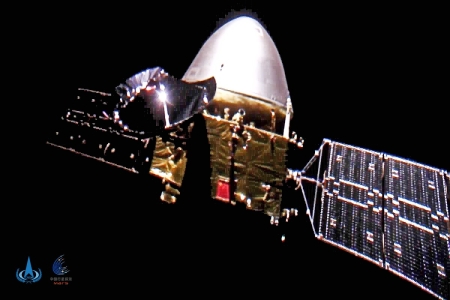
China has released several images taken of its Tianwen-1 orbiter/lander/rover by a camera ejected by the spacecraft on its way to Mars.
The images released by the China National Space Administration on Oct. 1 show the Tianwen 1 spacecraft traveling through the blackness of space. Tianwen deployed a small camera to take the self-portrait as it tumbled away from the mothership.
Two wide-angle lenses on the deployable camera were programmed to one image every second. The images were transmitted back to Tianwen via a wireless radio link, then downlinked back to ground teams in China.
In the images, Tianwen 1’s solar array wings and dish-shaped high-gain communications antenna are prominently visible. The white section of the spacecraft is the mission’s entry module and heat shield, which contains a Chinese rover designed to land on Mars and explore the surface.
The spacecraft is about halfway to Mars, and will arrive in Mars orbit in February. It will then spend several months surveying its candidate landing sites, of which there appear to be two, before releasing the lander/rover to the surface.
President Trump tonight ordered officials at the various agencies implicated in the Clinton/Russian collusion hoax and the illegal spying on his campaign by the Obama administration to release of all related documents, with no redactions, declassifying everything fully.
“I have fully authorized the total Declassification of any & all documents pertaining to the single greatest political CRIME in American History, the Russia Hoax. Likewise, the Hillary Clinton Email Scandal. No redactions!” Trump tweeted.
“All Russia Hoax Scandal information was Declassified by me long ago. Unfortunately for our Country, people have acted very slowly, especially since it is perhaps the biggest political crime in the history of our Country. Act!!!”
If this is so, then we are about the see the lid blow on this entire scandal, at last. These agencies have been hiding the facts by claiming that they need to redact a great deal of what is in any documents they are ordered to release. When those redactions however have been later stripped away so that we can read what was actually there, we have consistently found there was no justifiable national security reason for them. Instead, the only reasons for them was to to protect the lawbreakers at these agencies.
Since the leadership at these agencies is increasingly on Trump’s side in this matter, I suspect they will have no problem releasing everything, very quickly. I think we shall soon see clear evidence that former FBI head James Coomey and former CIA head John Brennan were directly involved in this spying operation, they made a conscious effort to manufacture a scandal for the express purpose of overthrowing the legally elected President of the United States, and they instigated it with the approval of the previous President, Barack Obama.
Link here. The author reviews the almost gleeful desire by many Democrats and their base to have Trump and his supporters die, either of COVID-19 or from a political revolution instigated by them.
And that’s a very dangerous thing to want, because the intended victim gets a say, and he may start saying the same thing about you. I could talk about walking through the wrecked villages of Kosovo – villages that had mostly belonged to the Serbs who started the civil war then lost it – but that is probably going to be lost on the pampered and parochial left. History, be it modern Balkans or ancient, such as the cautionary tale that was the decline and fall of the Roman Republic, is something they are too smart to bother studying. They know what they think and what they want and they can’t be bothered with pests nagging them about how their paucity of wisdom could very well set into motion events they cannot control and that are unlikely to turn out in the way they hope.
Read it all. He concludes by noting that we have a chance on election day to stop these fascist Democratic Party thugs, if only for another four years. And he is right. The defense of liberty never ends, and the moment you think so is the moment your liberty begins to disappear, taken by bullies whose only interest in life is the wielding of power.
Newly declassified CIA documents show that the spy agency briefed President Barack Obama in July 2016, during the presidential election campaign, about a Hillary Clinton campaign effort to plant a false Trump/Russian collusion narrative in the press in order “to vilify Donald Trump by stirring up a scandal claiming interference by the Russian security service.”
The memos indicate the CIA first received the information through monitoring of Russian sources but deemed it credible enough to both brief Obama on it in July 2016 and to refer the intelligence to the FBI in September 2016 for possible investigation.
The warnings came as the FBI was just starting its Crossfire Hurricane probe into now-disproven Trump-Russia collusion, aided by the Clinton campaign-funded dossier by Christopher Steele. They are likely to bolster GOP claims the James Comey’s FBI ignored clear evidence that the allegations were a political dirty trick and not evidence of a counterintelligence threat.
“Per FBI verbal request, CIA provides the below examples of information the CROSSFIRE HURRICANE fusion cell has gleaned to date,” the September 2016.referral from the Agency to the bureau read. ““An exchange [redacted] discussing US presidential candidate Hillary Clinton’s approval of a plan concerning US presidential candidate Donald Trump and Russian hackers hampering US elections as a means of distracting the public from her use of a private email server.”
Two months earlier, then-CIA Director John Brennan briefed Obama, according to handwritten notes written after the briefing. “We’re getting additional insight into Russian activities from [redacted],” Brennan notes read. “CITE alleged approved by Hillary Clinton a proposal from one of her foreign policy advisers to vilify Donald Trump by stirring up a scandal claiming interference by the Russian security service.” [emphasis mine]
These notes, written at the time by these CIA officials, also make it clear that this Trump/Russian collusion scam was directly approved by Hillary Clinton as a campaign tactic. Yet, though Obama, the CIA, and the FBI were all informed of the fake nature of this plan, the FBI under James Comey — apparently with Obama’s approval — made that plan a major FBI investigation that allowed the Obama administration, acting as a campaign surrogate for Clinton, to spy on her political opponent. After she lost the effort was then turned into a weapon to try to overthrow Trump, despite the fact that he had been legally elected by the American people.
Many people from that Obama administrion should be in prison for what to me increasingly appears to treasonable actions.
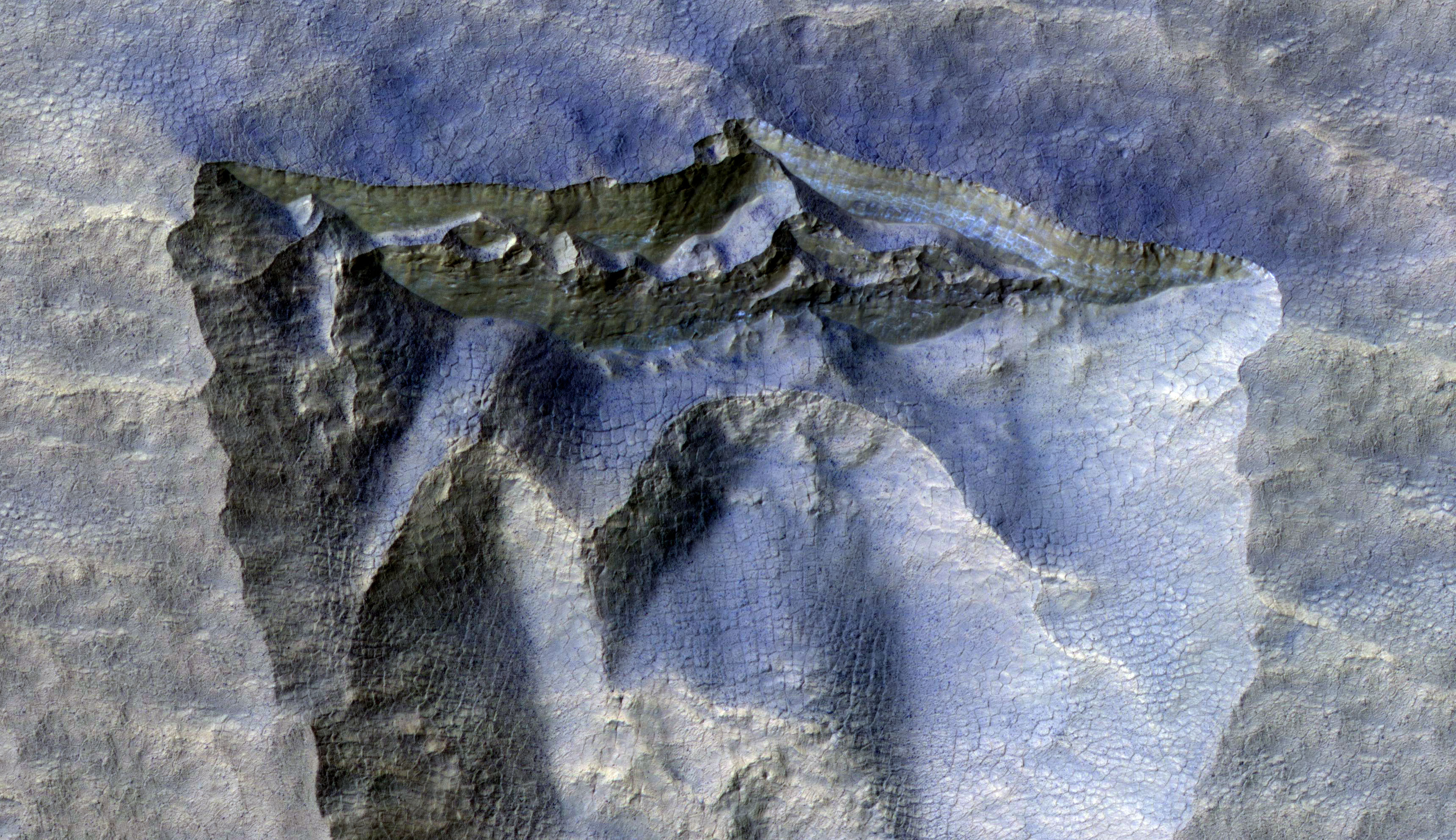
Click for full image.
Today’s cool image to the right, cropped to post here, shows an ice scarp located in the high southern latitudes south of Hellas Basin. It was taken on August 15, 2020 by the high resolution camera on Mars Reconnaissance Orbiter (MRO), and was released today as a captioned image. From the caption:
Scientists have come to realize that, just below the surface, about one third of Mars is covered in ice. We study this ice to learn about Mars’ ancient climate and astronauts’ future water supplies.
Sometimes we see the buried ice because cliffs form like the one in this image. On the brownish, dusty cliff wall, the faint light-blue-colored ice shows through. [emphasis mine]
This ice scarp is one of about two dozen [pdf] that have so far been found within the latitude bands of approximately 45 to 65 degrees latitude in both the north and south hemispheres. The data so far obtained suggests that the scarp exists because of a pure water ice layer just below the surface. Over time this pole-facing cliff retreats away from the pole towards the equator, leaving behind it an extended pit. In the cliff wall scientists think they have detected evidence of that water ice layer.
Blue in MRO hi-res images can indicate both water as well as very rough surfaces. While much of the blue here could be ether, the blocky cracks suggest it is ice. As explained by Colin Dundas of the U.S. Geological Survey’s Astrogeology Science Center in Arizona and lead author of the pdf above,
The crack patterns are likely thermal contraction cracks, which form in shallowly buried ice due to seasonal temperature changes causing it to expand and contract. When that repeats over many years it creates regular patterns of cracks that organize themselves into polygons.
The overview image below gives the location of all known such scarps, as of March of 2020, taken from the pdf paper that I linked to above.
» Read more
Capitalism in space: Northrop Grumann’s Cygnus freighter yesterday arrived at ISS, bringing with it four tons of supplies plus a new toilet.
The unpiloted cargo ship was loaded with four tons of supplies and equipment, including crew food and clothing, experiment hardware and material, the virtual reality camera, the new toilet and even samples of Estée Lauder skin cream that will be used in a commercial photo shoot for the company’s social media platforms.
The $23 million toilet, or “universal waste management system,” is smaller and more sophisticated than the station’s current potty and includes modifications to make it easier for female astronauts to use.
Next up for ISS are two manned missions later this month, first a Soyuz bringing a crew of three, followed by the second SpaceX Dragon manned mission, bringing a crew of four. In between the present crew of three will return to Earth.
Further work on ISS by the astronauts has now narrowed the location of the station’s long-term slow leak to the aft area of the Russian Zvezda module.
As of Monday, the station crew had not located the precise site of the leak, but officials believe they have traced it to a transfer compartment at the rear section of the Zvezda module, near an aft docking port where a Russian Progress resupply freighter is attached.
The rate of leak continues to be slow and thus not any danger to the crew. It is also a concern, as it could become a safety issue should it increase. They want to find it and patch it. Furthermore, Zvezda is ISS’s second oldest module, launched in 2000. If this leak is a sign of that age is even more essential to know.
Capitalism in space: As a result of the spate of launch aborts in the past few weeks, the head of SpaceX, Elon Musk, is now planning a personal review of the company’s launch facilities in Florida next week.
Musk would like SpaceX to increase its cadence such that it can reach 48 launches in 2021, which would more than double the company’s previous record for total number of missions in a single year. Technical scrubs like the ones this week would prevent this. Achieving frequent launches will require smooth operations.
“We’re doing a broad review of launch site, propulsion, structures, avionics, range & regulatory constraints this weekend,” Musk tweeted. “I will also be at the Cape next week to review hardware in person.”
This review aligns with the company’s entire strategy regarding rocketry. Instead of accepting such aborts as the cost of doing business, Musk wants to review procedures to see if launches can be made more reliable.
Musk’s statement that they want to be able to do 48 launches next year is most intriguing, as it suggests, based on their manifest of launches, that they are going to launch a lot of Starlink satellites.
The uncertainty of science: A team of scientists have now identified 24 exoplanets from the Kepler telescope archive that they propse might actually be better for life than Earth itself.
All the exoplanets are rocky and terrestrial, like the Earth. All are in the habitable zone, meaning that they orbit their star at a distance that makes their general temperature comparable to Earth.
What makes them superior, according to these scientists, are three factors. First, their stars are not G-type stars, like the Sun, but K-types. K-types have much longer lifespans, 70 billion years compared to the Sun’s 8 to 10 billion, allowing more time for life to develop.
Second, the planets have a slightly greater mass than Earth.
Part of the reason the Earth is habitable is because it’s large enough to be geologically active, giving it a protective magnetic field, and has enough gravity to retain an atmosphere. According to the team, if a planet was 10 percent larger, it would have more surface area to live on. If it was 1.5 times as massive as the Earth, its interior would retain more heat from radioactive decay, would remain active longer, and hold onto its atmosphere for a longer time.
Finally, the orbits of these two dozen exoplanets makes them just slighter warmer than Earth, which is thought to be beneficial to life.
This is interesting, but it is pure guesswork. These factors might make our Earth life happier, but these scientists have no idea if such conditions are beneficial or harmful to the creation of life. At present we have zero data on what the ideal conditions would be.
After a number of weather delays, SpaceX this morning finally launched another 60 Starlink satellites into orbit, using its Falcon 9 rocket.
They also successfully landed the 1st stage, on its third flight, the 61st time they have done this. One fairing half was also making its third flight, and was also recovered. I have embedded the live stream of the launch below the fold.
The leaders in the 2020 launch race:
25 China
16 SpaceX
10 Russia
4 ULA
4 Europe (Arianespace)
The U.S. has retaken the lead from China, 26 to 25, in the national rankings.
» Read more
Link here. The author delves into the so-called “science” of some of the most hyped “white supremacy” academic research, and finds it not only wanting, he finds it downright garbage and not worth the recycled paper it is written on.
No surprise. Race and gender studies are all lies and bigotry, designed not to improve the knowledge of the human race, but to slander all whites, to dehumanize them, and to make it justifiable to treat them as second-class citizens.
I liked his opening however:
With summer 2020 finally in the rearview mirror, and after seven months of “two weeks to flatten the curve,” I’m getting a little sick of “the science.” Not science, mind you, but theee science, the thing that leftists keep assuring us exists—a singular, canonical truth we all must obey. Mind you, it sure seems like there’s not a great deal of agreement about “the science” regarding COVID: You don’t need masks/You do need masks. Hydroxychloroquine doesn’t work/Hydroxychloroquine totally works. Sunlight doesn’t help/Sunlight helps. COVID doesn’t linger in the air/COVID totally lingers in the air/COVID doesn’t linger after all.
Large crowds spread COVID/Large crowds don’t spread COVID (if it’s a BLM crowd).
Theee science is whatever today’s CNN home page says it is. If that happens to contradict yesterday’s home page, well, that’s your fault for having a memory. [emphasis in original]
The number of lies and inconsistencies coming from the “We’re all gonna die from COVID-19” crowd is legion. In this one short quote he sums the worst up quite succinctly.
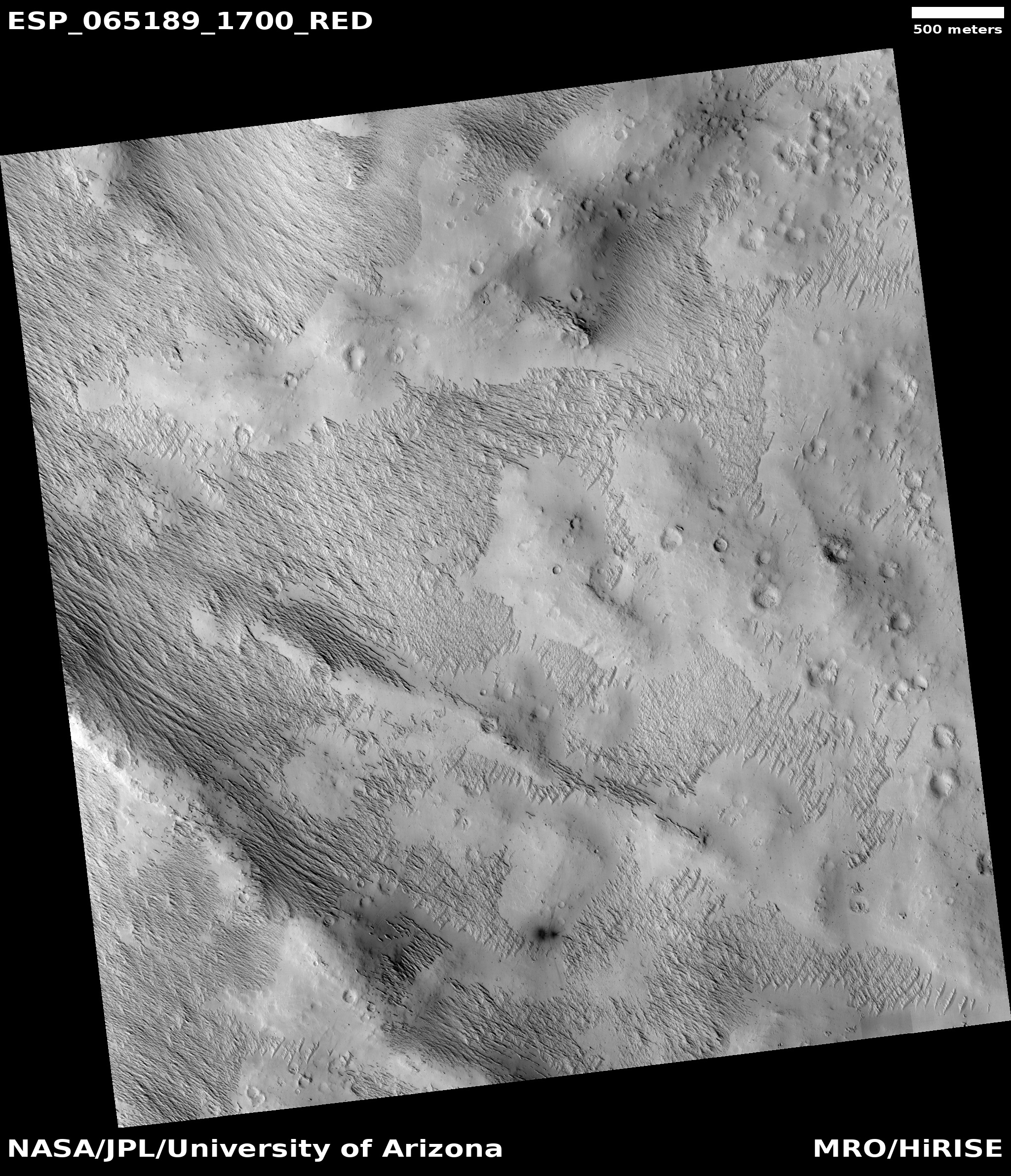
Click for full image.
The image to the right, cropped to post here, is a captioned photo from the high resolution camera on Mars Reconnaissance orbiter and released today. From the caption:
The black spots [recent impacts] form because the craters exposed cleaner materials in the subsurface beneath the bright, dusty surface.
Our image is also interesting because the surface has a criss-cross pattern formed by wind activity. Bright ripples that are oriented from the upper right to the lower left are perpendicular to the wind flow. In contrast, outcrops that have been eroded by the wind are oriented perpendicular to the ripples to produce the criss-cross pattern we now observe.
The overview map below might also help explain this criss-cross pattern.
» Read more

Click for full image.
In this case the donut is a crater dubbed Bell E Crater, with a second concentric rim in its interior. The photo to the right, reduced to post here, was taken by Lunar Reconnaissance Orbiter (LRO) as part of its high resolution survey of the entire Moon. As noted at the first link:
Craters not only vary in shape but also in complexity. There are simple craters and complex craters with ring structures and mountains at the center. Somewhere in between is Bell E, a small crater located within the larger Bell crater. These donut-shaped formations are commonly known as concentric craters. Many questions remain on the origin of donut craters. While there have been several ideas about their origin, including double impacts, the currently favored hypotheses involve volcanic processes and compositional variations.
The article outlines four hypotheses for explaining this crater’s formation, a perfectly aligned double impact, ripples at impact into thick warm lava, layers of different densities, and later volcanic activity. None do a good job of explaining all of the concentric craters found on the Moon, and thus suggest that these craters might have formed from some combination of more than one theory.
Embedded below the fold in two parts.
» Read more
Of the two launches scheduled for tonight, Northrop Grumman’s Antares rocket was the only one to launch, lifting off on schedule at 9:16 pm (Eastern). This was the company’s third launch this year.
SpaceX’s launch however aborted at T-2 seconds. No word on why the rocket’s computer’s shut down, or when they will reschedule.
The leaders in the 2020 launch race remain unchanged:
25 China
15 SpaceX
10 Russia
4 ULA
4 Europe (Arianespace)
The Antares launch however puts the U.S. back into a tie with China, 25-25, in the national rankings.
The Michigan Supreme Court today struck down the endless number of arbitrary lock down orders imposed by Democratic governor Gretchen Witmer, stating that her actions were “an unlawful delegation of legislative power to the executive branch in violation of the Michigan Constitution.”
In a 4-3 ruling, the court determined the governor did not have the authority under state law to issue any additional emergency declarations pertaining to the pandemic after April 30. That was the last date when the legislature allowed the governor to declare an emergency.
Whitmer has relied on an interpretation of an emergency powers law passed in 1945 and the Emergency Powers Act of 1976 to issue a litany of executive orders related to the pandemic. The orders mandated the closure of businesses and restricted the number of people allowed to gather at events, all in the name of safety and preventing the spread of coronavirus.
Everyone whose businesses were damaged or lost their job because of her illegal actions should sue Witmer personally. This abuse of power should cost her, in the hope that other governors down the road will think twice before trying the same thing.
The numerous launch scrubs this past week has created an unprecedented situation tonight, two orbital launches scheduled only 27 minutes apart from two different East Coast spaceports.
First Northrop Grumman will try again to launch its Cygnus cargo freighter to ISS from Wallops Island, Virginia, with the launch scheduled for 9:12 pm (Eastern). The first launch attempt last night was aborted 2:21 seconds before liftoff “after receiving off-nominal data from ground support equipment.”
Second, SpaceX will try to launch two Air Force GPS satellites from Cape Canaveral, Florida, with the launch scheduled for 9:43 pm (Eastern). This launch has been delayed several times because of the repeated launch scrubs of ULA’s Delta 4 Heavy rocket, attempting to launch a military reconnaissance satellite. ULA’s launch had priority for the range, but with it delayed due to the investigation over the T-7 second launch abort on September 30th, the SpaceX’s GPS launch moves up in line.
The first will be live streamed on NASA TV, the second by SpaceX. I have embedded the live streams for both below the fold.
» Read more