Today’s blacklisted American: Book touting Judeo-Christian values blacklisted from libraries

Kirk Cameron, blacklisted

They’re coming for you next: Librarians across America — the same ones running drag queen storybook hours with little kids — are routinely blacklisting television actor Kirk Cameron from doing his own library event reading his own book, As You Grow, because it tries to teach children traditional Judeo-Christian values.

It is common for community libraries to run story-hour programs for kids and parents that correspond with the release of a new book. In recent years, libraries have come under fire for promoting drag queens and other LGBTQ+ centric story hours for young children. It now appears to be the case that those same libraries, which are largely funded by taxpayers, have decided there is no space in their programming lineups for more traditional and faith-based titles.

Cameron’s book, As You Grow, ‘teaches biblical wisdom and the value of producing the fruit of the spirit: love, joy, peace, patience, kindness, goodness, gentleness, faithfulness, self-control,’ according to the author.

You can buy Cameron’s book here.
» Read more

10 comments

Curiosity looks down Gediz Vallis

Curiosity's looks down Gediz Vallis
Click for original image.

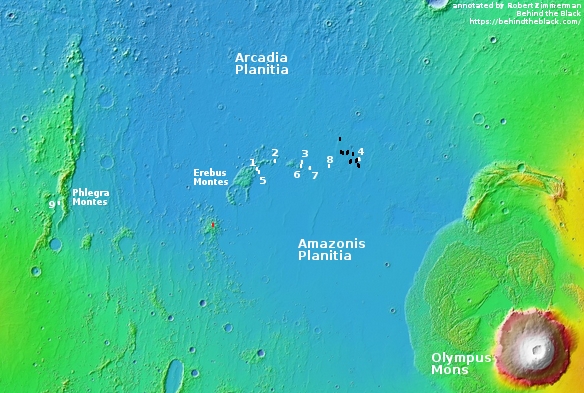
Overview map
Click for interactive map.

The panorama above was taken by Curiosity’s right navigation camera today, December 14, 2022, looking down into Gediz Vallis, the giant slot canyon that the rover will use as its route up Mount Sharp.

The red dotted lines above and on the overview map to the right indicate approximately the planned route for Curiosity. The yellow lines indicate the approximate area covered by the panorama above.

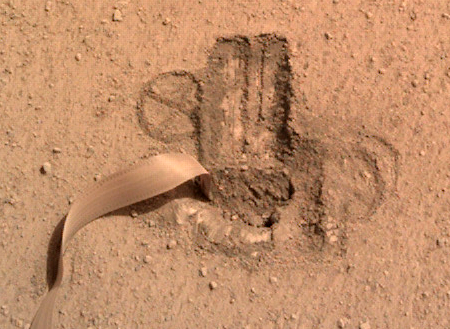
At present the scientists are attempting to drill into the marker band on which Curiosity sits. This marker layer is visible at many places at about the same elevation on all sides of Mount Sharp’s flanks. The white arrows indicate other examples of it in this overview map. It generally appears smooth and flat, which suggests it is made of a harder substance more resistant to erosion. That hardness was confirmed when Curiosity’s first drill attempt into it last week failed. The scientists are now trying again.

0 comments

Juno snaps heat image of Jupiter’s volcano-covered moon Io

Io's volcanoes
Click for full image.

The image to the right, cropped and reduced to post here, was taken on July 5, 2022 by one of the infrared instruments on the Jupiter orbiter Juno of the moon Io, known for having many many active volcanoes.

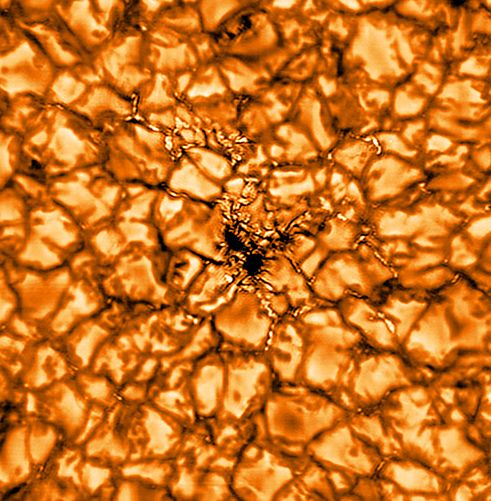
This infrared image was derived from data collected by the Jovian Infrared Auroral Mapper (JIRAM) instrument aboard Juno. In this image, the brighter the color the higher the temperature recorded by JIRAM.

Each bright spot is an active volcano, some of which have been in the past photographed during eruptions. In fact, the first such photo was taken in March 1979 by the Voyager-1 spacecraft just after its fly-by of Jupiter, and was the first time any active volcano outside of Earth had ever been identified.

What made that discovery more profound was that only a week earlier scientists had published a paper predicting active volcanoes on Io, caused by the strong tidal forces from Jupiter’s gravity.

Since then planetary scientists have been studying Io’s volcanism repeatedly, tracking the evolution of specific volcanoes over time as they erupt and then become dormant.

1 comment

Space Force and South Korea set up joint office to monitor North Korea

The U.S. Space Force has now partnered with a new South Korean Air Force space division to jointly monitor the space-based and military actions of North Korea, including its increasingly aggressive missile testing program.

From the first link:

[Brig. Gen. Anthony Mastalir, commander of the U.S. Space Forces Indo-Pacific.] later told reporters the unit will undergo analysis in the coming months to assess its mission capabilities and said it is interested in holding discussions with South Korea regarding specific future missions, like missile warning and defense.

The new unit is expected to help monitor, detect and trace projectiles from the North and elsewhere in an operation likely to reinforce overall deterrence capabilities of the South Korea-U.S. alliance, observers said.

This new office really isn’t anything new, simply the renaming and reshuffling of the military bureaucracy from the American Air Force to the Space Force. The military has been present in South Korea since the Korean War in the early 1950s, monitoring North Korea. All that has really changed is North Korea’s growing ability to launch missiles, thus changing the focus of that monitoring, combined with South Korea’s recent effort to accelerate its own space effort, both civilian and military.

0 comments

NASA, Boeing, and the UAE negotiating partnership for building Lunar Gateway airlock

According to press reports in the United Arab Emirates (UAE), that country is negotiating with NASA and Boeing on a partnership to build an airlock module for NASA’s Lunar Gateway Moon space station.

US aerospace company Boeing said it has held discussions with Emirates officials about the UAE providing an airlock module on the Lunar Gateway. This is an airtight room that astronauts would use to enter and exit the space station.

John Mulholland, vice president and International Space Station programme manager at Boeing, told The National that the company was “actively working” with the UAE on the concept and design.

It appears the UAE is offering to pay Boeing to build it for NASA, and would expect in exchange a larger share in the use of the station.

If this deal works out, the UAE will essentially replace Russia as a Gateway partner. Russia had signed an agreement with NASA in 2017 to build that airlock, but that deal is now null and void following the Russian invasion of the Ukraine and its desire to partner with China instead.

For the U.S., this is a win-win, since it will now be an American company building the airlock, not Russia.

3 comments

Rwanda and Nigeria to sign Artemis Accords

Rwanda and Nigeria have become the first two African nations to sign te Artemis Accords, bringing the number of signatories to this American-led alliance to 23.

Neither Nigerian nor Rwandan officials described in detail any plans to participate in Artemis at the signing ceremony, but at the Secure World Foundation event, a State Department official said that is not a condition for signing the Accords.

“We continue to encourage all responsible spacefaring nations to sign the Accords, and we also encourage countries that are just developing their space sector to also consider signing,” said Kristina Leszczak of the State Department’s Office of Space Affairs. “We stress that interested countries do not need to come to the table with existing space capabilities or even near-term plans to contribute to Artemis. We find this opens the conversation up to a much more diverse group.”

The full list of signatories so far: Australia, Bahrain, Brazil, Canada, Columbia, France, Israel, Italy, Japan, Luxembourg, Mexico, New Zealand, Nigeria, Poland, Romania, Rwanda, Saudi Arabia, Singapore, South Korea, the United Kingdom, the United Arab Emirates, the Ukraine, and the United States.

The accords, bi-lateral agreements between each nation and the U.S., were designed during the Trump administration to emphasize the rights of private investors in space and thus do an end-around of the Outer Space Treaty. Under the Biden administration it is no longer clear if that remains the goal. The existence of a signed alliance led by the U.S. and the capitalistic west however gives the U.S. the political force to protect those rights, assuming the American government is interested in the future in doing so.

4 comments

Hakuto-R sends first image back to Earth

Hakuto-R's first released images
Go here and here for original images.

The private Hakuto-R lunar lander, owned and built by the Japanese-based company Ispace, is operating as planned and has sent back its first images from two different cameras.

The larger image to the right was taken by a camera on one of Canada’s payloads. It shows the Earth two minutes after launch, with the rocket’s upper stage acting as a frame. The inset, reduced to insert here, was taken 19 hours after launch by the lander’s main camera, and shows the Earth at night. Both images demonstrate that the spacecraft is stable and functioning perfectly.

The goals of the mission remain mostly engineering. Its focus is demonstrating first that Ispace’s lander can do what it says so that future customers will be confident buying payload space. Similarly, the payloads, such as the UAE’s Rashid rover, are doing the same thing.

0 comments

Ariane 5 successfully launches three satellites

Arianespace’s Ariane 5 rocket successfully launched two communications satellites plus a weather satellite today, leaving that rocket only two more launches left before it is permanently retired.

As this was only the fifth successful launch this year by Arianespace (representing Europe), the leader board in the 2022 launch race remains unchanged:

58 China
56 SpaceX
21 Russia
9 Rocket Lab
8 ULA

The U.S. still leads China 80 to 58 in the national rankings, but now trails the entire world combined 90 to 80.

0 comments

December 13, 2022 Quick space links

Courtesy of BtB’s stringer Jay.

  • NASA begins testing of more SLS rocket engines
  • This story is certainly connected to the decision to buy more SLS’s from Boeing. The new rockets however won’t launch for years, so I suspect this testing is partly an effort to justify the high cost of SLS.


1 comment

The featureless volcanic ash plains of Mars

The featureless volcanic ash plains of Mars

Cool image time! The photo to the right, cropped, reduced, and sharpened to post here, was taken on September 10, 2022 by the high resolution camera on Mars Reconnaissance Orbiter (MRO). It shows what appears to be a relatively featureless plain with a surface resembling stucco.

At -9 degrees south latitude, this is in the Martian dry equatorial regions. No ice or glaciers here. However, the consistent orientation of the knobs and hills suggest dunes and sand blown by prevailing winds, and that guess holds some truth. This location is deep within the Medusae Fossae Formation, the largest volcanic ash deposit on Mars, covering an area about as big as India, and believed to be the source of most of the red planet’s dust.

We are thus looking at thick layer of ash, its surface shaped over eons by the winds of Mars’ thin atmosphere.
» Read more

1 comment

Today’s blacklisted Americans: Archaeologists go underground to practice their research

What modern academia demands from teachers, researchers, and students
Mindless conforming robots: What today’s leftist academia demands

The modern dark age: In order to do their archaeological research free from the Marxist and bigotry tropes now required in academia — or else be blacklisted — many young archaeologists are now going underground, forming anonymous chat groups to discuss their work safe from blacklisting.

The essay at the link first outlines in detail the oppressive leftist culture that now makes honest and open scientific research difficult if not impossible among our intellectual class. Dare to say or write anything that even suggests some cultures are different or better than others and you will be ostracized so quickly you won’t know what happened to you.
» Read more

12 comments

Research: Those who get the jab are intolerant and eager to discriminate

According to a new peer-reviewed research paper in Nature that studied more than 15,000 people in 21 countries, those who chose to get COVID shots are strongly intolerant of those who have not, and express that intolerance with an eagerness to deny others their human rights.

The research found that vaccinated people express discriminatory attitudes towards individuals who are unvaccinated at levels as high as or higher than discriminatory attitudes directed towards other common targets of prejudice, such as immigrant populations or people who struggle with drug addiction. On the whole, this prejudice tends to be one-sided; only in the USA and Germany do the authors find that unvaccinated individuals feel some antipathy towards those who are vaccinated, although no statistical evidence of negative stereotyping or exclusionary attitudes towards these latter individuals were observed. Researchers also found evidence in support of discriminatory attitudes against the unvaccinated in all countries except Hungary and Romania and find that discriminatory attitudes are more strongly expressed in cultures with stronger cooperative norms.

You can read the paper here.

I can guess that the higher level of anger by the unjabbed to the jabbed in the U.S. is directly because the discrimination and intolerance imposed by the jabbed, such as Joe Biden’s shot mandates, violated what Americans consider their fundamental Constitutional rights. Who wouldn’t be hostile to someone who illegally cost you your job, your career, or even all your social contacts, because you didn’t want to get a COVID shot?

The study however is in general very depressing, because it tells us that the open-mindedness and toleration that was the hallmark of western civilization is largely gone. The future, built by the intolerant attitudes of today’s majority populations, will be a vicious and narrow-minded place.

5 comments
1 530 531 532 533 534 2,413