April 10, 2017 Zimmerman/Batchelor podcast
Embedded below the fold. I like John Batchelor’s title for this podcast: “Capitalism in space means cheaper, faster, better, cheapest.
» Read more
Very brief descriptions, with appropriate links, of current or recent news items.
Embedded below the fold. I like John Batchelor’s title for this podcast: “Capitalism in space means cheaper, faster, better, cheapest.
» Read more
On April 3, while I was in the Grand Canyon, NOAA posted its monthly update of the solar cycle, covering sunspot activity for March. As I have been doing every month since 2010, I am posting it here with annotations to give it context.
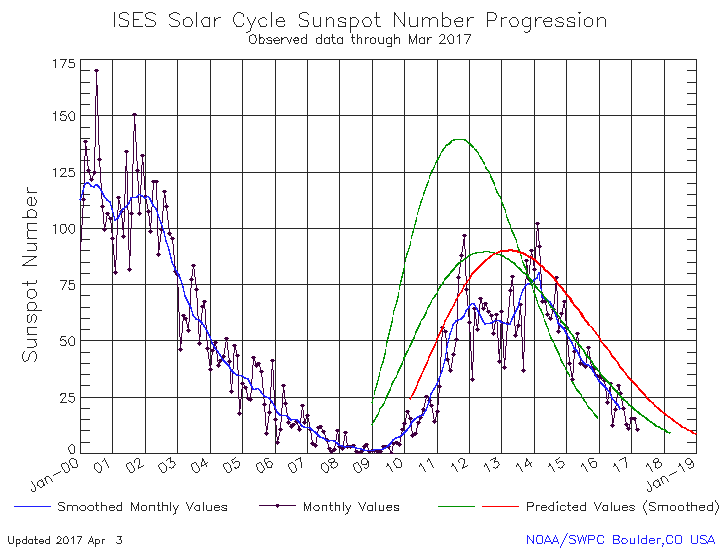
The graph above has been modified to show the predictions of the solar science community. The green curves show the community’s two original predictions from April 2007, with half the scientists predicting a very strong maximum and half predicting a weak one. The red curve is their revised May 2009 prediction.
The decline in sunspots continues to run below predictions, suggesting an end to this solar cycle and a solar minimum as early as sometime in 2018. And as I noted in my February update, sunspot activity continues to track the Sun’s 27 day rotation, alternating every two weeks between blank and active hemispheres. We had the longest stretch, more than two weeks, without sunspots in March. This was followed by about two weeks of activity, followed by several blank days and a relatively inactive Sun at present, beginning a little less than a week ago. I expect this period of inactivity to last another ten days or so, and then things will pick up again.
Where’s my safe space? A California professor from Fresno State University has repeatedly called for the assassination of Donald Trump as well as the execution of Republicans.
This professor, Lars Maischak, has said “Trump must hang” and has called for “the execution of two Republicans for each deported immigrant.”
Not surprisingly, a preliminary investigation into his statements by the university has found them to be acceptable as they were done in his capacity as a private citizen.
Notice how nothing bad ever happens to leftwing academics who espouse violence and the murder of their political opponents. Even if you were to make believe these kinds of statements are protected under the first amendment (which they are not), they are clearly immoral and unacceptable in a civilized society. Yet, the intellectual academic community does nothing to protest.
And what happened to Obama’s demand for civility? It sure appears that it was only being applied to conservatives, while allowing leftists to act out the most violent behavior undeterred by anyone.
In another indication that the Trump administration is going to completely reshape the U.S.’s environmental policy, Energy Secretary Rick Perry refused to sign a statement issued during the G7 meeting in Italy endorsing the Paris climate treaty.
Secretary of Energy Rick Perry said the U.S. “is in the process of reviewing many of its policies and reserves its position on this issue, which will be communicated at a future date,” Italy’s industry and energy minister Carlo Calenda said in a statement. Calenda said other G7 members “reaffirmed their commitment towards the implementation of the Paris Agreement to effectively limit the increase in global temperature well below 2°C above pre-industrial level.”
The Trump administration would not sign onto a statement mentioning Paris, since the president is still deciding whether or not to keep his campaign pledge. Perry also wanted the G7 to include support for coal and natural gas in its statement. “Therefore, we believe it is wise for countries to use and pursue highly efficient energy resources,” Perry said in a statement after his meeting in Rome with energy ministers from Canada, France, Germany, Italy, Japan, the UK and the European Union.
Under pressure from the Trump administration to do something about North Korea’s out-of-control and aggressive nuclear and missile program, China has worked out an agreement with South Korea to take “strong action”.
It remains a question how serious this response will be, but it is also the first sign in a long time that China is finally taking the threat from North Korea seriously.
Update: China refuses acceptance of coal from a fleet of North Korean ships.
This new story confirms that China was serious about this ban when it announced it in February. Set to run to at least the end of this year, the loss of income to North Korea, very poor already, should have some influence there. Whether good or bad, however, remains unknown. One cannot expect irrational and mad individuals holding great power to come to rational conclusions.
The new colonial movement: A draft bill to create a Turkish space agency has been introduced in that country’s parliament.
The Turkish Space Agency, according to the draft bill, will also be in charge of coordinating, managing, and operating all satellite requirements, design, manufacture, launch, and operations in Turkey, as well as coordinating private Turkish industries towards those goals. Jane’s Defence Weekly reports that the draft bill for the Turkish Space Agency has previously been held up for years due to a dispute between the Turkish military and several Turkish administrations as to who should be the lead within the agency. The draft bill in front of parliament suggests that the military have lost that argument, doubtless because of the aftermath of the July 2016 attempted coup, and instead it will take the lead on technical issues rather than policy and strategy.
Capitalism in space: The stock of the Italian rocket engine company Avio jumped 11 percent in value on its first day of public trading.
The company is the prime contractor for Arianespace’s Vega rocket, and is also making engines and parts for the new Ariane 6 rocket being built by Airbus-Safran.
Capitalism in space: In an effort to reduce costs and increase efficiency Aerojet Rocketdyne is cutting approximately 300 jobs while closing facilities in California and Virginia.
Rancho Cordova’s nearly 70-year run as a hub of the aerospace industry will soon end. On Monday, Aerojet Rocketdyne Inc. announced that it would relocate or eliminate about 1,100 of its 1,400 local jobs over the next 2 1/2 years and shut down manufacturing operations in the area. The company also said it would close its facility in Gainesville, Va.
Rocket engine manufacturing will be consolidated in a new plant in Huntsville, Ala. In all, 800 jobs will be added in Huntsville by the end of 2018.
The company is faced with stiff competition from Blue Origin and others, and until now has resisted changing its methods of operation, which in the past relied on generous government contracts that were uninterested in lowering costs. That world appears to be ending, and so it appears that the Aeroject Rocketdyne is finally changing as well. This is a good thing, as it increases the chances that the company will survive.
In reviewing data for the past fifteen years have scientists have identified an unexpected cold region in Jupiter’s upper mid-latitudes as large as the Great Red Spot.
“The Great Cold Spot is much more volatile than the slowly changing Great Red Spot, changing dramatically in shape and size over only a few days and weeks, but it has re-appeared for as long as we have data to search for it, for over 15 years,” Stallard said. “That suggests that it continually reforms itself, and as a result it might be as old as the aurorae that form it – perhaps many thousands of years old.”
The Great Cold Spot is thought to be caused by the effects of the magnetic field of the planet, with the massive planet’s spectacular polar aurorae driving energy into the atmosphere in the form of heat flowing around the planet.
Though they think the cold region is related to the aurora, I suspect they really do not have enough information to really understand what is going on.
The new colonial movement: The Swedish Institute of Physics has completed construction and delivered a science instrument to be flown on China’s Chang’e 4 spacecraft that will bring an orbiter, lander, and rover to the Moon’s far side in 2018.
The instrument will be installed on the rover, and will study the surface and how it interacts with the solar wind. This will also be a continuation of research performed by India’s Chandayaan-1 orbiter.
The New Horizons science and engineering team has placed the spacecraft back in hibernation mode for the first time since prior to its fly-by of Pluto in 2014.
During hibernation mode, much of the New Horizons spacecraft is unpowered. The onboard flight computer monitors system health and broadcasts a weekly beacon-status tone back to Earth, and about once a month sends home data on spacecraft health and safety. Onboard sequences sent in advance by mission controllers will eventually wake New Horizons to check out critical systems, gather new Kuiper Belt science data, and perform course corrections (if necessary).
This hibernation period will last until September, when they will wake the spacecraft so that they can make a mid-course correction in preparation for the January 1, 2019 flyby of Kuiper Belt Object 2014 MU69.
A large archive of Canadian ice cores has been lost, melting when the freezer they were stored in failed.
The 2 April failure left “pools of water all over the floor and steam in the room,” UA glaciologist Martin Sharp told ScienceInsider. “It was like a changing room in a swimming pool.” The melted cores represented 12.8% of the collection, which held 1408 samples taken from across the Canadian Arctic. The cores hold air bubbles, dust grains, pollen, and other evidence that can provide crucial information about past climates and environments, and inform predictions about the future.
The storage facility is normally chilled to –37°C. But the equipment failure allowed temperatures to rise to 40°C, melting tens of thousands of years of history. Among the losses: some of the oldest ice cores from Mount Logan, a 5595-meter-high mountain in northern Canada. “We only lost 15 meters [of core], but because it was from the bottom of the core, that’s 16,000 years out of the 17,700 years that was originally represented,” Sharp says.
Scientists also lost 66 meters of core from Baffin Island’s Penny Ice Cap, which accounts for 22,000 years—a quarter of the record. That leaves “a gap for the oldest part, which is really the last glaciation before the warming that brought us into the present interglacial,” Sharp says.
Considering the cost and difficulty of drilling these cores, and then safely bringing them to the facility without melting, it seems to me astonishing that the facility did not have back-up freezer capability.
A Russian Soyuz capsule safely returned three astronauts to Earth this morning.
This completes the second flight of the Soyuz-MS upgraded capsule.
The new MS series sports more efficient solar panels, a new Kurs NA approach and docking system weighing less than half that of its predecessor, additional micro-meteoroid debris shielding, and a modified docking and attitude control engine – which will add redundancy during docking and deorbit burns.
Russian cosmonaut Georgy Grechko died today at the age of 85.
Grechko was one of the Soviet Union’s most important early cosmonauts, flying some of the first long term missions on several of Russia’s early Salyut stations. He was also important in that in the first real elections run by the Soviet Union he ran for office against party officials, won, and helped throw the Communists out of power.
I met and interviewed Grechko when I was writing Leaving Earth. He struck me as a kind and intelligent person, exactly the kind of person you’d want in charge, and who rarely gets that chance. Russia is diminished by his passing.
Our government in action! An Idaho solar panel project that cost $4.3 million (so far) only produces enough energy per day to run one microwave.
On March 29th, the solar road panels generated 0.26 kWh, or less electricity than a single plasma television consumes. On March 31st, the panels generated 1.06 kWh, enough to barely power a single microwave. The panels have been under-performing their expectations due to design flaws, but even if they had worked perfectly they’d have only powered a single water fountain and the lights in a nearby restroom.
Solar FREAKIN’ Roadways has been in development for 6.5 years and received a total of $4.3 million in funding to generate 90 cents worth of electricity.
Obviously, none of this matters. The people who created the project care, and that’s what counts!
Fascists: An angry mob of around 250 at Claremont McKenna College blocked access to a speech while threatening violence to the speaker and forcing her to end the speech early.
A throng of angry protesters converged at Claremont McKenna College on Thursday and effectively shut down a pro-police speech as they surrounded the building, forcing the speaker to give the talk via livestream to a near-empty room as they yelled “F*ck the police” and “Black Lives Matter” and banged on windows.
Heather Mac Donald, a Manhattan Institute scholar and author of the 2016 book “The War on Cops,” even gave her talk earlier than originally planned at the preppy and private Southern California campus because of the rowdy crowd estimated at more than 250 protesters, she told The College Fix via email Thursday. Thirty minutes into the speech, police officers told her to cut it short, and she was given a four-officer escort through a side door and safely through some surprised protesters who had flanked that exit, Mac Donald said.
These leftist protesters at all these universities nothing but brown-shirted jack-booted thugs, using violence to silence any dissent to their way of thinking. Worse, it increasingly appears they are going to succeed, as it appears most college administrations and their faculty agree with their violent tactics, while the general public seems uninterested in stopping the oppression being imposed here.
Capitalism in space: In order to compete with SpaceX ULA announced this week that it will cut its launch price for the Atlas 5 rocket by one third.
United Launch Alliance has dropped the price of its workhorse Atlas 5 rocket flights by about one-third in response to mounting competition from rival SpaceX and others, the company’s chief executive said on Tuesday. “We’re seeing that price is even more important than it had been in the past,” Tory Bruno, chief executive of United Launch Alliance, or ULA, said during an interview at the U.S. Space Symposium in Colorado Springs. “We’re dropping the cost of Atlas almost every day. Atlas is now down more than a third in its cost,” Bruno said.
It appears that they have discovered that the prime reason they lost their bid of an Air Force GPS satellite launch to SpaceX was because their price was too high.
Capitalism in space: The head of the Air Force’s space division said yesterday that they would be willing to launch satellites using Falcon 9 used first stages.
“I would be comfortable if we were to fly on a reused booster,” General John “Jay” Raymond told reporters at the U.S. Space Symposium in Colorado Springs. “They’ve proven they can do it. … It’s going to get us to lower cost.”
After being promoted on an Australian tv show an effort to use public help to plow through Kepler’s vast archives discovered four new exoplanets within two days.
In three days, the Australia iteration of astronomy TV show Stargazing Live brought us #SpaceGandalf and now its viewers have discovered four planets. After it was promoted on the show, citizen scientists and fans of the program came together to contribute to a crowd-sourcing project, stalking around 100,000 stars on the Zooniverse website, which displays recent data from the Kepler Space Telescope.
And you betcha, in just 48 hours, around 10,000 volunteers discovered scores of potential new planet candidates, with scientists confirming the discovery of four “super-Earth” planets orbiting a star in the constellation of Aquarius.
Worlds without end: Astronomers have detected an atmosphere around an Earth-sized exoplanet 39 light years away.
The researchers pored over measurements from the European Southern Observatory in Chile and found that at one wavelength band of light, the planet looked larger than at others, as it crossed the face of its parent star. “These things don’t pop up in the way you expect,” said John Southworth, an astronomer at Keele University in the UK. “We found evidence for the atmosphere at one wavelength band and that wasn’t what we were expecting.”
The observations point to an atmosphere that is rich in water or methane, but it will take more measurements with other telescopes to identify the chemicals present.
The planet is about 16% larger than Earth. There remain a lot of uncertainty here with this result, so we should not yet take it too seriously.