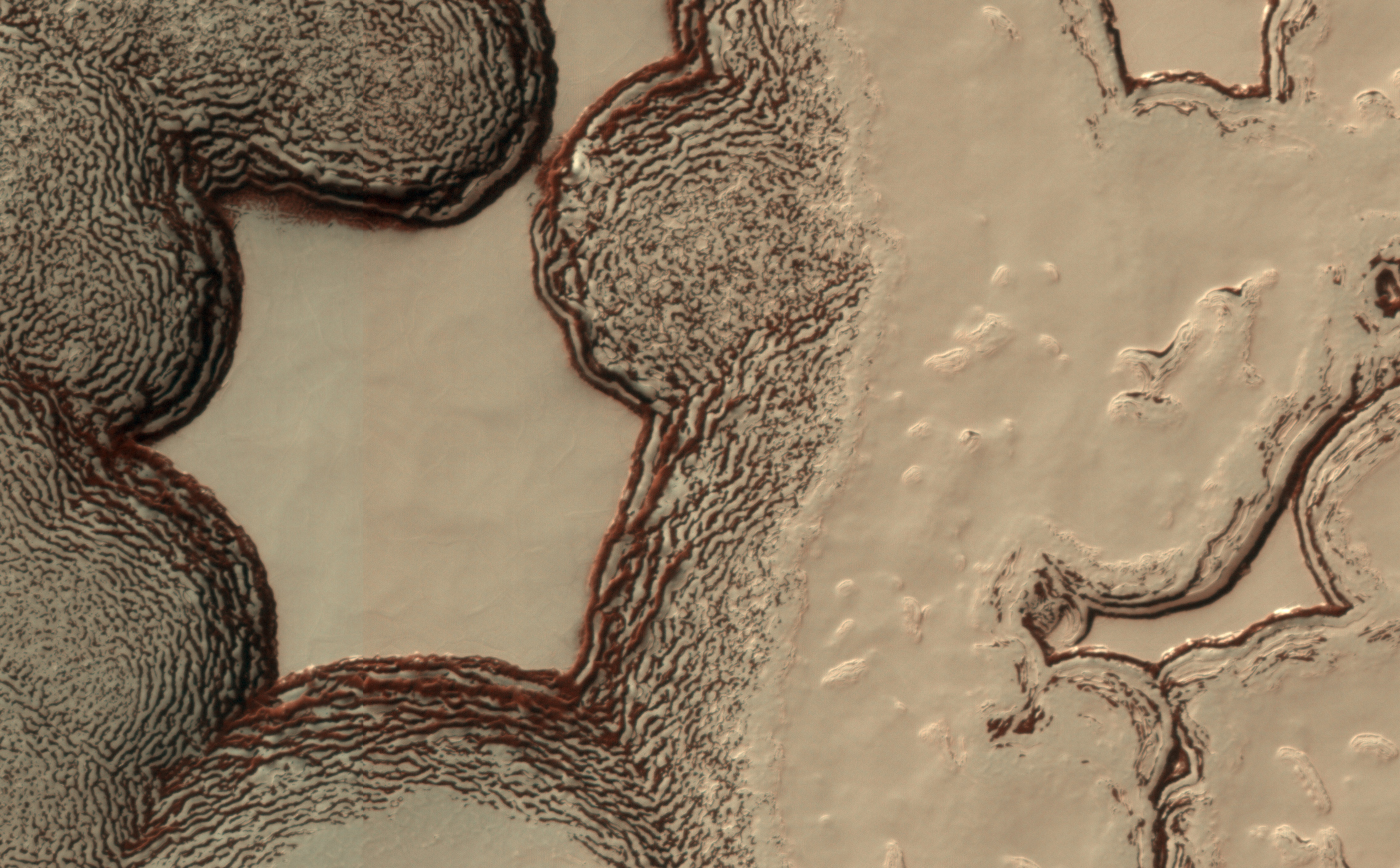
Large glacier-filled crater/depression on Mars?

Glacier-filled depression?
Click for full image.

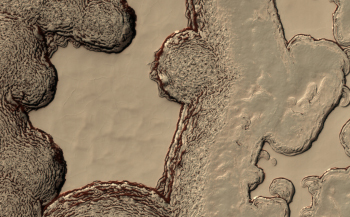
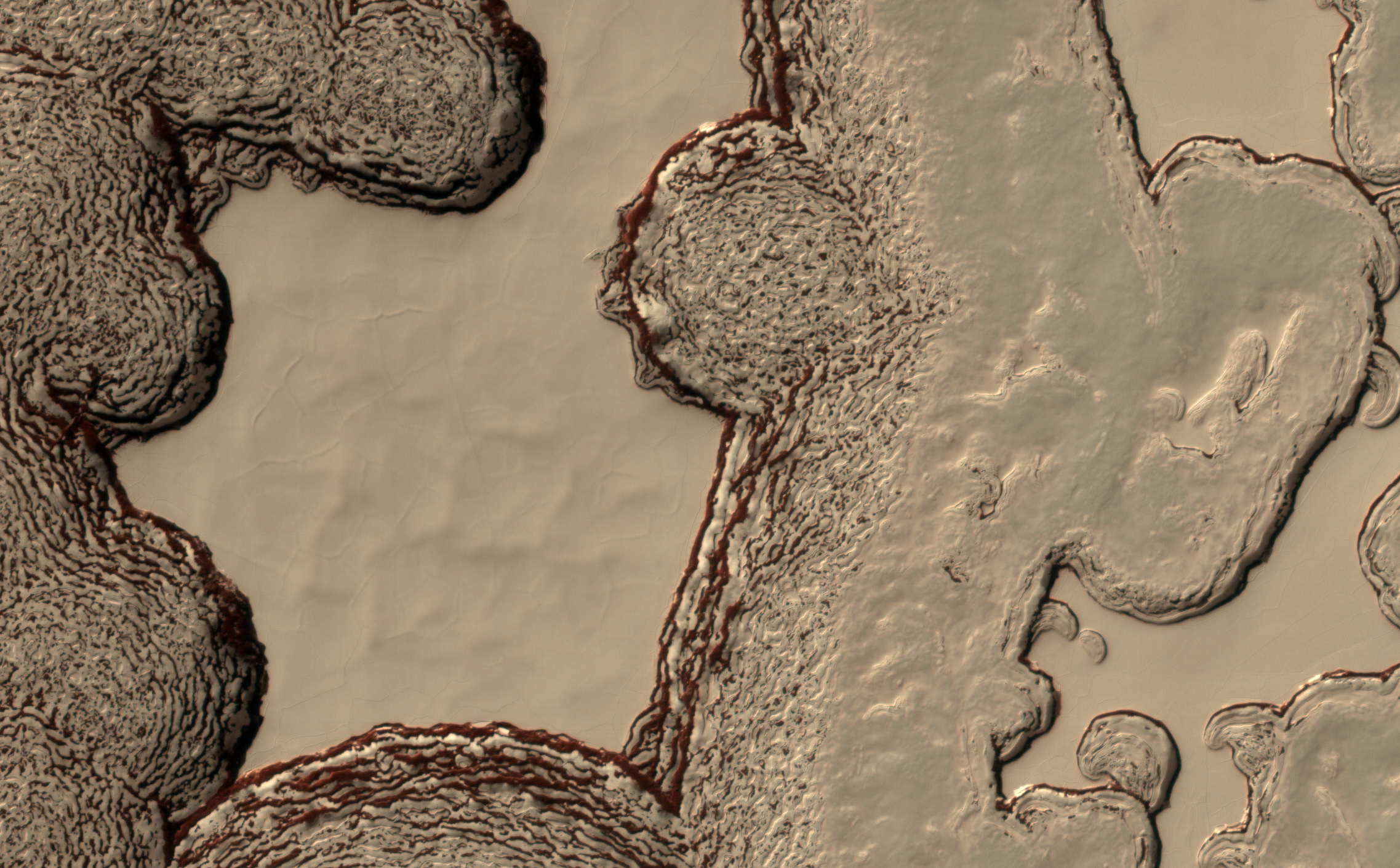
Cool image time! The photograph on the right, rotated, cropped, and reduced to post here, was taken by the high resolution camera on Mars Reconnaissance Orbiter (MRO) on December 21, 2019. It shows the eastern half of the floor and interior rim of a large squarish-shaped crater or depression in what seems to be an unnamed region of chaos terrain located in the transition zone between the Martian southern highlands and the northern lowland plains.

The floor of this depression has many of the features that indicate the presence of a buried ice glacier, including flow features on the depression floor, linear parallel grooves, and repeating moraine features at the slope base. In fact, all these features give the strong impression that this crater is ice-filled, to an unknown depth.

Chaos terrain, a jumble of mesas cut by straight canyons, are generally found in this transition zone, and could be an erosion feature produced by the intermittent ocean that some believe once existed in the northern lowlands. Whether or not an ocean lapped against these mesas and created them, this chaos terrain is believed to have been caused by some form of erosion, either wind, water, or ice.

Wide context view

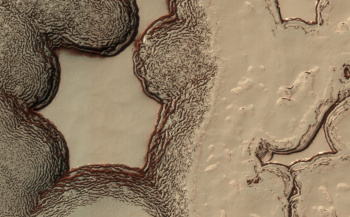
The location is of this chaos terrain in that transition zone is illustrated by the context map to the right. It sits on the edge of the vast Utopia Basin, one of the largest and deepest northern lowland plains. It also sits several hundred miles due north of the planned landing site of the Mars2020 rover in Jezero Crater. There is a lot of chaos terrain in this region, with lots of evidence of buried glaciers flowing off the sides of mesas.

Today’s image, with its numerous features suggesting the presence of a buried glacier filling the depression, reinforces this evidence.

Closer context view, showing the chaos terrain region

What impresses me most about this particular depression — should it be ice-filled — is its size. I estimate from the scale of the image that the depression is about six miles across, somewhat comparable though slightly smaller than the width of the Grand Canyon. And yet, unlike the Canyon it appears to have a wide flat floor across its entire width. The second context map to the right zooms in on this chaos region to show how relatively large the depression is. It would not be hard to spot it from orbit. We don’t know the depth, but even if relatively shallow this depression still holds a heck of a lot of water ice.

While the depression appears like a crater in lower resolution wider photographs, higher resolution images suggest it is not round but squarish. Why is not clear, and unfortunately MRO’s high resolution camera has taken no other images of it. This image was also one of their terrain sample photographs, taken not because of any specific research request, but because they need to use the camera regularly to maintain its temperature. This location, having few previous images, fit this schedule and made sense photographing.

Thus, no one appears to be specifically studying this location, making it a ripe subject for some postdoc student who wants to put their name on some Martian geology.

0 comments

Dragon capsule for first manned mission shipped to Florida

Capitalism in space: SpaceX yesterday shipped to Florida the Dragon capsule it will use for its first manned mission, now set for sometime between April and June.

No official word yet on any specific launch date, though there are reports that they are targeting May 7.

In that same story at the second link a NASA official admitted that one of the big issues is filling out the paperwork.

“Even though it sounds mundane, there is a load of paper that has to be verified, and signed off, and checked to make sure we’ve got everything closed out,” [said chief of human spaceflight Doug Loverro.] “It is probably one of the longest things in the tent to go ahead and do. It’s underappreciated but critically important. You’ve got to make sure you’ve done everything you need to do along the way.”

Properly documenting what you are doing is always essential, but if you over do it you raise costs unnecessarily while simultaneously delaying things. And isn’t it interesting that both of these issues — budget overruns and scheduling delays — have been systemic on all of NASA’s projects for decades?

Furthermore, while good documentation can help prevent problems and help you figure out what went wrong, when things go wrong, doing more of it will not further reduce problems or failures. If anything, too much paperwork will likely increase mistakes by focusing workers on the wrong things. This seems to be one of NASA’s problems in recent years.

Regardless, it does look like that first privately built launch will happen in mere months. The one decision remaining that could legitimately delay it would be if NASA decides to make it a longer mission, requiring more training for its astronauts.

12 comments

A baffling repeating fast radio burst

Astronomers are baffled by a fast radio burst, a phenomenon that is a mystery in its own right, that also repeats its bursts in what appears to be a regular pattern.

Researchers looking at data from the Canadian Hydrogen Intensity Mapping Experiment Fast Radio Burst Project (CHIME/FRB) first spotted this FRB, known as FRB 180916.J0158+65, in 2019. In January 2020, they published a paper in the journal Nature that reanalyzed old data and found more than one burst from FRB 180916.J0158+65. They traced this FRB back to a relatively nearby spiral galaxy. What’s new in this latest paper, published Feb. 3 to the arXiv database, is the regular pattern in the bursts. The FRB, they found, goes through four-day cycles of regular activity, bleating out radio waves into space on an almost hourly basis. Then it goes into a 12-day period of silence. Sometimes the source seems to skip its usual four-day awake periods, or lets out only a single burst. CHIME/FRB is able to watch the FRB only some of the time, they noted, so it’s likely the detector misses many FRBs during the awake period.

At present they have no idea what is causing the pattern, other than a realization that it defies all the theories for explaining the previously discovered fast radio bursts.

1 comment

NASA breaks ground on new communications antenna

NASA has broken ground on the construction of the first new communications antenna since 2003 at its Goldstone, Californa, site, one of three the agency maintains worldwide for communicating with its planetary probes.

There has been a desperate need to both expand and upgrade this network, dubbed the Deep Space Network, for years, a need that will grow even more desperate next year with the addition of two more rovers on Mars.

6 comments

The range for exposed ice scarps on Mars keeps growing

Overview of ice scarp locations on Mars

In January 2018 scientists announced the discovery of eight cliffs with visible exposed ice layers in the high mid-latitudes of Mars. At the time, those eight ice scarps were limited to a single crater in the northern hemisphere (Milankovic Crater) and a strip of land in the southern highlands at around latitude 55 degrees south.

In the past two years scientists have been using the high resolution camera on Mars Reconnaissance Orbiter (MRO) to monitor these scarps for changes. So far they have seen none, likely because the changes are below the resolution of the camera.

They have also been able to find more scarps in the southern hemisphere strip beyond that strip at 55 degrees south.

Now they have found more scarps in the northern hemisphere as well, and these are outside Milankovic Crater. As in the south, the new scarps are still all along a latitude strip at about 55 degrees.

The map above shows with the black dots the newer scarps located in the past two years. The scarp to the east of Milankovic Crater is typical of all the other scarps, a steep, pole-facing cliff that seems to be retreating away from the pole..

The scarp to the west of Milankovic Crater is striking in that it is actually a cluster of scarps, all inside a crater in the northern lowland plains. Moreover, these scarps are more indistinct, making them more difficult to identify. According to Colin Dundas of the U.S. Geological Survey’s Astrogeology Science Center in Arizona,
» Read more

1 comment

SpaceX hires Bill Gerstenmaier as consultant

SpaceX has hired NASA’s former manager of its human exploration program, Bill Gerstenmaier, as a consultant working with their “reliability team.”.

It appears that SpaceX wants to take advantage of Gerstenmaier’s expertise on human spaceflight as it is about to begin manned Dragon flights. It also appears that Musk wants to return a favor as well, as Gerstenmaier was likely the main person behind the decision to award SpaceX its initial Dragon cargo contract in December 2008. Musk has said repeatedly that this decision in many ways saved his company.

Overall, a wise decision by SpaceX. In his later years at NASA, Gerstenmaier lost sight of the importance of budget and schedule in his management of SLS and Orion, leading to his ouster. However, his knowledge of human spaceflight and the political mechanics needed to do it with NASA is unsurpassed. SpaceX will definitely benefit from this hire.

7 comments

An update on Comet 2I/Borisov

Link here.

Overall, this second known interstellar object to pass through the solar system appears to be a very typical comet. They have found however that its nucleus is much smaller than at first thought, only 200 to 500 meters across, which means that radiation pressure from the Sun could cause its rotation to spin up, with the possibility that this spin could get fast enough to cause the comet to break up.

The comet made its closest approach to the Sun in December, and will spend the next year-plus flying outward to beyond Saturn.

2 comments

Scientists admit worst case global warming prediction won’t happen

The uncertainty of science: In a commentary published in the science journal Nature last week, a scientist admitted that the worse case global warming prediction, cited more the 2,500 times in the literature and a favorite of politicians and global warming activists, is not likely to happen and should no longer be referenced.

What is surprising here is not the discovery that this climate computer model doesn’t work, but that Nature was willing to publish the admission, and that this scientist, who still fears human-caused global warming, was willing to write it. The major science journals have in recent years taken sides in this scientific field, advocating the theory that increased carbon dioxide will cause the climate to warm, something no journal should ever do.

The article however has this quote that clearly illustrates the uncertainties of all climate predictions:

Scientists are still uncertain as to how sensitive global temperatures are to a doubling of CO2 in the atmosphere. The value, known as the Charney Sensitivity still isn’t known for certain, over 40 years after it was first introduced in 1979 by the United States National Academy of Sciences and chaired by Jule Charney. He estimated climate sensitivity to be 3 °C (5.4 °F), give or take 1.5 °C (2.7 °F).

Without knowing the true climate warming response to increased CO2, essentially all climate models become a crap-shoot. It is a glaring illustration of just how imprecise climate science actually is.

Note that this area of ignorance is only one of many. We don’t know the influence of pollution on the climate. We don’t know the influence of the Sun on the climate. And we don’t know the influence of clouds on the climate. And I could go on.

15 comments

Remnant moraine on Mars

Remnant moraine on Mars
Click for full image.

Cool image time! Using both Martian orbiters and rovers scientists are increasingly convinced that Mars has lots of buried glaciers in its mid-latitudes. These glaciers are presently either inactive or shrinking, their water ice sublimating away as gas, either escaping into space or transporting to the colder poles.

The image to the right, cropped and reduced to post here, shows some apparent proof of this process. Taken by the high resolution camera of Mars Reconnaissance Orbiter (MRO) on December 23, 2019, it shows a weird meandering ridge crossing the floor of a crater. The north and south parts of the crater rim are just beyond the cropped image, so that the gullied slope in the image’s lower left is actually a slope coming down from that rim.

My first reaction upon seeing this image was how much that ridge reminded me of the strange rimstone dams you often find on cave floors, formed when calcite in the water condenses out at the edge of the pond and begins to build up a dam over time.

This Martian ridge was certainly not formed by this process. To get a more accurate explanation, I contacted Dan Berman, senior scientist at the Planetary Science Institute in Arizona, who had requested this image. He explained:
» Read more

1 comment

NASA get boost in Trump proposed budget for 2021

The 2021 budget request by the Trump administration includes a big budget increase for NASA while also proposing major cuts to many of its science programs.

According to the analysis at the second link, the big gainer is Artemis. The losers in astronomy are the space telescope WFIRST and the airborne telescope SOFIA, both of which the administration wants terminated. Also on the chopping block are two climate satellites.

I plan to go through the budget in the next day or so and do my own analysis, which will also provide a longer term context that I guarantee no other news source will do. For example, routinely when most mainstream sources declare a cut in any program, it only means either a reduction in its growth rate, or a reduction to spending levels deemed entirely satisfactory only a few years before. To understand any new budget proposal, you need to look at the long term spending trends.

I will, as I have done in the past, also include more than just NASA in my analysis, reviewing the budget changes for all the science agencies.

I would do this today, but an eye doctor’s appointment this afternoon takes priority.

1 comment

The terrible consequences of NOAA’s data tampering

Link here.

In 2017 Tony Heller broke the story of how NOAA and NASA have been routinely adjusting their historic global temperature records to cool the past and warm the present in order to create the illusion that the climate is warming, far more than it is.

The post by Heller at the link above focuses in on how that tampering, which erased from the temperature data the record-hot year of 1934, is then used by both NOAA and NASA to claim each year for the past decade was the hottest ever.

The raw data however tells a far different story. The raw data from 1934, as reported amply at the time, recorded big heat waves and murderous droughts and extensive dust storms, all far more extreme than anything we have experienced in the past decade. Moreover, that raw data matches well with public news stories, and also matches well with all the published science prior to the 2000s.

Since then, however, intellectual honesty and the real scientific method has been replaced by an agenda-driven political manipulations. Having 1934 be the hottest year ever cannot stand, especially if present temperatures do not exceed that year’s records. Global warming demands a correction!

The nicest interpretation we can give to these adjustments is that the scientists are innocently engaged in confirmation bias. They believe the Earth is warming due to increased carbon dioxide in the atmosphere, and thus they must find evidence of that warming, even if it requires data adjustments to past record-hot years like 1934, adjustments that they then rationalize as necessary and scientifically justified.

More likely, they have decided that their political agenda to prove human-caused global warming requires them to be intellectually dishonest and the falsify the global temperature record. If so, this is a tragedy beyond words, as it signals that the revolution in human thought that began with the Renaissance and Galileo and was reinforced and cemented by the Enlightenment and Francis Bacon, has now ended.

That revolution made possible a burst of human creativity and civilization that lasted more than five hundred years. The consequences for future generations should that revolution be rejected now cannot be good.

18 comments

Martian dust devil!

Martian dust devil!
Click for full image.

Cool image time! The science team for the high resolution camera today posted a new captioned image, cropped by me to the right to post here, showing an active Martian dust devil as it moves across the surface of Mars.

Dust devils are rotating columns of dust that form around low-pressure air pockets, and are common on both Earth and Mars. This Martian dust devil formed on the dust-covered, volcanic plains of Amazonis Planitia. The dust devil is bright, and its core is roughly 50 meters across. The dark streak on the ground behind the dust devil is its shadow. The length of the shadow suggests the plume of rotating dust rises about 650 meters into the atmosphere!

That’s about 2,100 feet tall, almost a half mile in height. The location, Amazonis Planitia, is part of the northern lowlands of Mars, flat and somewhat featureless. It is also somewhat near the region near Erebus Montes that is the candidate landing site for SpaceX’s Starship rocket, a region that appears to have a lot of ice just below the surface.

The science team also linked to a 2012 active dust devil image that was even more spectacular. I have also posted on Behind the Black a number of other dust devil images, highlighting this very active, dramatic, and somewhat mysterious aspect of the Martian surface:
» Read more

3 comments
1 941 942 943 944 945 2,413