Election fraud in Nevada

The testimony embedded below by Jesse Binnall, one of the lawyers for Trump that conducted research into the election in Nevada, is quite shocking if true. He is speaking to the state’s senate’s Homeland Security and Government Committee at a hearing this week.


[Youtube, being a tool of the Democrat Party election machine, has removed the first upload. I have found it elsewhere.]

Part of his testimony is further confirmed by a separate investigation that found almost 4,000 non-citizens voted illegally.

Under a subpoena, the state’s GOP obtained data that showed green card holders and non citizens who had obtained driver’s licenses. From this official data set, the Nevada GOP “compared this detailed information against the county voter records in Nevada” and “discovered that 6,260 non citizens were registered to vote and 3,987 non-citizens had voted.”

The worst aspect of this is that it is consistent with similar stories and evidence in other states. Such allegations must not be ignored or simply dismissed. They must be investigated, hard.

8 comments

An update on the testing of SLS’s core stage

Link here. The article provides more information on the temperature issue that caused the seventh of eight fueling tests of the core stage to abort early.

The temperature issue arose when NASA transferred superchilled liquid oxygen, to fuel the rocket, from a holding facility to the core stage of the SLS. This procedure has been modeled and verified before, Julie Bassler, SLS stages manager at Marshall, told reporters during the same teleconference. But this was the first time the transfer actually took place.

“We were actually just a few degrees different than what we wanted to see coming in,” she continued, but said the temperature must be precise during the initial phases of filling the tank. The requirement is minus 290.57 degrees Fahrenheit (minus 179.21 degrees Celsius.) But the liquid oxygen was slightly cooler, at minus 296.67 degrees Fahrenheit (minus 182.59 degrees Celsius).

“We filled up [the tank] just enough to pass the phase where we knew we weren’t going to be able to get the temperature to a level that was going to be acceptable to meet the requirement, and that’s when they caught us … in the testing,” Bassler continued.

Despite this issue, NASA still hopes to do the last core stage test, dubbed the Green Run, in the last week in December. During that static fire test they will fuel the core stage entirely and then fire its engines for the full duration of an actual launch — almost ten minutes. If all goes well they will then pack up the stage and ship it to Florida for the planned November unmanned test mission sending Orion around the Moon.

They have no schedule margins, however, because all the components of this very expensive and complex rocket need a lot of time to get anything done. The two solid rocket boosters that will be attached to the sides of the core stage only have a twelve month lifespan once assembled, and they are holding off assembling them pending this test. The core stage itself needs two months to be disassembled, and then two months to be reassembled in Florida. And there remain the issue of a failed power unit in the Orion capsule that could take four to twelve months to repair.

The article however had this telling quote, based on comments from a NASA official, about future launch procedures, that sent a chill up my spine:
» Read more

7 comments

Genesis cover

On Christmas Eve 1968 three Americans became the first humans to visit another world. What they did to celebrate was unexpected and profound, and will be remembered throughout all human history. Genesis: the Story of Apollo 8, Robert Zimmerman's classic history of humanity's first journey to another world, tells that story, and it is now available as both an ebook and an audiobook, both with a foreword by Valerie Anders and a new introduction by Robert Zimmerman.

The print edition can be purchased at Amazon or any other book seller. If you want an autographed copy the price is $60 for the hardback and $45 for the paperback, plus $8 shipping for each. Go here for purchasing details. The ebook is available everywhere for $5.99 (before discount) at amazon, or direct from my ebook publisher, ebookit. If you buy it from ebookit you don't support the big tech companies and the author gets a bigger cut much sooner.


The audiobook is also available at all these vendors, and is also free with a 30-day trial membership to Audible.
 

"Not simply about one mission, [Genesis] is also the history of America's quest for the moon... Zimmerman has done a masterful job of tying disparate events together into a solid account of one of America's greatest human triumphs."--San Antonio Express-News

House passes bill that attempts to protect Apollo Moon sites

The House today passed a bill that would require any American business planning a Moon mission to agree to not disturb the Apollo lunar landing sites.

[The bill] requires any federal agency that issues a license to conduct a lunar activity to require the applicant to agree to abide by recommendations in the 2011 NASA report “NASA’s Recommendations to Space-Faring Entities: How to Protect and Preserve the Historic and Scientific Value of U.S. Government Artifacts” and any successor recommendations, guidelines or principles issued by NASA.

All well and good, but this does nothing to stop other nations from touching those sites. Moreover, making all of those sites and whatever the astronauts did there totally sacrosanct is not reasonable. On the later Apollo landings the astronauts used a rover to travel considerable distances. Should every spot the astronauts visited by now considered holy? If anything, scientists will wish to return and gather more data at these locations to better understand the initial Apollo results.

Not that any of this really matters. In the long run the decision on how much these sites should be protected will be made by the people who live on the Moon. I suspect, as pioneers living on the edge of survival, they will have less interest in making memorials to past achievements and be more focused on getting things done, now.

6 comments

India successfully completes second launch in 2020

Using its PSLV rocket India today successfully placed a communications satellite into orbit.

This was only the second launch by India in 2020. At the start of the year ISRO had predicted they would complete as many as twelve launches. Instead, their panic over COVID-19 shut them down.

The leader board for the 2020 launch race presently stands unchanged, though a SpaceX rocket is on the launchpad and might lift-off in the next 90 minutes. [UPDATE: SpaceX has stood down and will try again tomorrow.]

33 China
24 SpaceX
14 Russia
6 ULA
6 Rocket Lab

The U.S. still leads China 39 to 33 in the national rankings.

0 comments

Conscious Choice cover

Now available in hardback and paperback as well as ebook!

From the press release: In this ground-breaking new history of early America, historian Robert Zimmerman not only exposes the lie behind The New York Times 1619 Project that falsely claims slavery is central to the history of the United States, he also provides profound lessons about the nature of human societies, lessons important for Americans today as well as for all future settlers on Mars and elsewhere in space.

 
Conscious Choice: The origins of slavery in America and why it matters today and for our future in outer space, is a riveting page-turning story that documents how slavery slowly became pervasive in the southern British colonies of North America, colonies founded by a people and culture that not only did not allow slavery but in every way were hostile to the practice.  
Conscious Choice does more however. In telling the tragic history of the Virginia colony and the rise of slavery there, Zimmerman lays out the proper path for creating healthy societies in places like the Moon and Mars.


“Zimmerman’s ground-breaking history provides every future generation the basic framework for establishing new societies on other worlds. We would be wise to heed what he says.” —Robert Zubrin, founder of the Mars Society.


All editions are available at Amazon, Barnes & Noble, and all book vendors, with the ebook priced at $5.99 before discount. All editions can also be purchased direct from the ebook publisher, ebookit, in which case you don't support the big tech companies and the author gets a bigger cut much sooner.


Autographed printed copies are also available at discount directly from the author (hardback $29.95; paperback $14.95; Shipping cost for either: $6.00). Just send an email to zimmerman @ nasw dot org.

Chang’e-5 sample return capsule successfully recovered in China

The new colonial movement: The sample return capsule for China’s Chang’e-5 mission, the first to bring lunar samples back to Earth since 1976, has been successfully recovered in the inner Mongolia region of China today.

Chinese officials confirmed the roughly 660-pound (300-kilogram) capsule landed at 12:59 p.m. EST (1759 GMT) Wednesday, or 1:59 a.m. Thursday in Beijing.

Recovery crews dispatched to the remote landing zone converged on the capsule in helicopters and off-road vehicles, traveling across the snow-covered plains of Inner Mongolia in the middle of the night. Ground teams reached the Chang’e 5 return module within minutes to begin operations to secure the capsule, and planted a Chinese flag in the frozen soil next the spacecraft.

Crews plan to transport the module to Beijing, where scientists will open the sample carrier and begin analyzing the moon rocks.

For China this success is a major milestone for its government-run space program. They have demonstrated superb technical capabilities that will serve them on many more future missions. They have also signaled to the world and the U.S. that they mean business in space, and that their published plans to build colonies on the Moon are serious. They have also made it clear that they will enforce control over any territory they occupy, notwithstanding the rules of the Outer Space Treaty. Any American government that makes light of these facts and refuses to aggressively compete with China is going to quickly discover it shut out of the most valuable locations on the Moon.

0 comments

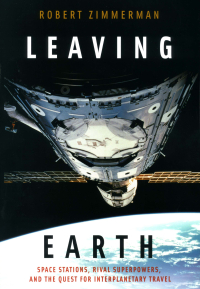
Leaving Earth cover

Leaving Earth: Space Stations, Rival Superpowers, and the Quest for Interplanetary Travel, can be purchased as an ebook everywhere for only $3.99 (before discount) at amazon, Barnes & Noble, all ebook vendors, or direct from my ebook publisher, ebookit.

If you buy it from ebookit you don't support the big oppressive tech companies and I get a bigger cut much sooner.


Winner of the 2003 Eugene M. Emme Award of the American Astronautical Society.

 
"Leaving Earth is one of the best and certainly the most comprehensive summary of our drive into space that I have ever read. It will be invaluable to future scholars because it will tell them how the next chapter of human history opened." -- Arthur C. Clarke

InSight: Mars’ crust is thin, and its interior is many layered with a molten core

Scientists yesterday released results from the seismometer on the Mars InSight lander that suggest that the crust of the red planet is thin and that its interior is many layered with a molten core.

[T]wo moderate quakes, at magnitude 3.7 and 3.3, have been treasure troves for the mission. Traced to Cerberus Fossae, deep fissures in the crust 1600 kilometers east of the landing site that were suspected of being seismically active, the quakes sent a one-two punch of compressive pressure (P) waves, followed by sidewinding shear (S) waves, barreling toward the lander. Some of the waves were confined to the crust; others reflected off the top of the mantle. Offsets in the travel times of the P and S waves hint at the thickness of the crust and suggest distinct layers within it, Brigitte Knapmeyer-Endrun, a seismologist at the University of Cologne, said in an AGU presentation. The top layer may reflect material ground up in the planet’s first billion years, a period of intense asteroid bombardment, says Steven Hauck, a planetary scientist at Case Western Reserve University.

At 20 or 37 kilometers thick, depending on whether the reflections accurately trace the top of the mantle, the martian crust appears to be thinner than Earth’s continental crust—a surprise. Researchers had thought that Mars, a smaller planet with less internal heat, would have built up a thicker crust, with heat escaping through limited conduction and bouts of volcanism. (Though Mars is volcanically dead today, giant volcanoes dot its surface.) A thin crust, however, might mean Mars was losing heat efficiently, recycling its early crust, rather than just building it up, perhaps through a rudimentary form of plate tectonics, Mojzsis says.

The thin crust provides a solid basis for explaining the large volcanoes and vast lava plains on the planet. Combined with the light gravity, magma would have found an easier path to the surface. Handed this knowledge, planetary geologists can now make a first stab at outlining more precisely the planet’s early volcanic history.

4 comments

SpinLaunch expands operations at Spaceport America in NM

Capitalism in space: SpinLaunch, the private launch startup that proposes to fling payloads into orbit rather than launch them in a rocket, has announced that it will be expanding its operations at Spaceport America in New Mexico.

The company already built a $7 million, 10,000-square-foot facility at the Spaceport after announcing plans last year to conduct all testing there on its new technology. Now, the company is doubling down, with plans to hire an additional 59 people and invest another $46 million over 10 years. The state Economic Development Department will support the expansion with $4 million in Local Economic Development Act funding, said EDD Secretary Alicia J. Keyes.

…Under its expansion, the company plans to actually build the centrifuge launch system at the spaceport, with test launches to start next year. “We expect by next summer to begin flight test operations at the spaceport, and we expect to continue to test new flight designs there for the foreseeable future,” Yaney told the Journal. “We see it as a permanent facility for us.”

The idea is fascinating, but I have some doubts. First, the accelerations will be so high that it might limit the company’s customer base, since many satellites will likely not be able to withstand those forces.

If it works, however, the company will have found a truly clever way to eliminate entirely the need for a first stage, and maybe even the second stage.

7 comments

ESA funds ArianeGroup prototype vertical landing hopper

The European Space Agency (ESA) has now committed 33 million euros for ArianeGroup to develop a prototype vertical landing hopper dubbed Themis that would begin testing first stage landings by ’23.

ArianeGroup and its collaborators in Belgium, Switzerland, France and Sweden offer critical technical knowhow gained through the development of Europe’s next-generation engine – Prometheus – which will power Themis.

ESA’s Prometheus is a highly versatile engine capable of providing 1000 kN of variable thrust and is reignitable which makes it suitable for core, booster and upper stage application. An onboard computer handles engine management and monitoring in real time – a crucial feature for reusability.

ArianeGroup is the private consortium led by Airbus and Safran that is building Ariane 6. This deal suggests that ESA amd ArianeGroup has finally recognized that Ariane 6, built without reusability, is a lemon and is not attracting customers. This new contract starts the process of developing a reusable first stage.

They still might be too late. They will only begin testing the Themis prototype in ’23, with no clarity on when a full scale version will follow. Meanwhile, it is very likely that SpaceX’s fully reusable Starship/Super Heavy will be flying orbital missions by then, and likely charging far less than they presently do for their Falcon 9.

7 comments

Cones on Mars!

Today’s cool image is actually a bunch, all found recently in the monthly image download from the high resolution camera on Mars Reconnaissance Orbiter (MRO).

All the photos I post below show pimple-like cones, all of which appear to be a type of small volcano. The cones are found in a wide range of locations, from the northern lowland plains to the cratered highlands to the mid-latitude transition zone between the two. They are also found at the bottom of deep canyons, in the floors of craters, and amidst mountains.

Let us begin.
» Read more

2 comments

Dark storm on Neptune changes direction unexpectedly

Dark storm on Neptune
Click for full image.

Using the Hubble Space Telescope, astronomers have found that a dark storm discovered on Neptune in 2018 has been drifting across the gas giant in unexpected ways.

The storm, which is wider than the Atlantic Ocean, was born in the planet’s northern hemisphere and discovered by Hubble in 2018. Observations a year later showed that it began drifting southward toward the equator, where such storms are expected to vanish from sight. To the surprise of observers, Hubble spotted the vortex change direction by August 2020, doubling back to the north. Though Hubble has tracked similar dark spots over the past 30 years, this unpredictable atmospheric behavior is something new to see.

Equally as puzzling, the storm was not alone. Hubble spotted another, smaller dark spot in January this year that temporarily appeared near its larger cousin. It might possibly have been a piece of the giant vortex that broke off, drifted away, and then disappeared in subsequent observations.

The photo to the right, cropped and reduced to post here, shows both storms. The smaller dark spot can be seen faintly to the right of the larger storm.

Since Hubble has been observing Neptune in 1993 it has seen four such storms, all of which have faded away after about two Earth years. What causes the storms as well as their motions in Neptune’s atmosphere remains unknown, and any theories posited (such as those noted at the link) are highly unreliable, considering the paucity of data we have about Neptune’s atmosphere and the meteorology of such gas giants.

2 comments

Study: Wearing used mask worse than no mask at all

WHO's do's and don't's for mask use
For the full images, go here and here.

The mask of ignorance: A new study has found that wearing a used mask, even an N95 type, is likely more risky to your health than wearing no mask at all.

Wearing a used mask could be more dangerous than not wearing one at all when it comes to warding off COVID-19, a new study has found.

A new three-layer surgical mask is 65 percent efficient in filtering particles in the air — but when used, that number drops to 25 percent, according to the study published Tuesday in the Physics of Fluids.

Researchers from the University of Massachusetts Lowell and California Baptist University say that masks slow down airflow, making people more susceptible to breathing in particles — and a dirty face mask can’t effectively filter out the tiniest of droplets.

These results are not only not surprising, they are backed up by more than a century of research into mask use for medical purposes. Using masks improperly is not sanitary, and increases your risk for getting ill, as clearly shown by the WHO graphic to the right. The results also illustrate once again that the purpose of mandating mask use has nothing to do with reducing the spread of COVID-19 (which it decidedly has not), but are instead designed to demonstrate the power of our rulers to muzzle and control the population, for the purpose of obtaining power.

75 comments
1 1,007 1,008 1,009 1,010 1,011 2,930