
Electric cars are wonderful — except no ones buying
What does this story really tell us? Electric cars are wonderful — except that the dealer hasn’t sold any.
What does this story really tell us? Electric cars are wonderful — except that the dealer hasn’t sold any.
Bumped. Scroll down for updates!
From the abstract of Geoffrey Marcy’s talk today at 6:30 pm (Eastern) at this week’s meeting in Seattle of the American Astronomical Society:
The NASA Kepler Mission has discovered over 700 candidate planets, with most having diameters less than 5 times that of Earth and some as small as that of Earth. One planet has a radius, mass, and density in a new domain having no counterpart in our Solar System, opening a new chapter in planetary science. [emphasis mine]
A press conference is scheduled for 11 am (Eastern). Stay tuned!
Update I. A NASA press release just made public says that Kepler has discovered a rocky planet only 1.4 times the size of the Earth.
Kepler 10b [is] a rocky planet with a mass 4.6 times that of Earth and with an average density of 8.8 grams per cubic centimeter — similar to that of an iron dumbbell.
The press conference is ongoing, but the Kepler results are still to come.
Update II. The star the planet orbits, Kepler 10, is similar to our Sun in mass and size, but older, about 8 billion years old, and is 560 light years away. Kepler 10 is also a relatively bright star in the Kepler field of view, about 11 magnitude.
The planet’s orbit itself is only 8.4 days long. Its density, 8.8 grams per cubic centimeter, is 8.8 times greater than Earth’s. This data, based on all planet models, also suggests that the planet should be a rocky planet like the Earth, though heavier and larger with a surface gravity twice that of Earth.
Since the planet orbits so close to its sun, it is a scorched world, very hot. The scientists expect that it has no atmosphere. It is also probably tidally locked, with one side always facing its Sun.
Update III: Geoffrey Marcy, one of the world’s premier exoplanet scientists, is now commenting on these Kepler results, saying he considers this discovery “among the most profound discoveries in human history.”
Update IV: In answer to a press question, the scientists speculated that the planet might have formed as a gas giant farther from the star, then migrated inward and had its gas atmosphere stripped away. No one knows yet if this is true however.
Studies of further transits might learn more about the planet, such as the temperatures between its two hemispheres. As the planet orbits the star and its illuminated side comes into view, they can see the change in temperature and thus track it. Right now they think the sunlight side could be as hot as 2500 degrees Fahrenheit.
If you want to watch the press conference for yourself, they will be posting the video here.

On Christmas Eve 1968 three Americans became the first humans to visit another world. What they did to celebrate was unexpected and profound, and will be remembered throughout all human history. Genesis: the Story of Apollo 8, Robert Zimmerman's classic history of humanity's first journey to another world, tells that story, and it is now available as both an ebook and an audiobook, both with a foreword by Valerie Anders and a new introduction by Robert Zimmerman.
The print edition can be purchased at Amazon or any other book seller. If you want an autographed copy the price is $60 for the hardback and $45 for the paperback, plus $8 shipping for each. Go here for purchasing details. The ebook is available everywhere for $5.99 (before discount) at amazon, or direct from my ebook publisher, ebookit. If you buy it from ebookit you don't support the big tech companies and the author gets a bigger cut much sooner.
"Not simply about one mission, [Genesis] is also the history of America's quest for the moon... Zimmerman has done a masterful job of tying disparate events together into a solid account of one of America's greatest human triumphs."--San Antonio Express-News
Black gold! Three to four billion barrels of oil — 25 times more than previously predicted — are now thought to lie under certain geological formations in North Dakota and Montana.
Want to tone down the rhetoric? Maybe the left should look at itself: The progressive “climate of hate:” An illustrated primer, 2000-2010.

Now available in hardback and paperback as well as ebook!
From the press release: In this ground-breaking new history of early America, historian Robert Zimmerman not only exposes the lie behind The New York Times 1619 Project that falsely claims slavery is central to the history of the United States, he also provides profound lessons about the nature of human societies, lessons important for Americans today as well as for all future settlers on Mars and elsewhere in space.
“Zimmerman’s ground-breaking history provides every future generation the basic framework for establishing new societies on other worlds. We would be wise to heed what he says.” —Robert Zubrin, founder of the Mars Society.
All editions are available at Amazon, Barnes & Noble, and all book vendors, with the ebook priced at $5.99 before discount. All editions can also be purchased direct from the ebook publisher, ebookit, in which case you don't support the big tech companies and the author gets a bigger cut much sooner.
Autographed printed copies are also available at discount directly from the author (hardback $29.95; paperback $14.95; Shipping cost for either: $6.00). Just send an email to zimmerman @ nasw dot org.
The shooting in Tucson might cause NASA to drop Congresswoman Giffords’ husband as commander of Endeavour’s last mission this spring.
Leaving Earth: Space Stations, Rival Superpowers, and the Quest for Interplanetary Travel, can be purchased as an ebook everywhere for only $3.99 (before discount) at amazon, Barnes & Noble, all ebook vendors, or direct from my ebook publisher, ebookit.
If you buy it from ebookit you don't support the big oppressive tech companies and I get a bigger cut much sooner.
"Leaving Earth is one of the best and certainly the most comprehensive summary of our drive into space that I have ever read. It will be invaluable to future scholars because it will tell them how the next chapter of human history opened." -- Arthur C. Clarke
An evening pause: Projected in a museum in Vienna.
Russian scientists are about to drill into Lake Vostok, a lake buried for the last 14 million years beneath the almost two and a half mile thick Antarctic icecap.
The next time someone begins ranting about how the money from “big oil” is used to attack the science of global warming, tell them to take a look at this post, which outlines in detail the more than $2 billion that the U.S. government plans to spend on climate change research in 2011 alone (too much of which is unfortunately used by partisans like James Hansen to try to prove the Earth is warming).
Here are two links that I think are worth reading in connection with the aftermath of yesterday’s tragic shootings in Tucson:
Two sicknesses on display in Arizona.
Disgusting partisanship on display after shooting.
Above all, these murders are horrible and a terrible tragedy. For anyone from either party to try to make political gain from them is beyond despicable.
I should also note that, unlike most Islamic terrorists attacks where either no one in the Muslim community protests while many Muslim leaders express joy or agreement with the violence, I can find no one who is happy about yesterday’s murders. The general response from across the American political spectrum is horror and agony. Such things are wrong and should not happen. It is this distinction that separates Western culture from modern Islam. Until the Islamic community finally stands up to its medieval bullies, I will continue to consider it a threat to civilization and freedom.
An evening pause:
In a paper published today in Geophysical Research Letters of the American Geophysical Union, scientists describe how they have been able to produce remarkably detailed images of the ground buried almost a mile under the ice sheet of Greenland. These radar techniques are the same used in the past by spacecraft to image the hidden surface of Venus, only far more sophisticated.
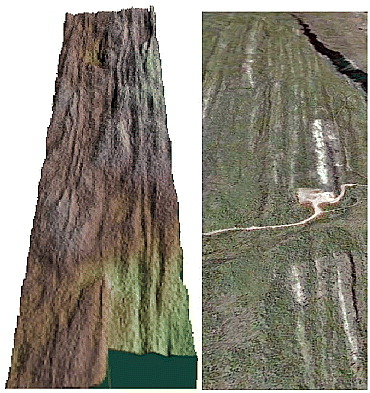
This image from the paper compares the radar image of the Greenland surface (on the left) to an photograph of a known surface feature in the Northwest Territories of Canada, produced thousands of years ago by the giant icesheets of the last Ice Age. Both are at the same scale, about a third of a mile across, and are looking at the surface at an oblique angle of about 45 degrees. With the radar-produced image on the left, sunlight is simulated as coming from the right, with the elevation increasing as the colors go from green (lowest) to yellow to brown to purple (highest).
The long grooves, generally 30 to 100 feet deep and extending sometimes several miles, are produced as the icesheet slides across the ground. In the radar image, however, these grooves are slowly being ground out now.
It is the resolution of this technique that is so exciting. That they can look through ice almost a mile thick and resolve objects that are only tens of feet across tells me that someday it will be possible for spacecraft to map the smallest features on the surface of Venus or Titan. More exciting, this suggests that the technology will one day exist to even map the unknown surface of gas giants like Jupiter or Saturn, and do it in breathtaking detail.
Yowza!
What does this tell us about the quality of his journalism degree? A freelance writer and journalism graduate of Columbia University has been caught fabricating material for an article in the Village Voice.
From Watts Up With That: Data from the Argos ocean floats says that the Earth’s climate, as measured by the heat content of the ocean, has been cooling since 2001, not warming as predicted by climate models. You can download the actual science paper, “The Energy Balance of Earth,” here.
An evening pause: This video doesn’t quite get you to the top, but it definitely gives you a feel for the spectacular nature of the hike.
It ain’t just NASA that’s having budget problems: The lack of a budget from Congress is going to delay the launch of two civilian NOAA weather satellites by more than a year.
Some squeals from the right: Don’t cut defense.
As much as I think it necessary to aggressively fight the wars we are in, I have no doubt that the budget of the Defense Department could be trimmed by significant amounts, without harming our capabilities in the slightest.
More please, especially in places like Iraq, Iran, and Pakistan! Thousands of Egyptian Muslims show up in Coptic Christian churches to act as “human shields.”
The battle begins: The House Budget Chairman, Paul Ryan, says that all spending bills will be written to exclude all funds for ObamaCare.
As I say, expect the squealing to be loud.