
September 10, 2024 Zimmerman/Batchelor podcast
Embedded below the fold in two parts.
To listen to all of John Batchelor’s podcasts, go here.
» Read more
Embedded below the fold in two parts.
To listen to all of John Batchelor’s podcasts, go here.
» Read more
An evening pause: Performed live 2007.
Hat tip Judd Clark, who notes that at one point he counted “five lead guitarists on stage, besides Sheryl.”

On Christmas Eve 1968 three Americans became the first humans to visit another world. What they did to celebrate was unexpected and profound, and will be remembered throughout all human history. Genesis: the Story of Apollo 8, Robert Zimmerman's classic history of humanity's first journey to another world, tells that story, and it is now available as both an ebook and an audiobook, both with a foreword by Valerie Anders and a new introduction by Robert Zimmerman.
The print edition can be purchased at Amazon or any other book seller. If you want an autographed copy the price is $60 for the hardback and $45 for the paperback, plus $8 shipping for each. Go here for purchasing details. The ebook is available everywhere for $5.99 (before discount) at amazon, or direct from my ebook publisher, ebookit. If you buy it from ebookit you don't support the big tech companies and the author gets a bigger cut much sooner.
"Not simply about one mission, [Genesis] is also the history of America's quest for the moon... Zimmerman has done a masterful job of tying disparate events together into a solid account of one of America's greatest human triumphs."--San Antonio Express-News

Harvard: where you can spend a lot of money
getting a shoddy education
Two stories last week proved beyond a shadow of a doubt that Harvard is at this moment in time the worst American college in the nation, its faculty and staff clearly having no interest in teaching critical thinking. Instead, they are more focused on suppressing dissenting views while making their prime task indoctrinating students into the Marxist and queer agenda that is divorced from reality but eager to discriminate against whites and Jews.
First the Foundation for Individual Rights and Expression (FIRE) and the College Pulse published their fifth annual College Free Speech Rankings, surveying almost 60,000 students across more than 250 universities. Guess which university ranked at the very bottom of the list, for the second year in a row?
Harvard University retained its position as the lowest-ranked institution for free speech for the second consecutive year. Harvard, Columbia University, New York University all received an “Abysmal” rating for their speech climates. The University of Pennsylvania and Barnard College round out the bottom five. These schools not only have low levels of administrative support for free speech. They also have low levels of student comfort in expressing their views on controversial political topics and a strong bias in favor of allowing liberal speakers on campus over conservative ones.
Next, to prove this ranking was well deserved, it appears that Harvard’s administration has refused to cooperate with the local district attorney and the police in investigating the pro-Hamas rioters who attacked Jewish students during the violence that occurred on campus in October 2023, violence committed in support of the rape, torture, and murder of innocent men, women, and children near Gaza that same month.
» Read more
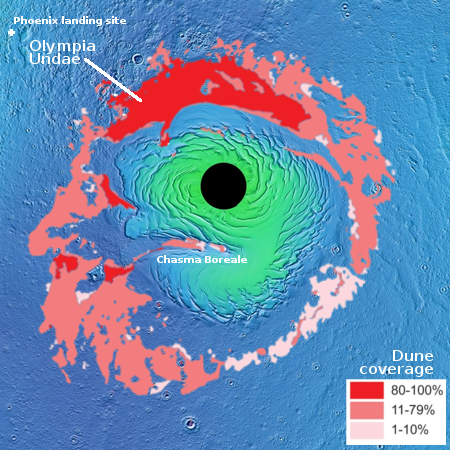
The Martian north pole.
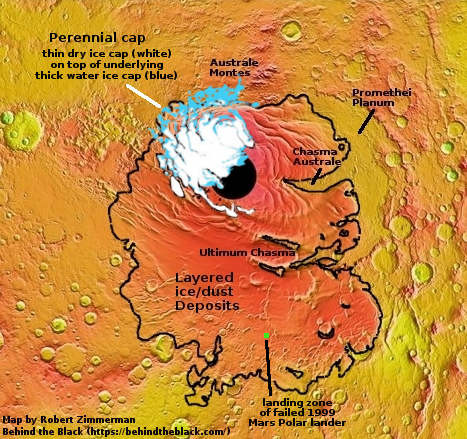
The Martian south pole.

What the colors mean in terms of elevation
A new paper, in review for the past year, has now been published describing the differences between the north and south poles of Mars, the most fundamental of which involve the planet’s orbit and the different elevations of the two poles, with the south pole three to six miles higher in altitude (as indicated by the colors on the maps to the right).
The cumulative data has allowed the researchers to explain why — when the thin winter cap of dry ice sublimates away in the spring — the process at the south pole results in spiderlike features that get enhanced from year to year, but in the north pole that sublimation process produces no such permanent features.
In both cases, the spring sunlight passes through the clear winter mantle of dry ice to heat its base. The sublimated trapped CO2 gas builds up, until the pressure causes the mantle to crack at weak spots. In the south that trapped gas flows uphill each spring along the same paths, carving the riverlike tributaries dubbed unofficially as “spiders” and officially as “araneiform terrain.”
Geophysicist Hugh Kieffer described that process in 2006. A few years later, [Candice] Hansen [the new paper’s lead author] followed up with her own model for the north polar cap, which also displays fans in the spring.
She found that the same phenomena occur in the north, but rather than relatively flat terrain, these processes play out across sand dunes. “When the Sun comes up and begins to sublimate the bottom of the ice layer, there are three weak spots – one at the crest of the dune, one at the bottom of the dune where it meets the surface and then the ice itself can crack along the slope,” Hansen said. “No araneiform terrain has been detected in the north because although shallow furrows develop, the wind smooths the sand on the dunes.”
There is also a lot more dust in the north, including a giant sea of dunes that circles the polar cap. In addition, the northern winter is shorter due to the planet’s orbit, and takes place during the annual dust storm season, causing there to be more dust concentrated within the northern ice. All of these factors make the the dunes and general surface in the north is more easily smoothed by the wind.

Now available in hardback and paperback as well as ebook!
From the press release: In this ground-breaking new history of early America, historian Robert Zimmerman not only exposes the lie behind The New York Times 1619 Project that falsely claims slavery is central to the history of the United States, he also provides profound lessons about the nature of human societies, lessons important for Americans today as well as for all future settlers on Mars and elsewhere in space.
“Zimmerman’s ground-breaking history provides every future generation the basic framework for establishing new societies on other worlds. We would be wise to heed what he says.” —Robert Zubrin, founder of the Mars Society.
All editions are available at Amazon, Barnes & Noble, and all book vendors, with the ebook priced at $5.99 before discount. All editions can also be purchased direct from the ebook publisher, ebookit, in which case you don't support the big tech companies and the author gets a bigger cut much sooner.
Autographed printed copies are also available at discount directly from the author (hardback $29.95; paperback $14.95; Shipping cost for either: $6.00). Just send an email to zimmerman @ nasw dot org.

Click for original image.
Using data obtained from one of the instruments on the European Space Agency’s (ESA) Mars Express orbiter, scientists have now published an atlas of the clouds of Mars and made it available to the public.
The picture to the right, cropped, reduced, and sharpened to post here, is just one example of the images in the atlas. From the caption:
This image displays two atmospheric phenomena: the white curved lines are gravity wave clouds, while the brown areas are dust lifted from the ground by wind. The colour shift visible in the dust lifting event might be indicative of very fast winds, a phenomenon currently under investigation by other members of the team.
The atlas contains more than 300 images of various Martian cloud formations, from the one to the right to images of cirrus clouds on the top of Olympus Mons, Mars’ largest volcano. You can download it here (the file is a very large spreadsheet).

The White House to SpaceX: “Great business you got there! Really be
a shame if something happened to it!”
According to an update today on SpaceX’s Starship webpage, the FAA has told the company to not expect a launch license for its next Starship/Superheavy orbital test launch until late November.
We recently received a launch license date estimate of late November from the FAA, the government agency responsible for licensing Starship flight tests. This is a more than two-month delay to the previously communicated date of mid-September. This delay was not based on a new safety concern, but instead driven by superfluous environmental analysis. The four open environmental issues are illustrative of the difficulties launch companies face in the current regulatory environment for launch and reentry licensing.
This two month delay is actually a four month delay, since SpaceX had previously stated it was ready to launch in early August. » Read more

Leaving Earth: Space Stations, Rival Superpowers, and the Quest for Interplanetary Travel, can be purchased as an ebook everywhere for only $3.99 (before discount) at amazon, Barnes & Noble, all ebook vendors, or direct from my ebook publisher, ebookit.
If you buy it from ebookit you don't support the big oppressive tech companies and I get a bigger cut much sooner.
"Leaving Earth is one of the best and certainly the most comprehensive summary of our drive into space that I have ever read. It will be invaluable to future scholars because it will tell them how the next chapter of human history opened." -- Arthur C. Clarke

Proposed spaceports surrounding Norwegian Sea
During an interview at a conference this week, Daniel Metzler, the CEO of the German rocket statup Isar Aerospace, imitated the kind of comments issued routinely by Elon Musk prior to one of SpaceX’s daring test launches, stating that the first launch of Isar’s Spectrum rocket will be a success “if we don’t blow up the launch site.”
“For me, the first flight will be a success if we don’t blow up the launch site,” explained Metzler. “That would probably be the thing that would set us back the most in terms of technology and time.” He went on to explain that the company’s “test early and improve iteratively” development approach was inherently risky.
Though no launch date has been set, there are indications based on the activity at the Andoya spaceport in Norway, where Isar has a 20-year lease on the only launchpad, that this launch could occur within the next month or so. Andoya received its spaceport license late last month, and it also appears that Norway’s bureaucracy is not acting to delay this activity, as has the Civil Aviation Authority in the United Kingdom.
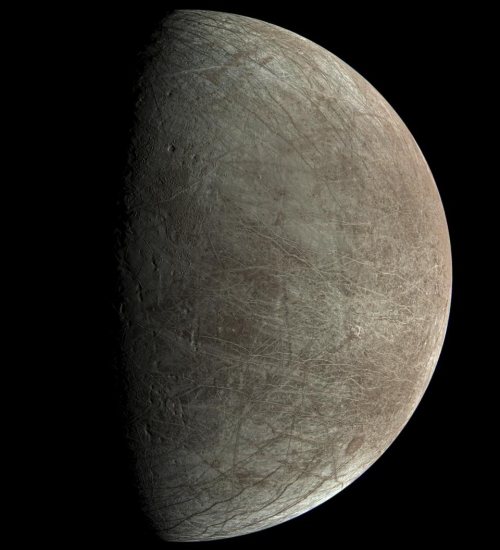
Europa in true color, taken by Juno September 2022.
Click for full image.
In making the decision to allow Europa Clipper to be launched on a Falcon Heavy on October 10, 2024, NASA and JPL officials explained that after several months of testing, they believe the improperly hardened transistors installed throughout the orbiter will “heal” themselves while in the low radiation portions of its orbit around Jupiter.
[The testing] showed the transistors in question will, in effect, heal themselves during the 20 days between the high radiation doses the probe will receive during each of 49 close flybys of Europa, all of them deep in Jupiter’s powerful magnetic field and radiation environment.
In addition, onboard heaters can be used as needed to raise the temperature of affected transistors, improving the recovery process. “After extensive testing and analysis of the transistors, the Europa Clipper project and I personally have high confidence we can complete the original mission for exploring Europa as planned,” said Jordan Evans, Europa Clipper project manager at NASA’s Jet Propulsion Laboratory.
I hope this analysis is right, though I fear there is a lot of wishful-thinking involved. It could be however that this testing, in combination with what engineers have learned during Juno’s so-far 64 orbits around Jupiter, might have reassured them.
We however will not know for sure until Europa Clipper is on its way and reaches Jupiter in 2030.

When Typhoon Yagi (what hurricanes are called in the Asian Pacific) made landfall on September 6, 2024, carrying winds as high as 150 miles per hour, it not only caused flooding and power outages, it apparently did significant damage to China’s new launch facilities at its coastal Wenchang spaceport.
The site has two launch towers, one dedicated to servicing the state’s Long March 8 rockets, while the other services both public and private rockets, including a Long March 12 that was due to make its debut launch later this year.
On Saturday, the city’s deputy mayor, Wei Bo, said the typhoon had posed a “serious threat” to facilities and equipment at the commercial space hub but emergency restoration work was being carried out.
As is usual with China’s state-run press, few details were released, including the actual damages, both to the launch facilities and to the nearby cities.
China has been using this spaceport increasingly to support its space station as well as launch planetary probes. It has also developed a commercial launchsite there for its pseudo-private companies to use. How this damage will impact future launches remains unknown.
Early this morning SpaceX successfully launched its Resilience Dragon capsule carrying four passengers on Jared Isaacman’s mission to do the first entirely private spacewalk. The Falcon 9 rocket lifted off from the Kennedy Space Center in Florida.
Resilience is flying its third flight. The first stage completed its fourth flight, landing on a drone ship in the Atlantic.
The spacewalk will take place on September 12, 2024. In between the crew will spend the next two days preparing for that, while flying in an orbit with a apogee of 870 miles, the highest any person has flown from Earth since Apollo. That orbit will be lowered slightly for the spacewalk itself.
The leaders in the 2024 launch race:
89 SpaceX
38 China
10 Rocket Lab
9 Russia
American private enterprise now leads the rest of the world combined in successful launches 104 to 57, while SpaceX by itself leads the entire world, including American companies, 89 to 72.

The real rocket behind tonight’s launch
SpaceX tonight will attempt the launch of the private manned Polaris Dawn mission, led and paid for by billionaire Jared Isaacman and carrying three other crew member (including two SpaceX employees).
I have embedded the live stream below, which has already begun. The launch is presently scheduled for 3:38 am (Eastern), with a four hour launch window.
The mission is planned as a five day mission, during which two astronauts will do a tethered spacewalk, though the entire crew will be in EVA spacesuits. This will be the first entirely private spacewalk, involving no government involvment at all. The mission will also attempt reach the highest orbit since the Apollo days, more than 870 miles.
As I wrote the day of the mission’s first launch attempt:
The mission’s real goal however has nothing to do with engineering and everything to do with freedom and the American dream. This is an entirely private mission. The rocket is privately built. The capsule is privately built. The launchpad is privately built. The launch crew is privately employed. The astronauts are all private citizens, with one paying the way for the entire flight and two flying as employees of SpaceX to test the operation of its capsule in orbit.
No government money is involved. The government had little or no say on what will happen. The mission will illustrate in very stark terms what the American dream is all about, since it has been conceived, paid for, and created entirely by private citizens following their own dreams and goals.
Hail to freedom! May the bell of liberty always ring.
An evening pause: Short but sweet. As she notes, the performance “turns into a Disney movie.”
Hat tip James Street.

Click for original image.
Cool image time! The picture to the right, cropped and reduced to post here, was taken on March 29, 2024 by the high resolution camera on Mars Reconnaissance Orbiter (MRO).
The science team labels this “troughs in Labeatis Fossae.” On Mars, the word “fossae” is used to indicate regions where there are a lot of parallel fissures. Though there are a few examples where such fissures might have been caused by the movement of ice or water, carving out the channel, in almost all cases this is not the cause. Instead, fossae are usually formed when the surface stretches, either because underground upward pressure pulls it apart, or because there is a sideways spread at the surface. The resulting cracks are generally considered what geologists call “grabens,” depressions caused at faultlines when the ground on either side moves apart in some manner.
In this case the break in the trough proves this is a graben, though why it broke at this spot is not clear.
» Read more
.JPG)
Robert Reich, labor secretary under Bill Clinton
They’re coming for you next: Based on the behavior of loyal Democrats in the past five years, no on should be surprised by this story. Several big name Democratic Party supporters have now called for the complete censorship and imprisonment of Elon Musk for the horrible crime of disagreeing with them and campaigning for their opposition.
First we have Robert Reich, that petty dictator who was once secretary of labor under President Bill Clinton and teaches public policy at — you guessed it — the University of California in Berkeley. In an op-ed for the leftist British newspaper The Guardian, Reich claims Musk is “out of control” and for this crime he must be squelched. First he calls for a global boycott of Tesla and X but then tops this demand with some decidedly tyrannical desires:
» Read more

According to a tweet yesterday by Elon Musk, SpaceX is aiming for a 2026 launch of its first unmanned Starship to Mars.
The first Starships to Mars will launch in 2 years when the next Earth-Mars transfer window opens. These will be uncrewed to test the reliability of landing intact on Mars. If those landings go well, then the first crewed flights to Mars will be in 4 years.
Flight rate will grow exponentially from there, with the goal of building a self-sustaining city in about 20 years.
The graphic to the right indicates the planned landing zone, with the four red dots the four prime locations. Three of the four are very flat, though they also appear to have a lot of very near-surface ice, accessible simply by digging a shovel into the ground. Attempting to land at any will definitely test Statship’s ability to land on Mars intact. A global map of Mars is shown below, showing the location of this landing zone. The map shows where researchers believe the saltiest water on Mars would be. According to this data, in the Starship landing zone some of that near-surface ice will turn to liquid brine a little less than one percent of each year. Otherwise it will be more easily processed for drinking and fuel.
As always with these ambitious predictions, Musk is aiming high, with the likelihood that this first mission will not make that ’26 date. At the same time, he is making it very clear that a first attempt will certainly happen by ’28.
I also think the timing of this announcement is intriguing, coming one day after NASA was forced to cancel the launch in October of two Mars orbiters because it could not be certain Blue Origin would have the New Glenn rocket ready on time. Musk’s response is to say that SpaceX is now about to begin regularly privately funded and privately built missions to Mars, on a schedule, essentially asking: “Which company would you choose to do things in space?”
» Read more
Boeing’s Starliner manned capsule landed last night at White Sands in New Mexico, the undocking, de-orbit, and descent occurring as planned with no hitches.
The mission however was not a full success. Intended as the first manned demo flight of the capsule, it did not complete that demonstration. It took astronauts up to ISS, but did not bring them home. NASA made the decision that the technical problems during launch and docking to ISS were sufficient enough to preclude putting the astronauts back on board for the return flight.
NASA says it “will review all mission-related data” before deciding whether to certify the capsule for operational manned flights. The agency has essentially two choices. First, it could decide that the successful return with no hitches of this manned flight, even with no one on board, fulfilled Boeing’s obligations. It will certify the capsule, allowing Starliner’s next manned mission to fly with NASA paying the bill. Doing so however would likely expose NASA to a lot of bad publicity, since the press right now sees Boeing as the root of all technical evil, and will pile on to the agency for putting safety last.
Second, NASA could avoid that bad press and play hard-nosed and demand another manned demo flight, on Boeing’s dime, as required by contract. If so, however, expect Boeing to refuse to do it, citing the cost and the company’s fiscal responsibility to its shareholders. Even if successful Boeing is unlikely to ever recover those costs through passenger sales.
Based on this negotiating situation, I predict NASA will choose the former. The successful landing suggests this is probably the right decision. It however will not do so immediately, but will release a series of announcements touting the positive results from its review of that “mission-related data”. By dribbling out each positive result bit-by-bit, the goal will be to soften the press so that when the agency finally certifies Boeing for that next manned mission and thus agrees to pay for it, the press will not pile on so hard.
At least, that will be the agency’s hope. The mainstream propaganda press however doesn’t usually read NASA press releases, and even when it does it knows so little about the subject that it almost always comes to the wrong conclusion. Moreover, its present desire to attack Boeing in all conditions will likely help it report these stories badly.
Embedded below the fold in two parts.
To listen to all of John Batchelor’s podcasts, go here.
» Read more
An evening pause: Peformed live 1986.
Hat tip Judd Clark.
Courtesy of BtB’s stringer Jay. This post is also an open thread. I welcome my readers to post any comments or additional links relating to any space issues, even if unrelated to the links below.
The landing is scheduled for 12:03 am (Eastern) tonight.
The company has had serious financial troubles, and has thus pulled back from building and launching rockets to simply making small engines and thrusters for satellites.
The star it orbits is M-dwarf about 35 light years away, and has a solar system of four known exoplanets, so far.
The models suggest some debris could reach both Earth and Mars in about thirteen years, producing the first man-made meteor shower. The debris poses no threat however.
The orbit is highly elliptical, and it is unclear at this moment if the debris cloud poses a threat to any other satellites
After reviewing the status of launch preparations by Blue Origin of its New Glenn rocket, NASA today decided to cancel the launch because it appeared that Blue Origin would not be able to meet the October 13-21 launch window for sending the agency’s two Escapade orbiters to Mars.
NASA announced Friday it will not fuel the two ESCAPADE (Escape and Plasma Acceleration and Dynamics Explorers) spacecraft at this time, foregoing the mission’s upcoming October launch window. While future launch opportunities are under review, the next possible earliest launch date is spring 2025.
The agency’s decision to stand down was based on a review of launch preparations and discussions with Blue Origin, the Federal Aviation Administration, and Space Launch Delta 45 Range Safety Organization, as well as NASA’s Launch Services Program and Science Mission Directorate. The decision was made to avoid significant cost, schedule, and technical challenges associated with potentially removing fuel from the spacecraft in the event of a launch delay, which could be caused by a number of factors.
The press release of course is vague about why the launch has been canceled, but the reasons are obvious if you have been paying attention. Though Blue Origin has clearly been making progress towards the first launch of New Glenn, recent reports suggested strongly that it would be impossible for it to assemble the rocket, integrate the two orbiters, and get everything on the launchpad on time.
Rocket Lab, which built the orbiters, of course fully supported the decision, though that company very much wanted it to fly now to demonstrate its ability to make low cost smallsat planetary probes.
This failure of Blue Origin to meet this deadline speaks poorly of the company. To serve the satellite and especially the planetary research community rocket companies must be able to launch on schedule and on time. Blue Origin has failed to do so in this case. It appears Jeff Bezos needs to ramp up the pressure on his moribund company to finally get it to perform in the manner he desires, as described by Bezos himself recently.