Texas lawmakers now lobbying to move NASA headquarters to Houston

First it was Florida. Then it was Ohio. Now Texas lawmakers are lobbying the Trump administration to move NASA headquarters from Washington to Houston.

A coalition of Texas lawmakers is calling on President Donald Trump to relocate NASA’s headquarters to Houston when the office lease in Washington D.C. expires in 2028. U.S. Senator Ted Cruz and U.S. Rep. Brian Babin (R- Woodville) are leading the charge to make Houston the new landing spot for NASA headquarters. Several other Texas representatives signed onto the letter Wednesday urging Trump to make this shift.

That politicians in three different states are lobbying in this manner tells us it is almost certain that NASA’s headquarters is leaving DC. More important, it tells us that the agency’s entire bureaucracy — including its many scattered centers nationwide — are going to go through a major shake-up, including major reductions and closures. It appears Trump has made the headquarters a plum that these politicians are chasing in order to get them to agree to major cuts elsewhere.

7 comments

Astronomers detect chemicals on exoplanet that on Earth come from life

The uncertainty of science: Using the Webb Space Telescope, astronomers have detected two different molecules that on Earth are only linked with biology in the atmosphere of an exoplanet orbiting a red dwarf star within its habitable zone.

Earlier observations of K2-18b — which is 8.6 times as massive and 2.6 times as large as Earth, and lies 124 light years away in the constellation of Leo — identified methane and carbon dioxide in its atmosphere. This was the first time that carbon-based molecules were discovered in the atmosphere of an exoplanet in the habitable zone. Those results were consistent with predictions for a ‘Hycean’ planet: a habitable ocean-covered world underneath a hydrogen-rich atmosphere.

However, another, weaker signal hinted at the possibility of something else happening on K2-18b. “We didn’t know for sure whether the signal we saw last time was due to DMS, but just the hint of it was exciting enough for us to have another look with JWST using a different instrument,” said Professor Nikku Madhusudhan from Cambridge’s Institute of Astronomy, who led the research.

…The earlier, tentative, inference of DMS was made using JWST’s NIRISS (Near-Infrared Imager and Slitless Spectrograph) and NIRSpec (Near-Infrared Spectrograph) instruments, which together cover the near-infrared (0.8-5 micron) range of wavelengths. The new, independent observation [of dimethyl sulfide (DMS) and/or dimethyl disulfide (DMDS] used JWST’s MIRI (Mid-Infrared Instrument) in the mid-infrared (6-12 micron) range.

This data is not yet proof of biology. For example, the concentrations of these molecules in K2-18b’s atmosphere is thousands of times greater than on Earth. It is just as likely that numerous as yet unknown non-biological chemical processes in this alien environment have produced these chemicals. The scientists however are encouraged because the theories about ocean life on this kind of habitable ocean-covered superearth had predicted this high concentration of these chemicals.

At the same time, they readily admit there are many uncertainties in their data. They have asked for another 16 to 24 hours of observation time on Webb — a very large chunk rarely given out to one research group — to reduce these uncertainties.

You can read the peer-reviewed paper here [pdf].

4 comments

Genesis cover

On Christmas Eve 1968 three Americans became the first humans to visit another world. What they did to celebrate was unexpected and profound, and will be remembered throughout all human history. Genesis: the Story of Apollo 8, Robert Zimmerman's classic history of humanity's first journey to another world, tells that story, and it is now available as both an ebook and an audiobook, both with a foreword by Valerie Anders and a new introduction by Robert Zimmerman.

The print edition can be purchased at Amazon or any other book seller. If you want an autographed copy the price is $60 for the hardback and $45 for the paperback, plus $8 shipping for each. Go here for purchasing details. The ebook is available everywhere for $5.99 (before discount) at amazon, or direct from my ebook publisher, ebookit. If you buy it from ebookit you don't support the big tech companies and the author gets a bigger cut much sooner.


The audiobook is also available at all these vendors, and is also free with a 30-day trial membership to Audible.
 

"Not simply about one mission, [Genesis] is also the history of America's quest for the moon... Zimmerman has done a masterful job of tying disparate events together into a solid account of one of America's greatest human triumphs."--San Antonio Express-News

Northrop Grumman launches reconnaissance satellite

Northrop Grumman yesterday successfully launched a National Reconnaissance Office surveillance satellite, its Minotaur-4 rocket lifting off from Vandenberg in California.

This was the company’s first launch since 2023. Northrop Grumman’s Antares rocket has been out of commission since the company used up its Ukrainian-built first stages, waiting for Firefly to complete its replacement. The repurposed Minotaur-4 missile does not have the capability to replace it.

The leader board for the 2025 launch race remains unchanged:

43 SpaceX
19 China
5 Rocket Lab
5 Russia

SpaceX still leads the rest of the world in successful launches, 43 to 33.

0 comments

Conscious Choice cover

Now available in hardback and paperback as well as ebook!

From the press release: In this ground-breaking new history of early America, historian Robert Zimmerman not only exposes the lie behind The New York Times 1619 Project that falsely claims slavery is central to the history of the United States, he also provides profound lessons about the nature of human societies, lessons important for Americans today as well as for all future settlers on Mars and elsewhere in space.

 
Conscious Choice: The origins of slavery in America and why it matters today and for our future in outer space, is a riveting page-turning story that documents how slavery slowly became pervasive in the southern British colonies of North America, colonies founded by a people and culture that not only did not allow slavery but in every way were hostile to the practice.  
Conscious Choice does more however. In telling the tragic history of the Virginia colony and the rise of slavery there, Zimmerman lays out the proper path for creating healthy societies in places like the Moon and Mars.


“Zimmerman’s ground-breaking history provides every future generation the basic framework for establishing new societies on other worlds. We would be wise to heed what he says.” —Robert Zubrin, founder of the Mars Society.


All editions are available at Amazon, Barnes & Noble, and all book vendors, with the ebook priced at $5.99 before discount. All editions can also be purchased direct from the ebook publisher, ebookit, in which case you don't support the big tech companies and the author gets a bigger cut much sooner.


Autographed printed copies are also available at discount directly from the author (hardback $29.95; paperback $14.95; Shipping cost for either: $6.00). Just send an email to zimmerman @ nasw dot org.

April 16, 2025 Quick space links

Courtesy of BtB’s stringer Jay. This post is also an open thread. I welcome my readers to post any comments or additional links relating to any space issues, even if unrelated to the links below.

1 comment

Leaving Earth cover

Leaving Earth: Space Stations, Rival Superpowers, and the Quest for Interplanetary Travel, can be purchased as an ebook everywhere for only $3.99 (before discount) at amazon, Barnes & Noble, all ebook vendors, or direct from my ebook publisher, ebookit.

If you buy it from ebookit you don't support the big oppressive tech companies and I get a bigger cut much sooner.


Winner of the 2003 Eugene M. Emme Award of the American Astronautical Society.

 
"Leaving Earth is one of the best and certainly the most comprehensive summary of our drive into space that I have ever read. It will be invaluable to future scholars because it will tell them how the next chapter of human history opened." -- Arthur C. Clarke

Astronomers discover a well-developed spiral galaxy too soon after the Big Bang

The early spiral galaxy
Click for original image.

Using the Webb Space Telescope, astronomers have discovered the earliest known well-developed spiral galaxy, dubbed Zhúlóng (meaning torch dragon in Chinese), that exists only about one billion years after the Big Bang and much too soon for such a spiral galaxy to have formed.

The false-color infrared Webb image to the right, cropped to post here, shows clearly the galaxy’s spiral structure.

Zhúlóng has a surprisingly mature structure that is unique among distant galaxies, which are typically clumpy and irregular. It resembles galaxies found in the nearby Universe and has a mass and size similar to those of the Milky Way. Its structure shows a compact bulge in the center with old stars, surrounded by a large disk of younger stars that concentrate in spiral arms.

This is a surprising discovery on several fronts. First, it shows that mature galaxies that resemble those in our neighborhood can develop much earlier in the Universe than was previously thought possible. Second, it has long been theorized that spiral arms in galaxies take many billions of years to form, but this galaxy demonstrates that spiral arms can also develop on shorter timescales. There is no other galaxy like Zhúlóng that astronomers know of during this early era of the Universe.

You can read the peer-review research paper here. The scientists posit a number of theories to explain this spiral galaxy, none of which have much merit at this time because so little data exists from that time period. That only one such spiral galaxy is presently known does not mean such galaxies were rare at that time. It merely means our census of galaxy populations in the early universe remains woefully incomplete.

3 comments

The Bahamas suspends further Falcon 9 1st stage landings pending environmental report

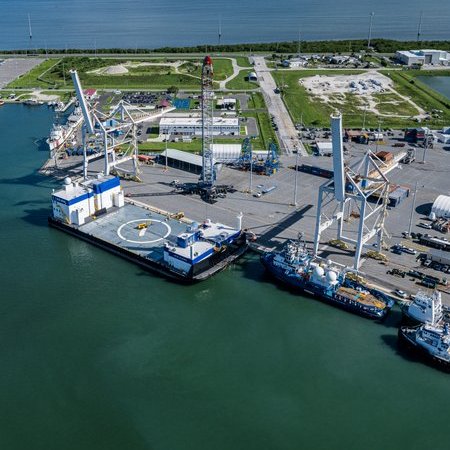
The government of the Bahamas has suspended any further Falcon 9 1st stage landings within its territorial waters until SpaceX completes and submits a full environmental report that proves the one previous drone ship landing in February caused no environmental changes at all.

This quote from the article explains everything:

Addressing calls from environmentalists for an EIA, Mr Dontchev [SpaceX’s vice president of launch] said officials heard their feedback. He added that SpaceX hopes to complete the EIA by the end of summer and resume landings thereafter.

The economic impact of space tourism in The Bahamas has also come into focus. [Deputy Prime Minister Chester] Cooper said the February landing could have sparked a greater interest among students inspiring them to pursue STEM studies. SpaceX also announced its $1m donation to the University of The Bahamas in support of STEM education. [emphasis mine]

First, anti-Musk activists, using the environment as a ploy, made enough noise that the Bahamas government felt forced to bow to them. Second, SpaceX is making sure that government will bow more to it by contributing a lot money to its government educational programs.

Expect more landings soon, as SpaceX predicts.

3 comments

Curiosity marches on

Curiosity looks down hill
Click for original image.

The science team for the Mars rover Curiosity has been moving the rover as fast as it can in order to get to the intriguing boxwork geology about a half mile to the west and slightly higher on Mount Sharp.

The image to the right, cropped, reduced, and sharpened to post here, was taken today by the rover’s left navigation camera, and looks downhill to the north from within the parallel canyon Curiosity entered earlier this week. Because the Martian atmosphere was especially clear at the time, the mountains that form the rim of Gale Crater are quite distinct, 20 to 30 miles away. The view down the canyon also provides a vista of the crater’s floor, more than 3,000 feet below.

In the past two Martian days the science team has had the rover climb uphill a total of 364 feet, a remarkably fast pace considering the rocky nature of the terrain. It appears the engineers have done a spectacular job refining the rover’s software so that it is possible for it to pick its way autonomously through this minefield of rocks, and do so without subjecting its already damaged wheels to more damage.
» Read more

3 comments

First images ever of a live transparent colossal squid in its natural environment

Baby giant colossal squid
Click for original image.

Using an autonomous submersible, scientists have captured the first pictures and video ever of a live transparent colossal squid in its natural habitat.

This one was captured on film using a remotely operated vehicle at a depth of 1,968 feet (600 m) during the team’s 35-day expedition to uncover new marine life. It’s a juvenile squid, about 0.98 ft (30 cm) long, with a transparent body, iridescent eyes, trademark hooks on the middle of each of its eight arms, and clubs on its two long tentacles.

…If you’re looking at this and wondering why this colossal squid doesn’t resemble the hefty red one you saw being pulled aboard a fishing boat back in 2007, good eye! That’s because this species starts out transparent, and loses its see-through appearance as it ages. Dr Kat Bolstad, associate professor at the Auckland University of Technology Lab, noted that the red coloration seen in the arms suggests this creature could switch between looking transparent to opaque.

I have embedded the video below.
» Read more

0 comments

China successfully tests a three-satellite constellation in lunar space

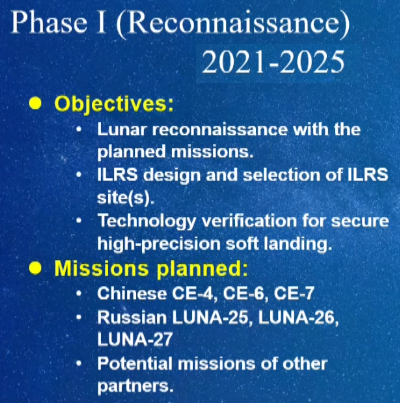
China/Russian Lunar base roadmap
The original Chinese-Russian lunar base plan, from June 2021.
Most of the Russian components are not expected to launch.

China’s state-run press today announced that it has successfully completed the first three-satellite communications test of a constellation in a Distant Retrograde Orbit (DRO) in lunar space.

DRO-A and DRO-B, two satellites developed by the Chinese Academy of Sciences (CAS) and deployed in the DRO, have established inter-satellite measurement and communication links with DRO-L, a previously launched near-Earth orbit satellite. The achievement was disclosed at a symposium on Earth-moon space DRO exploration in Beijing on Tuesday.

DRO is a unique type of orbit, and the Earth-moon space refers to the region extending outward from near-Earth and near-lunar orbits, reaching a distance of up to 2 million kilometers from Earth. In the Earth-moon space, DRO is characterized by a prograde motion around Earth and a retrograde motion around the moon, said Wang Wenbin, a researcher at the CAS’ Technology and Engineering Center for Space Utilization (CSU). Since DRO provides a highly stable orbit where spacecraft require little fuel to enter and stay, it serves as natural space hub connecting Earth, the moon and deep space, offering support for space science exploration, the deployment of space infrastructure, and crewed deep-space missions, Wang said.

On Feb. 3, 2024, the experimental DRO-L satellite was sent into a sun-synchronous orbit and began conducting experiments as planned. The DRO-A/B dual-satellite combination was launched from the Xichang Satellite Launch Center in southwest China’s Sichuan Province on March 13, 2024, but failed to enter its intended orbit due to an anomaly in the upper stage of the carrier rocket.

Facing this challenge, the satellite team performed a “life-or-death” rescue operation under extreme conditions, promptly executing multiple emergency orbit maneuvers to correct the trajectory of the two satellites. After a journey of 8.5 million kilometers, the DRO-A/B dual-satellite combination ultimately reached its designated orbit, according to Zhang Hao, a researcher at CSU who participated in the rescue operation.

On Aug. 28, 2024, the two satellites were successfully separated. Later, both DRO-A and DRO-B established K-band microwave inter-satellite measurement and communication links with DRO-L, testing the networking mode of the three-satellite constellation, Zhang said.

China’s government space program continues to follow a very rational and well-thought-out plan for establishing a manned base on the Moon, as shown in the 2021 graph to the right that China appears to be achieving as planned. While it is very likely it will not meet its 2030 goal for landing a human on the Moon, it is clearly establishing the technology for making that landing in a reasonable timeline with a later long-term permanent presence in a lunar base possible.

1 comment

German rocket startup Rocket Factory Augsburg replaces its CEO

Screen capture of test failure
Screen capture from video of test failure in August 2024.
Note the flame shooting out sideways.

In a major managerial shake-up as it preps for its first launch attempt later this year, the German rocket startup Rocket Factory Augsburg has replaced its CEO, switching from someone with more general business experience to a CEO with a lot of direct experience in the space industry itself.

In an April 11 statement not widely publicized by the company, RFA announced that Stefan Tweraser, who had been chief executive since October 2021, had been replaced by Indulis Kalnins.

The announcement did not give a reason for the change, but it suggested that the company was seeking someone with expertise in the aerospace industry to lead the company. Kalnins is on the aerospace faculty of a German university, Hochschule Bremen, and has been managing director of OHB Cosmos, which focused on launch services.

…Tweraser, by contrast, came from outside the space industry. He joined RFA after past work that included being a consultant at McKinsey & Company, country director for the DACH (Germany, Austria and Switzerland) region at Google and executive at music streaming company Deezer. [emphasis mine]

The highlighted phrase provides I think the explanation for the change. The company had hoped to launch last year, but had a major failure during a static fire engine test on the launchpad, destroying the rocket first stage. The company has probably decided it needed someone in charge who had some hands-on experience with launchpad operations.

1 comment
1 203 204 205 206 207 2,929