Exploring Arizona’s Abandoned Highway 60 and the Claypool Tunnel
An evening pause: Better late than never. I forgot to schedule some pauses. This one is fascinating because of the history of technology it reveals.
Hat tip Diane Zimmerman.
An evening pause: Better late than never. I forgot to schedule some pauses. This one is fascinating because of the history of technology it reveals.
Hat tip Diane Zimmerman.
Courtesy of BtB’s stringer Jay.
These are the same two images the company posted on April 10th, so either nothing is happening, or they are simply not telling us anything.
The idea is to simulate the lunar environment and find out ways to eliminate dust issues.
It appears the launch tower will be completed one month early, in May, with the foundation hole for the second pad 96% dug.
The company hopes with this plan it will be bought whole by a single buyer and thus saved. There remains no guarantee that will happen. The auction will now occur on May 18th.
All told, completed or parts of 11 Starships exist, as well as completed or parts of 8 Superheavies.
On Christmas Eve 1968 three Americans became the first humans to visit another world. What they did to celebrate was unexpected and profound, and will be remembered throughout all human history. Genesis: the Story of Apollo 8, Robert Zimmerman's classic history of humanity's first journey to another world, tells that story, and it is now available as both an ebook and an audiobook, both with a foreword by Valerie Anders and a new introduction by Robert Zimmerman.
The print edition can be purchased at Amazon or any other book seller. If you want an autographed copy the price is $60 for the hardback and $45 for the paperback, plus $8 shipping for each. Go here for purchasing details. The ebook is available everywhere for $5.99 (before discount) at amazon, or direct from my ebook publisher, ebookit. If you buy it from ebookit you don't support the big tech companies and the author gets a bigger cut much sooner.
"Not simply about one mission, [Genesis] is also the history of America's quest for the moon... Zimmerman has done a masterful job of tying disparate events together into a solid account of one of America's greatest human triumphs."--San Antonio Express-News
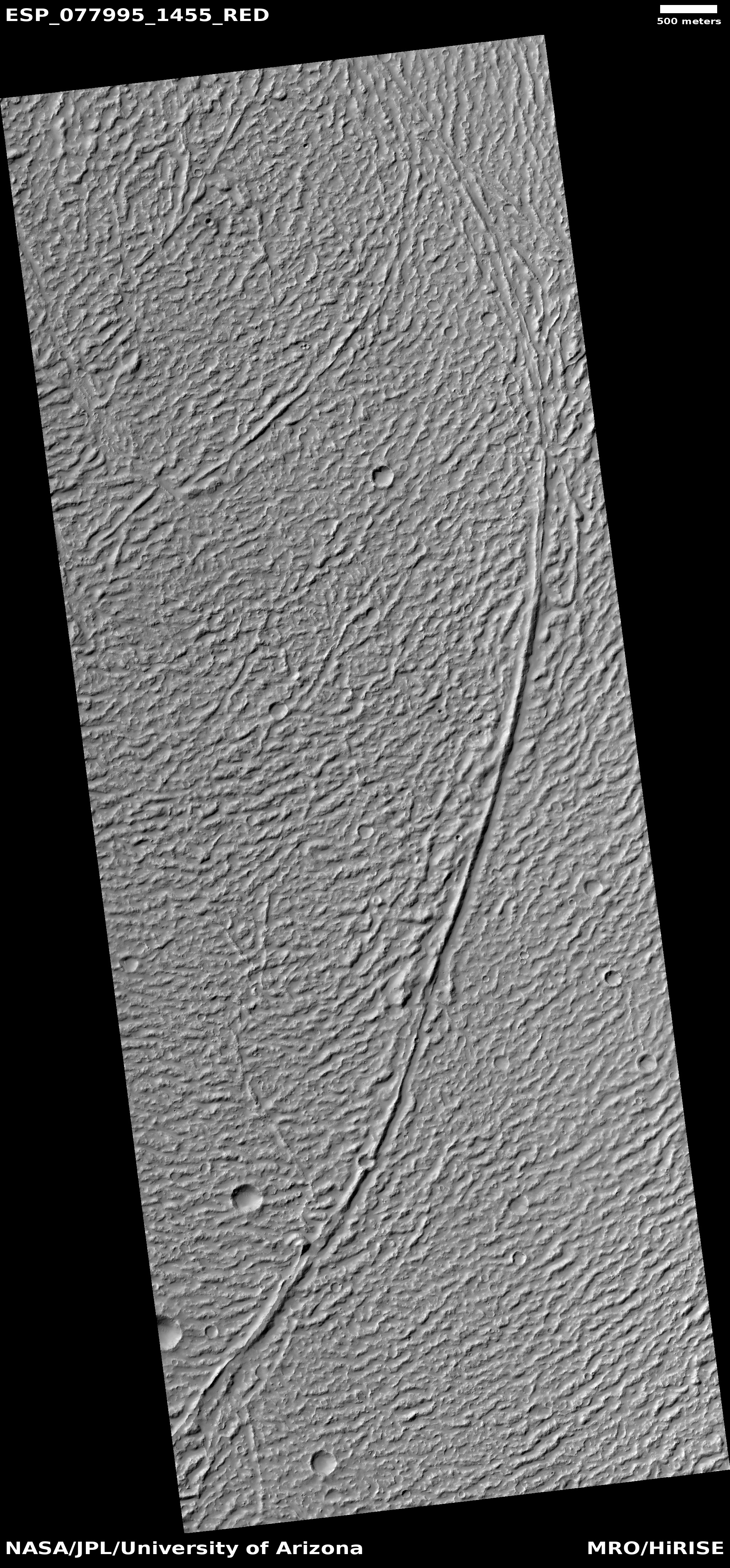
Cool image time! The picture to the right, cropped, reduced, and sharpened to post here, was taken on January 17, 2023 by the high resolution camera on Mars Reconnaissance Orbiter (MRO) by the camera team not as part of any particular research project but in order to fill a gap in the camera’s schedule so as to maintain its proper temperature. In such cases the camera team tries to pick potentially interesting spots.
This cliff, about 1,100 feet high, is the north wall of a major volcano channel flowing across the Tharsis Bulge, the lava plains that surround Mars’ giant volcanoes. Located in the dry equatorial regions, there is no near surface ice here, but a lot of dust, much of it likely volcanic ash. In the full picture are several ancient craters, all of which are almost entirely buried by this dust and ash.
The cliff wall itself is made up of numerous layers, each representing a past volcanic flood lava event that covered this region with a new flow of material. These events occurred over more than a billion years.
» Read more
NOAA this week once again published an update of its monthly graph that tracks the number of sunspots on the Sun’s Earth-facing hemisphere. As I do every month, I have posted this graph below, with some additional details included to provide some context.
In April the number of sunspots dropped again, for the second time in the past three months. The high activity previously had suggested that the solar maximum was going to be much higher than predicted, or possibly would come sooner than expected. The drop however now suggests that the fast rise in sunspot activity that we have seen since the beginning of the ramp up to solar maximum in 2020 might finally be abating.
» Read more
Now available in hardback and paperback as well as ebook!
From the press release: In this ground-breaking new history of early America, historian Robert Zimmerman not only exposes the lie behind The New York Times 1619 Project that falsely claims slavery is central to the history of the United States, he also provides profound lessons about the nature of human societies, lessons important for Americans today as well as for all future settlers on Mars and elsewhere in space.
“Zimmerman’s ground-breaking history provides every future generation the basic framework for establishing new societies on other worlds. We would be wise to heed what he says.” —Robert Zubrin, founder of the Mars Society.
All editions are available at Amazon, Barnes & Noble, and all book vendors, with the ebook priced at $5.99 before discount. All editions can also be purchased direct from the ebook publisher, ebookit, in which case you don't support the big tech companies and the author gets a bigger cut much sooner.
Autographed printed copies are also available at discount directly from the author (hardback $29.95; paperback $14.95; Shipping cost for either: $6.00). Just send an email to zimmerman @ nasw dot org.

Whitworth University, where teaching close-mindedness
is our number one goal!
They’re coming for you next: When the conservative Turning Point USA chapter at the private Christian Whitworth University in Washington state arranged a lecture from Xi Van Fleet — a refugee from communist China — it discovered it could not do so because it needed the approval of the college’s student organization, and the leaders of that organization voted 9-4 to blacklist that speaker.
On April 12, Whitworth’s student government voted 9-4 to deny a conservative group’s request to invite Chinese dissident Xi Van Fleet to speak at the university in Spokane, Washington. Van Fleet, now a Virginia resident, escaped Mao Zedong’s Cultural Revolution and frequently criticizes ideas such as critical race theory and hecklers’ vetoes that, in her view, mirror it.
The minutes of this student government meeting are available online [pdf]. If you read them, you find that it is very clear these students do not believe in freedom of speech and instead think the most important thing a college can do is to protect them from hearing ideas they don’t like. These university-level government activists also exhibited an incredible level of general ignorance. Consider this comment from Niraj Pandey, listed as an International Student Senator:
» Read more
Cool image time! The picture to the right, reduced and sharpened to post here, was taken by the Hubble Space Telescope and released today. It shows a galaxy only 30 million light years away, making almost our neighbor. From the caption:
NGC 3489 has an active galactic nucleus, or AGN. The AGN sits at the center of the galaxy, is extremely bright, and emits radiation across the entire electromagnetic spectrum as the black hole devours material that gets too close to it.
This lenticular galaxy is a Seyfert galaxy, which is a class of AGN that is dimmer than other types of AGNs. They generally don’t outshine the rest of the galaxy, so the galaxy surrounding the black hole is clearly visible. Other types of AGNs emit so much radiation that it is almost impossible to observe the host galaxy.
That active nucleus is the bright dominate sphere at the galaxy’s center, large enough to overwhelm a large percentage of the rest of the galaxy. Its existence and dominance suggests that this galaxy is aging, and is beginning the transition from a spiral to an elliptical. In fact, its arms have already mostly vanished, and there is at present little star-formation on-going.
Leaving Earth: Space Stations, Rival Superpowers, and the Quest for Interplanetary Travel, can be purchased as an ebook everywhere for only $3.99 (before discount) at amazon, Barnes & Noble, all ebook vendors, or direct from my ebook publisher, ebookit.
If you buy it from ebookit you don't support the big oppressive tech companies and I get a bigger cut much sooner.
"Leaving Earth is one of the best and certainly the most comprehensive summary of our drive into space that I have ever read. It will be invaluable to future scholars because it will tell them how the next chapter of human history opened." -- Arthur C. Clarke
According to an official from the startup SUAS Aerospace, Ireland is an ideal location for the creation of a new spaceport.
Mr O’Halloran, who is now vice chairman of Irish space company SUAS Aerospace, said space vehicles could be launched from Ireland for telecommunications, environmental monitoring, or medical experiments.
…He later told the Irish Examiner: “There are loads of companies in Europe that need to have a facility of a launch pad, or a spaceport, and by and large they are all heading towards the Azores. The UK is now starting to set up spaceports, but they are now outside the EU. Ireland is ideal as a launching site.”
This Irish company’s focus, according to its website, is “…to build a leading European Space Port providing flexible commercial satellite launch facilities with provision for engine and rocket testing.” And it wants to do it in Ireland. O’Halloran’s speech was an effort to gin up both private and government support for the project, including a commitment of the Irish government to provide it the land it needs for such a site.
There are already three spaceports under development within the EU, in Spain, Norway, and Sweden, all of which at the moment are for suborbital rockets exclusively. Ireland’s location could make it a better choice for orbital launches, as it has many more options for flight paths over the Atlantic without crossing land.
An UP Aerospace suborbital rocket exploded yesterday only four seconds after launch in New Mexico, destroying a number of private and NASA science and commercial payloads.
An UP Aerospace rocket, 20 feet tall and carrying a NASA payload, exploded moments after liftoff today. The unfortunate event not only affected the NASA TechRise Student Challenge payloads but also delayed a poignant tribute to the late NASA astronaut, Phillip K. Chapman, and chemist Louise Ann O’Deen.
The rocket was set to launch the cremated remains of Chapman, NASA’s first Australian-born American astronaut, finally granting him his long-awaited journey to space.
Chapman and O’Deen’s remains were payloads from the commercial company Celestis. The thirteen NASA payloads were part of its TechRise Student Challenge program for 6th to 12th grade students.
An evening pause: A bit of energy to start the week. Performed live 1991. For those unfamiliar with this rock piece (like me), I think it helpful here to turn on captions to find out what the performers and audience are singing.
Hat tip James Street.
Courtesy of BtB’s stringer Jay.
This is a Reddit discussion, so nothing is confirmed. Someone else notes the company has over 7500 employees according to Linkedin, while another notes again Bezos’ billion dollar per year commitment to the company. None of that has yet produced an orbital rocket, or a robust production line of BE-4 rocket engines.
To be used to test the upper stage? Its engines? A dummy stage? And when? New Glenn development started almost a decade ago. One wonders.
No word on when it goes into operation
Cool image time! The picture to the right, rotated, cropped, reduced, and sharpened to post here, was taken on February 19, 2023 by the high resolution camera on Mars Reconnaissance Orbiter (MRO). It shows the many many many layers that are found in the cliffs of Valles Marineris, the largest known canyon in the solar system and far far larger that Earth’s Grand Canyon.
The elevation difference between the red dots is just under 4,000 feet. Yet that high point is still more than 7,000 feet below the rim of the canyon, more than thirty miles to the south. And the lower dot is still about 18,000 feet above the low point in this side canyon of Valles Marineris, about thirty miles away to the northeast.
In other words, in sixty miles from rim to floor the canyon at this location drops about 25,000 feet, only 4,000 feet less than the height of Mount Everest. Compare that with the Grand Canyon’s slopes, which drops in eleven miles about 5,000 feet, beginning at the main south rim lookout at the start of Bright Angel trail.
» Read more

Starship/Superheavy at T+4:02, just after the self-destruct command
was issued on April 20, 2023. It also appears to be the fate of SpaceX’s
entire Boca Chica operation, if the environmental radicals get their way.
A group of environmental groups as well as a non-profit corporation calling itself the Carrizo/Comecrudo Nation of Texas, Inc, today filed a lawsuit against the Federal Aviation Administration FAA), demanding it shut down SpaceX’s Boca Chica facility and block all further Superheavy/Starship launches.
You can read the lawsuit here [pdf]. Its essence is contained in these two paragraphs:
The area surrounding the SpaceX facility at Boca Chica is a biologically diverse and essential habitat area for many species, including federally protected wildlife and animals that are considered sacred to the Carrizo/Comecrudo People, such as the critically endangered ocelot. The SpaceX facility is smack in the middle of publicly owned conservation, park, and recreation lands, including a National Wildlife Refuge, two State Parks, a State Wildlife Management Area, and a State Coastal Preserve. These lands are of extraordinary conservation value for a range of federally and state lists wildlife and other protected species such as migratory birds. Bird species from both the Central and Mississippi flyways converge there, making it an essential wintering and stopover area for migratory birds as they move north and south each year.
SpaceX activities authorized in the FONSI/ROD [the environmental reassessment issued last year] have and will adversely affect the surrounding wildlife habitat and communities. In addition to harm from construction activities and increased vehicle traffic, rocket launches result in intense heat, noise, and light pollution. Furthermore, the rocket launches and testing result in explosions which spread debris across surrounding habitat and cause brush/forest fires — including one that recently burned 68 acres of adjacent National Wildlife Refuge. The FAA calls these explosions “anomalies,” but in fact they occur frequently, with at least 8 over the past 5 years. FAA acknowledged that many more such “anomalies” are expected over the next 5 years. The U.S. Fish and Wildlife Service has found that prior SpaceX rocket explosions harmed protected wildlife and designated habitat in violation of the Endangered Species Act (ESA).
In other words, rockets and launch sites should never be placed inside wildlife refuges, because such activity is detrimental to wildlife.
A more false statement cannot be made. Under this conclusion the launch facilities at Cape Canaveral, which have been operating in the middle of a wildlife refuge now for more than six decades, should be shut down immediately. All the wildlife there must certainly be dead!
» Read more
Cool image time! The picture to the right has been significantly reduced but also significantly sharpened to post here. It was taken by the Hubble Space Telescope as part of a recent survey of “jellyfish” galaxies, galaxies located in galaxy clusters where there is a large concentration of galaxies whose combined gravity and intergalactic environment acts to pull material or “tendrils” out from the galaxy.
Rather than crop the image to focus on that single large central jellyfish galaxy, I have instead sharpened the much-reduced full photo to bring out clearly the number of surrounding galaxies. There is only one Milky Way star in this picture, the object with the four diffraction spikes in the lower-right. Every other dot is a galaxy, many of which can be seen to be very strangely shaped in the original full resolution image. In fact, I strongly recommend you click on the picture to explore that original image, just to see the variety of galaxy shapes.
The point of this picture today however is not to illustrate the wide variety of galaxies that can exist, but to underline the vast and largely incomprehensible scale of the universe. The large galaxy is thought to be 650 million light years away, which means it took light traveling at 186,000 miles per second that many years to get here. The surrounding galaxies are also all tens to hundreds of millions of light years from each other. Yet, their combined gravity, almost infinitesimal in strength, is enough to warp the shape of each.
We understand these numbers and facts intellectually, but do we understand them in reality? I think it is difficult, even if you work hard to come up with a scaled comparison. For example, it took nine years for the New Horizons spacecraft to get from Earth to Pluto, a distance of about 4.5 light hours. And New Horizons was the fastest traveling probe ever launched, moving at 36,400 miles per hour when it left Earth. Yet, this distance is nothing compared to the distance between these galaxies.
The vastness of existence really is beyond our comprehension. That we try to comprehend it speaks well of the human desire to achieve the impossible.
With SpaceX’s Falcon Heavy having just completed the first of three launches for Viasat’s new geosynchronous constellation of communication satellites, the satellite company has announced that it is cancelling its launch contract with Ariane-6 for the third launch.
The decision means the launch contract is up for grabs for the third ViaSat 3 internet satellite, the last of a three-satellite constellation Viasat is deploying to provide global broadband connectivity from space.
Viasat announced in 2018 it selected SpaceX, United Launch Alliance, and Arianespace to each launch one ViaSat 3 satellite, awarding launch contracts to three industry leaders.
The ULA launch, on its Atlas-5 rocket, is still scheduled for either late this year or early next.
The development of Ariane-6 however is years behind schedule. Furthermore, Arianespace has given priority on Ariane-6 to all of the ESA launches that formerly were going to be launched on Russian Soyuz rockets, further delaying Viasat’s launch.
For Viasat, the delays have become unacceptable, and it has now opened that third launch to bidding. Though both ULA’s Vulcan and Blue Origin’s New Glenn rockets could do the job, neither is operational either. It appears SpaceX’s Falcon Heavy is the only rocket available and is therefore almost certain to get the contract, a conclusion further confirmed by the timing of this announcement, just prior to that successful Falcon Heavy launch.
SpaceX today successfully placed a Viasat communications satellite into geosynchronous orbit using its Falcon Heavy rocket, completing its second launch in 2023. Also on board were two smallsats.
The company did not recover either side booster or the core stage in order to give the rocket the maximum lift to put Viasat’s satellite into its proper orbit. With this flight, the two side boosters had successfully completed eight and three missions during their lifespan.
The leaders in the 2023 launch race:
28 SpaceX
16 China
6 Russia
3 Rocket Lab
3 India
American private enterprise now leads China 31 to 16 in the national rankings, and the entire world combined 31 to 28. SpaceX by itself trails the entire world, including American companies, 28 to 31.
Yesterday Elon Musk held an hour-long audio press conference with a number of space reporters, broadcast over youtube. I have embedded that conference below, for those of my readers who wish to hear what Musk had to say, in his own words.
The key take-aways from Musk:
When asked about obtaining the permit for that next flight, Musk side-stepped the question. It remains to my mind the largest obstacle for meeting his schedule.
» Read more
European Space Agency officials revealed yesterday that the 52-foot radar antenna on its JUICE probe to Jupiter has failed to deploy as planned, and that they are attempting to shake what they think is a small pin free that is in the way.
Engineers suspect a tiny pin may be protruding. Flight controllers in Germany plan to fire the spacecraft’s engine in hopes of shaking the pin loose. If that doesn’t work, they said they have plenty of time to solve the problem.
Juice, short for Jupiter Icy Moons Explorer, won’t reach the giant planet until 2031. It’s taking a roundabout path to get there, including gravity-assist flybys of Earth and our moon, and Venus.
The radar antenna is needed to peer beneath the icy crust of three Jupiter moons suspected of harboring underground oceans and possibly life, a major goal of the nearly $1.8 billion mission. Its targets include Callisto, Europa and Ganymede, the largest moon in the solar system.
If this antenna cannot be freed, it will prevent JUICE from doing one of its prime missions.
Embedded below the fold in two parts.
To listen to all of John Batchelor’s podcasts, go here.
» Read more
An evening pause: A drone view of the Thornton Quarry in Illinois, one of the largest stone quarries in the world, which is located here.
Hat tip Wayne DeVette.
SpaceX today successfully used its Falcon 9 rocket to put a SES communications satellite into orbit.
The first stage successfully completed its eighth flight, landing on a drone ship in the Atlantic.
The company also attempted to complete a second launch just a little more than three hours later from Cape Canaveral, but the countdown of the Falcon Heavy rocket aborted just 59 seconds prior to liftoff. No word on what happened, though the company has another launch window beginning around 7:30 pm Eastern time tomorrow. If successful it would be the second Falcon Heavy launch in 2023, using two side boosters flying their eighth and third flights respectively. Because of the fuel needs of the payload, neither the side boosters or the core stage will be recovered.
The leaders in the 2023 launch race:
27 SpaceX
16 China
6 Russia
3 Rocket Lab
3 India
American private enterprise now leads China 30 to 16 in the national rankings, and the entire world combined 30 to 28. SpaceX by itself trails the rest of the world, including other American companies, 27 to 31.