June 12, 2024 Zimmerman/Batchelor podcast
Embedded below the fold in two parts.
To listen to all of John Batchelor’s podcasts, go here.
» Read more
Embedded below the fold in two parts.
To listen to all of John Batchelor’s podcasts, go here.
» Read more
An evening pause: I posted a different performance of this song by Steward in 2015. The live version below, performed live in 2020, includes a fascinating intro that describes the roots of the song, as well as some spectacular guitar solos.
Hat tip Wayne DeVette.
On Christmas Eve 1968 three Americans became the first humans to visit another world. What they did to celebrate was unexpected and profound, and will be remembered throughout all human history. Genesis: the Story of Apollo 8, Robert Zimmerman's classic history of humanity's first journey to another world, tells that story, and it is now available as both an ebook and an audiobook, both with a foreword by Valerie Anders and a new introduction by Robert Zimmerman.
The print edition can be purchased at Amazon or any other book seller. If you want an autographed copy the price is $60 for the hardback and $45 for the paperback, plus $8 shipping for each. Go here for purchasing details. The ebook is available everywhere for $5.99 (before discount) at amazon, or direct from my ebook publisher, ebookit. If you buy it from ebookit you don't support the big tech companies and the author gets a bigger cut much sooner.
"Not simply about one mission, [Genesis] is also the history of America's quest for the moon... Zimmerman has done a masterful job of tying disparate events together into a solid account of one of America's greatest human triumphs."--San Antonio Express-News
Armenia, formerly part of the Soviet Union, has now joined the American space alliance by signing the Artemis Accords, becoming the 43rd nation to do so.
This announcement came on the same day Armenia’s prime minister announced that the country was also leaving the Collective Security Treaty Organization (CSTO), created after the break-up of the Soviet Union and created from former U.S.S.R. provinces that are now separate nations.
Armenia’s ties with Russia, its long-time sponsor and ally, have grown increasingly strained after Azerbaijan waged a lightning military campaign in September to take the Karabakh region, ending three decades of ethnic Armenian separatist rule there.
Armenian authorities accused Russian peacekeepers who were deployed to Nagorno-Karabakh after a previous round of hostilities in 2020 of failing to stop Azerbaijan’s onslaught. Moscow, which has a military base in Armenia, rejected the accusations, arguing that its troops didn’t have a mandate to intervene.
It could also be that Armenian sees Russia as a hostile power, considering its invasion of the Ukraine. Russia’s failure to win quickly in the Ukraine and the bogged down nature of the war also make this a very good moment to break free from Russia. Putin doesn’t have the resources to invade another neighbor.
The Artemis Accords now includes these nations: Angola, Argentina, Armenia, Australia, Bahrain, Belgium, Brazil, Bulgaria, Canada, Colombia, Czech Republic, Ecuador, France, Germany, Greece, Iceland, India, Israel, Italy, Japan, Lithuania, Luxembourg, Mexico, the Netherlands, New Zealand, Nigeria, Peru, Poland, Romania, Rwanda, Saudi Arabia, Singapore, Slovakia, Slovenia, South Korea, Spain, Sweden, Switzerland, the United Kingdom, the United Arab Emirates, the Ukraine, the United States and Uruguay.
Whether it will do much depends wholly on what the U.S. does. Right now, the American government’s space effort is confused and incoherent. There is a lot of money being spread around, but not much getting accomplished.
Courtesy of BtB’s stringer Jay. This post is also an open thread. I welcome my readers to post any comments or additional links relating to any space issues, even if unrelated to the links below.
There are only 16 Atlas-5 launches left, with all the rockets now built and ready, leaving room for the assembly of Vulcan rockets.
This phenomenon is similar to another new aurora type that scientists claim to have discovered in 2017 and stupidly dubbed “Steve,” a name so asinine I have found it impossible to take the whole thing seriously.
The tweet does not say the country, but Jay says it is Sierra Leone.
Jay notes that their subscription price is $4,000 a month, gigantic compared to Starlink or any other similar service.
Now available in hardback and paperback as well as ebook!
From the press release: In this ground-breaking new history of early America, historian Robert Zimmerman not only exposes the lie behind The New York Times 1619 Project that falsely claims slavery is central to the history of the United States, he also provides profound lessons about the nature of human societies, lessons important for Americans today as well as for all future settlers on Mars and elsewhere in space.
“Zimmerman’s ground-breaking history provides every future generation the basic framework for establishing new societies on other worlds. We would be wise to heed what he says.” —Robert Zubrin, founder of the Mars Society.
All editions are available at Amazon, Barnes & Noble, and all book vendors, with the ebook priced at $5.99 before discount. All editions can also be purchased direct from the ebook publisher, ebookit, in which case you don't support the big tech companies and the author gets a bigger cut much sooner.
Autographed printed copies are also available at discount directly from the author (hardback $29.95; paperback $14.95; Shipping cost for either: $6.00). Just send an email to zimmerman @ nasw dot org.

The American Geophysical Union, where
science is no longer practiced
We’re all gonna die! According to a new paper touted today by the PR department of the American Geophysical Union (AGU), a new study has concluded — based on computer modeling — that the many giant satellite constellations totaling tens of thousands of satellites pose a risk to the ozone layer because the aluminium used in their structures that gets vaporized upon re-entry will interact with the ozone layer and destroy it.
You can read the paper here. From the abstract:
This paper investigates the oxidation process of the satellite’s aluminum content during atmospheric reentry utilizing atomic-scale molecular dynamics simulations. We find that the population of reentering satellites in 2022 caused a 29.5% increase of aluminum in the atmosphere above the natural level, resulting in around 17 metric tons of aluminum oxides injected into the mesosphere. The byproducts generated by the reentry of satellites in a future scenario where mega-constellations come to fruition can reach over 360 metric tons per year. As aluminum oxide nanoparticles may remain in the atmosphere for decades, they can cause significant ozone depletion.
The uncertainties and biases here are hard to count. First, it is a computer model (“Garbage in, garbage out”). Second, the simulations make many assumptions, most of which cannot be confirmed, or are simply absurd. For example, the model is based on a single “typcial, small satellite” coming from a specific orbit and elevation when we know these satellites will have many variations in size, make-up, and orbits. Third, the scientists admit they use “a worst-case scenario” for determining what would happen when the satellite re-enters the atmosphere.
Finally, and most damning, the whole premise of this threat is based on a somewhat implausive chain of chemical actions.
» Read more

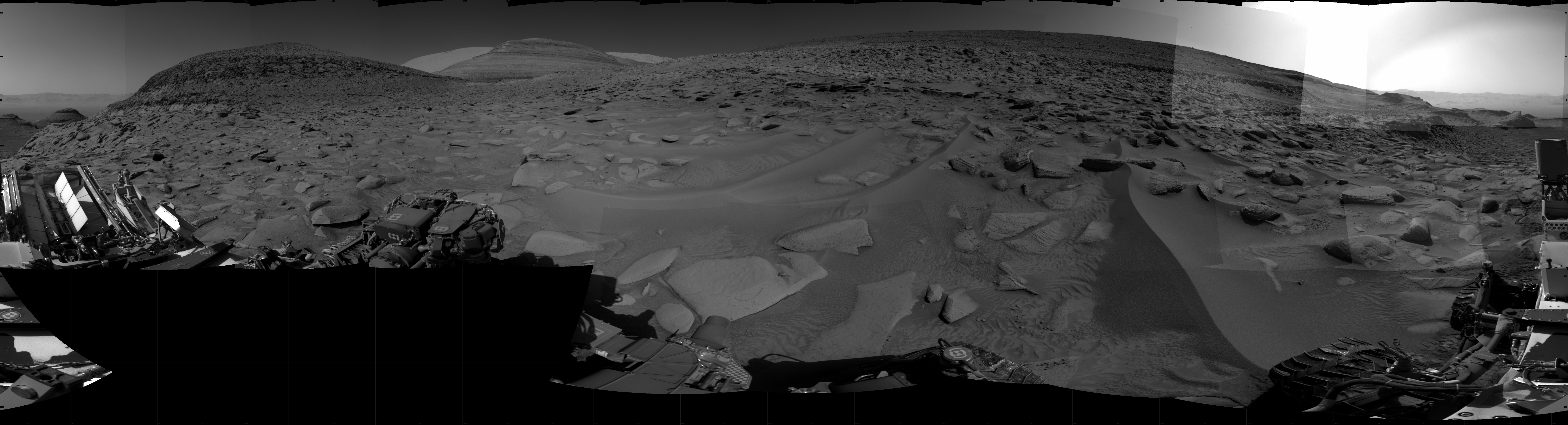
Click for full resolution. For original images, go here, here, here, and here.
Cool image time. The panorama above was created from four pictures taken on June 10, 2024 by the left navigation camera on the Mars rover Perseverance (captions found here, here, here, and here). It looks north at the nearest hill that forms the north part of the rim of Jezero Crater.
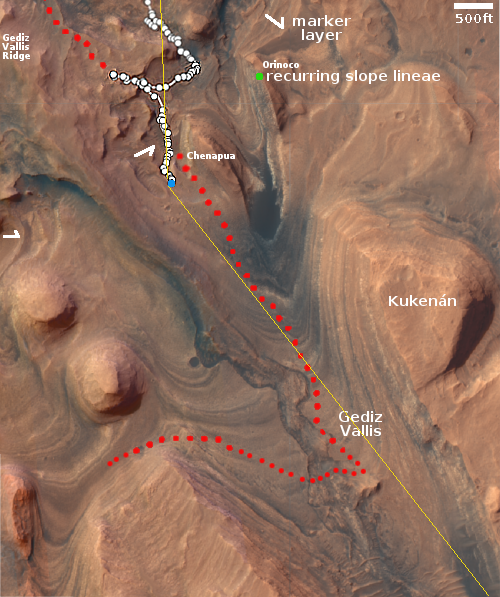
The overview map to the right provides context. The blue dot marks Perseverance’s present location, when it took these pictures. The yellow lines indicate the approximate area covered by the panorama. The red dotted line marks the rover’s planned route, while the white dotted line the route it has actually taken.
Because the rover is now at the base of this hill, it can no longer see the top of the crater’s rim. What it sees instead is the barren foothills of that rim, covered with dust, dunes, and many broken rocks.
As I have noted numerous times, the utter lack of life marks this as a truly alien landscape, compared to Earth. Nowhere on our home planet would you see terrain this empty of life. While NASA likes to claim that Perseverance’s main mission is the search for life on Mars, that claim is always a lie. It is very unlikely any life is going to be found here by Perseverance, and if that was its true scientific purpose it would never have been built nor launched.
What the scientists are doing is studying the alien geology of Mars, to try to understand how this utterly alien planet got to be the way it is now. Such knowledge is critical for the future explorers of space, as it will make it easier for them to understand the alien landscapes they will find elsewhere, within the solar system and eventually in other solar systems far beyond.
Leaving Earth: Space Stations, Rival Superpowers, and the Quest for Interplanetary Travel, can be purchased as an ebook everywhere for only $3.99 (before discount) at amazon, Barnes & Noble, all ebook vendors, or direct from my ebook publisher, ebookit.
If you buy it from ebookit you don't support the big oppressive tech companies and I get a bigger cut much sooner.
"Leaving Earth is one of the best and certainly the most comprehensive summary of our drive into space that I have ever read. It will be invaluable to future scholars because it will tell them how the next chapter of human history opened." -- Arthur C. Clarke

Click to see original three-frame movie.
Cool image time! The picture to the right is a screen capture from a three-frame movie created from photos taken by one of the navigation cameras on the Mars rover Curiosity. The white streak and other smaller streaks were created by charged particles hitting the camera’s CCD detector on May 20, 2024, from a solar storm caused by the strong solar flares presently being pumped out by the Sun.
The mission regularly captures videos to try and catch dust devils, or dust-bearing whirlwinds. While none were spotted in this particular sequence of images, engineers did see streaks and specks – visual artifacts created when charged particles from the Sun hit the camera’s image detector. The particles do not damage the detector.
The images in this sequence appear grainy because navigation-camera images are processed to highlight changes in the landscape from frame to frame. When there isn’t much change — in this case, the rover was parked — more noise appears in the image.
Curiosity’s Radiation Assessment Detector (RAD) measured a sharp increase in radiation at this time – the biggest radiation surge the mission has seen since landing in 2012.
The view of this picture is to the south, looking towards the top of Mount Sharp, though that peak, more than 25 miles away, is not visible because the mountain’s lower flanks are in the way. A second movie showing similar charged particle streaks was taken looking south, with the rim of Gale Crater barely visible 20-30 miles away.
SpaceX yesterday sent a crew and a U-Haul truck to five different farms in Saskatchewan, Canada, to retrieve eight pieces of debris that came from the service module trunk of a Dragon cargo capsule when the trunk was de-orbited to burn up in the atmosphere in February.
I am certain SpaceX engineers want to find out why this debris survived its fall through the atmosphere, so as to better predict what will happen on future de-orbits. If they determine that more of Dragon’s service module survives re-entry than previously predicted, it will require a rethinking on where such de-orbits are planned, making sure they always occur over the ocean.
It also appears that an academic who doesn’t know much about space engineering showed up during this retrieval to talk to the press and attack SpaceX.
Samantha Lawler, a University of Regina astronomy professor, was at the farm when SpaceX employees arrived on Tuesday. She said SpaceX needs to be transparent about how its operations are affecting the atmosphere, and how incidents like this are dealt with.
Lawler was quoted more fully (and more embarrassingly) in this other news report:
“SpaceX has over 6,000 Starlink satellites in orbit that they claim will burn up completely when they re-enter. That comes to 23 re-entries per-day when they are at full capacity. If those re-entries are all making it to the ground, dropping hundred pound pieces of garbage, that will kill lots of people,” Lawler explained.
To claim that any Starlink satellites are threat to hit the ground proves Lawler knowns nothing about space engineering and is acting merely as a anti-SpaceX “Karen” who wants to harass the company. Starlink satellites are too small to pose a threat. Moreover, SpaceX from day one has acted responsibly to de-orbit them under a controlled manner.
Nonetheless, this incident in Canada suggests that more material from larger orbiting objects can reach the ground, and requires a rethinking as to where to de-orbit them.
In doing a detailed global analysis of all the known gullies on Mars, scientists now believe the gullies are formed by a variety of factors, linked to both water and carbon dioxide as well as the planet’s radically changing rotational tilt — varying from 11 to 60 degrees — over time.
Noblet’s paper articulates a “hierarchy of factors” that describes where gullies occur, with well-supported explanations as to why they form in one place and not another. None of the explanations in this paper are new. What’s new is how Noblet and coworkers reconcile apparent contradictions and inconsistencies among other researchers’ explanations of gully formation, explaining why an explanation that works for one spot on Mars doesn’t work in another.
The map above, from their paper, shows the global distribution of the gullies, which appear to favor the same mid-latitudes where the planet’s glaciers are mostly found. The data from many different studies suggests that when the planet’s rotational tilt was high, these mid-latitudes regions were warmer, and the near-surface ice there would sublimate away to get redeposited at the poles. When this happened the sublimation would cause the pole-facing gullies to form.
The paper also suggests that any gullies changing today are likely the result of the sublimation of carbon dioxide, not water.
There is a lot more at the article at the link, which is an excellent summation of this research.
The Pentagon is so impressed with its experience using SpaceX’s Starlink system as well as its military-hardened version dubbed Starshield that it is negotiating the purchase from SpaceX of its own 100-satellite Starshield constellation.
Col. Eric Felt, director of space architecture at the office of the assistant secretary of the Air Force for space acquisition and integration, said the plan is to acquire a constellation of Starshield satellites by 2029, contingent upon receiving the necessary funding appropriations from Congress.
Speaking at SAE Media Group’s Milsatcom USA conference on June 10, Felt noted that the military has been an avid consumer of SpaceX’s commercial Starlink services, but also wants to take advantage of the company’s dedicated Starshield product line and procure a government-owned constellation. In a briefing slide presented at the conference, titled “Satcom 2029,” Felt showed the DoD’s notional future satcom architecture including more than 100 Starshield satellites.
If approved for funding from Congress, this Starshield constellation would be used in conjunction with other military communciations satellites, which could also include satellites provided by other satellite companies such as Amazon and its as-yet unlaunched Kuiper constellation. The main advantage for such a system is redundancy. It is very difficult for an enemy to take the system down, since it uses so many small satellites. It is also cheaper to maintain and upgrade.
New research now suggests strongly that the exposure to cosmic rays during a three-year-long mission to Mars would cause permanent damage to a person’s kidneys.
The results indicated that both human and animal kidneys are ‘remodelled’ by the conditions in space, with specific kidney tubules responsible for fine tuning calcium and salt balance showing signs of shrinkage after less than a month in space. Researchers say the likely cause of this is microgravity rather than GCR [galactic cosmic rays], though further research is required to determine if the interaction of microgravity and GCR can accelerate or worsen these structural changes.
The primary reason that kidney stones develop during space missions had previously been assumed to be solely due to microgravity-induced bone loss that leads to a build-up of calcium in the urine. Rather, the UCL team’s findings indicated that the way the kidneys process salts is fundamentally altered by space flight and likely a primary contributor to kidney stone formation.
Perhaps the most alarming finding, at least for any astronaut considering a three-year round trip to Mars, is that the kidneys of mice exposed to radiation simulating GCR for 2.5 years experienced permanent damage and loss of function. [emphasis mine]
The study used samples “from over 40 Low Earth orbit space missions involving humans and mice, most of which were to the International Space Station, as well as 11 space simulations involving mice and rats.”
If these results are confirmed, it means that any interplanetary spaceship is going to require significant shielding. Having a safe haven they can go to during high energy solar events will not work, as cosmic rays arrive randomly at all times. This research thus tells us that we can’t simply add engines to the space station designs presently being built to send them to Mars. Instead, we need a heavy-lifte capability (such as Starship) to get the much heavier, well-shielded habitable modules into orbit.
The rocket startup Stoke Space has successfully completed the first static fire test of the methane-fueled rocket engine that will be used on the first stage of its entirely reusable Nova rocket.
The engine, designed to produce up to 100,000 pounds-force of thrust, went up to 50% of its rated thrust in the two-second test. The goal of the test was to see how the engine started up and shut down, Andy Lapsa, chief executive of Stoke, said in an interview. “All of the complexity and a lot of the risk is in that startup transient and shutdown transient,” he said. “The duration of the test was short because the goal was to demonstrate the transient and then back out.”
The engine uses a design called full-flow staged combustion, where both the engine’s fuel and oxidizer — liquified natural gas and liquid oxygen, respectively — go through separate preburners before going into the main combustion chamber. That approach offers greater efficiency and a longer engine life, but is more complex to develop. It is currently used only on SpaceX’s Raptor engines that power its Starship vehicle.
The rocket’s upper stage uses hydrogen as its fuel, as well as a radical nozzle design. Instead of a single large nozzle, the thrust is released from a ring of tiny outlets at the permeter of the stage. It is hoped this design will better protect the system during re-entry from orbit, while allowing for more precise control upon landing, and thus make it possible to reuse the upper stage.
The first test launch is presently scheduled for 2025. This new engine test makes that date more realistic.