December 16, 2022 Zimmerman/Batchelor podcast
Embedded below the fold in two parts.
To listen to all of John Batchelor’s podcasts, go here.
» Read more
Embedded below the fold in two parts.
To listen to all of John Batchelor’s podcasts, go here.
» Read more
An evening pause: Hat tip Judd Clark.
On Christmas Eve 1968 three Americans became the first humans to visit another world. What they did to celebrate was unexpected and profound, and will be remembered throughout all human history. Genesis: the Story of Apollo 8, Robert Zimmerman's classic history of humanity's first journey to another world, tells that story, and it is now available as both an ebook and an audiobook, both with a foreword by Valerie Anders and a new introduction by Robert Zimmerman.
The print edition can be purchased at Amazon or any other book seller. If you want an autographed copy the price is $60 for the hardback and $45 for the paperback, plus $8 shipping for each. Go here for purchasing details. The ebook is available everywhere for $5.99 (before discount) at amazon, or direct from my ebook publisher, ebookit. If you buy it from ebookit you don't support the big tech companies and the author gets a bigger cut much sooner.
"Not simply about one mission, [Genesis] is also the history of America's quest for the moon... Zimmerman has done a masterful job of tying disparate events together into a solid account of one of America's greatest human triumphs."--San Antonio Express-News
SpaceX today successfully launched two communications satellites for the satellite company SES, beginning SpaceX’s contract to launch more satellites in its constellation of medium-Earth orbit satellites, replacing the Russians.
The first stage successfully flew its eighth flight, and landed successfully on a drone ship in the Atlantic.
This was also the company’s second launch today, with another launch scheduled for tomorrow.
The leaders in the 2022 launch race:
60 China
58 SpaceX
21 Russia
9 Rocket Lab
8 ULA
The U.S. now leads China 82 to 60 in the national rankings, but trails the entire world combined 92 to 82.
Courtesy of Jay, BtB’s stringer.
The EU issued the sanction because Tereshkova, as a member of Russia’s Duma, voted in favor of the annexation of several Ukrainian provinces. This means she cannot visit her daughter in Italy.
What makes this even more disgusting is that it was NASA red tape that delayed the launch more than two years. And yet, that wasn’t enough time for these idiots to do their paperwork so that competent people can actually accomplish something on schedule.
Now available in hardback and paperback as well as ebook!
From the press release: In this ground-breaking new history of early America, historian Robert Zimmerman not only exposes the lie behind The New York Times 1619 Project that falsely claims slavery is central to the history of the United States, he also provides profound lessons about the nature of human societies, lessons important for Americans today as well as for all future settlers on Mars and elsewhere in space.
“Zimmerman’s ground-breaking history provides every future generation the basic framework for establishing new societies on other worlds. We would be wise to heed what he says.” —Robert Zubrin, founder of the Mars Society.
All editions are available at Amazon, Barnes & Noble, and all book vendors, with the ebook priced at $5.99 before discount. All editions can also be purchased direct from the ebook publisher, ebookit, in which case you don't support the big tech companies and the author gets a bigger cut much sooner.
Autographed printed copies are also available at discount directly from the author (hardback $29.95; paperback $14.95; Shipping cost for either: $6.00). Just send an email to zimmerman @ nasw dot org.
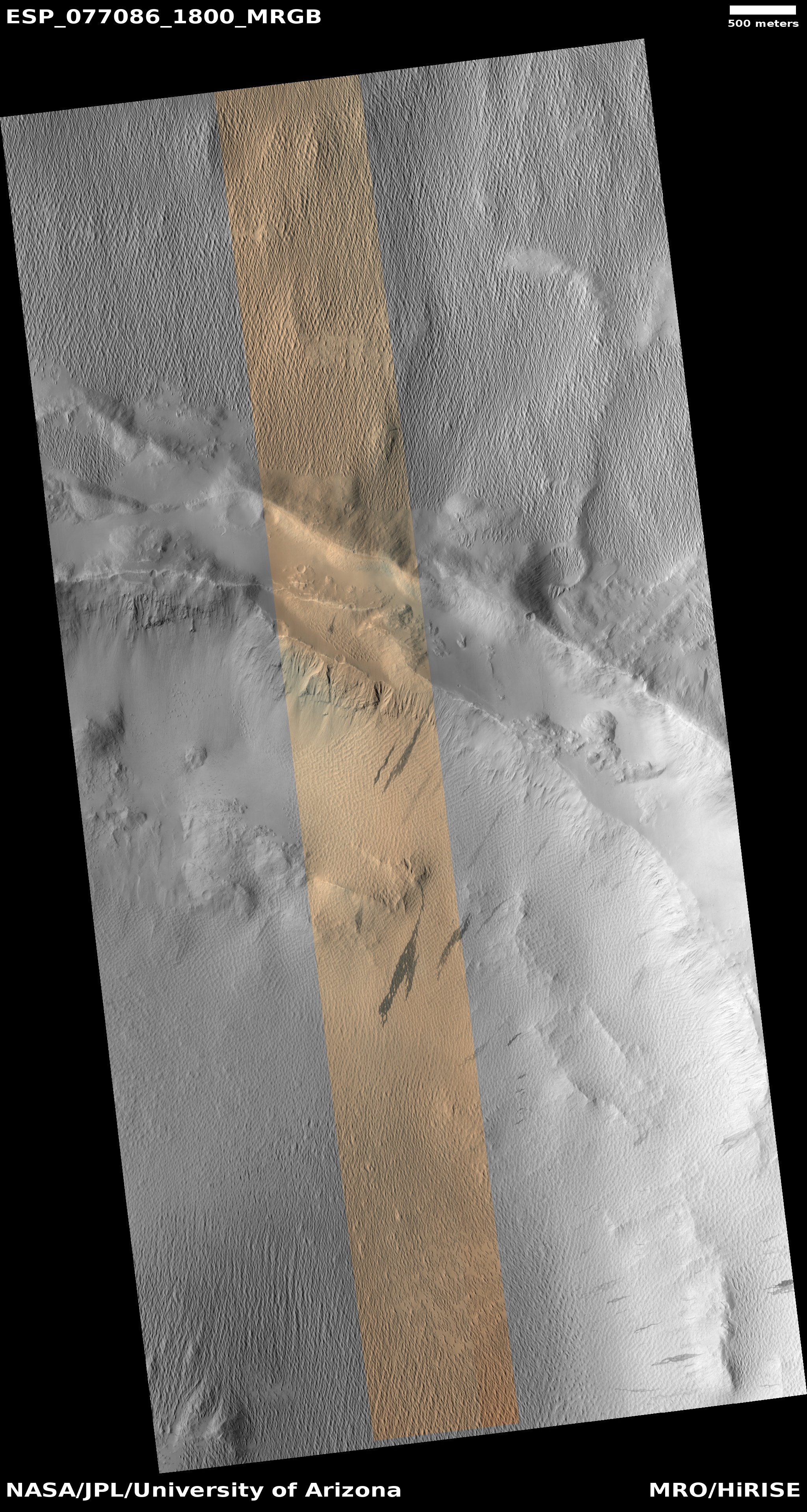
Cool image time! The photo to the right, rotated, cropped, reduced, and sharpened to post here, was taken on September 4, 2022 by the high resolution camera on Mars Reconnaissance Orbiter (MRO). The MRO science team labeled this simply “Diverse Terrain,” an apt description but woefully incomplete.
Though the grade here goes uphill to the south, there are ups and downs along the way. The flat areas near the top as well that band near the bottom appear to be the oldest terrain, with the rough hollows appearing to be places where that flat material has sublimated or eroded away.
This terrain is in the very high southern latitudes. South is to the bottom of this picture, with the south pole of Mars about 380 miles away. Thus, that eroding top layer is likely disappearing because it has either water ice or dry ice within it, and over time it sublimates away.
The picture itself was taken in winter, when the entire surface is likely covered with a thin mantle of dry ice that fell as snow with the coming of colder temperatures. A wider view of this region in the spring, taken by MRO’s context camera, shows that this mantle, now appearing like white frost, appears largely confined to the higher terrain. Apparently, the annual sublimation of this dry ice mantle is linked somehow to the erosion of this flat terrain.
The additional location information provided by overview map below helps explain why this terrain is so diverse.
» Read more
Cool image time! The photo to the right, reduced and cropped to post here, was taken by the Hubble Space Telescope and shows a barred spiral galaxy about 214 million light years away.
Scientists used NASA’s Hubble Space Telescope to image NGC 6956 to study its Cepheid variable stars, which are stars that brighten and dim at regular periods. Since the period of Cepheid variable stars is a function of their brightness, scientists can measure how bright these stars appear from Earth and compare it to their actual brightness to calculate their distance. As a result, these stars are extremely useful in determining the distance of cosmic objects, which is one of the hardest pieces of information to measure for extragalactic objects.
The press release of course focuses on this magnificent barred spiral. I however want to draw your attention to the smaller galaxy in the white box.
Since we do not know the distance to this distorted galaxy, we do not know if its distortion is caused by the barred spiral. It could be the bigger galaxy’s gravity is pulling material away.
More likely, based on the shape of this smaller galaxy, is that it is many light years farther away — which is why it looks so much smaller — and has been distorted because it is actually a collusion of two galaxies. The two bright nuclei with the red dust between strongly suggests such a collusion.
I highlight this background galaxy because it illustrates the importance when looking at any Hubble image to look at everything. To coin a phrase, there is gold in them thar hills, if you make the effort to look.
Leaving Earth: Space Stations, Rival Superpowers, and the Quest for Interplanetary Travel, can be purchased as an ebook everywhere for only $3.99 (before discount) at amazon, Barnes & Noble, all ebook vendors, or direct from my ebook publisher, ebookit.
If you buy it from ebookit you don't support the big oppressive tech companies and I get a bigger cut much sooner.
"Leaving Earth is one of the best and certainly the most comprehensive summary of our drive into space that I have ever read. It will be invaluable to future scholars because it will tell them how the next chapter of human history opened." -- Arthur C. Clarke
NASA has lost contact with one of the eight CYGNSS satellites it uses to track and measure hurricanes worldwide.
The remaining seven satellites that comprise the CYGNSS constellation remain operational and have continued collecting scientific data since FM06 went incommunicado last month, according to NASA’s primary statement about the incident. The constellation’s science work can continue without FM06, but if the team can’t reconnect with the spacecraft, the loss will reduce the spatial coverage of CYGNSS, which until November provided nearly gap-free coverage of Earth.
At the moment engineers do not know why contact was lost, or if they can regain it.
Using observations from both the Hubble Space Telescope and the now retired Spitzer infrared space telescope, astronomers now think that two super-Earth-sized explanets are not as rocky as previously believed, and are in fact liquid worlds with as much as half their make-up comprised of water. From the press release:
Water wasn’t directly detected at Kepler-138 c and d, but by comparing the sizes and masses of the planets to models, astronomers conclude that a significant fraction of their volume – up to half of it – should be made of materials that are lighter than rock but heavier than hydrogen or helium (which constitute the bulk of gas giant planets like Jupiter). The most common of these candidate materials is water.
“We previously thought that planets that were a bit larger than Earth were big balls of metal and rock, like scaled-up versions of Earth, and that’s why we called them super-Earths,” explained Björn Benneke, study co-author and professor of astrophysics at the University of Montreal. “However, we have now shown that these two planets, Kepler-138 c and d, are quite different in nature and that a big fraction of their entire volume is likely composed of water. It is the best evidence yet for water worlds, a type of planet that was theorized by astronomers to exist for a long time.”
With volumes more than three times that of Earth and masses twice as big, planets c and d have much lower densities than Earth. This is surprising because most of the planets just slightly bigger than Earth that have been studied in detail so far all seemed to be rocky worlds like ours. The closest comparison, say researchers, would be some of the icy moons in the outer solar system that are also largely composed of water surrounding a rocky core.
This data simply underlines a basic point: The information we have of all exoplanets is sparse, practically nil. Any conclusions about their make-up is an educated guess, at best. Even now the conclusion that these are water worlds should be treated with great skepticism.
Ingenuity on December 10, 2022 successfully completed 36th flight, flying about 180 feet to the northwest and then returning the same distance to land at its take-off point.
This was the third flight in a row to land at this point, and was also the third flight since the Mars helicopter’s software was upgraded to allow it to fly higher and over rougher terrain.
The green dot on the map to the right shows Ingenuity’s present position. The blue dot shows where Perseverance presently sits. The rover has been moving eastward, away from the cliff face to the west where it had gathered more core samples, including the first to contain surface regolith (that is, the dirt of Mars).
Engineers are already planning Ingenuity’s 37th flight, which is scheduled for tomorrow and will reposition the helicopter to a new landing spot.
At a science conference this week scientists provided an update on the changes that occurred to the asteroid Dimorphos after it was impacted by the DART spacecraft in September, shortening its orbit around the larger asteroid Didymos by 33 minutes.
The image to the right is a screen capture from a short movie made from 30 images taken by the Magdalena Ridge Observatory in New Mexico, and part of a new image release of the asteroid pair.
It shows the motion of the Didymos system across the sky over the course of roughly 80 minutes, and features a long, linear tail stretching to the right from the asteroid system to the edge of the frame. The animation is roughly 32,000 kilometers across the field of view at the distance of Didymos.
According to the scientists, the impact displaced more than two million pounds of material from Dimorphos.
Observations before and after impact, reveal that Dimorphos and its larger parent asteroid, Didymos, have similar makeup and are composed of the same material – material that has been linked to ordinary chondrites, similar to the most common type of meteorite to impact the Earth. These measurements also took advantage of the ejecta from Dimorphos, which dominated the reflected light from the system in the days after impact. Even now, telescope images of the Didymos system show how solar radiation pressure has stretched the ejecta stream into a comet-like tail tens of thousands of miles in length.
Putting those pieces together, and assuming that Didymos and Dimorphos have the same densities, the team calculates that the momentum transferred when DART hit Dimorphos was roughly 3.6 times greater than if the asteroid had simply absorbed the spacecraft and produced no ejecta at all – indicating the ejecta contributed to moving the asteroid more than the spacecraft did.
This information is teaching us a great deal about these two particular asteroids, which could be used if for some reason their totally safe orbit got changed and they were going to impact Earth. However, NASA’s repeated effort to make believe this info would be useful for deflecting other asteroids is somewhat absurd. It is helpful, but each asteroid is unique. The data from DART is mostly helping astronomers get a better understanding of the geology of these specific asteroids, which will widen their understanding of asteroids in general. Planetary defense is really a very minor aspect of this work.
According to Sergei Krikalev, who heads Roscosmos’ manned program, the leak of coolant from the Soyuz capsule docked at ISS could have been caused by a micrometeorite hit.
Sergei Krikalev, a veteran cosmonaut who serves as the director of crewed space flight programs at Roscosmos, said a meteorite striking one of external radiators of the Soyuz MS-22 capsule could have caused the coolant to escape.
The malfunction could affect the performance of the capsule’s coolant system and the temperature in the equipment section of the capsule but doesn’t endanger the crew, Krikalev said in a statement.
Krikalev said Russian flight controllers were assessing the situation and following temperature indicators on the Soyuz. “There have been no other changes in parameters on the Soyuz spacecraft and the station, so there is no threat for the crew,” he said.
The “equipment section of the capsule” is its service module, not its habitable orbital module or descent module.
Krikalev, the first Russian to fly on the space shuttle and occupy ISS, is a generally very reliable source. He is speculating, but not wildly but based on what is so far known. The upcoming inspection of the Soyuz using an ISS robot arm will soon tell us whether he is right or not. Krikalev also said that the inspection will tell them whether this capsule can be used to return its astronauts to Earth.
The launch list changes immediately! China also completed a successful launched today, using its Long March 11 rocket to put an experimental satellite into orbit, designed to do “in-orbit verification of new space technologies.”
The rocket is solid-fueled, and designed to launch quickly as needed. No word on where its lower stages crashed inside China.
The updated leaders in the 2022 launch race:
60 China
57 SpaceX
21 Russia
9 Rocket Lab
8 ULA
The U.S. still leads China 81 to 60 in the national rankings, but trails the entire world combined 92 to 81.
SpaceX early this morning used its Falcon 9 rocket to successfully launch an oceanography satellite, dubbed SWOT, for both NASA and France’s space agency CNES.
The satellite it designed to measure the height of water on 90% of the Earth’s surface.
The first stage was making its sixth flight, and successfully returned to Earth, touching down on its landing pad at Vandenberg Space Force Base.
The leaders in the 2022 launch race:
59 China
57 SpaceX
21 Russia
9 Rocket Lab
8 ULA
The U.S. now leads China 81 to 59 in the national rankings, but trails the entire world combined 91 to 81.
These numbers however should change again later today, as SpaceX has another launch scheduled.
An evening pause: Performed live 2020, probably early in the year before the Wuhan panic struck.
Hat tip Tom Wilson.
Courtesy of Jay, BtB’s stringer. All the links today have to do with the Soyuz capsule that is leaking on ISS.
The data was conveying information about the Soyuz leak. The words used by Dmitry Strugovets, the former head of Roscosmos press service, to describe the failure are not safe for this website. :)
The second link provides a description of the cooling system that is leaking. It appears the leaking material could be water, or “Isooctan LZ-TK-2”.
That next Soyuz, dubbed MS-23, is scheduled for a March launch, with a crew. If the capsule is sent empty, Russia would use the next Soyuz, MS-24 for that mission.
Cool image time! The photo to the right, cropped, reduced, and sharpened to post here, was taken on November 1, 2022 by the high resolution camera on Mars Reconnaissance Orbiter (MRO). It shows what the scientists label a “layered butte.” Like the mesas in the American southwest, those layers, or terraces, mark the geological history of this place, where over time layer upon layer was placed down, and then eroded away except for this mesa.
What makes the mesa even more intriguing and strange, however, are surrounding concentric cracks and the moat at the mesa’s base. These features suggest that at some point the ground below the mesa collapsed so that the entire mesa dropped, as a unit.
What could cause this? The overview map below provides a clue, though certainly not an answer.
» Read more
Today’s blacklisted American: When a chapter of the Federalist Society at the University of Kansas Law School scheduled an event featuring a speaker from the Alliance Defending Freedom (ADF), a pro-speech legal firm that has won many cases at the Supreme Court, the school’s “Diversity, Equity, Inclusion, and Belonging Committee” falsely claimed ADF promoted “hate speech”, and two members of the school’s faculty then tried to get the chapter to cancel the event.
The story of what happened are outlined in detail by a justice of the Kansas Supreme Court, Caleb Stegall, in his resignation letter [pdf] in protest of the college’s unwillingness to defend the principle of free speech and open debate. As he wrote, first the law school administrator called a meeting with chapter’s board of students:
» Read more
For the first time scientists have used the microphone on the Mars rover Perseverance to successfully record the sound of dust devil as it flowed overhead.
I have embedded a video of the recording below. The research paper can be read here.
Dust devils on Mars, while much less dense in its very thin atmosphere, are generally much larger than found on Earth.
The dust devil recently detected by Perseverance was 25 meters wide and 118 meters tall (82 feet by 387 feet), putting it squarely in the average zone in terms of size for Martian dust storms. But they can grow much bigger, too, as dust on Mars can be whipped up in huge global dust storms.
The data also picked up the sound of dust particles hitting the microphone, which will allow the scientists to measure the density of the devil.
» Read more
Arcom, the French television regulation agency, yesterday ordered the communication satellite company Eutelsat to stop allowing three Russian channels from broadcasting using the satellites.
In a news release, Arcom said the television stations’ coverage of Russia’s war in Ukraine “include repeated incitement to hatred and violence and numerous shortcomings to the honesty of the information.” Eutelsat said in a brief statement that “it will no longer be involved in the broadcasting of the three sanctioned channels within the prescribed time-frame.”
Arcom’s decision comes a week after France’s top administrative court, prompted by a request from the Paris-based Reporters Without Borders advocacy group, ordered Arcom to review an initial decision to permit Eutelsat to continue carrying the stations.
Arcom’s claim, that it made this order because of the content of the broadcasts, is another example of the blacklisting/censorship culture we now live in. The French regulators could have simply stated that, as an ally of the Ukraine in the Russian-Ukraine war, it does not want French-regulated satellites to provide aid to the Russian side. There is a war going on, and this alone is a rational reason to block the Russian channels.
Instead, Arcom uses censorship as its justification. It doesn’t like what the Russians are saying, and therefore has the right to censor them. Remember this argument, because in the future Arcom will likely use it again, but next time against any one of the other broadcast channels under its control that simply says something it doesn’t like.
Using its Long March 2D rocket, China last night successfully launched a classified remote sensing satellite into orbit.
The launch was from an interior spaceport. No word on where the first stage crash-landed.
The leaders in the 2022 launch race:
59 China
56 SpaceX
21 Russia
9 Rocket Lab
8 ULA
The U.S. still leads China 80 to 59 in the national rankings, but now trails the entire world combined 90 to 81.
Though SpaceX led China in successful launches for most of the year, China historically tends to do a lot of launches in the November-December time period. This is why it has surged ahead in the past month. SpaceX can still catch up, however, as it still has five launches planned for 2022. Either way, we will not know who comes out ahead until probably the end of the year.
That a private American company however has even a chance of beating out the entire world in annual launches is quite remarkable, whether or not SpaceX ends up ahead.